
Visiting one post-Soviet state, you can then recognize it in all others – the similar patterns of urban planning and the identical buildings, structures, roads, pipes, wires, tiles, etc. However, an outsider delving inside under the extreme familiarity of the material environment finds an extreme “strangeness” of social interactions and practices. The “Outside In” series is about emplaced paradoxes and nuances. It spotlights the mundane in Armenia’s peripheral locations, where the seemingly unspectacular encounters with people and things allowing us to capture the unique features of the territory.
Listen to the article.
Outside In
Essay 21
From the north, from the north… The bride was brought from the north.
From the 1975 film, “Bride from the North” directed by Nerses Hovhannisyan
Summer in Yerevan, that time of year when the phrase “hot hell” [շոգ դժոխք] becomes my common descriptor of lived reality. Some people love the heat, especially those born into it. But I am a Northern woman who knows how to layer up and use badger fat to fend off frostbite. There’s only so much you can do, however, to tolerate the unrelenting heat. In a nutshell, my ideal temperature range hovers between -20 to +25°C; anything below -20 is kind of uncomfortable and anything above +25 is hardly bearable.
Each second half of the year, I develop a pleasant amnesia about Yerevan summers, yet here we are again. The thermometer climbs past 30°C; the sun transforms my beloved pink metropolis into a concrete oven, complete with melting asphalt garnish and the scent of overheated car engines. Every grandmother’s warning about wearing a hat and every cosmetologist’s instruction about sunscreen become a life-or-death survival strategy.
During this season, along with other residents of Yerevan, I begin the annual pilgrimage to Lake Sevan. Now, it is not just a lake, but a promised land about 60 kilometers away and 2,000 meters above sea level. Leaving behind Yerevan’s urban heat island and ascending into the mountains, the temperature finally drops. Not dramatically, we are not talking about the High North, but enough for the air to feel breathable again. I begin to understand why ancient peoples believed mountains were the dwelling places of gods with their divinely mild climate.
But the real magic happens when you first catch sight of Sevan. There it is, stretching endlessly like a giant natural swimming pool. Welcome to the temporary climate refuge. The beaches (and I use that term loosely, as we are talking about rocky shores) are packed with fellow climate refugees from the Ararat Valley. Children run about with the energy of prisoners suddenly released into a yard, while adults move with the cautious optimism of people who have been burned before, both literally and figuratively.
And then comes the moment of truth: the plunge into Sevan’s refreshing waters. Now, here is where the tourist brochures engage in what can only be described as creative interpretation. “Refreshing” is indeed one way to describe the waters of a high-altitude lake, essentially refrigerated by mountain air for months on end. Another way might be “shockingly, bone-chillingly, soul-crushingly, put on your 7 mm wetsuit cold.” While my first visit to Lake Sevan was in October 2016, I only gained the courage to fully dip myself into its waters during the summer of 2023. The memory of that moment is still as clear as Sevan’s waters near Shorzha.
Having spent the morning baking in Yerevan’s something above 35°C heat, I approached the lake with the confidence of someone who had clearly forgotten the laws of physics. The water looked so inviting, so perfectly turquoise and calm. The first step was pleasant, that is true. Cool water lapped at my ankles, providing relief from the heat that had been my constant companion for weeks. The second step was where reality caught up with me. The cold hit my shins causing an involuntary gasp. But I proceeded. After all, how would I justify myself, after bathing in the Arctic Ocean, to shamefully retreat from dipping into Sevan? This was a battle between the hardened Northern woman and nature, between the heat-addled brain and the mountain-chilled water. And I was determined to win it.
However, by the third step, I was beginning to question my life choices. By the fourth, I was wondering if hypothermia was a legitimate concern in July. Though there was something beautifully masochistic about refusing to admit defeat, especially with my children watching from the shore. So, I pressed on, each step a small victory against the basic need for survival.
Tiny lyrical digression. I recently learned that humans don’t have instincts—not in the strict sense of hardwired, automatic responses. The reproductive instinct, maternal instinct, survival instinct? We are missing all of that. A cat would never voluntarily leap off a cliff, and a mouse would never plunge into Lake Sevan. But I obviously could and, naturally, did. How wonderfully evolved of us to be the only species capable of overriding millions of years of natural selection with a casual “hold my beer” moment. It is almost as if consciousness came with a side effect of making us spectacularly bad at staying alive without constant deliberate effort. The moment of full immersion into Sevan was transcendent in the way that only complete shock can be. For a split second, I went into a total shutdown. No thoughts, no sensations, just the pure, unadulterated experience of being suddenly and completely refrigerated. Then came the revival.
As my body adjusted to the new environment, something wonderful happened. The heat that had been building in my bones for weeks simply vanished. Thermal discomfort was replaced by bliss. I was cold, freezing cold. But it was a clean, honest cold that made perfect sense after months of artificial air conditioning and futile attempts to find shade in the declining tree cover of Yerevan’s streets.
The water, once I had stopped hyperventilating, revealed itself to be crystalline clear. I could see my feet on the rocky bottom, could watch small fish darting between the stones with the kind of energy that suggested they, too, were enjoying this cold paradise. The surrounding mountains reflected perfectly in the still surface, creating the illusion of floating in the sky.
After about fifteen minutes of determined swimming (because once you have committed to hypothermia, you might as well make it count) I finally emerged from the lake. The mountain air, which before the swim had seemed cool, now felt positively tropical against my chilled skin. Every breeze was a warm caress, and the sunrays which I dreaded in Yerevan became a personal gift from the universe.
The drive back to Yerevan was bittersweet. Descending from the mountains, I could literally feel the temperature rising with each kilometer. The air became heavier, more oppressive. But something inside me had changed. The memory of that cold water, that mountain air, that moment of perfect temperature equilibrium created a kind of psychological buffer against the heat. Returning to my apartment in Yerevan with air conditioning, to my daily struggle against the summer sun, I carried the knowledge that escape was possible. That somewhere, just an hour and a half away, there existed a place where the grass is really greener and the water is cold enough to shock me back to life. This is the true genius of Sevan—it does not just provide escape from the Yerevan heat but completely recalibrates the relationship with the environment when you remember what it feels like to be comfortable in your own skin.
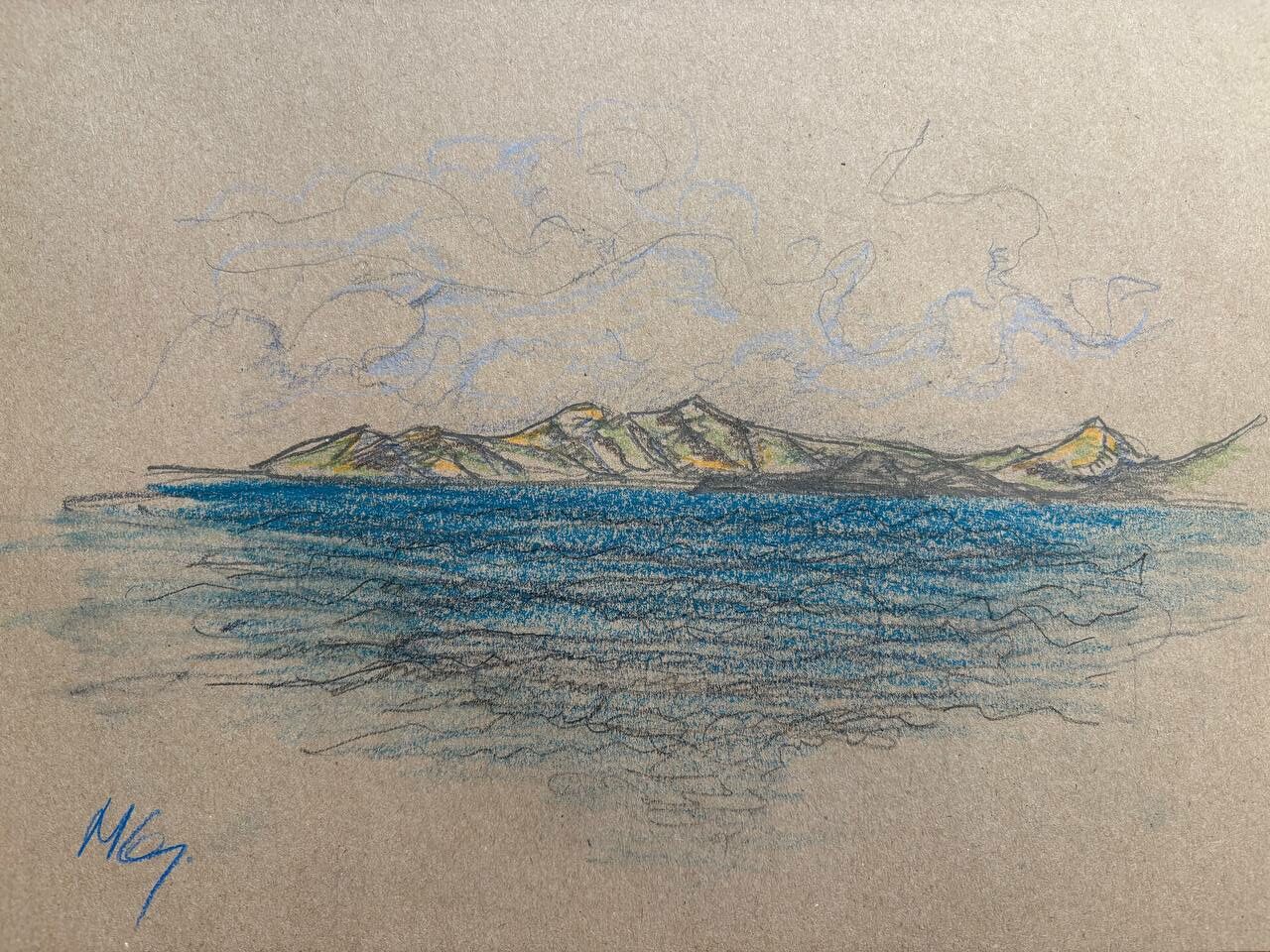
Drawing by Maria Gunko.
See all [Outside In] articles here
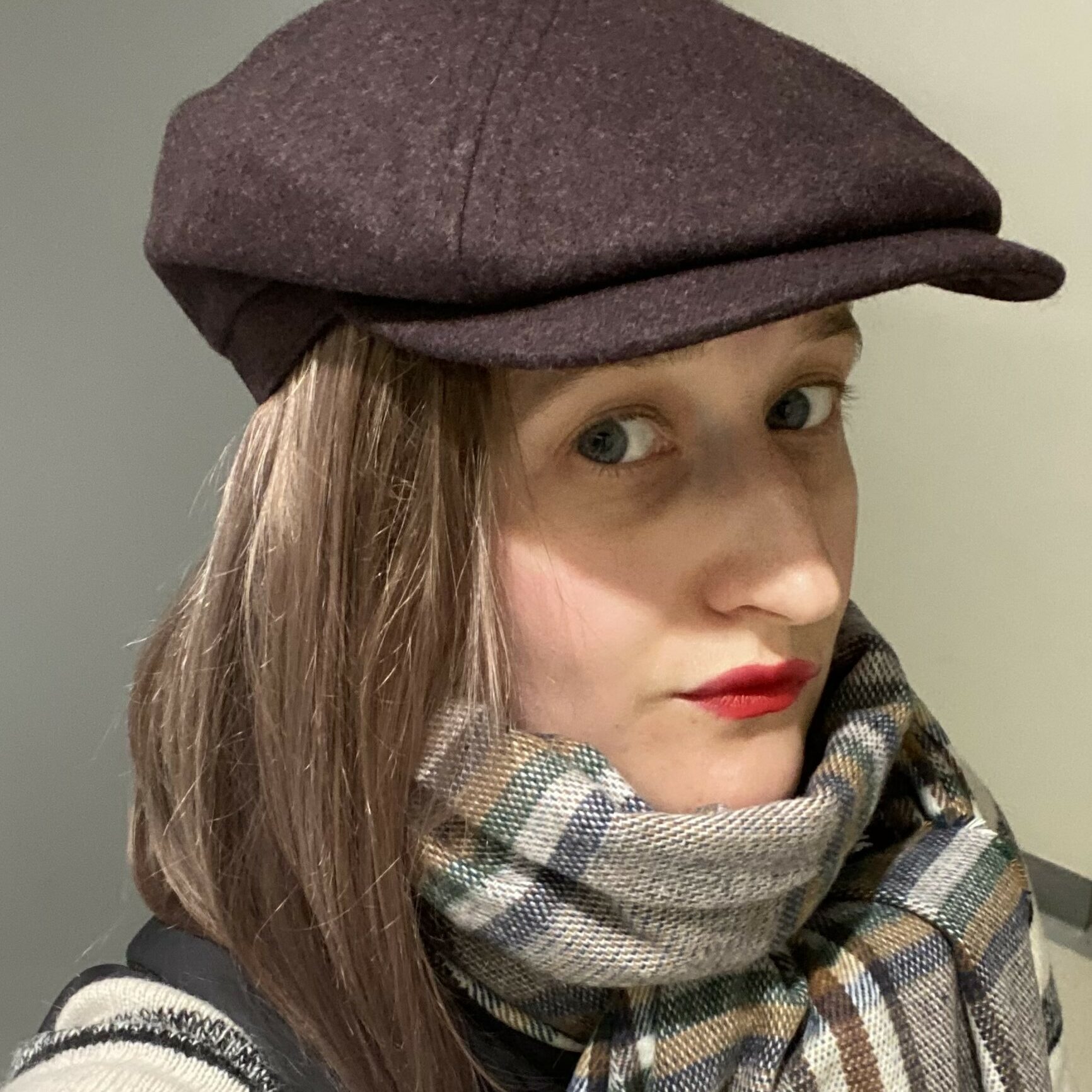
Maria Gunko is a DPhil Candidate in Migration Studies, Hill Foundation Scholar at the School of Anthropology and Museum Ethnography University of Oxford. Since 2023, she has joined Yerevan State University as a Visiting Professor. Maria holds an MSc and Kandidat Nauk (Russian post-graduate degree) in Human Geography.
Maria’s research interests lie in the intersection of urban studies and social anthropology, including ethnography of the state, infrastructures, and urban decay with a geographical focus on Eastern Europe and the Southern Caucasus. She is the co-editor of one monograph, author of over thirty scientific articles and op-eds.