

Listen to the AI generated audio article.
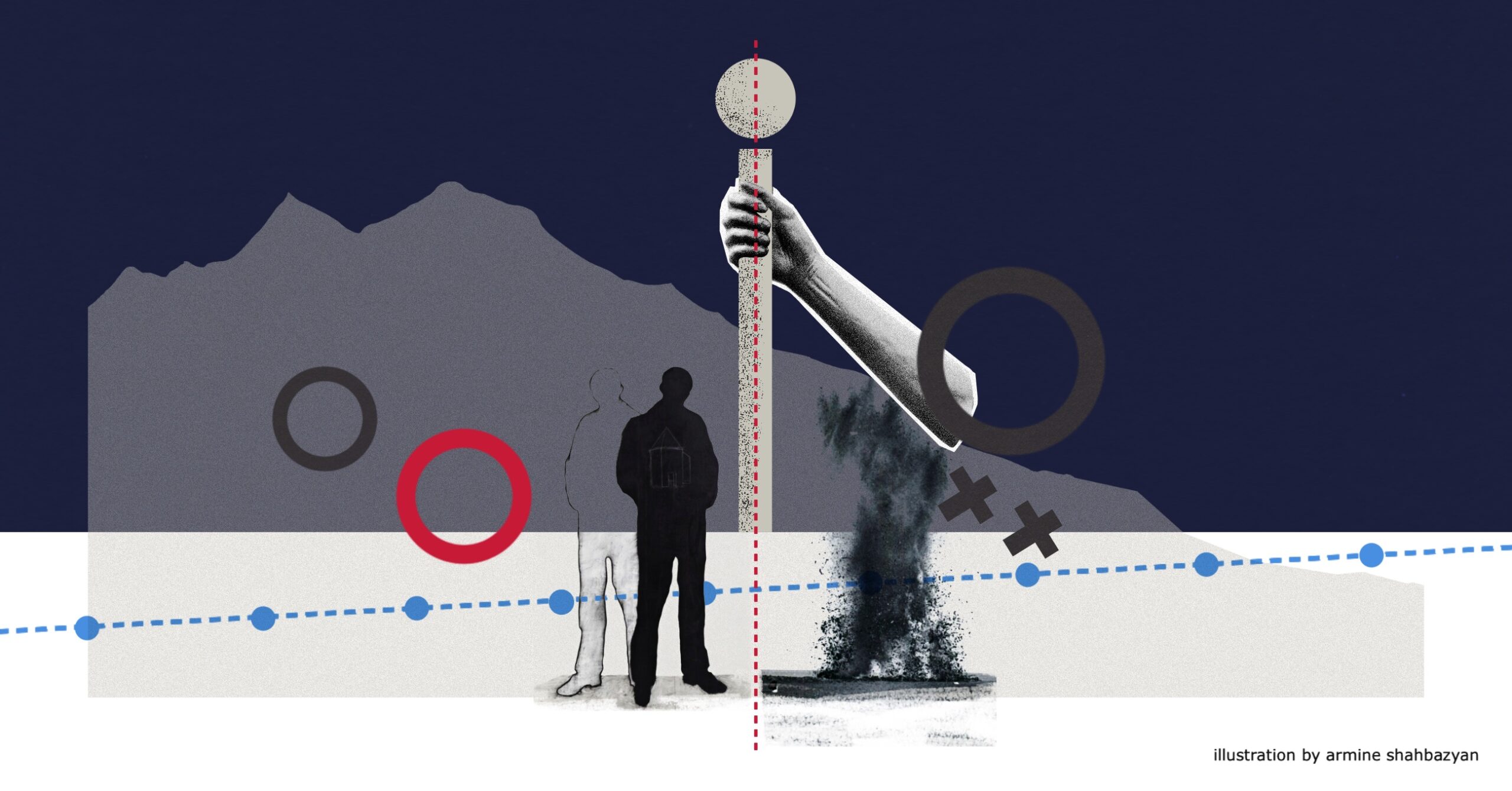
It is well known that there are key moments in the history of peoples, when the choices made set one or two generations on a long journey without prior knowledge of their destination. Armenia is no exception to this rule. And 2025, like 1991 or 1965, is a decisive year for Armenians. At each pivotal moment, a central question emerges: What regulates and governs the official or majority narrative of the moment? We have the answer: norm and force. But what do we mean by “norm” and “force” and what relationship can we establish between the two?
A norm is an implicit or explicit rule that determines what is considered acceptable, expected, or legal in a given society. In sociology, a norm is a set of shared social rules that guide the behavior and judgments of individuals. In law, a norm is an official prescription that establishes legal obligations. A norm is the law, the universal rule, that of legality to which everyone is called upon to submit, from the Armenian activist to the permanent members of the United Nations Security Council. The norm states the law, and the law makes the norm. It is valid for all and is binding on all, whether they are within or outside the established social group.
Force is the ability to act, to influence, or to resist. In sociology, force is the ability to impose one’s will or to influence power relations. In philosophy, force is a principle of affirmation, momentum, or transformation of reality. Force is power; it is the legitimate resource available to those who believe in its use to advance a cause in the name of justice. Force is specific, and only those who identify with it draw upon it in search of legitimacy for their identity, their message, and their actions. Force is therefore at the service of power, and power, in turn, responds to a need for justice—whether or not this justice is first recognized by the national community and later by the international community. This pursuit of force seeks to be legitimized by the entire national and then global society with a view to transforming the use of force into a particular or universal rule that can be imposed on all.
We find these two parallel processes once again in the current Armenian public debate. They were present in 1965, as they were in 1988–1991, but let us focus on the one that has been sweeping Armenian society since the beginning of 2025.
On one side stands the camp of power with Prime Minister Nikol Pashinyan, his government, his parliamentary majority, and all those citizens who seek to impose the force of the norm upon Armenian society. And what is this norm? It is the norm of Law—of the citizen-state, the State, sovereignty, of order, of good neighborliness, of a shared future, and of the real Armenia. The Armenia of 2025 aspires to be a normative Armenia, one that secures its place on the international stage without demands or messianism.
On the other side stands the parliamentary opposition camp with two former presidents (Kocharyan, Sargsyan), but also the ARF and the Church of Etchmiadzin, as well as, to a certain extent, first President Levon Ter-Petrosyan and the traditional Armenian organizations both in Armenia and in the diaspora. What are they seeking? To make the use of force a norm based on justice for Armenians—those of Artsakh, for example—and to impose it upon everyone, even upon humanity as a whole. What is this norm of force? That of justice (of national self-determination, for example), of identity politics, of conflict, of a past that must be reified, of vassalage in the service of Russian imperialism. The Armenia of 2025, in this vision, has no place; it is the Armenia of all time—the celestial Armenia—without temporal rupture, nor geographical or conceptual limits, and one that transcends the international order in the name of a revolutionary or pan-national ideal yet to be achieved.
If Armenia stands at a crossroads, between Law (the norm, serving the State) and Justice (the force, serving the Russian empire), between Peace and War, it is because it is the heir to a history and a social body that has no tradition of state sovereignty. None! Either the Armenian state, through the force of norms, prevails—making clear that any alternative endangers the very existence of the real Armenia. Or the nation, through the norm of force, triumphs, imposing the belief that the real world itself threatens the existence of Celestial Armenia.
These two narratives are viscerally opposed. The first, envisions Armenia as a sovereign, fully realized state, one that will, in time, secure stable borders and a defined place within the international system. But this vision presupposes a renunciation of a pan-national ideal, just as France renounced its empire in 1962 or Greece abandoned Enosis in 1974. The second presents Armenia as a besieged entity, effectively a Russian colony with no visibility on the international system’s map. While this narrative assumes justice for the Armenian victims of the 1915 genocide and the ethnic cleansing of Artsakh in 2023, it sustains an Armenian identity in a state of levitation, one that hovers above the realities of statehood and the world’s political frameworks.
It is, in a way, Law versus Justice or Peace versus War. It is up to the voters in Armenia to choose between the force of the norm (everything for the sovereign state) or the norm of force (everything for the global nation).
Can this dialectic between Law and Justice be overcome? We would like to believe it, but the seemingly reasonable compromise once embodied by Levon Ter-Petrosyan has only played into the hands of celestial Armenia, imperial Russia, and a fragile conception of justice. The proof? The only president uncomfortable with the question of Nagorno-Karabakh was the former leader of the Karabakh Committee; the only president uncomfortable with the idea of state sovereignty was also the founder of the Armenian Pan-National Movement, who, while claiming to defend Armenia’s sovereignty, in fact played directly into Russia’s hands. Neither Robert Kocharyan nor Serzh Sargsyan were uncomfortable with the Nagorno-Karabakh issue or the idea of sovereignty, since they de jure accepted Armenia’s submission to Russia or the idea of the norm of force. They believed that Russia’s protection entitled them to view “Greater Armenia” or “the two Armenian states” (Armenia and Nagorno-Karabakh) as a single, normative power. We know the outcome: Levon Ter-Petrosyan, Robert Kocharyan, Serzh Sargsyan, the ARF, Etchmiadzin, and their supporters sought the norm of force; they obtained only indifference and impotence, because they took the risk of testing the norm of force without the slightest guarantee and without defending the Armenian state.
There is no alternative to the force of the norm. Therein lies peace, rights and prosperity for Armenians. As for those who think that the force of the norm means throwing Armenia into the arms of Turkey, they have forgotten an essential point: the force of the norm is not vassalage to the norm of another. It is respect for one’s own norm, domination of the space regulated and institutionalized by sovereign law, the State above all else in good neighborliness and not the Nation in the service of the Russian Empire, in permanent conflict with its neighbors. In other words, the strength of the norm and the strength of the state are better than the illusion of a norm of strength and the mirage of a pan-national illusion.
Also see
Opinion

Law, Power and Perception: Broadening the Debate on Judicial Independence
Judicial independence in Armenia is more than legal rules; it is a matter of culture, perception and action. Gor Samvel broadens the debate, examining how law, ethics, and societal forces intersect, and calling for rigorous research to inform public understanding.
Read more
Resetting the Clock: August 8 and Armenia’s Path to Lasting Peace
Armenia did not achieve a sustainable, guaranteed peace on August 8. Rather, Armenia secured the opportunity to earn that peace by doubling down on efforts to become the primary guarantor of its security and prosperity, writes Raffi Kassarjian.
Read more
Advocating for Justice After the Peace Agreement
The Armenia-Azerbaijan peace process highlights the enduring tension between peace and justice. While legal rulings create certainty, they often fail victims. True reconciliation, experts argue, requires context-specific approaches where peace and justice coexist, even if one must yield to the other.
Read more

Turkey & Azerbaijan, every day & in different kinds of ways, reveal themselves to be real – not theoretical – existential threats to Armenia.
“Si vis pacem, para bellum” is a Latin adage: “If you want peace, prepare for war.”
George Santayana, the Spanish philosopher: “Those who cannot remember the past are condemned to repeat it.”
Shutting our eyes and ears and talking of “peace” will not save us.
Dear Vahe
Thanks for your message. One must know how to adapt one’s discourse to one’s means and not be excessive when one is weak. Being a sovereign state does not mean being a lamb. One cannot reflect on the strength of the norm with current Turkish-Azerbaijani arguments. All the best, G