

Visiting one post-Soviet state, you can then recognize it in all others – the similar patterns of urban planning and the identical buildings, structures, roads, pipes, wires, tiles, etc. However, an outsider delving inside under the extreme familiarity of the material environment finds an extreme “strangeness” of social interactions and practices. The “Outside In” series is about emplaced paradoxes and nuances. It spotlights the mundane in Armenia’s peripheral locations, where the seemingly unspectacular encounters with people and things allowing us to capture the unique features of the territory.
Listen to the AI generated audio article.
Outside In
Essay 23
During my undergraduate studies in geography, irrespective of our eventual specializations, we were all introduced to the basics of spatial data management and map-making. Though I can hardly compile a proper map today, what stuck is that every map is a lie of omission, a strategic flattening of spherical reality that cannot be represented without distortion. Maps mislead not only due to purely technical limitations like projection, scale, outdated data, or human error. The truth is that maps are made by humans as instruments of power as much as of navigation, tools that reveal certain truths while concealing others. Thereby, I approach maps with professional skepticism. But sometimes, the depth of their deception surprises even me.
For New Year 2025, I planned a road trip from Yerevan through Tbilisi and Bakuriani to Kars to see what remains of Armenian heritage, and to wander through Orhan Pamuk’s snow-covered reveries. Setting a route to Kars on Google Maps was unremarkable, but for the return journey my phone cheerfully suggested a route through Gyumri. No, not through the Bavra border crossing from Georgia back into Armenia, but directly from Kars to Gyumri, apparently crossing the Turkey-Armenia border around Akhurik.
For those unfamiliar with the South Caucasus’ geopolitical peculiarities, the Armenia-Turkey border has been sealed since 1993. Suggesting such a route is like recommending someone drive from India to Pakistan through Kashmir. Technically the roads exist on both sides, but good luck convincing the border guards you are just passing through for tandoori. A more universally understood example is telling a West Berliner in the 1970s that East Berlin makes for a convenient shortcut. The S-Bahn map showed connected lines, the destination was literally visible across concrete and barbed wire, but the Wall had a funny way of turning a 15-minute commute into a geopolitical incident. Some borders exist specifically to remind you they are closed, notwithstanding Google’s confident blue lines.
The Turkey-Armenia route vanished eventually, corrected by some algorithm or cartographer in Mountain View. But the incident lingered in my mind, a small digital absurdity that opened onto a larger question: How did we arrive at this peculiar moment when technology promises us the world while simultaneously obscuring our understanding of it?
The British Incident
Sometime in the fall of 2022, I was sitting in a makeshift café beneath Sanahin Monastery drinking Oriental coffee from a chipped mug. Just in front of me sat a jolly couple – young, British, and magnificently underprepared. Let us call them James and Emma. They had driven (partly taking ferries) from the UK to Armenia in an old Volkswagen van. This in itself was impressive, as it is the kind of journey that requires stamina, mechanical skills, and a high tolerance for border bureaucracy. But this was merely the opening act. Their destination, announced with casual confidence, was China. James explained, tracing an invisible line across the café table:
We are taking the ferry from Baku to Aktau. Then across Kazakhstan, and we’ll be in China in a few weeks.
I sipped my coffee, buying time, trying to formulate a response that would not sound overly patronizing:
You know Armenia is landlocked, right?
They blinked at me. Emma protested, gesturing vaguely eastward, as if proximity was the same as accessibility:
But Baku is just right there!
What followed was a crash course in Caucasus’ geopolitics, delivered over increasingly cold coffee. Yes, Baku is tantalizingly close, a mere few hundred kilometers away. No, you cannot simply drive there. The border with Azerbaijan has been closed since the First Nagorno-Karabakh War in the early 1990s. The border with Turkey, as previously established, is also closed. Iran requires a visa that takes weeks to obtain and, even then, comes with the small matter of driving through a theocratic state that views British passports with suspicion.
Then James asked hopefully:
-So, we go back through Georgia?
-Aha, back through Georgia.
-And then to Azerbaijan?
-No. The land border to Azerbaijan from Georgia is also closed since COVID…
After several minutes of silence, Emma came up with another brilliant idea, scanning a map on her phone:
What about going via Georgia and then through Russia to Kazakhstan?
I shook my head:
Like Iran. Different ideology, same suspicion. British passport holders and Russian authorities are not exactly on friendly terms these days…
I watched their faces as the information sank. They were trapped, not by mountains or rivers, but by manmade barriers. The ferry to Aktau would leave without them.
James and Emma left Lori province the next morning, heading south to Syunik. The grand Asian odyssey became (at least for the time being) reduced to an Armenian cul-de-sac. I never learned if they eventually made it to China, perhaps boarding a ship in Turkey and taking the long-established sea route through the Mediterranean via the Suez Canal and the Indian Ocean.
Maps at War
In September 2022, hundreds of thousands of Russian men were searching for exit routes after Putin announced “partial mobilization.” The internet became a strange bazaar of geographical desperation, featured in numerous Telegram chats.
“How are the border guards between Azerbaijan and Armenia?” one user asked in a chat I was monitoring. “Are they friendly? Do they let you through easily? Is it faster than in [Upper] Lars?” The question just sat there, unanswered. What response could one give? That the border does not exist for civilian crossings? That the soldiers on either side are separated by minefields and hatred? That even suggesting such a crossing reveals a profound disconnect from the realities of the South Caucasus?
“What about going through Tskhinvali?” someone proposed, referring to the capital of South Ossetia. “Or through Sukhumi [Abkhazeti]? Instead of waiting at [Upper] Lars?”
Upper Lars, for the uninitiated, is the sole functioning land crossing between Russia and Georgia, a mountain pass that becomes a nightmare bottleneck during high vacation season and at times of any crisis. The suggestion to bypass it via Tskhinvali or Sukhumi was creative, certainly, but suffered from one minor flaw: both routes would require crossing through breakaway territories that are, technically speaking, at war with Georgia.
I found myself simultaneously appalled and fascinated. These were not stupid people. But faced with an emergency, they discovered that their phones could not save them, that geopolitics trumps GPS. The phenomenon extends beyond crisis situations. I have met travelers in Yerevan who were shocked to learn they could not visit Baku on a weekend trip. There were people who thought Abkhazeti was just another Georgian region they could explore, drinking wine and bathing under the sun. I once explained to a confused colleague who was planning to visit Armenia in 2024 that no, you cannot simply drive from Armenia to Artsakh anymore. That the region is now controlled by Azerbaijan after the Second Artsakh war and the 2023 ethnic cleansing. That the roads which once connected these places have been erased not from maps but from reality.
The Sign to Ani
There is a road sign to Ani. It stands near the Armenia-Turkey border on the Armenian side, pointing helpfully toward one of the greatest Armenian medieval cities, a UNESCO World Heritage site of cathedral ruins and crumbling fortifications. The sign is clear, directional, optimistic. Follow this road, it suggests, and you will arrive at Ani.
What the sign does not mention is that Ani is in Turkey. That the border is closed. That the closest you will get is the village of Anipemza on the Armenian side, where you can stand at the edge of the Akhurian River gorge and squint across at the ruins through binoculars, observing a world you cannot immediately enter. Then, instead, you venture to Yererouk, the sixth-century basilica in Anipemza, a consolation prize for the inaccessible Ani. The Church is magnificent in its own right, sturdy early Christian architecture rising from the plateau, but so many who visit it are really there because they cannot get to Ani.
Perhaps this is the whole point of the sign. It is less about navigation and more about memory, a reminder that the ruins of Yererouk and Ani were once connected, that the border is newer than the churches, that maps can be redrawn but stones remember.
***
I keep returning to that café beneath Sanahin, to James and Emma with their impossible itinerary. There was something almost noble in their failure, reminiscent of medieval travelers who had to discover terrain by moving through it. They arrived in Armenia expecting a waystation, a brief stopover en route to somewhere else. Instead, they encountered what every visitor eventually learns: Armenia is not a corridor but a destination in itself, not a bridge but an island. It is landlocked and surrounded by closed borders, conflicts both frozen and active, historical grievances that predate Google by centuries. A map is not the territory. A route is not the journey. And sometimes, the only way to find yourself is to get spectacularly and hopelessly lost. Then find your way back to the metaphorical peaceful Sanahin for a cup of bitter coffee and a recalculation of what is actually possible.
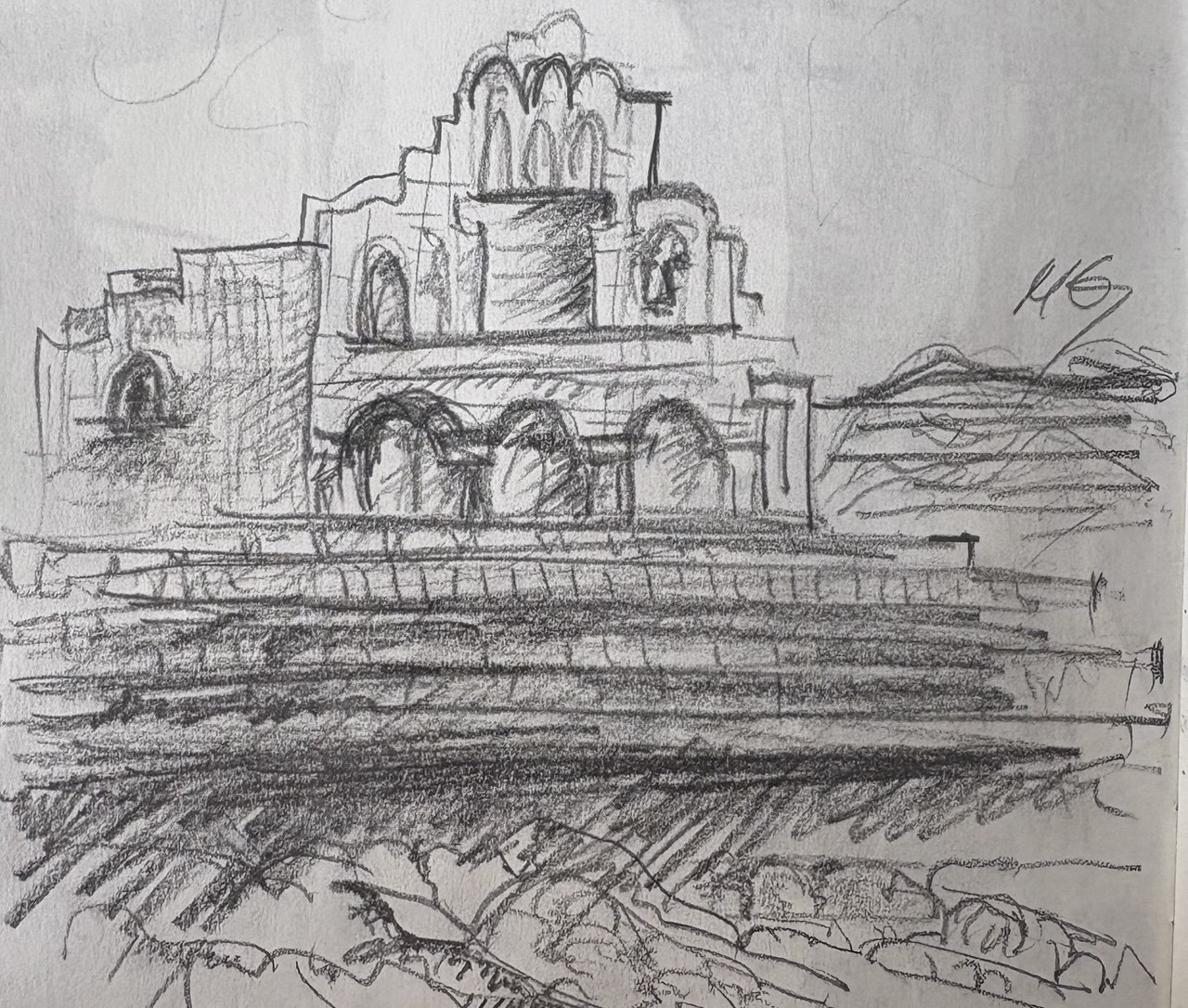
Drawing by Maria Gunko.
See all [Outside In] articles here

Maria Gunko is a DPhil Candidate in Migration Studies, Hill Foundation Scholar at the School of Anthropology and Museum Ethnography University of Oxford. Since 2023, she has joined Yerevan State University as a Visiting Professor. Maria holds an MSc and Kandidat Nauk (Russian post-graduate degree) in Human Geography.
Maria’s research interests lie in the intersection of urban studies and social anthropology, including ethnography of the state, infrastructures, and urban decay with a geographical focus on Eastern Europe and the Southern Caucasus. She is the co-editor of one monograph, author of over thirty scientific articles and op-eds.


Beautiful and painful. Thank you.