

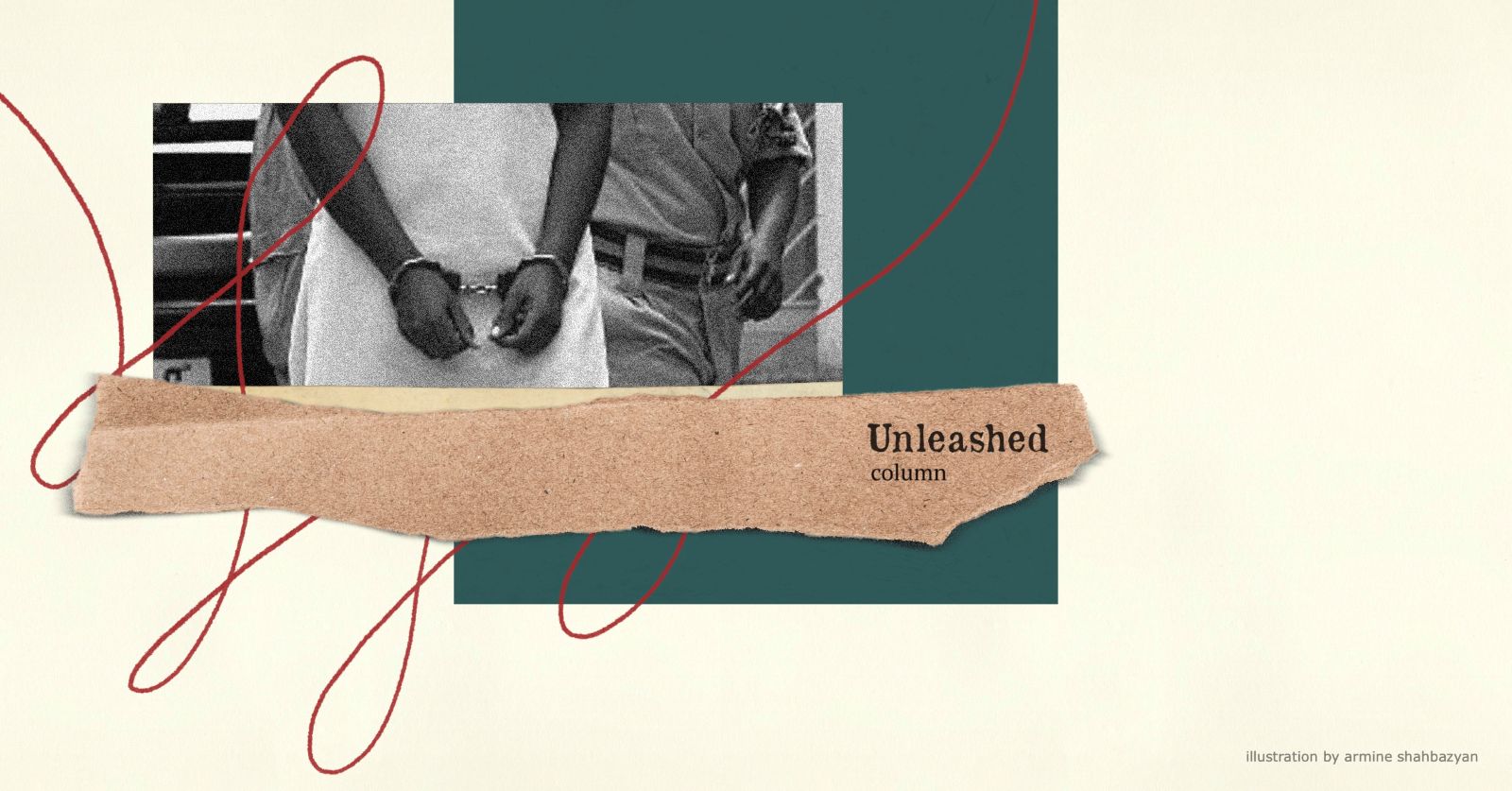

In The Hague last week, under crystal chandeliers and carefully curated speeches, three young Rwandans stood before a large audience to accept an award on behalf of their mother, Victoire Ingabire Umuhoza, who is in a Rwandan jail. Again.
As I stood alongside her children – Rémy, Raïssa, and Rist – watching them collect the Liberal International Prize for Freedom in her name, their poise and pain unmistakable, I felt a mix of pride and nausea. Pride because Victoire won this award for her unwavering, decades-long fight for democracy, political pluralism, and human rights in Rwanda, a fight she has refused to abandon despite imprisonment, harassment, and relentless state repression. And nausea, because I know the fucked-up language of “security” and “stability” used to justify her persecution far too well.
When she returned to Rwanda from exile in the Netherlands in 2010 to run for president, she did what democracies are supposed to let you do: she tried to participate. Instead, she was swiftly barred from standing, then arrested and charged with everything in the authoritarian playbook, including genocide ideology, threat to national security, terrorism, sectarianism, and divisionism.
In 2012, a Rwandan court sentenced her to eight years in prison. When she appealed, the Supreme Court extended it to fifteen. The African Court on Human and Peoples’ Rights later found that her rights to freedom of expression and a fair trial had been violated, and ordered Rwanda to restore her rights and undo the effects of her unlawful conviction. Kigali didn’t care, ignored the ruling, and carried on.
Thanks to international pressure, Victoire was eventually pardoned in 2018 after eight years of incarceration. She was released but not free – heavily restricted, under a travel ban, watched, harassed, her party never recognized, and her supporters intimidated, disappeared, or worse. All for stubbornly insisting that Rwandans deserve to be treated like citizens and co-authors of their future, not as subjects.
I met Victoire a year and a half ago as part of her legal team, working to restore her political rights so she could run in the July 2024 presidential elections. She was barred again from doing so, and Paul Kagame entered his fourth term with more than 99% of the votes. Then, in June of this year, enraged by her audacity to keep challenging him, Kagame’s people arrested her once more. This time they accused her of everything from forming a criminal group to planning to incite public disorder, conspiring to overthrow the government, and spreading false information. Same script, different labels. She’s been in jail 165 days as of today.
Victoire is more than someone who I have the privilege of fighting for. She is a warning to all of us who live in countries with dark pasts and fragile, hard-won spaces for dissent.
Armenia is another small state with a bloody history, surrounded by hostile neighbors, perpetually told that its security requires sacrificing something essential. For decades, the country had been captured by thugs, thieves, and oligarchs who treated state institutions like personal fiefdoms. Then in 2018, Armenians did something extraordinary: marching in unison and filling Republic Square, they pushed out the old guard and brought in a new government that promised transparency, accountability, and respect for rights – a genuine democratic victory that electrified the nation and captivated the world.
Fast-forward seven years, and the mood is very different.
I moved to Armenia five years ago and became a citizen two years later. Since then, I’ve watched the use of excessive force against protesters, with stun grenades, mass detentions, people bloodied in the streets, including journalists simply doing their jobs. I’ve seen opposition leaders, bloggers, clergy, and activists arrested or charged with hooliganism, terrorism, or coup-plotting. I’ve heard the casual smearing of government critics as traitors or “Russian agents”, as if the only possible explanations for disagreement are corruption or foreign control.
Spoiler alert: sometimes people just genuinely, legitimately disagree with you. That’s supposed to be the whole point of this democracy thing.
Which brings me back to Victoire, and to the simple but inconvenient truth: no one should rule indefinitely.
There’s a reason serious constitutions impose term limits: they protect societies from the rot that inevitably sets in when one person holds power for too long. The United States limits presidents to two terms, France to two consecutive five-year terms, and Kenya, Nigeria, and South Africa all cap their presidents at two terms – precisely to prevent the slide into entrenched rule. Countries that have removed term limits, like Russia, Uganda, and Rwanda, show what happens when those guardrails disappear: institutions decay, corruption deepens, and leaders become effectively untouchable.
Armenians know this story all too well. In 2015, Serzh Sargsyan pushed through a constitutional change that transformed Armenia from a semi-presidential system into a parliamentary one, a move widely understood as an escape hatch to stay in power indefinitely by shifting himself from president to prime minister. He promised he wouldn’t do it, then did exactly that, sparking the 2018 revolution.
The tragic irony is that the very constitutional setup Armenians rose up against has never been changed. Pashinyan, who swept to power on the promise of dismantling that system of entrenched rule, now benefits from it: under the current constitution, a prime minister can remain in office indefinitely so long as he keeps winning parliamentary majorities. And while a constitutional overhaul is planned for 2027, with term-limits floated among the possible reforms, nothing is guaranteed, and the risk of entrenched incumbency remains very real.
Research on term limits and political tenure is clear on the direction of travel: the longer leaders stay in power, the more likely institutions are to hollow out and corruption networks to grow. Studies show that extended tenure allows incumbents to build more sophisticated patronage systems, while weakening accountability. Scholars looking specifically at presidential term-limit evasion have documented how lifting or circumventing limits almost always coincides with democratic backsliding. The good news though is that, about a third of leaders who try to overstay actually fail, not because courts stop them, but because popular uprisings do.
Somewhere around the decade mark, even the best-intentioned leaders start to believe their own mythology. Power becomes a habitat. Everyone around them adjusts to keep them there. Bad news stops reaching the top. Only fear and paranoia manage to rise.
Bottom line: Stay long enough, and you become the very thing you once promised to get rid of.
To be sure, Rwanda and Armenia are very different places with very different histories. And their current leaders, in many ways, could not be more different. Kagame is a man who came to power through war, whose rule has been stained with blood and fear, and who has now held power for more than thirty years. Pashinyan, by contrast, rose through a peaceful, people-powered revolution without shedding a drop of blood, and has governed for just seven years so far.
But they are beginning to share some dangerous similarities: both began as liberation heroes who’ve been subsequently cast as the only barrier between their people and chaos. “Without us,” the subtext goes, “you all go back to 1994,” or “you lose the state,” or “the old oligarchs return.”
That narrative is intoxicating. It is also a lie.
Democracy in traumatized societies is not a luxury. It is the only non-suicidal path out of permanent victimhood. It requires that we protect the space for opposition, that we let people say things even if we don’t like what we hear, and that we refuse to call every critic an agent of the enemy. It is precisely because of such trauma that we cannot afford to let any one person, party, or movement become irreplaceable. Nobody should get to ride into office on a platform of “people power” and then decide that the people are a problem. The past is dark enough. We don’t need to recreate it in new packaging.
As Armenia heads toward new parliamentary elections in 2026, we have to decide whether 2018 was a one-off mood, or a long-term commitment. Our security and stability cannot be relinquished to strongmen with no expiry date. It lies in strong institutions, a healthy opposition, regular alternation of power, and citizens who are awake enough to call out the bullshit when those in charge drift off course.
In times like these, I think of Victoire’s children a lot, of what it means to grow up so far from their mother, a woman the world applauds on stages abroad while her own government keeps her locked away. I think of my own people, too, who finally tasted a bit of real democratic agency and now watch it begin to fray under the very same justifications we once condemned in others.
So, this piece is dedicated to Victoire, and to every political prisoner whose name we may or may not know. Here’s to their resistance, and to the victory they keep alive every day they refuse to give in.
See all [Unleashed] articles here
Listen to Sheila’s personal reading of “À la Victoire”.

Sheila Paylan is an international human rights lawyer and former legal advisor to the United Nations. Now based in Yerevan, she regularly consults for a variety of international organizations, NGOs, think tanks, and governments.

Thank you, Sheila, for your thoughtful insights and for inspiring this conversation through solid examples and helpful suggestions.