

Visiting one post-Soviet state, you can then recognize it in all others – the similar patterns of urban planning and the identical buildings, structures, roads, pipes, wires, tiles, etc. However, an outsider delving inside under the extreme familiarity of the material environment finds an extreme “strangeness” of social interactions and practices. The “Outside In” series is about emplaced paradoxes and nuances. It spotlights the mundane in Armenia’s peripheral locations, where the seemingly unspectacular encounters with people and things allowing us to capture the unique features of the territory.
Listen to the AI generated audio article.
Outside In
Essay 26
It was a foggy spring morning in a small Armenian town. Silva* was kneading dough. Her phone lay face-down on the windowsill when a message came. Silva did not reach for it immediately, not until she had carefully wiped her hands on the edge of her apron. She adjusted her glasses and read silently. Then said: “It arrived.” Her mother-in-law, seated at the kitchen table cleaning parsley leaf by leaf, did not look up. Did not ask how much: “Good. We will pay the gas first.”
Silva’s husband had left for Moscow six weeks earlier. That was the first money transfer since his departure. She opened the second drawer beneath the stove and took out a small notebook with worn-out edges and foxed paper. Inside, I could see columns of numbers filling several pages. Electricity. Gas. Flour. School fees. Medicine for her mother-in-law. Repayment to a cousin who had lent money during winter. The transfer had been anticipated. It was already divided before it arrived.
That scene is quite unremarkable by the standards of that town where following the collapse of socialism, lack of statecraft and deindustrialization had hollowed out the possibility of a life built in one place. Factories had closed. Infrastructure was in various stages of decay. Men had left to build cities for other people in Russia, and women had stayed behind. What I stumbled upon was not (at least not only) poverty or absence, but a life in waiting – patient, practiced, almost entirely invisible but carried along with endurance and dignity.
On the other side of town, Gayane leaned on her balcony railing with a cup. Her husband was in Moscow. “Until winter,” he had said. Every evening Gayane called him and narrated the day. She tilted the phone so he could see the courtyard. “Look, Ashot,” she joked, “nothing has changed.” After the call ended, she stayed on the balcony a while longer, observing. The children ran in circles. The old men settled into the gazebo. Somewhere a gate clicked shut.
Movement belongs to men, Maria jan. Stability is organized by women. This is how life goes on, round and round.
Gayane did not say this bitterly. She said it the way you state something that has always been true.
Anahit had moved to town from a nearby village two years earlier after marrying Hrachya. Several weeks after the wedding, he had left for Rostov-on-Don:
We hardly had time to talk, you know, how it should be. I did not even learn the house properly before he went.
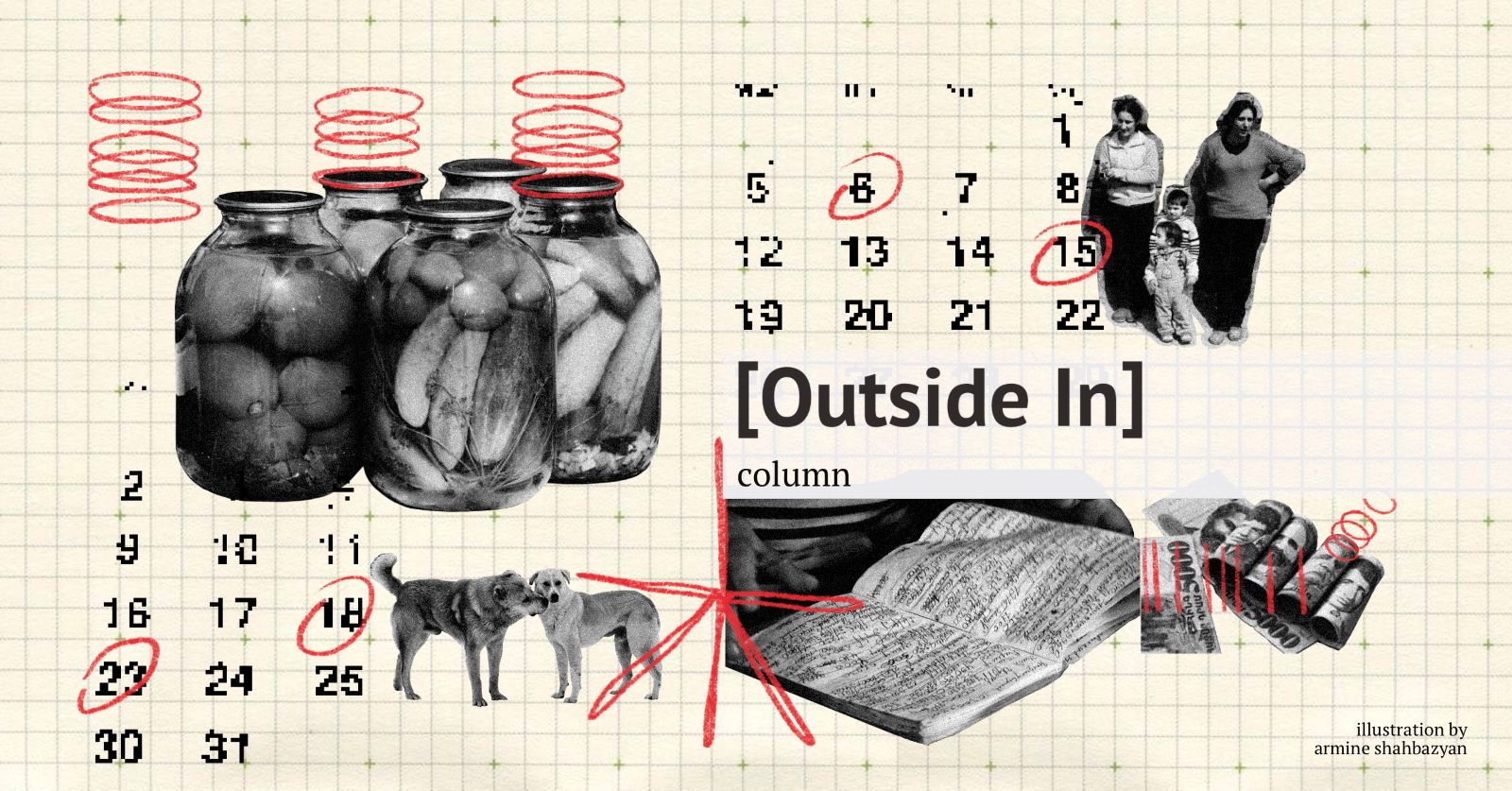
On the refrigerator in that house hung a calendar. Certain dates were circled in red pen – the days when the remittance was due.
He says I should ask him before making big decisions. But what is a big decision?
This was a deceptively small question. In it lived an entire universe of social relations – the nominal authority of the absent husband, the daily management of the woman who remained, and the gap between the two. This gap would widen with each silent day – every unreturned call, every message left on read, every month red circles remained empty, and every decision Anahit made and then attributed to someone else.
The small town I am writing about is by no means exceptional. Across the post-Soviet South Caucasus and Central Asia, we can witness strikingly similar geographies of departure and return, or non-return. If you Google the Armenian word խոպան, which stands for working abroad, you will see pictures of hundreds of men with bags at train stations or airports, departures that repeat season after season. Labor migration from Armenia, primarily to Russia, had restructured not just the national economy but the social structure and hierarchies of households. As of now, remittances constitute a substantial share of GDP. They pay for utility bills, medical procedures, clothing, food, and the ritual obligations that maintain a family’s standing in the community. But the numbers, however striking, can not capture what it means to live inside the reality they describe.
In 2019, Armenian director Tamara Stepanyan released “Village of Women”, a documentary about Lichk, a village in the Gegharkunik region. It portrays the life of women, children, and the elderly who remain in the village while husbands and sons work in Russia. The film follows women through summer’s slow pace, autumn’s harvest, and the thousand small decisions that keep the village alive until winter comes and men return. The return then becomes a brief and shy readjustment before the whole cycle starts again in spring. This is a quiet “matriarchal” everyday life that exists in the shadow of a patriarchal order neither side felt able to openly name.
The notebook under Silva’s stove, the red pen on Anahit’s calendar, the circular motion of Gayane’s hand when she told me about men who move – all of these are the materialities pertaining to that “matriarchal” life and the labor of waiting. The waiting is deeply active, saturated with calculation and anticipation. When Anahit’s father-in-law asked what she did all day, she laughed and answered: “I am waiting.” The response was received as a joke. Waiting did not count as labor because it left no material trace – no product, no accumulation, no visible output. Yet it organized everything. It structured her days, oriented her routines, kept her attuned to an elsewhere so that the household remained functional and coherent. Waiting was a work of alignment between a life in one place and a livelihood in another.
Later that afternoon, when Silva got the first remittance of the year, I accompanied her to the bank in the nearby town. She put on makeup and wore her best dark wool coat. On the way to the minibus stop, she told every acquaintance we passed the purpose of our journey. Withdrawing remittance money was a small performance, a demonstration that the household was functioning, that the absent husband continued to fulfil his role of a breadwinner, that the family remained intact and solvent. When we returned, Silva began to divide the cash. Part into a metal tin in the cupboard labeled “roof.” Part into an envelope for utilities. Part to her mother-in-law. By evening, the dough had risen. She baked the bread and set the table for dinner. The routine in the house continued even if the chair to the right of Silva’s father-in-law at the head of the table remained vacant.
It was this image – the set table, the empty chair – that captured the asymmetry at the heart of transnational households. The absent husband was figured as the one who “did something,” who endured hardship for the family. The wife who stayed was imagined as supported rather than sustaining. His labor was visible, hers was the condition that made his possible. Women inhabited a system of recognition in which continuity was taken for granted. Yet, the chickens were fed, the jars were sealed, the floors were swept, the table was set, the children were at school, and the elderly parents were cared for. These acts reproduced the material and effective conditions that allowed labor migration to continue at all – the stable home to remit to, the children whose wellbeing justified sacrifice, the property worth returning for. Without this work, there would have been nothing to leave for and nothing to come back to. And yet the work was rendered as simply “being here” and “waiting,” sort of a background condition, not the thing itself.
Silva’s notebook would fill several more pages before her husband Hayk came home. Anahit’s calendar would accumulate more red circles, some filled, some not. Gayane would lean on the balcony again in the evenings, tilting her phone toward the courtyard so her husband could see that nothing had changed. And perhaps that was the point, that nothing had changed, which means that things were in order. Continuity, in a place where so much had fallen apart, was its own form of achievement. Even if rarely recognized as such.
*Author’s note: The names of the characters are pseudonyms for data protection reasons. The text is written partially drawing on data collected with financial support from the European Research Council (ERC) under the European Union’s Horizon 2020 research and innovation programme (grant agreement no. 865976).
See all [Outside In] articles here

Maria Gunko is a DPhil Candidate in Migration Studies, Hill Foundation Scholar at the School of Anthropology and Museum Ethnography University of Oxford. Since 2023, she has joined Yerevan State University as a Visiting Professor. Maria holds an MSc and Kandidat Nauk (Russian post-graduate degree) in Human Geography.
Maria’s research interests lie in the intersection of urban studies and social anthropology, including ethnography of the state, infrastructures, and urban decay with a geographical focus on Eastern Europe and the Southern Caucasus. She is the co-editor of one monograph, author of over thirty scientific articles and op-eds.