


From emerging Armenian artists across the globe to Armenian-American talent in the United States, [Art Speak] spotlights the dynamic and diverse Armenian art world and more.
Listen to the AI generated audio article.
In an incisive three-hundred-page disquisition that draws on queer theory to analyze the monolithic heteropatriarchal thinking prevalent in Armenia today, Tamar R. Shirinian brings the study of contemporary Armenian society decisively into the 21st century through an astute ethnographic examination of the Third Republic. As in other Armenian communities before it, including those of the diaspora, the question of national survival often eclipses other concerns in the Republic of Armenia. A cultural anthropologist, Shirinian argues that this anxiety has largely been expressed through a dangerous public discourse centered on a rhetoric of “perversion”—both moral (aylandakutyun) and sexual (aylaserutyun)—that serves to deflect attention from pressing economic and political issues. Yet this same discourse, she suggests, also opens the possibility of futures that move beyond conventional nationhood.
“Survival of a Perverse Nation” is a welcome breath of critical fresh air. Some readers may find a few of Shirinian’s arguments tendentious, but she consistently grounds them in compelling and credible sources, ranging from contemporary journalism and writing to first-person interviews she conducted over nearly a decade (2014–2024). Shirinian begins by recalling that since its independence from the Soviet Union in 1991, Armenia has been dominated by a mafia-like oligarchic network under three successive presidents—Levon Ter-Petrosyan, Robert Kocharyan, and Serzh Sargsyan. Together these government henchmen of a national oligarchy oversaw the erosion of the country’s economy and armed forces while enriching themselves to shameful levels.
As often happens in such contexts, minorities—here sexual minorities—became convenient targets. A particularly egregious episode occurred in 2012 when the DIY Pub, known for its LGBTQ+ clientele, was firebombed. The attack was carried out by two Iranian-born Armenian brothers affiliated with a fringe Neo-Nazi group at the time, who claimed they were acting “to protect their nation against homosexuals and Turks,” whom they considered national enemies. Despite being caught on film, they faced little meaningful sanction and were treated as heroes in parts of the press. The bar’s owner, Tsomak Oganezova, was subsequently subjected to a coordinated hate campaign. As Shirinian recounts in her book, while appearing on a popular television talk show, Oganezova tried to convey the enormity of the hatred that she had been subjected to:
“I am an artist. I am a person. I have never hurt anybody. (…) it’s not enough that they’ve invaded my personal life, but they’ve threatened me…saying that this isn’t enough, that I must be murdered. They’ve put my picture [online] and said ‘Remember this face. This person must be burned.’ In 1941, when World War I started, 300,000 Armenians died fighting against fascism and now we have these ants, these pathetic little bugs, who are trying to propagate their rotten fascist ideas?”
Unfortunately, this outcry further turned public opinion against her. Oganezova was forced to flee to Sweden—another contributor to the ongoing brain-drain and emigration affecting the country.
Written after the loss of the 2020 Nagorno-Karabakh War, “Survival of a Perverse Nation” traces one source of Armenia’s persistent social and political stagnation to a deep-rooted cultural tendency that stretches back through mythology and history: to seek an ever-present paternal “Daddy” or would-be protector. Before turning to a more systematic analysis of the book, it is worth noting that some of the first-person testimonies it includes are deeply moving. Young people who simply wish to live freely, whether gay or straight, speak of resisting marriages of convenience and exploring their sexuality in a society that harshly restricts both. Their accounts are often heart-rending. They brought this writer back to his own experience growing up in a homophobic family in New York City during the 1980s, when the prospect of living closeted amid the AIDS crisis—before marriage equality or robust gay rights existed—sometimes produced a near-suicidal sense of despair. With that in mind, we may now turn to a closer look at Shirinian’s analysis.
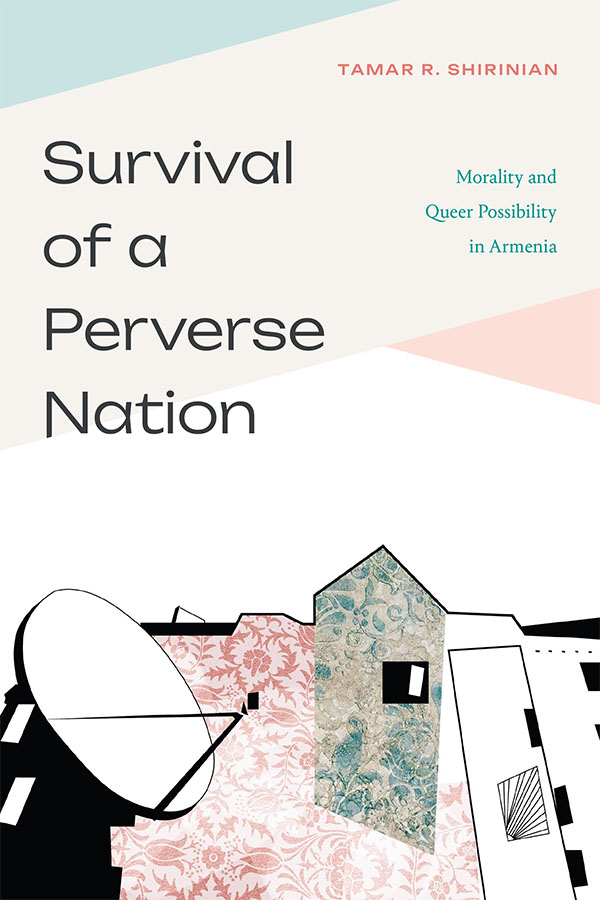
In her introduction and Chapter 1, Shirinian examines how many Armenians experienced the aftermath of the post-Soviet transition. These discussions often frame the nation as endangered, not only materially but morally. Shirinian therefore advances the view that Armenia became, in many respects, an ailing or “perverse” society that blamed its tiny population of sexual minorities and feminists for national decline rather than confronting the real causes. These included rule by an archaic cohort of oligarchs who pillaged the country while enforcing a doubly repressive system of social control shaped both by traditionalist Armenian norms and by corrupt authoritarian practices inherited from the Russian and Soviet eras. All were now subjected to an aggressive form of late-stage capitalism, a perversion in itself, as ordinary people could no longer lead sustainable lives under its untenable demands.
As Shirinian recounts, fear of homosexuality in Armenia has been particularly virulent, fueled by at least two unlikely factors: the country’s self-perception as a pokr azg—a small and vulnerable nation—and the lingering memory of the Armenian Genocide:
“The theme of survival within these myths and histories—especially as they have contemporary resonances—is produced as a result of the history of genocide/catastrophe. Although the myth of Hayk and other mytho-histories predate the nineteenth- and twentieth-century pogroms, massacres, and deportations by the Ottoman Empire, they are retold and remembered today as a projection of those later historical events. Furthermore, historical events after the Genocide—for instance, the 1988 earthquake in the Spitak region that was seen as one more tragedy in a long line of tragedies that the Armenian people had to overcome or the Nagorno-Karabakh war that was seen as the Genocide’s “sequel”—are also read through the theme of great and impossible survival.”
Everyone from the press to leading academics, from nationalist politicians to leaders of the Armenian Apostolic Church, routinely revived anxieties that Armenians could disappear despite their millennia-long history. Because homosexuals are perceived as not contributing to demographic reproduction, and because open discussion of their existence among Armenians is relatively recent, they have become convenient scapegoats for broader social anxieties.
To illustrate the conservative social norms she encountered in Yerevan, Shirinian notes that before conducting interviews she removed her hair dye and nose ring and wore long sleeves and dresses to conceal tattoos, so as not to be perceived as a “feminist” or somehow counter-cultural. Shirinian avoids condemning Armenians as a whole, instead directing her critique toward the country’s small ruling class and its supporters. Indeed, several years after most of the events discussed in the book, Nikol Pashinyan’s Velvet Revolution represented a popular uprising against the arbitrary authority of a discredited political elite.
Ignoring the country’s pressing economic challenges, successive governments since the collapse of the Soviet Union have often shifted blame for their failures onto marginalized groups. Drawing on a left-leaning “queer theory of political economy,” Shirinian argues that these anxieties stem not from individual morality but from structural political-economic conditions—particularly those associated with late-stage capitalism. In Chapter 2, “The Figure of the Homosexual,” she examines how homosexuality came to be framed as the principal threat to Armenia and to the survival of Armenian families. In the first decades of independence the corruption or moral perversion (aylandakutyun) of the oligarchic class was considered the most deleterious to Armenian statehood. In 2012, attention increasingly shifted to sexual perversion (aylaserutyun) in the form of homosexuality, which was falsely described as having been imported from morally bankrupt Western societies. Concurrently, the homosexuality of many of Armenia’s great cultural figures—from filmmaker Sergei Parajanov to poets Vahan Tekeyan and Yeghishe Charents—continued to be suppressed. As Shirinian asserts, homosexuals in Armenia were rarely visible in public life. Their presence had been so discreet that early media discussions on the topic focused simply on the question of what it meant that homosexuals existed in Armenia at all. In other words, it had scarcely occurred to many Armenians that any homosexuals might be living among them, raising the question of how such an invisible minority could plausibly be blamed for the country’s alleged moral decline. This attempt to blame all of society’s ills on homosexuals ultimately failed, as most people understood that their root cause was really oligarchy and its attendant corruption.
In the following chapter, “The Names-of-the-Fathers,” Shirinian further examines the centrality of patriarchal figures within Armenian culture, both in everyday life and in national mythology. From Hayk, the mythical father of all Armenians, to Ara the Beautiful, who defended the nation against the Assyrian princess Shamiram, to Vartan the Great, said to have saved Armenia at the Battle of Avarayr in 451 A.D., heroic paternal figures have long anchored Armenian historical imagination. The problem with making this into a national paradigm today, Shirinian suggests, is that in contemporary Armenia the “fathers”, i.e. the country’s political and military leaders, have either betrayed or abandoned the nation:
“The proper Law (of the Father) is the Symbolic order. My interlocutors, however, saw the political-economic elite as deeply in violation of this Symbolic order and authority. These elites—whom I will refer to as the nation’s sovereigns, those who have given themselves the power to rule—have usurped the power that originally belonged to Hayk. They include the president, the prime minister, members of Parliament, mayors, the chief of police, military elite, and so on. My analysis of my interlocutors’ claims and feelings points to how these usurpers have replaced the Name-of-the-Father Hayk, severely undercutting the possibilities of national survival.”
The hysteria that ensued in Armenia surrounding homosexuality thus in part reflects anger directed at an absent or morally compromised father figure. This chapter also includes a fascinating ethnolinguistic look at the role of nicknames such as “Nemets Rubo” and “Grzo” given to many of the country’s oligarchs as expressions of both intimacy between them and the common people, as well as a betrayal of that same intimacy. Using Shirinian’s astute paradigm, one might also interpret the recent conflict between the Armenian Church under Karekin II and the Armenian government under Nikol Pashinyan as another manifestation of this struggle between rival paternal authorities, perhaps reflecting a deeper national longing for a rescuing “father,” with different constituencies aligning behind different figures.
In Chapter 4, “Wandering Yerevan,” Shirinian puts a new spin on an old trope in modern ethnography, one that goes back at least to Walter Benjamin’s reflections in Illuminations on the flâneurs of Haussmannian Paris whose elegant boulevards and public spaces often became arenas of cultural contestation between mainstream society and agents of non-normative social change. In Yerevan, Shirinian finds that abandoned places such as the Botanical Garden, which are not policed or electronically surveilled, fulfill a similar role. The author demonstrates how these spaces can be simultaneously liberating for sexual minorities—serving as sites for cruising, socializing, or public readings—while appearing threatening to the broader public. The phenomenon itself is not unique to Armenia, though it appears to have emerged later there, as in other post-Soviet societies where such use of public spaces was long suppressed.
The next phase of Shirinian’s analysis becomes more theoretical. In Chapter 5, she introduces the concept of “An Improper Present,” a condition in which social, moral and political orders have broken down to such an extent that a nation struggles to imagine a coherent future. Shirinian convincingly recalls expressions common in public discourse at the time, phrases that many outsiders, particularly diasporans visiting or living in Armenia, found difficult to interpret. These included statements such as “There is no Armenia,” or “There are no families,” formulations that seemed to negate the nation’s very existence. Shirinian came across such expressions repeatedly, including when she visited Arpine, an elderly woman in Yerevan’s Sasuntsi Davit neighborhood who explained rather matter-of-factly: “My sweet girl, it’s good that you are interested in finding out about Armenian families. It’s very important. But you will not find anything. There are no families in Armenia. There are no families left. You should research something else.” The massive emigration of Armenians who left family and country to find work in Russia or elsewhere—most of them men—contributed to the feeling that traditional Armenian families and society had all but collapsed. After analyzing the despair caused by the country’s social and economic difficulties, Shirinian argues that this crisis could enable future change. It may compel younger Armenians to break with failed models of the past and imagine alternative futures, what queer theory elsewhere calls “world-making”.
Although “Survival of a Perverse Nation” does not attempt to outline a detailed roadmap for reform, such a shift would likely require granting Armenians greater agency over their own lives. This might include the freedom to choose whom they love regardless of gender; to marry or not marry; and to pursue professions of their choosing with fewer social constraints. Achieving this would entail a significant rethinking of public, private and governmental institutions to reflect the growing diversity and aspirations of Armenia’s citizenry. Shirinian’s hope, if I read her correctly, is that these theoretical (academic) frameworks that she employs may ultimately help younger generations envision new and more successful social paradigms.
The sixth and final chapter, intriguingly titled “The Politics of ‘No!’” argues that the beginnings of such change are already visible in emerging activist and grassroots movements. Their slogans, such as “We don’t have a daddy”, directly challenge nationalist patriarchal narratives that place mere survival at the center of political life. Armenians had begun to take agency over their futures in other areas of their daily lives by publicly protesting for reform, including continued increases in the cost of living, as Shirinian avers: “In fact, ‘No!’ had resounded loudly earlier that year, during the June 2015 #ElectricYerevan protests in opposition to the hike in electricity prices, especially in the slogan of the movement: ‘No to the Pillagers!’ (Voch Talanin!).”
Whether these and other more recent movements will succeed in creating “new potential queer political futures” remains uncertain, but they clearly offer alternative ways of thinking about identity, authority and belonging. In the conclusion, “Futures Without Daddy, or On Not Surviving,” Shirinian broadens her analysis, situating Armenia’s struggles within wider global crises including climate change, widening inequality, and rising intolerance. She ultimately encourages Armenians to move beyond the narrow imperative of “survival” and instead imagine more just and transformative futures.
A small caveat: while Shirinian’s application of queer theory and anthropology to Armenian society is innovative, there are moments when the framework feels alien to the Armenian context, proving in a sense its innovative nature. At times, one also desires more empirical data, for example, statistics on anti-LGBTQ hate crimes or domestic violence. That being said, “Survival of a Perverse Nation” is an unusually rich examination of Armenian society since independence, told from a thoroughly original perspective and filled with countless fascinating historical and cultural anecdotes.
Finally, the broader relevance of Shirinian’s arguments should not be overlooked. In an era when authoritarian and fascist tendencies are increasing around the world, including in the United States, her critique of late-stage capitalism, oligarchic power, and the scapegoating of minorities resonates far beyond the borders of Armenia. Elsewhere, observers of contemporary Armenian life have argued that the country is slowly emerging from its oligarchic past, placing its hopes on a new generation, particularly young women who are achieving unprecedented success in education, politics and business. Yet even optimistic observers may underestimate the lingering damage inflicted by patriarchal structures and entrenched homophobia. For many in the diaspora for example, these social realities remain a powerful deterrent to repatriation. As a result, the Republic of Armenia has lost many talented people who will remain abroad until meaningful structural changes occur, and until the mythical “Daddy,” like the statues of Stalin and Lenin that once dotted Armenian cityscapes, are finally toppled for good.
Christopher Atamian
Atamian’s work can be read in leading publications including The New York Times Book Review, The Huffington Post, The Brooklyn Rail, the New Criterion and Hyperallergic. He is the former dance critic for The New York Press and Publisher of KGB Magazine. He has also contributed to The Harpy Hybrid Review, AUB’s Rusted Radishes, and the Beirut Daily Star. He also wrote regularly for AIM Magazine, The Armenian Reporter, and Ararat Magazine.
Atamian is the co-founder and curator of Atamian Hovsepian Curatorial Project, an international undertaking with gallery spaces in New York City and Yerevan. To date he has authored and translated seven books and translations from Western Armenian and French; and has written and directed films that have screened at the Venice Biennale and film festivals internationally.
An alumnus of Harvard University, USC Film School and Columbia Business School, Christopher studied on a Fulbright Scholarship at the ETH Zürich. He has been the recipient of two Tölölyan Literary Prizes, a 2015 Ellis Island Medal of Honor and been nominated for the Pulitzer Prize and a National Book Award.Instagram: @christopheratamian
See all [Art Speak] articles here

Thank you Christopher for the very comprehensive review of Shirinian’s book. I just want to clarify that the anti-gender and homophobic discourse that Armenia adopted was clearly introduced and instigated (and there is documentation about this) from Russia as an anti-west strategy. Every time there was public unrest in Armenia the anti-gender arguments would rise up. Gender issues had become a political tool for attacking civil society and democracy in general. It seems to have subsided now as the concerns of society are more related to security issues and since Armenia has moved somewhat away from Russian influence.
Thanks Maro for reading the piece and commenting. The Russians do not help any but Armenian homophobia and gender biased is home grown and part of a rather regrettable reality.