

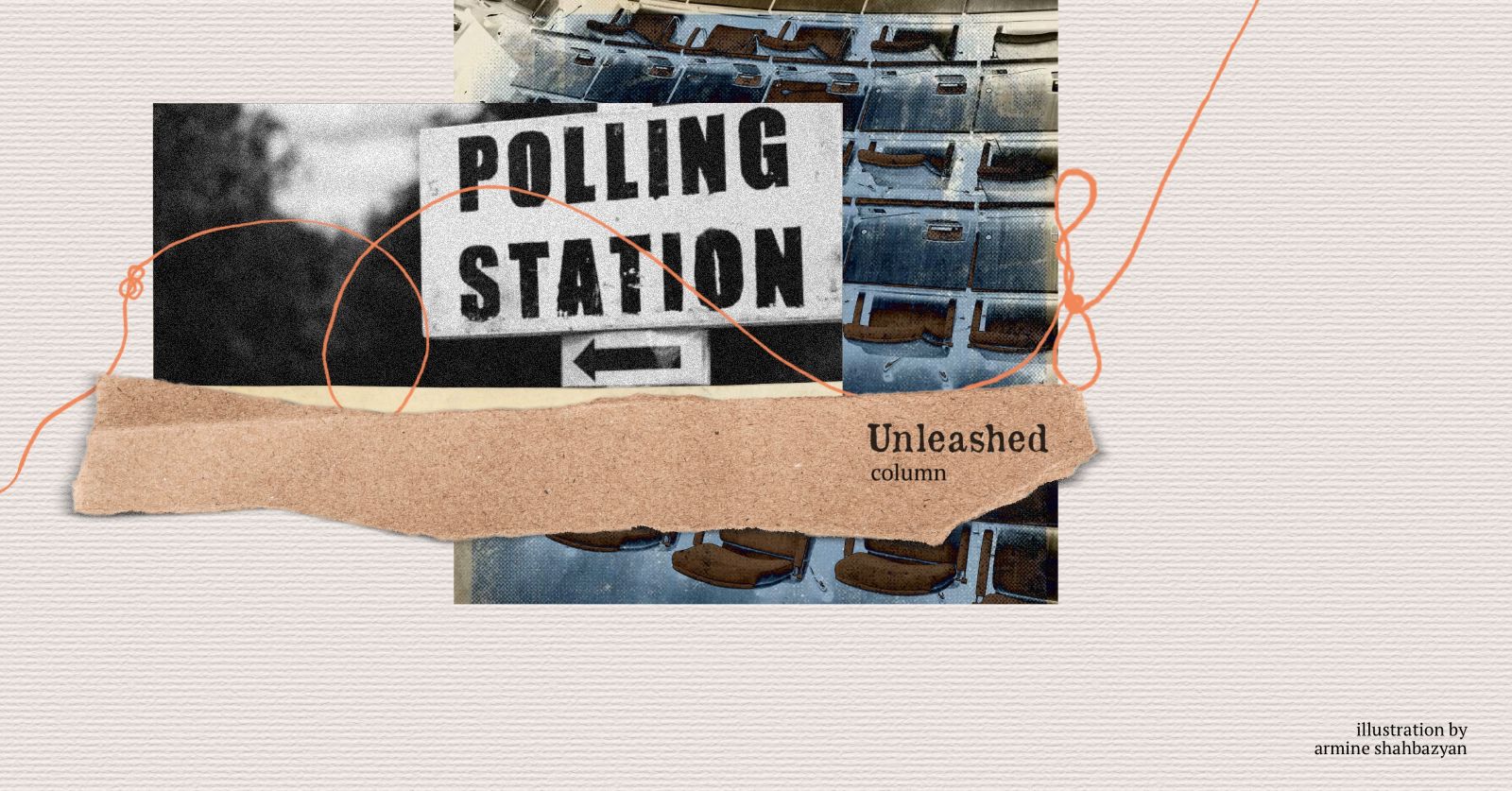
One of the earliest warnings I remember receiving from my mother came when I was very young and there was a federal election coming up in Canada. I asked my father who he was going to vote for. My mother gasped: “You don’t ask people that.”
She made it sound as if I had asked him something obscene, or incredibly rude. I remember being taken immediately aback, because I really couldn’t understand what I’d done wrong. There were lawn signs and posters and campaign ads everywhere. Adults were talking about politics in the background of everything. Debates and commercials about the election were all over TV. Why couldn’t I ask my own father who he was voting for?
Only later did I understand that, although we were safe in Canada, my mother’s reaction was the knee-jerk reflex of a recent immigrant from Turkey, where people could be attacked for their political views, for opposing the ruling party, or even for being perceived as having the wrong loyalties.
I understand that fear now and I respect where it came from. But I also reject it.
Since moving to Armenia, I have been called, or I’ve at least been perceived as, a great many things. I’ve been labeled a “Turkish asset”, a “spy”, and a “Nikol apologist”, while at the same time, depending on the article of the day, an anti-government dissident by the very government I’m supposedly apologizing for. It’s as if trying to think consciously and independently about Armenia’s future means I must secretly be trying to serve some nefarious other’s interests. I’m just trying to be a responsible, informed, and engaged citizen.
And for the first time in my life, I get to vote in Armenia.
To say that I’m excited about this would be an understatement and do very little justice to how absolutely privileged I feel to participate in something so important. To some, voting is just a right. To others, it’s a civic duty. In some countries, like Australia and Argentina, voting is even compulsory, meaning that citizens who fail to show up to the polls without a valid reason can face penalties.
No matter where in the world we are, elections of enormous consequence are happening around us, all the time. Fifteen U.S. states are holding primaries this June. Ethiopia is holding its general elections today, June 1, with more than 50 million registered voters. Peru holds its presidential runoff June 7, the same day Armenia holds its parliamentary elections, and Colombia’s presidential runoff is scheduled for June 21. Elections such as these shape the world order, but also the ordinary lives of the people trying to live within it.
To vote or not to vote is not really the question. If we can vote, then we really should, regardless of how predictable, chaotic, hopeless, or supposedly already decided things may seem. Because if our vote didn’t matter, there wouldn’t be so many forces working so hard to try to suppress it.
So, the real question—or perhaps the harder one—is: how should we vote?
When I was living in Tuscany in the early 2000s, there was an election season and I asked my hot new Italian boyfriend at the time who he was voting for. He answered without hesitation: “Berlusconi, of course.”
Of course? I was surprised. “Why of course?”
“Because he is going to win,” he said.
I remember looking at him and wondering whether he was an idiot, completely wrong for me, or both. Suffice it to say, we eventually broke up. But still, his answer stayed with me because it revealed an attitude I now see everywhere: vote for the winner. Vote like you’re placing a bet.
But elections are not horse races or football matches. Your vote is a choice. You vote for the person, party, platform, or vision that best reflects your conscience and the future you want. You look at who is running, what they stand for, what they’ve done before, what they’re promising now, and whether any of it survives basic scrutiny. Or you let a trusted outlet do some of the heavy lifting for you—not so you can outsource your judgment, but so you can exercise it better.
You also learn the rules of the game. In Armenia’s parliamentary system, parties and blocs have to clear electoral thresholds to enter parliament, which means voters often start doing the math before they even reach the ballot box. Is this party too small? Is this vote going nowhere? Am I wasting my vote if I choose the one that actually reflects what I believe?
Maybe. But maybe not. Maybe your chosen party will lose. Maybe it’ll barely cross the threshold. Maybe it won’t cross it at all. But what if it does? What if it gains enough support just to enter parliament? What if it then becomes part of a healthier opposition? What if your “wasted” vote is one of many that helps give rise to a new political force?
The only truly wasted vote is the one that is never cast. So, if you are truly stuck, find your fallback. On a multiple-choice exam, if you don’t know the answer, you still pick something. Leaving it blank guarantees zero. You eliminate the obviously wrong answers. You look for the one that makes the most sense. Sometimes you go with your gut. Sometimes you pick C.
And if you’re anything like me, sometimes you start with the woman.
This election season, one name that keeps coming up for me is rights activist Nina Karapetyants, the prime ministerial candidate of the newly formed “I Am Against All” party. I can barely mention her without someone cutting me off to say: “Oh, so you want to vote for her just because she is a woman?”
First of all, calm down.
And second of all, what if I did?
To be sure, her party’s platform is rather unusual. It proposes a temporary 100-day government focused on electoral reform, after which parliament would be dissolved and new elections held under revised rules. She also reportedly undertakes not to engage in politics for the next 10 years afterward, which is objectively insane as a campaign promise, but also, in this political climate, somehow refreshing.
So no, it wouldn’t necessarily be just because she’s a woman. But even if it were, people vote for men for much worse reasons all the time. Because he looks strong, or shouts well. Because he seems like he can “control things.” Because he is rich, or smart, or not the other guy. Or worse, because he is going to win.
So why is “because she is a woman” suddenly the most unserious reason in the room? Frankly, in a political culture and world that has been so thoroughly shaped, broken, damaged, and re-damaged by men, the woman card is not the worst card to play. Why keep doing the same thing over and over and expect a different result? Maybe it’s worth seeing what the country could do in the hands of a woman. Even if only for 100 days.
The point is that if you can vote, then all you need to do is just show up, use your brain, trust your gut, and don’t let anyone bully you into their logic. Vote for the future you want represented, even if imperfectly. Vote for the leadership and/or the opposition you think your country deserves. Vote for the change you believe your country needs. Vote for the party that makes you feel slightly less hopeless. Or, just vote for the person who makes you laugh because her party’s name is basically “I hate everyone,” which is honestly not entirely unrelatable.
But vote.
And if you have the right to vote and simply choose not to use it, then maybe spend a little less time trashing the country, the government, the opposition, the people, and the process. It’s not sexy to sit on the bleachers complaining while others show up to exercise the civic duty you couldn’t be bothered to perform.
So, on June 7, or whenever it’s your turn wherever you are, put your grown-up pants on and go vote for [blank].
See all [Unleashed] articles here
Listen to Sheila’s personal reading of “Vote for [Blank]”.

Sheila Paylan is an international human rights lawyer and former legal advisor to the United Nations. Now based in Yerevan, she regularly consults for a variety of international organizations, NGOs, think tanks, and governments.

Great article. I really hope more people in Armenia vote intelligently rather than out of despair or fear. And if I were able to vote, I think I would vote for Nina Karapetyants, even if only because she is offering something different. And because she is a woman. 🙂
I’m glad you liked the piece, Armen! And hopefully someday you’ll be able to vote here too 🙂
Sheila…
You have a unique talent that that encourages topics that we think of but share public discourse on and as a result rewards your readers by enabling perspectives we may not have considered.
We in the diaspora , would be well served to internalize that the voting citizens decide the path forward for Armenia. Our love for Armenia may be boundless but respecting its sovereignty applies to all.
Thank you sharing your gift.
Stepan
Dear Stepan,
Thank you so much for this. What you wrote is exactly the kind of engagement I hope these pieces can invite, and I could not agree with you more on Armenia’s sovereignty and the importance of respecting its citizens.
That said, I also believe our diaspora is one of our most valuable national assets, so the love and respect must be mutual. I have the highest hopes that we will find the perfect sweet spot there someday.
With so much gratitude for your continued readership and support,
Sheila