
From emerging Armenian artists across the globe to Armenian-American talent in the United States, [Art Speak] spotlights the dynamic and diverse Armenian art world and more.
Listen to the AI generated audio article.
The body keeps its secret, this nothing, this spirit that isn’t lodged in it, but spread out, expanded, extended across it, so much so that the secret has no hiding place, no intimate fold, where it might someday be discovered. The body keeps itself as secret…The body is the unconscious, seeds of ancestors sequenced in its cells.”
Jean-Luc Nancy, Corpus
It is perhaps no accident that we refer to an artist or writer’s lifetime output as a “body” of work. The canvas, the sculptor’s block, the writer’s page: all become surfaces onto which we inscribe, conceal, reveal and transform experience. And few contemporary artists engage questions of physical presence, memory, secrecy and transformation as insistently as Carol Peligian.
In one series, Peligian casts her own form to create sculptures that are at once elegant, vulnerable and defiant. Hidden within several of these works is a secret object she refuses to disclose, a gesture that mirrors the unknowable psychic and biological mysteries each person carries from birth to death. Elsewhere, the pelvis becomes a shifting formal center as limbs and anatomical fragments twist and reconfigure in ways that evoke both Michelangelo and Rodin.
In another series, dolls stand in for the female body—fragmented, manipulated and reimagined—suggesting both vulnerability and resilience. Across a rich cross-disciplinary practice that encompasses both painting and sculpture, Peligian transforms anatomy into metaphor, creating an art of concealment, memory and revelation. Her artistic practice can be read through the lens of feminist theory that sees the female body as a contested site where social meanings are imposed, revealing the body as a carrier of history, identity, secrecy and consciousness. Judith Butler and Elizabeth Grosz use versions of this idea: the body is shaped by systems of power and representation rather than existing as something purely “natural”.
Elegance and intellectual whimsy underpin Peligian’s practice, as she frequently draws upon the contours and imprints of her own form. In her “Secrets” series, she wraps herself in raw material, embedding within each form a durable elemental object before encasing the work in fiberglass. Best Kept Secret, in blue fiberglass and white statuario marble nearly three feet long and almost two feet high, seduces with its twists and turns and things we cannot see. Another piece in the series Hush Hush hangs pretty in pink. The cleverly named opalescent white Things Keep Their Secrets implies both the secret that Peligian has placed within the sculpture for posterity to discover, or perhaps to remain forever elusive, and the intimate secrets that make up the human/female corpus.
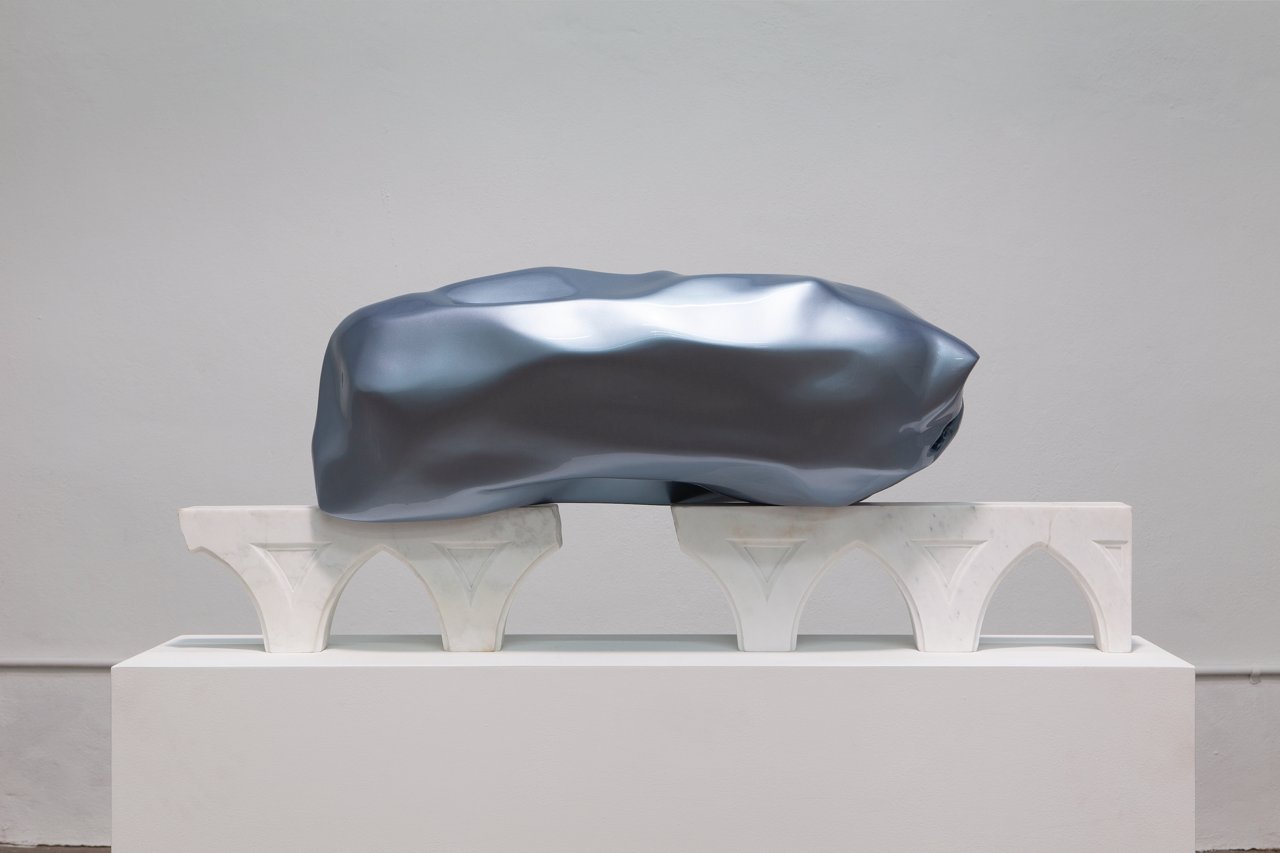
Best Kept, 2019. Aluminum, painted fiberglass, secret object, marble 21” x 48” x 18″.
But it is the sleek, black He by She (mirror polished steel, aluminum, fiberglass, urethane, paint, and secret object, 42″ x 84″, variable dimensions) that seduces the most. Here Peligian collapses oppositions between mind and body, masculine and feminine, interiority and external presence. Stretching seven feet in length, the sculpture consists of two dark, wave-like forms that meet and support one another at their apex, their mirrored silhouettes turning downward toward the earth.
Commenting on this series, she notes: “Each one of these sculptures has an indestructible secret object within it. When everything else is fated for destruction, these objects will still live within. This is connected to the idea of the woman as a vessel. The indestructible item within symbolizes a mother’s love, which unlike anything else is unconditional.”
Something unique and spiritual lies at the core of these sculptures. Peligian’s process itself is organic. “I talk to each new piece and ask it: what do you want? To get the ‘correct’ color, I put the piece in different positions to get the form and color that live best together, or else I see the piece as a failure…” Pneuma and breath are also important in a piece. It’s an additive process. This process reshapes the material into something more mysterious. In so doing, the artist connects to motion, to the will and the subconscious, as well as the atoms that we are made of which connect us to the surrounding universe.
Here Peligian paraphrases Robert Irwin, who said that “Some things we are not responsible for, and don’t own.” As she relates this last quote, her eyes are aglow with the realization that this particular process bears similarity to another important human activity: “It’s like kissing someone. It’s over when it’s done. It’s not yours anymore.” She then references Lousie Bourgeois, who once said that the fate of the work is to be destroyed: “True. But here the secret object is indestructible and elemental.”
In Shift and Lift, her 2024 solo exhibition at Atamian Hovsepian Curatorial Practice, Peligian exhibited a large grouping of small cast urethane dolls in transparent pink, drawn from her ongoing series What a Little Doll (3” x 6” x variable/7.6” x 15.2” x variable in.) As viewers descended the gallery staircase, they were met by 150 figures assembled atop a glass ceiling, suspended above eye level so that the installation functioned simultaneously as sculpture and collective apparition. The work was based on a figurine given to the artist by a friend when she was eleven years old. It was also inspired by the fourteenth-century Pleurants or The Mourners which she encountered years later in Dijon, France.
At the same time, Peligian incorporates the seductive visual language of mass consumer culture, transforming the dolls into objects that appear tactile and desirable even as they remain physically inaccessible to viewers below. The clustered figures call to mind the vast ranks of terracotta sculptures depicting the armies of Qin Shi Huang, the first emperor of China, reimagined here in contemporary form as a symbolic assembly advancing the ongoing struggle for women’s rights and agency. Illuminated from above, the dolls refract light into prism-like effects, producing an atmosphere at once fragile and radiant.
In a meeting at her Long Island City studio, Peligian remarked that: “In a weird way the dolls let me work through aspects of the patriarchal culture which I shed while coming of age during second wave feminism and reading people like Gloria Steinem and Betty Friedan.” The original Pleurants that the statuettes are based on reappear in Mourners, a quasi-mystical short film shown in Atamian Hovsepian’s downstairs screening room. In the film they are magnified and travel with their faces covered in shawls through a picturesque forestscape, accompanied by haunting music. When she first saw these statues as a student in France, Peligian was struck by their sheer aesthetic power and by the personal histories that they seemed to carry forth although they dated from the Middle Ages and were made of stone.
Lying at the crux of Peligian’s practice is a preternatural work ethic married to a sense of wonder about the world and the artistic process itself: “When I get into the studio. I am really trying to see something I have never seen before. My subject matter involves issues of permanent importance to me. I’ve always been interested in the tension between control and chaos in sculpture, especially as it is sensed by both the individual and society. Also: human rights, migration, the body.”
Along with Louise Bourgeois, Joan Jonas, Agnes Martin, and Phyllida Barlow, Peligian continues the mission of women making a decided impact on the current art historical record. A daughter of New England, Peligian attended Rhode Island School of Design Saturday School before embarking on a decades-long career as an artist. There have been setbacks along the way, including a devastating 1983 flood which destroyed thousands of pieces. Starting from scratch, she reopened her studio in Manhattan and then Long Island, ultimately expanding and shifting her practice to include sculpture, installation, and video.
Today the studio is a combination of sculptural chantier and salon: sweets and culinary treats greet the visitor along with an occasional glass of champagne to accompany discussions of her work, but also politics, books, art historical theory and all manner of sundry topics. This intellectual curiosity forms part and parcel of her art practice itself, where an idea always subtends a new work. It’s a way of moving forward, a true calling: “This chose me. I knew when I was three years old,” she says. A little farther along, Peligian likens the artistic process to doing the breaststroke and pushing water back in order to move forward.
While her mother’s family hailed from Dikranagert, her paternal grandparents were survivors of the Armenian Genocide from Sebastia on her father’s side. “My father was born in upstate New York and was baptized Episcopalian, and mom was from Rhode Island,” she says. Peligian’s artistic identity is therefore shaped by both her American upbringing and her Armenian heritage.
In 2005, she was commissioned to design a genocide memorial at Nova Southeast University in Florida, which initiated her transition into sculpture. The resulting, large-scale Susurrus (2006) (18”x12” by variable) today stands outside the Business School H. Wayne Huizenga College of Business and Entrepreneurship. Its title refers to a soft whispering or murmuring sound such as that made by rippling water or tree branches bending in the wind. The piece rises skyward, a rippling, curtain-like form.
The complex process of constructing a specialized machine to shape and curve aerospace grade aluminum and create a truly fluid monument. The monument is dedicated not just to fallen Armenians, but to the survivors of 20th century genocides, namely the Holocaust, Bosnian, Rwandan, and Cambodian genocides as well: “I asked myself: have we learned nothing, that we’re still doing this?”
In a documentary short directed and produced by filmmaker Sophie Shahinian, Peligian describes how her two grandparents survived the Armenian Genocide. Her grandmother was cast out to the Syrian desert to die. “She wasn’t just subjected to deportations, but to multiple rapes. She was also tattooed by the Bedouin tribes along the way. Of course, as a child I had no way of understanding what these tattoos meant. They branded women as being soiled. I think everyone standing today is a testament to their ancestors and their ability to survive. And to live. And to flourish,” Peligian asserts defiantly. She further relates that when trauma is absorbed internally, the psyche frequently fragments or slips into states of dissociation, creating a rupture between physical experience and conscious awareness.
A contrapuntal lightness also marks Peligian’s work, one which counterbalances some of the darkness in the world. No piece better illustrates this than Mary Boone (2013). Made of aluminum, black female mink, and brass, Peligian decked out her old ladder in a homage to said gallerist’s unmatched glamor. The ladder also comes with its own original footwear, which Peligian terms “ferocious little Mary Boone feet.” The second much larger ladder Peligian made, titled Louise (I’ll Be Right Up)—stands a full ten feet tall, and is eight-legged, also in homage to Louise Bourgeois and her own mother. Cast from her late mother’s coffee table legs, the feet here are much softer. Whence came the urge to create such a piece? From her choice of materials and shapes, though the artist admits that some of it is truly unexplainable: “You work and you can’t make it up. It comes from a joining of your emotions and your will, of the subconscious connecting to the conscious. Everything goes into your work: people, country, your personal life. Artists are vessels. “You push the blender button on high…and the result is a purified mixture.” Citing another important influence, Peligian adds: “Gerhard Richter opened the door for me as a kid before he was famous. He was abstract and hyper figurative. He couldn’t be branded.”
Peligian’s work often connects the human body to broader environmental concerns, especially themes related to climate change and ecological preservation. Her film Too Hot to Handle was screened at Atamian Hovsepian Gallery in New York alongside Mourners, with both films presented together on a single screen. Through these works, Peligian combines feminist perspectives with environmental discourse, questioning traditional assumptions about intellectualism and femininity while encouraging deeper awareness and public engagement. Her daughter, glaciologist Alexandra Boghosian, appears in both films, and over the last decade the two have maintained an ongoing creative and intellectual collaboration through the exchange of research, ideas and working practices.
Another notable work, the 2019 Lucy (24k gold, steel; 10” x 10” x 12”), presents a woman’s pelvis as a rotating, glistening form. As Peligian explains, “I’ve always been obsessed by the body and by this thing—the pelvis—that ushers into the world. Which is why I made this work, Lucy.” Using an actual human pelvis as her model, she cast the sculpture in 24-karat gold over plastic and metal. In 2019 she expanded from a single pelvis to create a series beginning with 6 lbs. 4 1⁄2 ounces (her daughter’s birth weight), a nickel-plated bronze work made of nine interlocking pelves ranging from birth through adulthood (14” x 10” x 10”).
In 2025, she created four new versions of the sculpture in an ongoing series: two black patinas (one matte and one semigloss), one gold-plated, and another in bead-blasted bronze. Peligian emphasizes that color fundamentally shapes the outcome of a work, even when the same model is used, since patinas can vary widely in effect. As she puts it, “Color demands placement. There is a lot of trial and error in order to get the color to become or be the form, to eliminate the narrative.” In this, she recalls Wassily Kandinsky, who argued in Concerning the Spiritual in Art that meaning in art emerges through the placement and relationships of color, with contrast and arrangement producing emotional and spiritual force. Driven by a desire to reveal the uniqueness of all living forms, Peligian elevates her art beyond the mundane into the spiritual.
Another important series of paintings exhibited in Shift and Lift uses material in ways both new and exciting. The use of interference pigments to change color in the from her Avian Lux series dazzles aesthetically while addressing issues of migration and the seduction of movement. Discussing two of these paintings, including Avian Lux #2, 2021-22 (oil, urethane on aluminum 48″ x 54″) Peligian explains that she used aluminum as her “canvas” to make a colloidal from the paint before applying pigments concentrically. As a result of this technique, the paintings shift as you move from one side of the room to the other.
At the core of Peligian’s creative output lies a daily engagement with the key political and intellectual ideas of her time, as well as a reverence for intellectual engagement and an infectious joie de vivre. Her always lively conversations are peppered with witticisms and adages, learned references to Middle Eastern history and French literary theory, fascinating anecdotes about meeting artistic idols of hers such as Leonard Cohen, and heartfelt reminiscences about friends and family that she has lost. In a recent studio tour, pithy disquisitions included: “Beauty rules.”; “When in doubt, strip it down.”; “The Earth is a giant sculpture.”; and “Material is just material—something that you manage.” And the artistic kicker: “Finished objects look almost foreign to me.” Something magical then about an artistic practice that produces fur-covered ladders, memorials to fallen ancestors, glowing meteors, secret objects hidden inside sealed sculptures, and an army of precious glass dolls that reassert the role of women in history.
Peligian’s fascination with the mystery of life as we know it pushes her forward to keep producing new work. She sees art as fundamental to human existence and said that, “It reminds us of where we come from, confronts us with where we are, and if we listen, tells us where we are going.” What emerges from her work is at once cerebral yet visceral, brazen yet soothing—an incandescent testament to the human spirit and the artist’s ability to give form to timeless ideas in ways that still feel fresh and unforeseen.