
Listen to the AI generated audio article.
“At a young age, having attended a school in Pondicherry, I read a History of Rome in the French language, whose author is Mussi Rolin, in 16 volumes. And I made a pact in my heart to publish it in our own language, since I saw the benefits to the readers, that is, both on account of its constitutional government, its [love of] unity, and also for its patriotism and so on… for this translation will be very useful for our nation.”
—Edward Raphael Gharameants‘
Letter to the Mkhit‘arist Congregation in Trieste, September 10, 1785.
“Whatever Sum… is to be lodged in the Company’s Treasury upon their Interest Bond and the Interest… appropriated for the Translation and Print of the Roman History… and… the Antient History… by Mons. De Rolin into the Armenian Language…. Therefore, all the Interest… will be given for the same purpose until accomplishment of the said two works. After that, the said Interest… applied for the Fund of a School for the Poor Armenian Boys… that the Boys and their Masters need live decently.”
—Edward Raphael Gharameants‘
Last Will and Testament of Edward Raphael, esq. of Madras, 1792
“Rollin would open, therefore, the doors of the National College.”
—Sahak Vardapet Ter-Movsesian
“The Patrons of the Moorat-Raphael Colleges and Their Testaments” (Venice, 1937)
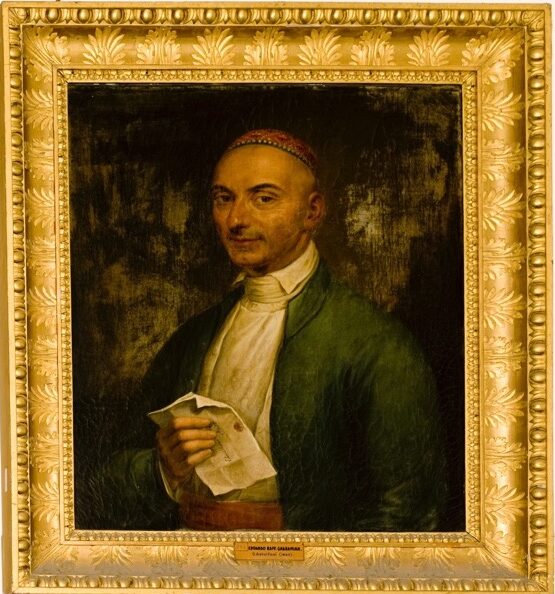
Portrait of Edward Raphael Gharameants‘ by Italian artist Gaetano Astolfoni in 1840, housed in the San Lazzaro degli Armeni gallery in Venice.
Among the wealthy Armenian merchants who flourished in the commercial world of the eighteenth-century Indian Ocean, few left a more enduring mark on Armenian intellectual history than Edward Raphael Gharameants‘.[1] He is remembered today principally as the benefactor whose fortune ultimately endowed the Raphael College in Venice, later incorporated into the Collegio Armeno Moorat-Raphael. Yet Raphael was far more than a successful merchant or generous philanthropist. His life reveals the intimate relationship between commerce, historical reading, patriotism and educational patronage in the eighteenth-century Armenian diaspora. More than perhaps any other Armenian merchant of his generation, he consciously transformed commercial wealth into cultural capital, investing in books, printing presses, schools and historical education. His remarkable testament (quoted above), which required the Armenian translation of Charles Rollin’s The Roman History From the Foundation of Rome to the Battle of Actium before the principal provisions of his bequest could be implemented, invites us to reconsider the intellectual origins of one of the most important acts of cultural patronage in early modern Armenian history and in the history of the Mkhit‘arist Congregation in Venice.
Drawing on unpublished East India Company records, including Edward Raphael’s “Last Will and Testament” (1792), the inventory of his estate, and, above all, his numerous Classical Armenian letters reproduced in extenso in a nineteenth-century biographical study, I offer here a preliminary sketch of Raphael’s life. Rather than retelling his biography, I focus on a pivotal episode in his intellectual development: his early encounter with Charles Rollin’s celebrated account of Roman history and the lasting influence it had on his admiration for republican virtues, patriotism and constitutional thinking. As the epigraph to this study indicates, Raphael read Rollin’s 16-volume work at a French missionary school in Pondicherry, not long after its publication in Paris in 1739. He could scarcely have been more than a teenager.
This essay reconstructs the microhistory of a singular act of reading Roman history in eighteenth-century India. Drawing together scattered documentary traces preserved across archives on three continents, it examines the historical processes through which this seemingly private encounter with the past was transformed into an enduring institutional legacy, ultimately providing the intellectual and financial foundation for the celebrated Collegio Armeno Moorat-Raphael in Venice, a foremost center of Armenian diasporic education. More broadly, the essay explores the possibility that Edward Raphael’s engagement with Charles Rollin’s Roman History constitutes one of the very few, perhaps the only, surviving “traces” of what Christopher Bayly has termed the discourse of “righteous republics” in the Indian Ocean before 1800.[2] As an “exceptional normal” case, Raphael’s reading of republican Rome and its civic virtues may therefore offer an unusually revealing window onto the circulation, appropriation, and localization of political ideas across the Indian Ocean during the global eighteenth century. In doing so, it also speaks to broader debates on the character and geography of the “global Enlightenment” in recent world-historical scholarship.[3]
A Microhistory of a Merchant Reformer
Born into a Catholic merchant family in New Julfa near Isfahan in 1744, Edward Raphael Gharamiants‘ belonged to a lineage originally from Aparan in Nakhijevan that had been deported to Safavid Iran during the forced migrations of 1603–1604 under Shah Abbas I. It is unclear whether his family belonged to the Roman Catholic confession before relocating to New Julfa early in the seventeenth century, as their natal town’s association with the Franciscan Catholic order of the Fratres Unitores suggests, or whether they converted subsequently. His own autobiographical fragment places considerable emphasis on inherited family memory but elides this question.[4] It starts its genealogy with Edward’s grandfather Khachik, son of Gharam who was the first to be born in New Julfa. Having been orphaned and reduced to poverty, this Khachik had decided to rebuild the family’s fortunes through long-distance commerce in the Indian Ocean during the late-seventeenth century before returning to New Julfa around 1690 as a prosperous merchant.
Edward’s father Raphael married into the Catholic Khojamalian (Cojamal) family, itself connected by marriage to the prominent Catholic Shahrimanian family of New Julfa. Like his father, Raphael was active in the “country trade” of the Indian Ocean and particularly with its Southeast Asian margins. An inquisition document from Manila in 1735 records Raphael as one of five Armenians residing in Manila’s Chinatown of Binondo, where the sojourning Armenian merchants often resided.[5] Three years later, we find Edward Raphael’s father once more residing in the Spanish outpost, traveling frequently on trade between the Philippine capital and Pondicherry and Canton.[6]
By 1745, and under circumstances unknown to us, Raphael had died, possibly suffering shipwreck or dying on the high seas as his son would a half century later. This had left his widow (Edward’s mother) Nanajan little choice but to move the household, with the young Edward and his sister, from New Julfa to French Pondicherry. Her wealthy father, Hovhannes Khojamalian (Coja Owanes Cojamal to the French) had established himself in the French settlement as a merchant in 1746. In Pondicherry, ten-year-old Edward received his earliest formal education. Though cryptically alluded to as “a school” in Edward’s letter, more than likely this French missionary establishment was the Capuchin school mentioned by Marguerite Labernadie in her Le Vieux Pondichérry, 1674-1815 as being next to the Capuchin church built in 1739 but destroyed by the British during their conquest of the French settlement in 1761.
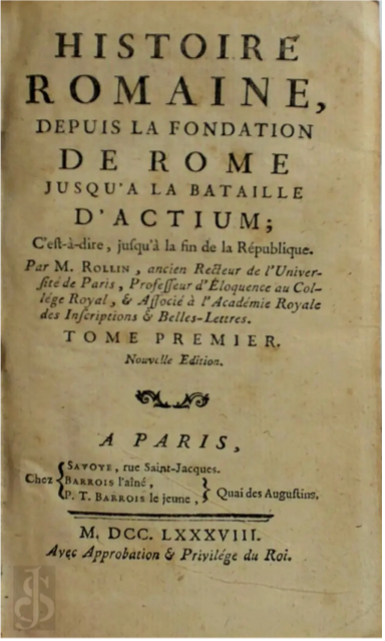
Charles Rollin’s The Roman History, From the Foundation Of Rome to the Battle Of Actium
The young Edward’s education was interrupted by the outbreak of the Seven Years’ War. This largely Anglo-French conflict culminated in the British conquest of Pondicherry in 1761, forcing the family to relocate to Madras. Although brief, his Pondicherry education was formative for the young Edward. According to his later correspondence, it was there that he first encountered Charles Rollin’s Roman History, whose ideals of patriotism, constitutional government, civic virtue, and unity—all popular themes throughout the eighteenth century—profoundly shaped his later educational philanthropy. Edward Raphael remembered his reading of Rollin so profoundly that he made a Classical Armenian translation of the Jansenist’s history of Roman virtue and civic republicanism the precondition for a multi-million-dollar endowment for an Armenian college he hoped to establish in Europe for orphans of his nation.
In Madras, Edward became one of the leading Armenian merchants on the Coromandel Coast. As a result of his commercial fortunes, he soon rose to a position of eminence in the township’s society. He served on a public committee for the Mayor’s court of Madras in 1786 together with several of Madras’ most prominent “private merchants,” including two of (Indo-) Portuguese background and another Julfan Armenian, Shahamir Shahamirian, who will resurface later in our story.[7] Around this time, he sent his two older sons, Alexander and John to an exclusive gentlemen’s private school in London, where shortly later they were joined by their sister Anna.
In 1787, we come across Edward’s name as one of the “syndics” or caretakers of the Roman Catholic Church in Madras along with two other Catholics of probable Portuguese background and a certain Miguel Johannes (Mukel Tēr Hovanessian), a fellow Catholic Julfan merchant who would introduce Raphael to two Mkhit‘arist missionaries and alms collectors from Trieste in 1785.[8] Raphael was so wealthy at the time that he is listed as loaning the considerable sum of 9,150 Spanish dollars (around a million US dollars in 2026) to the English East India Company and to their Council at Canton in 1786, made payable to his friend and later one of the executors of his will, the above-mentioned Miguel Johannes in Madras.[9]
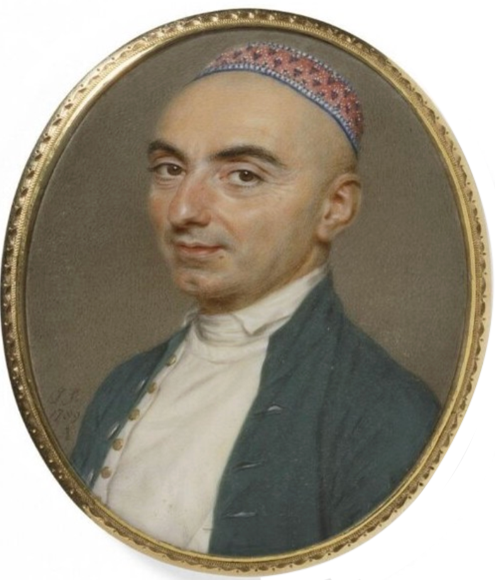
Portrait of Edward Raphael Gharameants‘, watercolor on ivory, by John Smart, ca. 1789, held at the Victoria and Albert Museum, London, United Kingdom.
Edward Raphael reached the pinnacle of his success in 1788. In that year, along with Josias du Pre Porcher of Fort Saint George, Thomas Redhead of Calcutta, John Balfour, John Chamier, Thomas Cockburn, and Benjamin Torin jointly with Nathaniel Edward Kindersley, he became one of the co-founders of the Carnatic Bank, the first Joint-Stock Bank in the Madras.[10] It is most likely in this period too that Raphael sat for a portrait by John Smart, “one of the finest miniature painters in Europe,” then a resident in Madras as painter/portraitist for the town’s elite.[11] An object that signals its bearer’s multiple identities as a cultured merchant, Raphael’s oval-shaped “watercolor on ivory” portrait is now held at the Victoria and Albert Museum.[12] Edward Raphael is at once portrayed here as a member of Madras’ elite English/European society and also as its familiar “other.” He acts, speaks, plays, and even mostly dresses the part, except for his skullcap—a uniquely Julfan sartorial accoutrement atop which the four-cornered Julfan tall hat was usually placed. But Raphael is also a stranger in this society. He is an “alien” twice removed; first as an Armenian merchant from Iran and second as a Roman Catholic in a time of Anglo-French rivalry and war in South Asia. In Georg Simmel’s words, he is the quintessential “stranger,” who “in spite of being inorganically appended to it… is yet an organic member of the group.”[13]
Raphael’s trading activities stretched from Madras to Calcutta, Canton, Macau[14] and Manila in the East, and as far as Amsterdam and London in the West, where he owned shares in the English and Dutch East India Companies. He traded in a number of niche commodities along the “triangular trade” between Madras or Pondicherry, Canton in China, and Manila. His post-mortem inventory of estates indicates that Raphael was financially connected to leading Madras agency-house figures, including Josias Du Pré Porcher and Porcher Redhead & Co., and participated in maritime-credit networks extending to Manila, Batavia, Lisbon, and, through the East India Company, the French port of Lorient.
In addition to finance and banking, including substantial loans to the European East India Companies, Raphael was heavily invested in the trade of “piece goods” or cotton textiles from India, which sold very well in Canton and Manila in exchange for American silver from Potosí.[15] Unlike the estate inventories of several other Armenian merchants active in India and China, Raphael’s contains no explicit reference to the China opium trade, then widespread in the circles that Raphael engaged with, including possibly, those of his son-in-law who will reappear later in our account.[16]
Raphael also had significant property investments in India and China. In Madras alone, Raphael maintained several residences for different seasons. In addition to his main mansion in the presidency town, our merchant owned at least five other separate and “commodious” homes with land. Up until his untimely death, he also owned a home in Canton which he sold to a certain James Matthew Gyress in the late 1780s as well as a “House & Ground” at Pondicherry, where he had attended school as a youngster.
Commercial distinction and cultural refinement were not Raphael’s only hallmarks. He was also the epitome of what I have elsewhere described as perhaps the first “post-confessional reader” among Armenians before the nineteenth century.[19] His reading horizons, sensibilities and tastes extended well beyond the narrower confines that characterized the history of reading in early modern Armenian societies.
Unlike most Armenian readers of his time, Raphael cared little for printed religious works such as commentaries on the Gospels. Instead, history, travel literature, and especially works that instilled honor and pride among Armenians—whether Catholic or Apostolic (Gregorian)—were top on his reading list. As his extensive correspondence with the Mkhit’arist monks in Trieste makes clear, he had little interest in confessionally inflected books or in yet another Psalter from the Mkhit’arist press. In a letter dated 1786, Raphael writes back to the superior of the convent in the Habsburg port city and addresses criticism he had received about his secular reading habits.
I know with certainty that I gain nothing by writing this, but I’m worn out by pain as [my] mind considers [the issues you have raised]. So, accepting your criticisms with humility, I also make bold to say a few things about our Excellent readers, who are in our churches, because of whom there exists no readership among the laity. I’m not opposed to admitting that first they need to preach the faith in Jesus in an Orthodox manner and to print Holy Scripture, but I recognize and know that we have enough. Now it’s necessary to publish books, which create an opportunity as zeal for patriotism, knowledge, and valor, etc.[20]
It was this commitment to a new kind of reading—and, indeed, to a new vision of education—that inspired Edward Raphael to sponsor the translation of Charles Rollin’s masterpiece into Classical Armenian. This singular act of patronage is what sets Raphael apart from his contemporaries. It also constitutes his greatest historical significance, shedding light not only on Armenian intellectual history, but also on the place of the Armenian diaspora within broader global, particularly Indian Ocean, engagements with Roman history, civic republicanism, and ideals of republican virtue that extended well beyond the familiar horizons of the eighteenth-century Atlantic world.
Commissioning Roman History in Madras and Dying at Sea
The decade from 1775 to 1785 was an unusual one for Madras’ small but affluent Armenian community. Within a few years, Fort St. George, the British East India Company’s administrative center in Madras, drew an unprecedented succession of Armenian Catholic fundraisers and emissaries from Mount Lebanon, Rome, Trieste and Venice. United by confession, these monks nonetheless pursued distinct and at times competing agendas.
The first delegation to arrive consisted of two monks from the mother convent of the Mkhit‘arist congregation of San Lazzaro in Venice. They arrived in 1772, a few years before the period under discussion. Their short sojourn was principally guided by their wish to sell Mkhit‘arist printed books, to look into a huge bequest left to the order by Catholic Armenian merchants in Bengal a decade earlier, and to report back on what Armenian readers in India were interested in reading. Although their stay was brief, it secured a significant windfall for the San Lazzaro convent through the Bengal bequest of 1764, enabling the publication of around 12 important publications.
The Antonine monk from Mount Lebanon, Ter Andreas Ouzounean, by contrast, spent a decade cultivating Madras’ leading Armenian Catholic families. His efforts bore fruit in 1791, when Edward Raphael’s close friend, the Julfan merchant Miguel Joanes, left a substantial fortune to the Armenian Catholic Order in the mountains north of today’s Beirut. His endowment funded the construction of a belfry, a seminary, and the endowment for the scholarship of six perpetual seminary students. Our merchant Raphael was only tangentially involved in this affair though he did host the “Lebanese” monk for some time in his home and agreed to pay for a printing press in Mount Lebanon, though nothing appears to have come of this.[21]
Important as these benefactions were, they paled next to Raphael’s singular contribution to Armenian cultural history. In commissioning a Classical Armenian translation of Charles Rollin’s Roman History, he sought to lay the intellectual foundation for a secular Armenian college in Europe. The project grew out of the third and most important fundraising mission to Madras, this time from two other Mkhit‘arist priests belonging to a splinter and rival congregation established in Trieste in 1775 after a major “schism” on the island led to the division of the order.
A decade after this order’s founding, the desire for a major benefaction to fund Trieste’s plans to open a school or college, led to the expedition of monks Nigoghayos Buzayan (Nicholas Pusany) and Boghos Mēhērean on a fundraising mission to Madras. There the monks were introduced to Edward Raphael through Miguel Johannes in 1785. When Buzayan introduced his congregation’s proposal for “opening a school for the children of the Armenian nation,” Raphael saw the opportunity to realize his own long-cherished desire “to do a good deed for my nation.” He agreed to finance the school but made two extraordinary preconditions. He would deposit 50,000 rupees in a European bank, whose interest would be used to translate Rollin’s Roman History and to support a school for Armenian boys of middling families. There they would be educated in Armenian, Latin, and the language of the host country. Buzayan himself was to serve as rector. His second request was for Buzayan to accompany his two elder sons, Alexander and John, to an elite gentleman’s training school in the British capital and to educate them in Classical Armenian, which the latter grudgingly agreed to. Buzayan moved to London in 1786 and remained Alexander and John’s tutor and guardian for well over 20 years, contributing to the two young men’s education and cultivation. Alexander Raphael (the eldest) went on to become the Sheriff of London in 1819. In 1839, the Anglicized gentleman was elected as the first Catholic Member of Parliament.
In January 1791, Raphael hastily left Madras for London by sea. Before his ill-fated voyage, he wrote a new codicil to his will, promising to endow funds for a school in Europe. Having been angered and dismayed that the Trieste order had taken his money and published the Armenian translation of only the title page of Rollin’s masterpiece, he left a significant endowment to Buzayan and the Mkhit‘arists for a college. But he insisted that before any school could open, the endowment’s income was first to finance the translation and publication, in Classical Armenian, of all of Rollin’s sixteen-volume Roman History and the thirteen-volume Ancient History. Only once both works had appeared in print would the revenues pass to the Mkhit‘arist monks for a school for poor Armenian boys, under the lifelong direction of Buzayan, who was empowered to appoint his own successor.
The translation of Rollin was thus no ordinary act of literary patronage; it was the indispensable intellectual prerequisite for a new model of Armenian lay education where confessional and class differences between the children of the affluent in Constantinople and the orphaned or poverty-stricken from across the Ottoman Empire, including Eastern Anatolia and Asia Minor, would all be eligible for the same education.
What followed was tragic. Having recently lost both his young wife and his mother, Raphael settled his affairs and sailed for London early in 1791 aboard the East Indiaman Prince William-Henry, accompanied by his youngest son Louis, and an Indian servant. His immediate concern seems to have been his children’s education—above all, reports that his daughter Anna Mariam, then studying in England, was drifting toward the Anglican Church. Near the Cape of Good Hope, Raphael fell into a dispute with the ship’s captain, Ralph Dundas, over cabin accommodations. Apparently his rebuffing of the captain’s request to change his spacious room with a pregnant woman in the lower cabins had resulted in the captain’s refusal to break bread with him as usual. Already in frail health and deeply humiliated, Raphael suffered a fatal heart attack on June 25, 1791, just days before the ship reached London. He was 48 years of age. “The contempt of the captain for him was such that,” writes Edward Raphael’s first biographer, “he was unwilling to keep the body on the ship for an additional day to deliver it on land to the soil, but on the spot dumped it in the water as feed for the fish.”[22]
Raphael’s death opened a complicated struggle over the execution of his will. Soon after news of his demise at sea had become known, Father Puzayan who was the beneficiary of Raphael’s “Funds for a Charity” traveled to Venice and switched allegiances from the Trieste Mkhit‘arists to those of Venice. Puzayan also transferred his power of attorney to the Abbot of the Venice order Stepanos Melk‘onean.
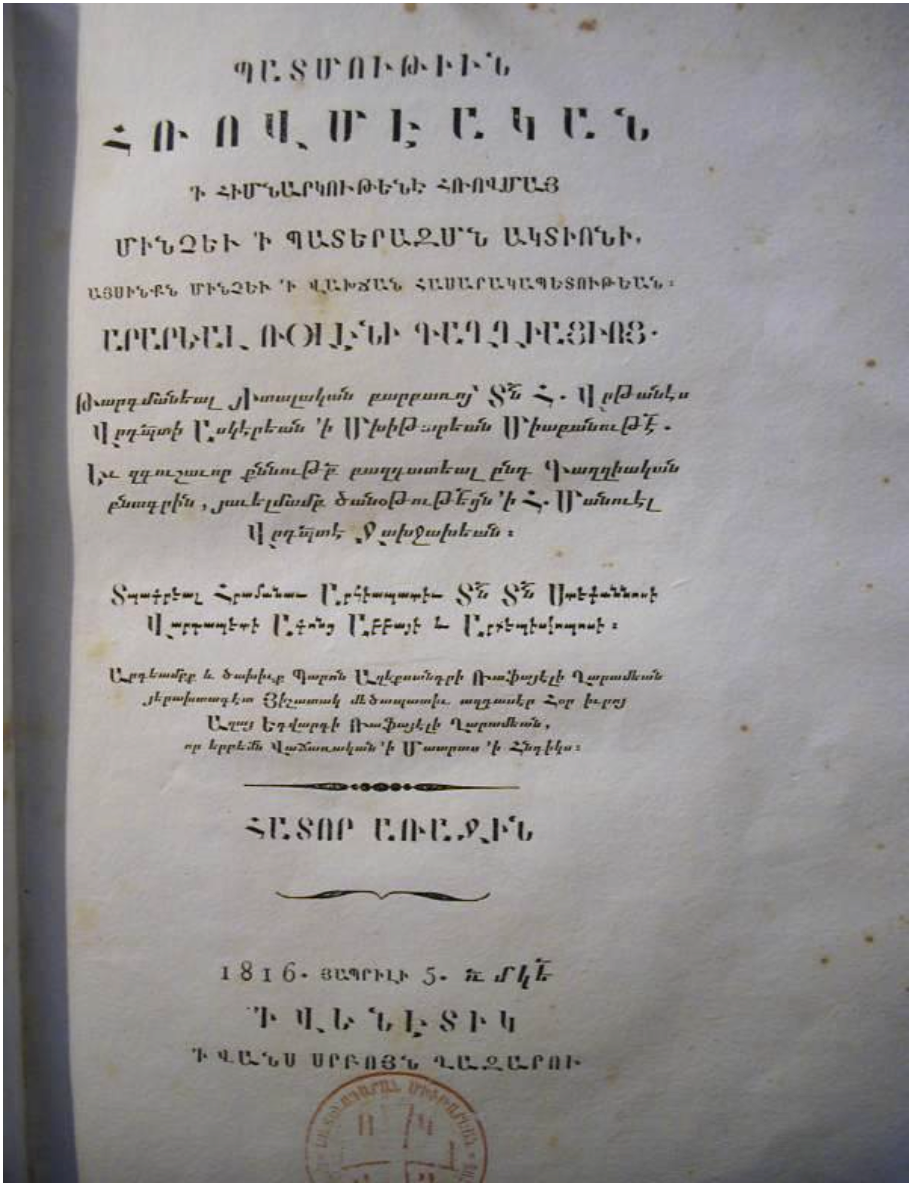
Armenian translation of Roman History from its Foundations until the Battle of Actium.
Between 1816 and 1818, the multilingual printing press on San Lazzaro published, in six octavo volumes, Roman History from its Foundations until the Battle of Actium (Պատմութիւն Հռովմէական ՚ի հիմնարկութենէ Հռովմա մինչեւ պատերազմն Ակտիոնի). The translation was done by philologist Father Vrdanes Askerean, not from the original French but from an Italian rendition. Between 1825 and 1829, the same press published a translation of Rollin’s 12-volume Ancient History in six volumes, thus fulfilling all the requirements set by Raphael.[23]
Six years after the last volume of Rollin’s Ancient History came off the press in San Lazzaro, the Congregation received a significant portion of the “Charity of the Funds” to rent out a section of the Palazzo Pessaro on the Grand Canal. To inaugurate the Raphael School of Venice, the San Lazzaro monks held a small ceremony in the presence of dignitaries and 15 Armenian students on September 16, 1836. In 1850, the Funds for a Charity were so substantial and the dividends on their investment in gold assets of the Bank of England so plentiful that the congregation purchased one of Venice’s most celebrated palaces with its spacious gardens, the Palazzo Zenobio also known as Ca’ Zenobio.
In 1816, Raphael’s affluent son-in-law, Samuel Mkrtich Moorat (also a merchant with connections in China and the Philippines), bequeathed an even larger endowment to “purchase land in any part of Europe…for the funding of an academy for orphans and poor children of the Armenian nation.” Like his father-in-law, Moorat was also guided by a philanthropic and patriotic desire to spread “enlightened knowledge” to his destitute and “forlorn” people. His patronage of 150,000 Madras Star Pagodas ($75-115 million in today’s currency) was meant “to diffuse among the nation…the light of knowledge and wisdom [so that] our unprotected nation may awaken from the torpitude of sleep and carelessness and for establishing the academy.”[24]
The upshot was the creation of the Samuel Moorat Academy in Padua (1838) and especially the Samuelian College in Paris. With the political turmoil caused by the Paris Commune in 1871, the students and part of the funds from this Paris academy were joined to the Raphael College in Venice. The result was the Collegio Armeno Moorat-Raphael, arguably the premier center of Armenian higher education in the world.
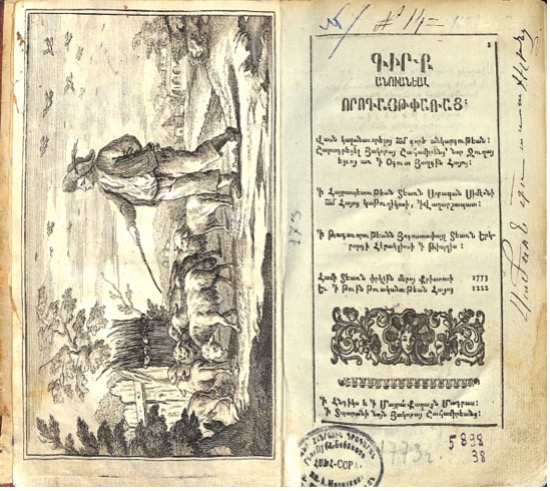
Vorogayt Paṙats‘ (The Snare of Glory), published in Madras in the late 18th century, proposed a democratic constitution for a future independent Armenian state.
To conclude, let us briefly return to our wealthy yet notoriously frugal merchant patron and his enduring fascination with Charles Rollin’s Roman History, with its celebration of Roman civic virtue, love of the patria, constitutional rule, and devotion to the public good. A full analysis of the place of classical Roman virtue and works of Roman history such as Rollin’s must await a separate study. Such an inquiry would undoubtedly shed further light on the ways in which Ancient Rome occupied a central place in the nascent political thought that emerged among the Armenians of Madras in the 1780s and 1790s. A curious political tract with a republican constitution for a future Armenian state that would not exist on the map for another 120 years also devoted several pages of encomiums to Rome and its republican tradition. Entitled Vorogayt Paṙats‘ or The Snare of Glory, this proto-constitutional treatise published in Madras in the late 1780s had the following astonishing request in its introduction:
It is extremely necessary for us to strive, if possible, to translate the history of the Romans from the beginning until their decay into the Armenian language as all the nations of Europe have in their own languages. And whoever among the Armenians becomes the cause of the publication of this translation will have his memory remembered among us.”[25]
Despite Raphael’s incredible act of cultural and educational patronage and his stubborn insistence that the Roman History (in 16 octavo volumes!) be translated into Classical Armenian, his legacy among most Armenians today is all but forgotten.
In memory of Vartan P. Djerrahian, 1943 (Addis Ababa) – 2026 (Montreal).
Footnotes: