
From emerging Armenian artists across the globe to Armenian-American talent in the United States, [Art Speak] spotlights the dynamic and diverse Armenian art world and more.
Listen to the AI generated audio article.
Titled simply The Book of Genocides, Dana Mashoian Walrath’s new graphic history is unlike anything that has appeared before, utterly original in both content and presentation. Part history, part art book and part personal reckoning, it grew out of a 2016 art installation at Vermont’s Studio Place Arts. Walrath later created two inventive documentaries, collectively titled “The Animated Book of Genocides,” which received an honorable mention for the 2026 Ars Electronica Prize for Digital Humanity.
Published by Harvard University Press, the book is already receiving considerable attention. On September 6, The Guardian’s David Smith, titled his review: ‘‘’It leaves holes inside of you’: graphic novel aims to remember the history and horror of genocide.’” And coverage to date has consistently praised the way the book encourages readers to think about genocide in new and sometimes enlightening ways.
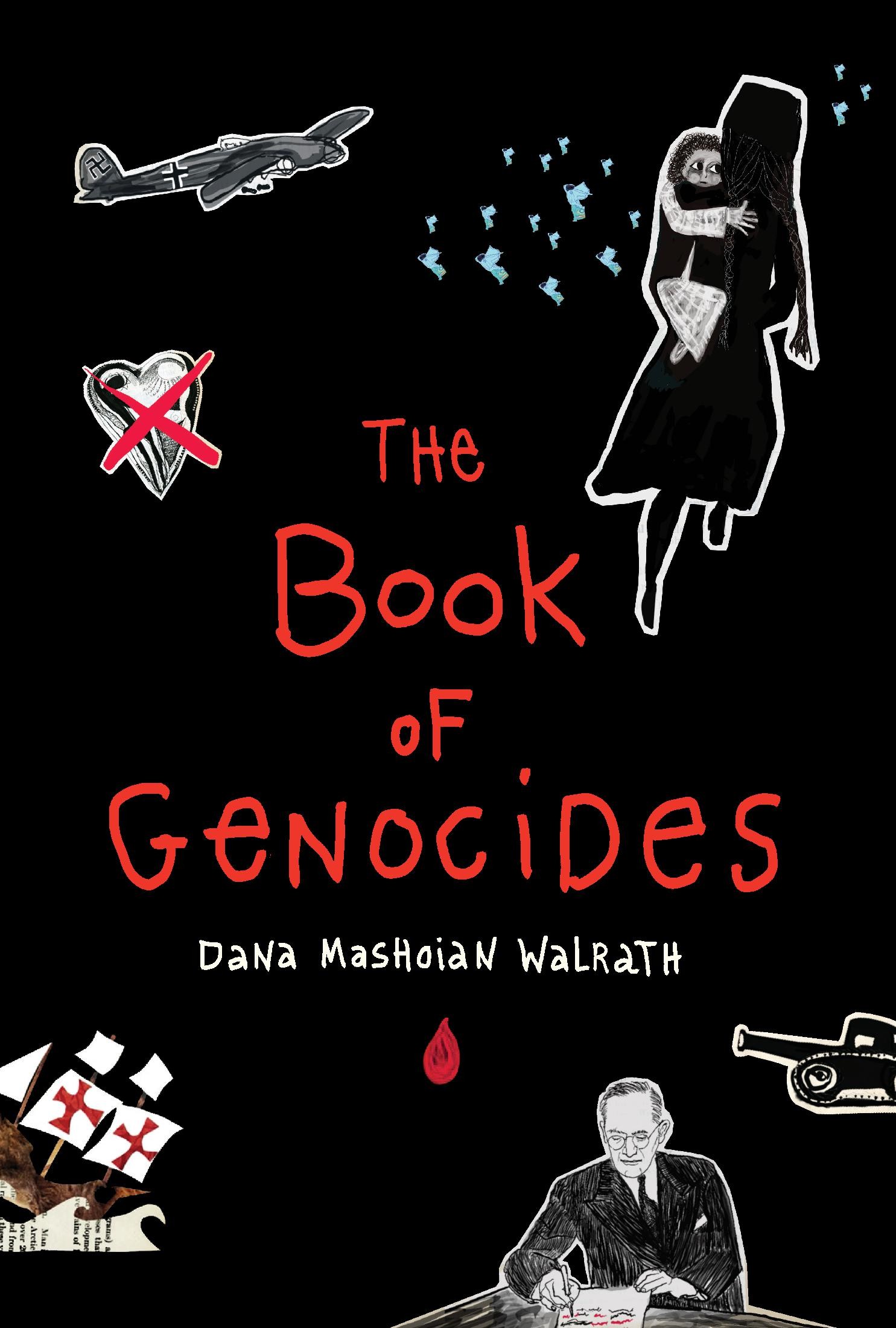
The Book of Genocides, cover.
Mashoian Walrath examines ten genocides: the Genocide of the First Peoples of the Americas; the Genocide of Black Americans; the Genocide of Aboriginal Australians and Torres Strait Islanders; the Armenian Genocide; the Genocide of Jews in the Holocaust; the Palestinian Genocide; the Cambodian Genocide; the Tutsi Genocide in Rwanda; the Bosnian Genocide; and the Rohingya Genocide. The author deliberately avoids splitting hairs over the precise definition of genocide. “These events were all terrible enough to be remembered as genocides, though I know historians will quibble,” she writes. In each case, the author also explicitly names the people who were targeted. Thus, she writes “The Genocide of Jews in the Holocaust” rather than simply “the Holocaust” and “The Tutsi Genocide in Rwanda,” rather than just “the Rwandan Genocide.” It is a small but significant distinction: the victims remain at the center of the story.
As an artist, writer, anthropologist, and granddaughter of genocide survivors, Mashoian Walrath uses her work to challenge cycles of violence. “I aim to offer readers a sense of connection across borders, histories, and identities,” she writes. “At its core, the book is a call to action—one that challenges the idea that human violence is inevitable.” Its unusual form presents the topic in ways that a traditional account could not. The author mixes line drawings, pencil sketches, and watercolors with collages of photographs and sepia-toned pages from a racist zoology textbook that belonged to her mother in the 1950s. The result is a dazzling amalgam of visual elements. The textbook itself becomes part of the argument: Walrath uses the language of zoology to demonstrate how easily human beings have historically been described as something less than human. To illustrate how “human beings can dehumanize each other,” she includes interactive sections: portraits can be cut into thirds and rearranged in a turn-the-flap book, causing their subjects to “transform back and forth between human, beast, predator, vermin, parasite.” The effect is deliberately disturbing.
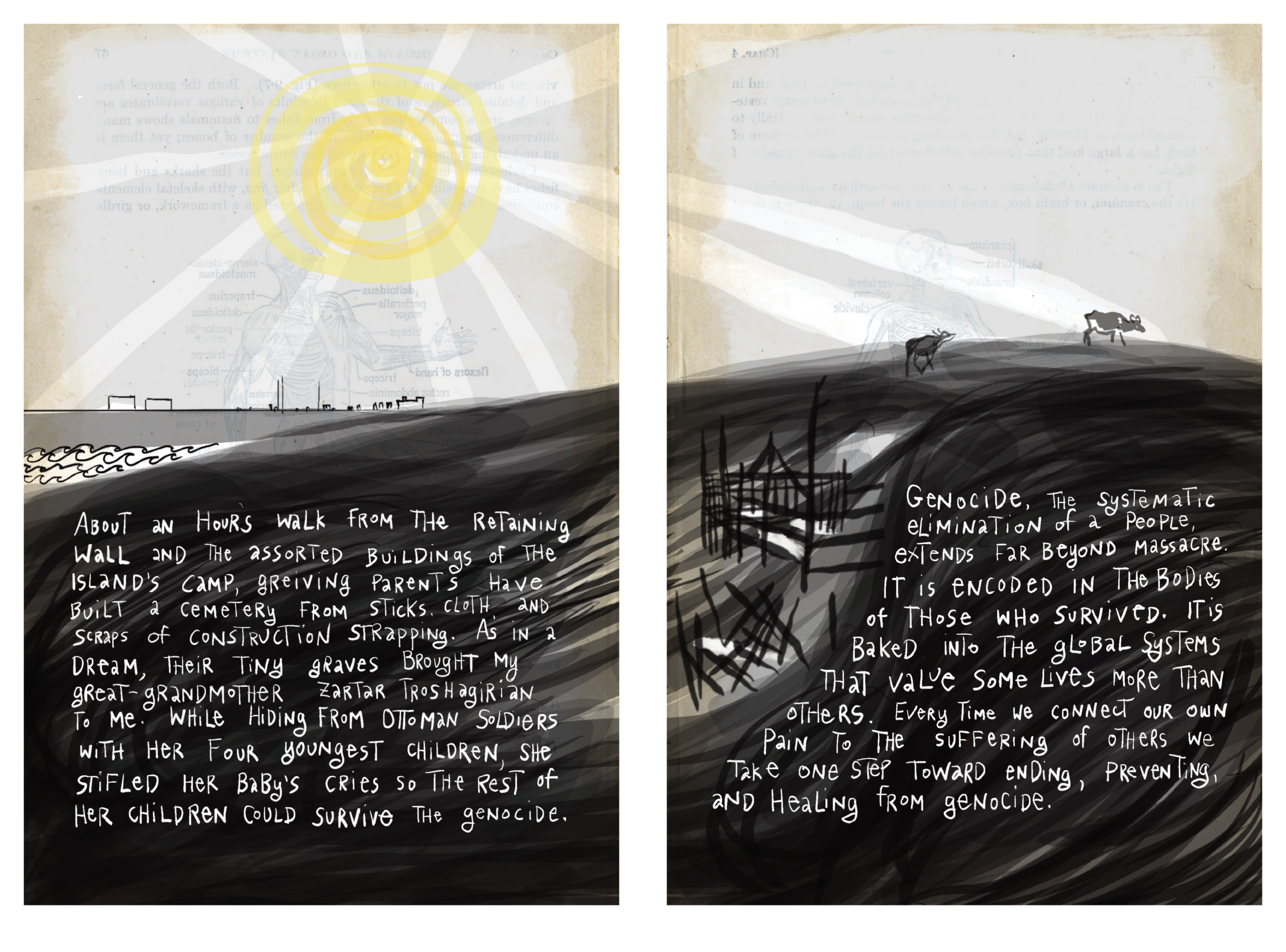
The Book of Genocides, spread, epilogue.
Walrath is a seasoned artist and author. Her award-winning works include Aliceheimer’s, a graphic memoir about her mother’s battle with dementia, and Like Water on Stone, a verse novel about the Armenian Genocide. A MacDowell Fellow and Atlantic Fellow, her various comics, art, and writing have appeared in The Nation, Slate, on NPR, and in anthologies such as Menopause: A Comic Treatment, a New York Times Best Book of 2020. In The Book of Genocides, Mashoian Walrath’s superb drawings and handwritten, calligraphic text explore the atrocities themselves as well as the political and social mechanisms that preceded them. The historical sections discuss, among other things, the Indian Allotment Act of 1887 and the Jim Crow laws, showing how legal and political structures helped make mass violence and oppression possible. She wants us to understand what happens before the killing begins: how language changes, how laws are constructed, how people are classified, separated, and dehumanized, and how political systems prepare the ground for catastrophe. Poems and illustrations make the history visceral rather than merely documentary.
In the section on the Palestinian Genocide, for example, she draws portraits of past Israeli leaders such as Yitzhak Rabin and Shimon Peres and identifies the pre-state paramilitary/ terrorist organizations they belonged to, including the Palmach, Lehi, and Haganah. She is also willing to draw connections that many Western publications have historically been reluctant to make, including between the broader history of the Armenian Genocide and the conflict with Azerbaijan and the ethnic cleansing of Artsakh.
In fact, the section on the Armenian Genocide is particularly powerful because it is so deeply intertwined with Mashoian Walrath’s own family history. She begins with a brief overview of the Ottoman Empire, including the jizya tax levied against Christians, as well as the clothing they were forced wear, which identified them as non-Muslims. She follows the decline of the Ottoman Empire, the rise of the Young Turks and the systematic campaign of extermination carried out by the paramilitary Teşkilat organizations. The author includes hand-drawn reproductions of New York Times front pages describing the killings and the deportations, including the death marches that drove Armenians through the Syrian desert. She then follows the story through the Treaty of Sèvres and into the history of modern Turkey.
For Walrath, this is family history: “The book grew out of the fragments I knew about my grandparents’ experiences during the Armenian Genocide,” she explains. “Long ago I kept noticing the same patterns, colonization, land theft, apartheid, political denial, reappearing across different histories. Now, as conflicts intensify around the world, understanding this history feels more urgent than ever.” Walrath is careful, however, to distinguish between governments and the ordinary people who live under them: “In 1984, I took a roots trip to what is now eastern Turkey,” she writes. “I felt a deep connection to my grandparents’ homeland … and a strong sense of continuity with the Kurds and Turks still living there in remote villages…Throughout the book, I try to offer readers that same sense of connection across borders, histories, and identities.”
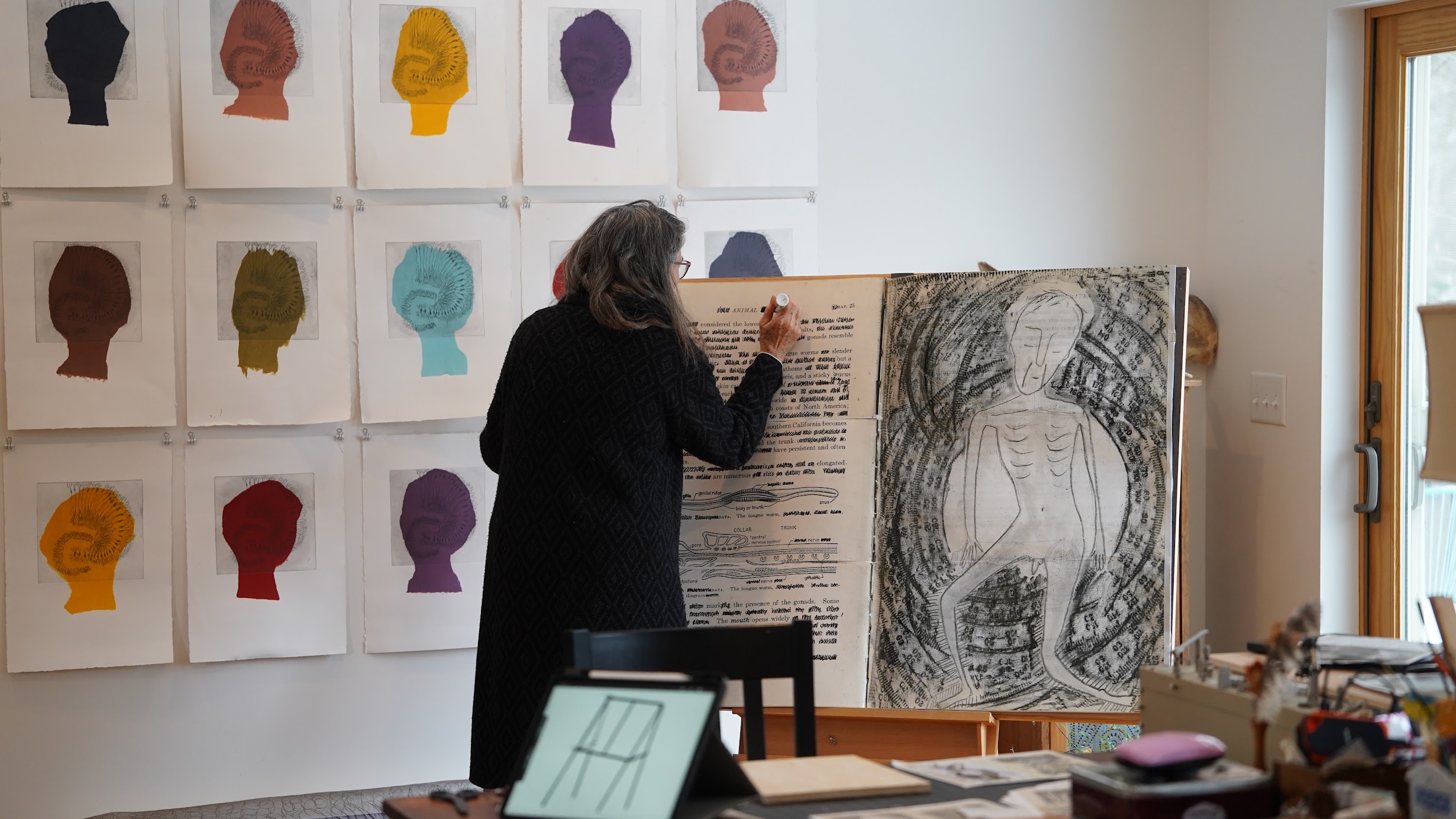
In each section of The Book of Genocides, the author draws over pages from her mother’s zoology textbook. She takes the horrifying language used to categorize and describe animals to draw parallels with the ways human beings have been categorized and dehumanized. Even the poems are constructed from the textbook: the author blacks out portions of the original text and uses the remaining words to create new meanings. A poem in the section on the Genocide of the First Peoples of the Americas is among the most powerful. It begins:
“Many migrate,
Four escape and emerge
To swim in the water,
they remain for a day or more,
Joined by other bodies
Squeeze through a small opening to lie free,
Divide
Blast, form a single cell
Enclosed small cavity. The cell, secret hell…”
The words, originally written as scientific description, become something altogether different when placed against the history of genocide. Walrath says she settled on the graphic format after discovering comics such as “Maus” and “Fun Home”: “Comics…enabled me to do what all writers are taught: to show and not tell. By visualizing how genocide happens repeatedly, I demonstrated how it follows set patterns, and that subconsciously builds bridges—comics take us out of a teaching role into an active understanding role.” Ultimately, she wants the reader to question their own thoughts and actions: “By actively turning the pages, the person looks at their own complicity: Have I ever called somebody a beast? Have I ever thought of someone as a parasite because they’re not contributing enough? The act of cutting through taught systems and structures is a form of liberation.”
Born in the United States, Mashoian Walrath made sure to include the genocides that took place in her home country: the destruction of Native American peoples and the genocide of Black Americans. The history of Black Americans begins with the Middle Passage and its enormous human cost, followed by slavery and the racial laws. She also describes the atrocities committed by Nazi Germany during the Holocaust in World War II that ultimately led Raphael Lemkin to coin the word “genocide,” from “genos” or race, in Greek and “cide,” or to kill, in Latin. Her inclusion of a fascinating “scorecard” drives home another of the book’s central points: comparative victimology—the attempt to rank genocides according to the number of people killed or the degree of cruelty involved—makes little moral sense. The numbers are obviously important to historians, but they shouldn’t determine whether or not we recognize an act as genocide.
Rather than an exercise in victimhood, Mashoian Walrath has used her family history as a bridge to other histories. That is both the book’s great strength and perhaps its greatest challenge: how to universalize our own suffering, to recognize that of others? Walrath believes that we can. Given the continuing debate over how genocide is remembered, represented, and understood, The Book of Genocides offers important new pathways of exploration. It asks whether remembering genocide differently might help us recognize the warning signs before it is too late. When asked what she hopes readers will take away from the book, she says: “That genocide is not inevitable. That it depends on human-made systems, structures, and beliefs. And because those are human-made, we can also undo them.” History gives us plenty of reasons to doubt this assertion. But in the end, that is perhaps precisely why the argument is worth making.