
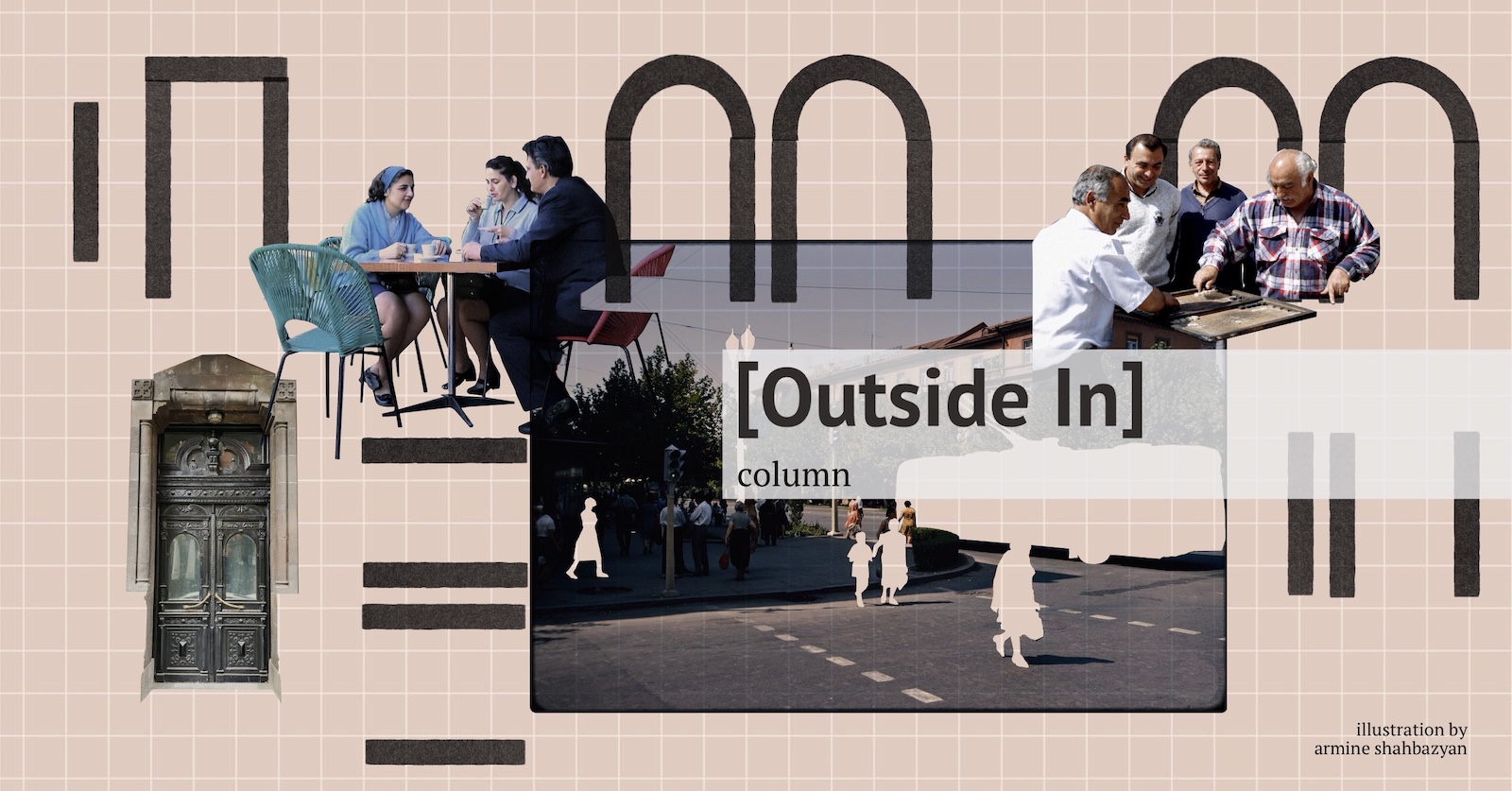
Visiting one post-Soviet state, you can then recognize it in all others – the similar patterns of urban planning and the identical buildings, structures, roads, pipes, wires, tiles, etc. However, an outsider delving inside under the extreme familiarity of the material environment finds an extreme “strangeness” of social interactions and practices. The “Outside In” series is about emplaced paradoxes and nuances. It spotlights the mundane in Armenia’s peripheral locations, where the seemingly unspectacular encounters with people and things allowing us to capture the unique features of the territory.
Listen to the article.
Outside In
Essay 31
We step and do not step into the same rivers; we are and are not.
Heraclitus, Fragment B49a, trans. T. M. Robinson
Remembrance of a particular form is but regret for a particular moment; and houses, roads,
avenues are as fugitive, alas, as the years.
Marcel Proust, “Swann’s Way”, trans. C. K. Scott Moncrieff
Try writing the word door on a sheet of paper. Then write it again, and again. Somewhere around the thirtieth repetition, most people report a change; the word stops being a word. It becomes a string of shapes, an arbitrary arrangement of lines that could just as easily mean nothing at all. The psychologist Chris Moulin and his colleagues ran exactly this experiment and received, in 2023, an Ig Nobel Prize for it.
This research that seems silly at first opens up to larger questions of human experience. What the scientists had induced in the laboratory has a name —jamais vu—never seen. You might have heard of déjà vu, the false alarm of having seen or heard something before. Jamais vu is déjà vu’s lesser-known alter ego, a sensation that something you know perfectly well has suddenly become foreign or alienated. While déjà vu is the mind mistaking the new for the familiar, jamais vu is the mind mistaking the familiar for the new. Both are, in the clinical sense, errors. Yet sometimes I feel that jamais vu is an accurate reading of the ever-changing world around us.
It happened to me this summer while crossing one of Yerevan’s courtyards I have walked hundreds of times before. I walked past a building with a café where I used to go for dinners. It was exactly the same apartment building of pink tuff with closed off balconies and lines of laundry outside. The door to the café was there too, but the café was not. In its place was something with a different name, different atmosphere, and a different crowd. I stopped and stood there for a moment, the way I might have stood in a room I have entered and forgotten why. The courtyard had not changed very much. It had just stopped being mine—like a lover with whom you parted ways, encountered by chance years later on the other side of a crowded room. The same face, the same gestures, the same way of tilting the head while listening, and yet none of it is addressed to you anymore.
A City Rewriting Itself
One could argue that every city gives an opportunity to experience jamais vu. Look at Yerevan. The city most visitors walk through today is largely a twentieth-century creation drawn over the top of Persian-era Erivan – its fortress, bazaars, mosques, and low flat-roofed houses. Someone who knew Erivan in 1850 and returned in 1950 would not have recognized it at all.
The rewriting never stopped; it only changed hands. In the 2000s, Northern Avenue was cut through three closely knit old neighbourhoods, some of whose houses were registered heritage sites. Families who had lived there for generations were forced out under eminent domain, a mechanism meant to serve the public interest that, in this case, handed the land to private developers. Compensation was often meagre or never properly paid. Where courtyards once stood, there is now a pedestrian boulevard of polished stone and luxury boutiques. The covered market on Mashtots, Pak Shuka, with its Soviet-era arched façade and its pyramids of dried fruit and spices, was sold, gutted, and reopened as a supermarket. Only its façade was kept, like a mask on a different face. More recently, Firdusi, a stone’s throw from Republic Square, has suffered a similar fate. What has come down there is not merely a cluster of low-rise houses but the entirety of urban fabric where people, too, had lived for generations. My friends who grew up in Yerevan list these places the way one lists dead relatives. With time, the drama of loss has faded; what remains in their words is a certain deliberate precision, as if getting the names right were the last remaining duty.
I arrived too late for those changes. I know Pak Shuka only as a supermarket with a misleadingly grand façade and Northern Avenue as a convenient shortcut from Abovyan Street to the Opera that I use without ever really wondering about its past. For me, these are not jamais vu at all, they are merely vu – seen as it is. The strangeness belongs to those who knew the earlier version. To experience jamais vu there needs to be a prior familiarity. You cannot be estranged from a place you never knew. My own estrangements in Yerevan are smaller and more recent. And, I realize, mostly they are not about buildings.
The Ship of Theseus
In 2022, Yerevan acquired a new layer almost overnight. Tens of thousands of people like me arrived from countries affected by the Russia-Ukraine war with laptops, children, pets, and a vague sense of how long we might stay. New places opened to cater to this population: co-working spaces, bars and cafés with ironic names, lecture and poetry reading venues, a whole parallel infrastructure of exile assembled at remarkable speed.
Then, gradually, this Yerevan began to thin. Some went on to Tbilisi, Belgrade, Lisbon, Berlin. Some went back to where they came from. Farewell dinners became a genre of the time, with their own rituals – toasts to “the next city”, distribution of houseplants and kitchen equipment among those still staying, promises to visit that everyone understood was a sign of kindness rather than an actual plan. Some departures were a small pinch, others I grieve till today, but all of them took a piece of me elsewhere. The places that had opened en masse closed at a similar speed as the population that sustained them was not there anymore. My preferred dinner café in the courtyard was one of them.
Of course, Armenia has a much longer history of coming and leaving. The wave of Russian-speaking migrants is all but a footnote to it. Since independence, the country has lost a substantial share of its population to emigration – to Russia, to Europe, to the United States. In September 2023, the direction reversed with brutal speed. More than a hundred thousand people from Artsakh arrived in Armenia within days, carrying with them cities and villages they cannot return to even to be estranged from it. Their Stepanakert remains fixed at the moment of departure, preserved precisely because no one can walk back in and find it altered (at least not in the foreseeable future). Yet part of Artsakh came along—in zhingyalov hats sold from new bakeries, in accents overheard at bus stops—a reminder that what makes a city familiar or strange is less the stones it is built of than the people one shares it with.
Seeing the city through the lens of jamais vu is experiencing it as a configuration of routines and people; a barista who knew your order, a shop attendant who enquired about the health of your family, a friend who was always late to the same bar. When the configuration dissolves, the materiality can remain perfectly intact and still become unreadable, like the word door on the thirtieth line.
So, when does a changed thing become a strange one? Places change all the time, and most of it we absorb without much thinking: a new shop sign, a relaid pavement, a tree cut down. Ancient philosopher Plutarch wrote of the ship on which Theseus returned to Athens. The Athenians preserved it for centuries by replacing its rotting planks one by one, until people began to argue whether it was still the same ship at all. Cities are in some sense like Theseus’s ship. They move on under the same name while being rebuilt plank by plank, stone by stone. I think the threshold is crossed not when the last original plank is removed, but when the last person who could confirm the memory of it is gone. As long as someone can say yes, the counter was there, and we sat by the window, a place is altered but still lives. When no one is left to say it, the memory loses its witnesses and stories become myths. Like the word on the page, the turn to strangeness never announces itself. There is no single repetition at which the door collapses. You only notice afterwards that it has.
Someone Else’s First Time
Last week, passing by the fenced-off and prepared-to-be-deconstructed Post Office building on Saryan Street, I went back to the courtyard café. This time I went in. It was lunchtime, and the new place was full. Two women at the window were laughing about something on a phone. A young man was preoccupied with reading a paper book while waiting for his order. I am not sure whether they knew what was here before, and there was no reason why they should. My jamais vu was their vu – their beginning of a familiarity that will one day, when this place closes too, become their estrangement. Perhaps this is the only consolation I can offer. Yerevan is not becoming strange. It is becoming someone else’s familiar.
I ordered a pot of jasmine tea, sat at a table that had never been mine, and began relearning.
See all [Outside In] articles here
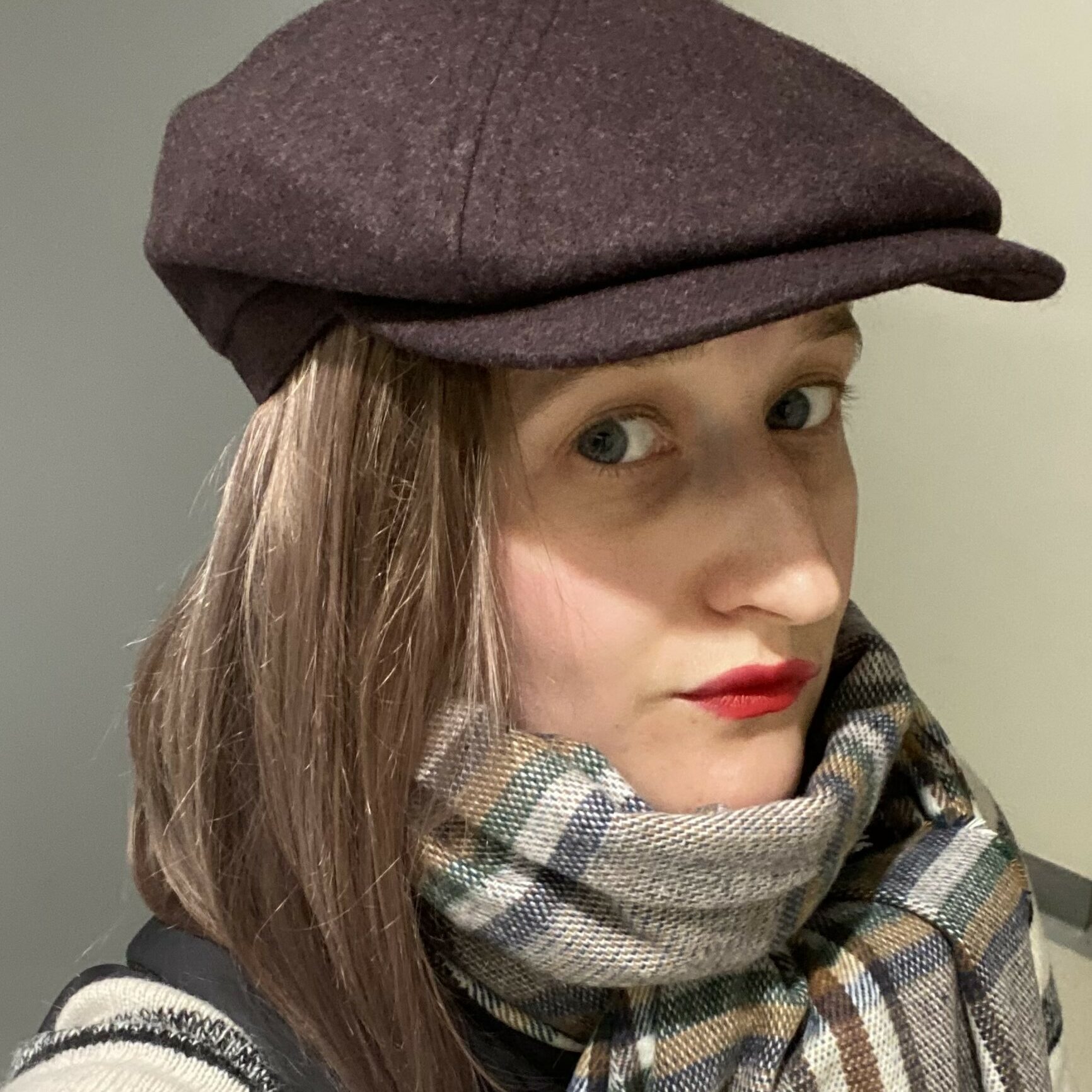
Maria Gunko is a DPhil Candidate in Migration Studies, Hill Foundation Scholar at the School of Anthropology and Museum Ethnography University of Oxford. Since 2023, she has joined Yerevan State University as a Visiting Professor. Maria holds an MSc and Kandidat Nauk (Russian post-graduate degree) in Human Geography.
Maria’s research interests lie in the intersection of urban studies and social anthropology, including ethnography of the state, infrastructures, and urban decay with a geographical focus on Eastern Europe and the Southern Caucasus. She is the co-editor of one monograph, author of over thirty scientific articles and op-eds.