
Listen to the AI generated audio article.
A humorous, passionate scientist with his white hair tied in a ponytail sits at a screen, navigating Stellarium, an open-source sky map for astronomers. Aleksey Grave, maintenance engineer and head of the Observational Astronomy Department, is locating his target. He turns to another table and enters the coordinates. With an old-fashioned interface, the software automatically steers a structure beyond the walls of the room.
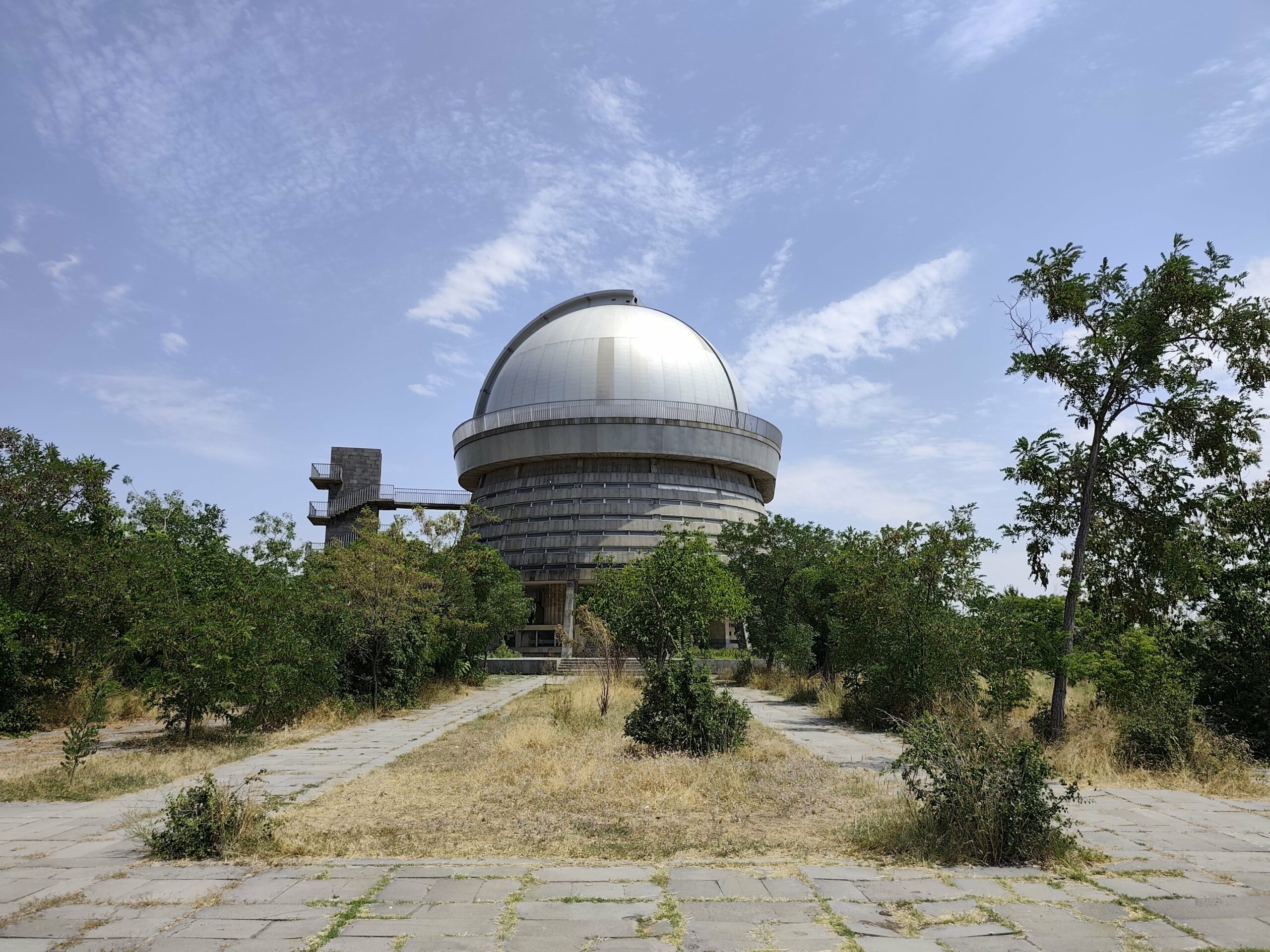
The “two-point-six” as they call it at the Byurakan Astrophysical Observatory (BAO), is a 100-ton telescope, 2.6 meters in diameter and roughly ten meters long. It is the largest observational instrument at the observatory. The gargantuan instrument sits beneath a modular dome atop a concrete Soviet-era building. Motors, counterweights and vibration-dampening systems built into the structure keep the telescope steady as it turns toward the sky.
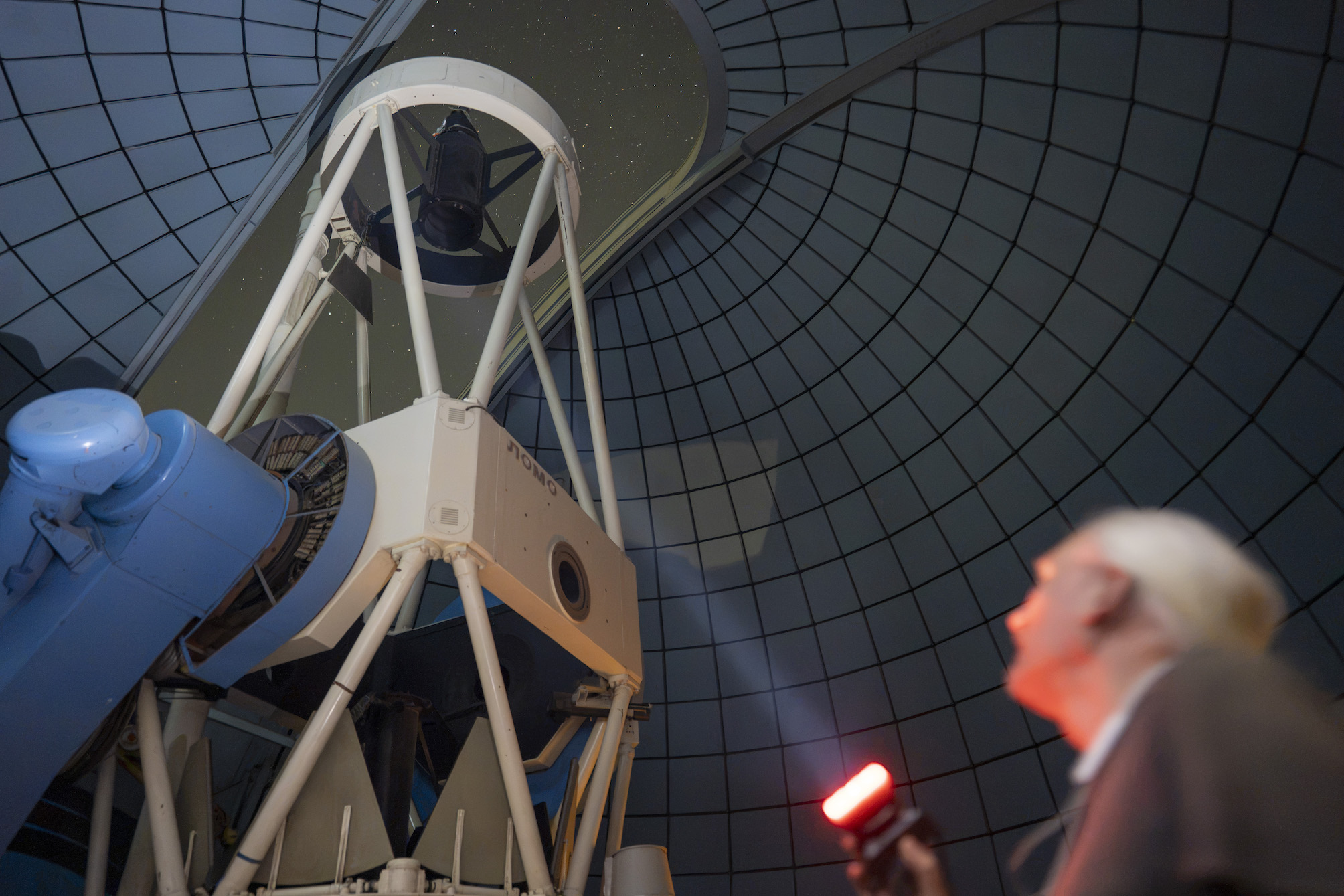
Aleksey in front of the “two-point-six”.
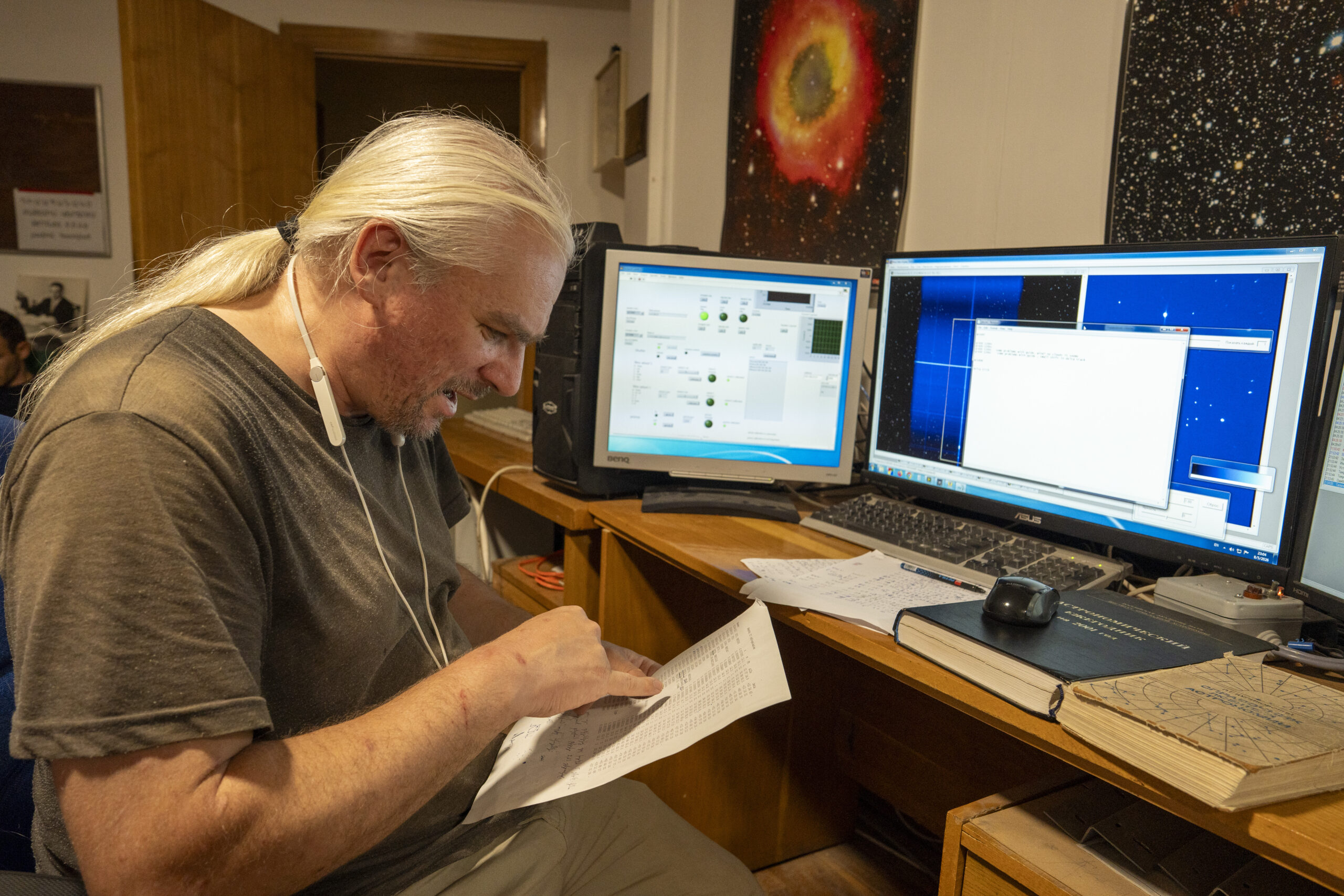
Aleksey in the control room.
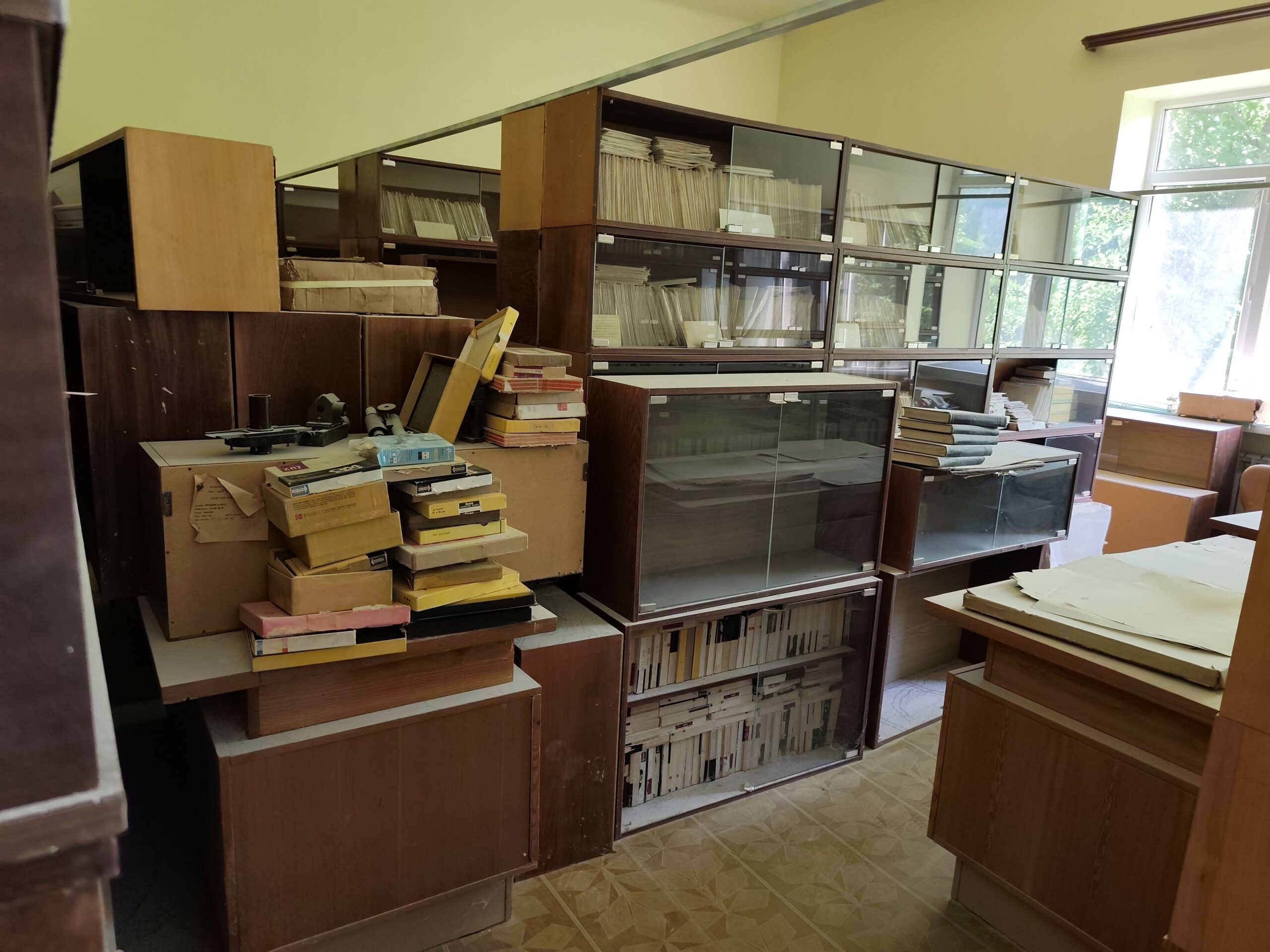
The Markarian Survey’s physical archive.
Aleksey is targeting Mrk 898, an object identified in the historic Markarian Survey. Conducted by Beniamin Markarian and his colleagues at the Byurakan Astrophysical Observatory between 1965 and 1980, the survey remains BAO’s greatest scientific legacy. Using the observatory’s 1-meter Schmidt telescope fitted with a special prism, the astronomers captured the light spectra of millions of objects across a vast area of the sky. It was the first systematic survey of its kind and remains the largest objective-prism survey ever conducted, covering some 17,000 square degrees. UNESCO recognized the archive in 2011 by including the First Byurakan Survey in its Memory of the World International Register, which preserves documentary heritage of global significance.
Aleksey’s work builds on the Markarian Survey: he draws on its observations to generate new data about known objects using more sophisticated systems. It’s like photographing something captured on old photographic film with a digital camera: the resolution improves, while digital technology allows analysis and post-processing that were previously impossible.
Among the objects Markarian identified were more than 1,500 UV-excess galaxies. To understand what these galaxies are, imagine a large toilet that is constantly draining. The drain represents the black hole at the center of the galaxy. As matter spirals toward the black hole, it is stretched, and torn apart by the enormous gravitational forces, a process known as spaghettification. Imagine a piece of toilet paper lying flat before being pulled toward the drain. As it spirals inward, it stretches, twists and eventually breaks apart.
Scale up the toilet paper to the size of a star. The extreme forces can heat the material to enormous temperatures, causing it to emit intense light. Markarian categorized these galaxies, which are extremely bright in ultraviolet light because of their hyperactive black holes; hence the name “UV-excess galaxies.” Astronomers study them to learn what the universe was like in its cosmological infancy when this activity was typical of newborn galaxies.
While these processes unfold far away in the universe, Aleksey begins a new observation run inside the two-point-six control room. It’s a lengthy process. The dome must open two hours in advance to let the temperature stabilize: even a millimeter of thermal deformation can translate into a deviation of billions of kilometers when observing objects at immense distances. Acquiring data for Mrk 898 takes an hour or more. So, over the course of a night, even a productive scientist can make only a handful of observations.
The problem at BAO today is that what Aleksey does, reobserving known objects with modern equipment, is not part of an institutionalized program. Officially, his duties are to organize scientists’ observations and maintain the telescopes. His passion drives him to record and store new data.
“Now there is no specific program,” Aleksey says. “So, I can do whatever I want. And at least I have this list.”
This is emblematic of BAO’s current position: its best instrument, the two-point-six, dates to 1975. It was the world’s seventh-largest telescope at the time. Today, according to BAO director Dr. Areg Mickaelian, it ranks 48th. It is also barely used.
During the Soviet era, when operating at full capacity, BAO pushed the boundaries of knowledge. Markarian captured nearly 2,000 sections of the sky on physical photographic plates measuring 16 x 16 centimeters. Each plate contained 15,000 to 20,000 objects, each appearing as a smear on glass. He screened them all by hand; his life’s work had a global impact.
Today, BAO’s activity and scientific impact are very different.
A Legacy Written in the Stars
BAO marked its 80th anniversary in September 2026 with an international symposium. Founded in 1946 by Viktor Ambartsumian, regarded as the father of modern astrophysics in the Soviet Union, the observatory was established on the southern slope of Mount Aragats to investigate the mysteries of the universe. Ambartsumian selected the site, at an altitude of 1,400 meters, for its clean air, minimal cloud cover, and lack of light pollution. He couldn’t have imagined how much the environment would change over the next eight decades: according to Aleksey, the number of clear days has fallen from 150 per year to 75.
The observatory officially opened in 1956. Its facilities, including telescope towers, laboratory buildings, central offices, a conference hall, and a guest house, are nestled in a protected park that is home to more than 140 plant species.
BAO is a place where Ambartsumian’s aura still lingers. The house he died in 1996 sits within the observatory’s grounds. From the bedroom, a balcony opens onto a spectacular view. Beyond an orchard, the building housing the Schmidt telescope used for the Markarian Survey stands in the foreground, with the Arax River Valley and Mount Ararat beyond. But this is only the outer shell of Ambartsumian’s presence.
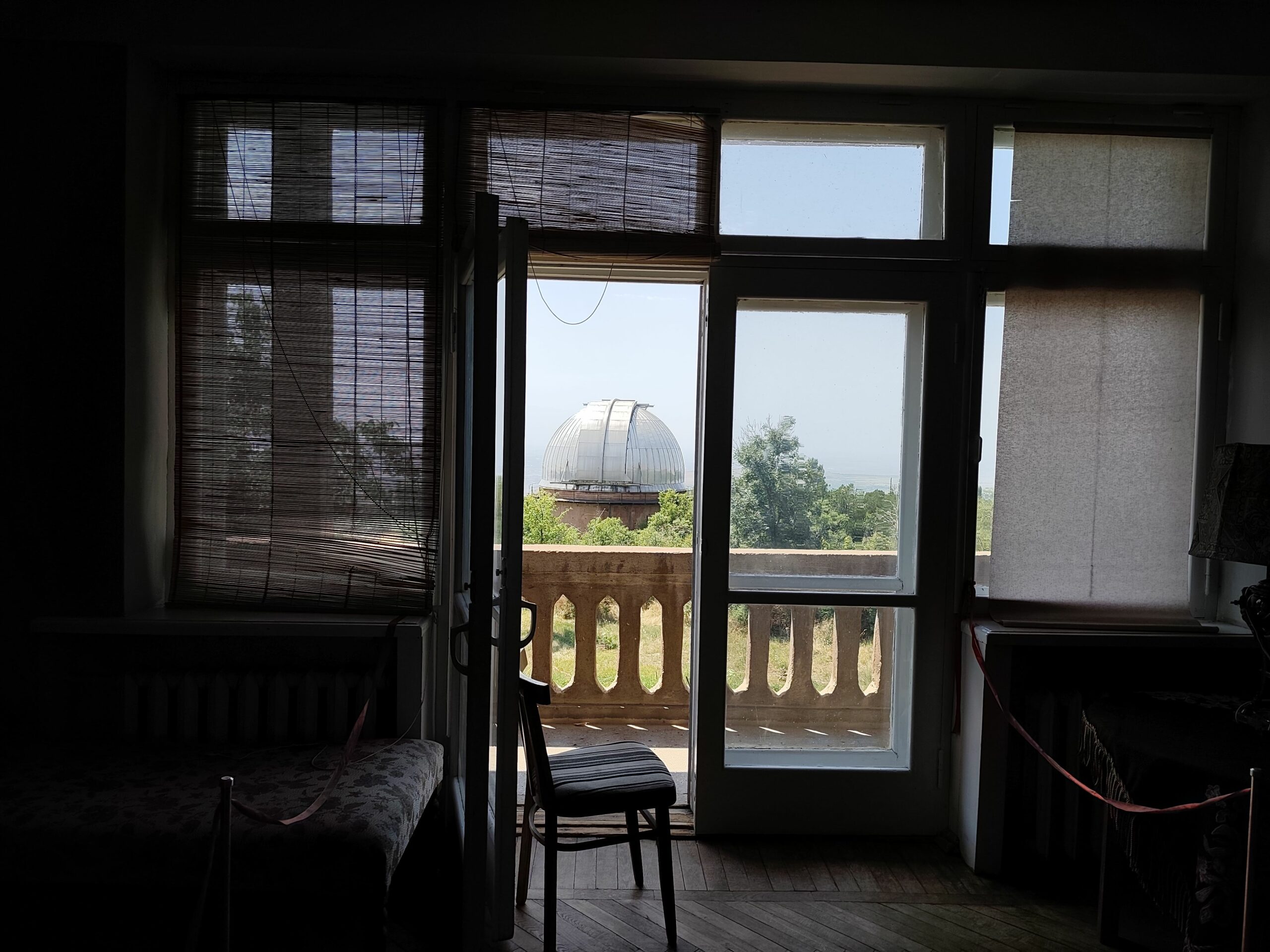
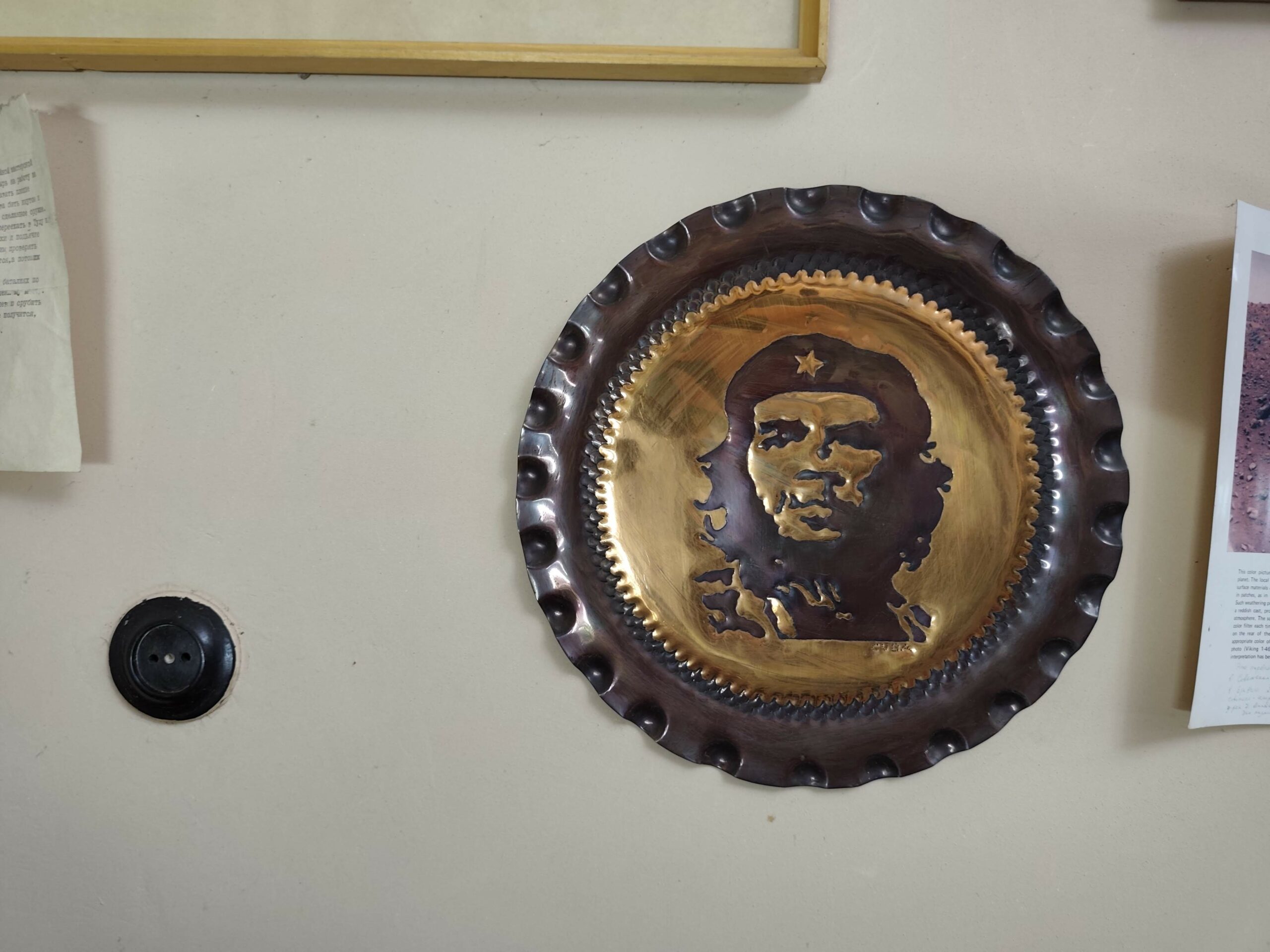
The view from Ambartsumian’s house and Che Guevara’s plate.
Among the house’s original ornaments is a plate hanging on the wall, a portrait of Che Guevara. The plate was a gift from Georgia’s astrophysics community, where Ambartsumian was born. Its inscription reads: “Che did the revolution on earth. Ambartsumian did the revolution in the sky.” Before Ambartsumian’s theoretical contributions, the universe was considered dead, an entity frozen after the Big Bang. Ambartsumian challenged this paradigm, providing evidence that stars are still being born and that celestial objects exhibit active processes. He theorized, for example, the existence of UV-excess galaxies, later proven true.
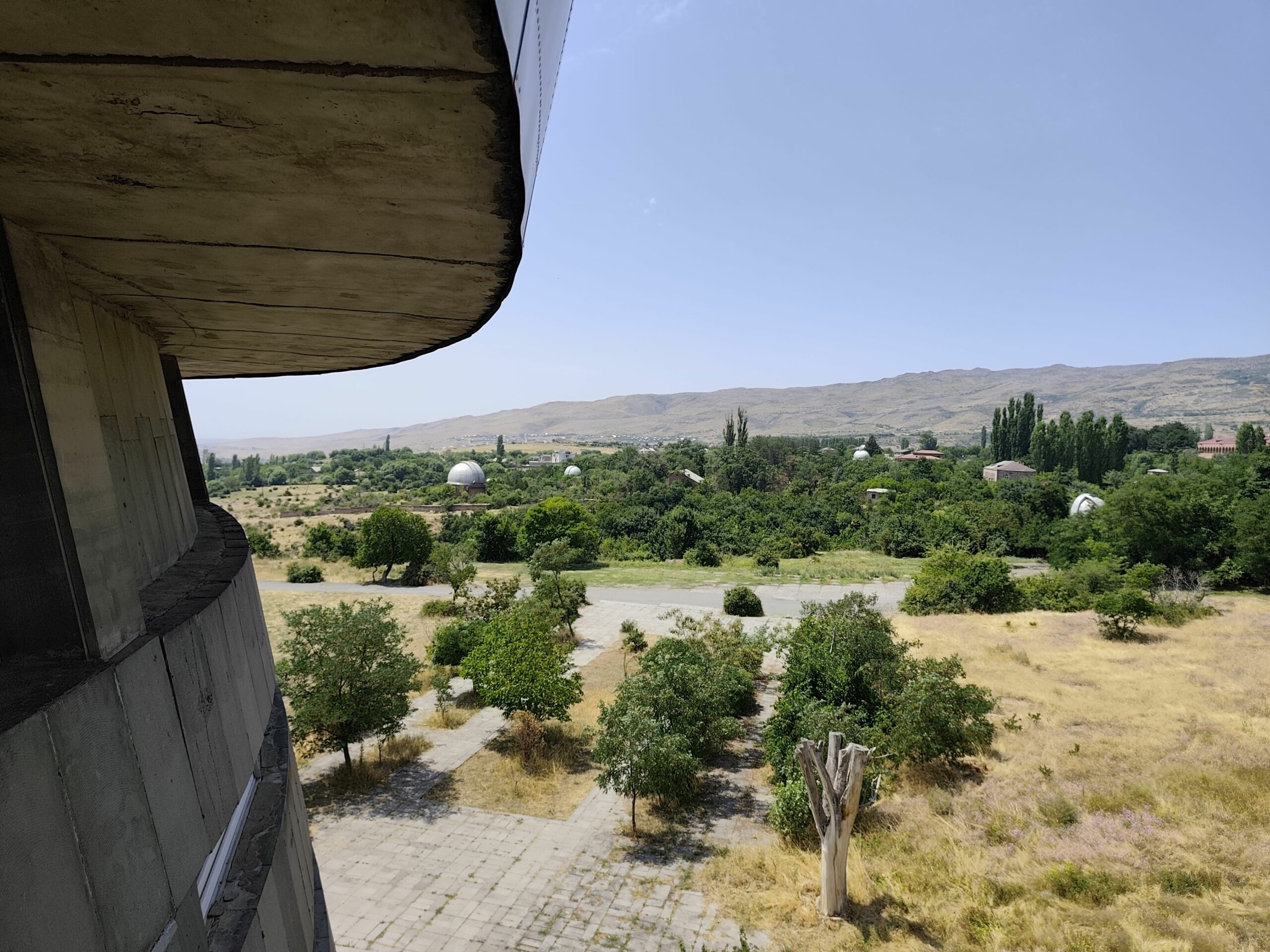
BAO and the protected park, viewed from the tourist entrance of the two-point-six building.
This flurry of activity took place during BAO’s Soviet-era peak, when the institute operated on a much larger scale than it does today. Mickaelian says it had 300 personnel, including approximately 120 scientists.
During the Cold War, when diplomatic relations between the USSR and the United States were strained, science was one of the few fields where cooperation remained possible. BAO became an important hub for such exchanges. In September 1971, the observatory hosted the first Soviet-American conference on Communication with Extraterrestrial Intelligence (CETI), providing a rare meeting point for scientists from both sides.
High-profile visitors, including Nobel laureates, attended the conference and returned to BAO in the years that followed. Then came the “cold and dark” years of the 1990s, when newly independent Armenia was gripped by economic devastation and energy shortages. BAO, too, operated with virtually no funding, forcing it to shut down most of its infrastructure. Many employees could no longer come to work, but a small group of scientists stayed.
“I call them heroes,” Mickaelian says, reflecting on their deduction. “And maybe all scientists who survived in our conditions are.”
The institute survived in part because of them. In 2013, the Armenian government formally designated the observatory a site of “National Value.” This is the highest level of state recognition and protection available for cultural and scientific assets; only the Matenadaran and the Armenian Genocide Museum-Institute share this status.
From Global Hub to Struggling Institution
Today, BAO operates under significant material and financial constraints compared with its historical peak. The observatory’s annual funding is less than one million euros; at least 20 times less than what Mickaelian says is needed to run the entire infrastructure. This has also affected staffing. The number of scientists has fallen to 40, and total staff to 100. Despite these hardships, Mickaelian notes that BAO has fared better than other institutes. While Armenia’s scientific community has shrunk by a factor of seven, BAO’s has declined by a factor of three.
The observatory has 12 telescopes, but only four are currently in use. Two of these active instruments are dedicated to scientific research—the two-point-six and the one-meter Schmidt. The other two are used for night excursions and tourism. The remaining eight are dedicated to student projects and are not used by scientists for research.
Daily operations reflect these resource limitations. According to Aleksey, “not many” scientists use the two-point-six. He cites several reasons, including a lack of logistical support. Part of his role is organizing and coordinating staff observations, but he says there are major hiccups in maintaining a steady stream of newly generated data. The uncomfortable night shifts and low pay further discourage scientists.
Dr. Kamo Gigoyan, senior research associate at BAO, confirms Aleksey’s account. He’s been conducting observations since 1984, but in 2026 he conducted only “a few.” According to Gigoyan, organizational problems began in 2018, when institutional restructuring was introduced to improve efficiency. Although the technical issues were resolved thanks to Aleksey’s expertise, the main problem is a lack of knowledge and knowledge transfer. No one is passing on to the new generations the knowledge needed to operate the telescopes.
But the problem is bidirectional. Gigoyan openly admits that he refuses to work with local students who have completed the master’s degree in astrophysics offered by the Department of Physics at Yerevan State University: “I don’t have enough technical possibilities,” he stresses, so he cannot train them properly. He calls for increased public funding to launch a new course at BAO.
Finding New Ways to Stay Relevant
That’s why BAO has to act strategically. The institute converts its prestige and scientific heritage into international opportunities, sustaining its global relevance despite resource limitations. The best example is the digitalization of the Markarian Survey, carried out in collaboration with Cornell University and Università La Sapienza.
Mickaelian links BAO’s prestige to its past achievements, saying that “everything was due to the Markarian Survey.” Thanks to the survey, Armenia secured a place among the only 20 countries in the world that are part of the International Virtual Observatories Alliance, a consortium that facilitates access to data gathered by institutes in member states.
Astronomy’s highly collaborative environment helps keep BAO’s scientific activity alive. As a rule, new data must be made public after one year. Combined with the Virtual Observatory Alliance, this norm helps compensate for gaps in BAO’s operations: Dr. Gigoyan’s French colleagues help him analyze data from Gaia, one of the European Space Agency’s publicly available observation missions. “For me, getting new results is very important,” he says.
BAO’s legacy also supports its geopolitical and scientific leadership in the region, a role Mickaelian discusses with pride. In 2015, the International Astronomical Union (IAU) established a coordinating office at the institute, positioning BAO as the leading astronomical center for Southwest and Central Asia. This scientific diplomacy continues independently of broader political tensions. Turkey joined the coordinating office in 2017.
“This year I was invited to Istanbul University for a seminar,” Mickaelian says, noting that Turkish astronomers are eager to collaborate. BAO also maintains “very nice relations” and official agreements with Georgia and Iran, as well as active collaborations with Russian students and researchers. Azerbaijan remains the exception: its scientists do not maintain contact with BAO, though Mickaelian asserts that “Azerbaijani astronomy is not so strong… So we don’t lose much.”
In summary, it would be unfair to describe BAO as a paralyzed institution that merely guards its glorious past. It remains prestigious, but it can no longer produce milestones or breakthroughs on the scale of the Markarian Survey.
Today, the astronomy community has telescopes as large as 11.9 meters in diameter, far beyond what BAO can observe with its two-point-six telescope. State-of-the art projects are building a telescope 40 meters in diameter. BAO’s opportunity lies in incremental science: focusing on a well-established niche such as the Markarian Survey and using digitalization to characterize it more fully.
Innovation, then, comes not from new theories or revolutionary discoveries, but from new methods of observation and astronomy’s highly collaborative environment. Together, these strengths allow BAO to endure with dignity among financial difficulties and a difficult, long-overdue internal reorganization.