
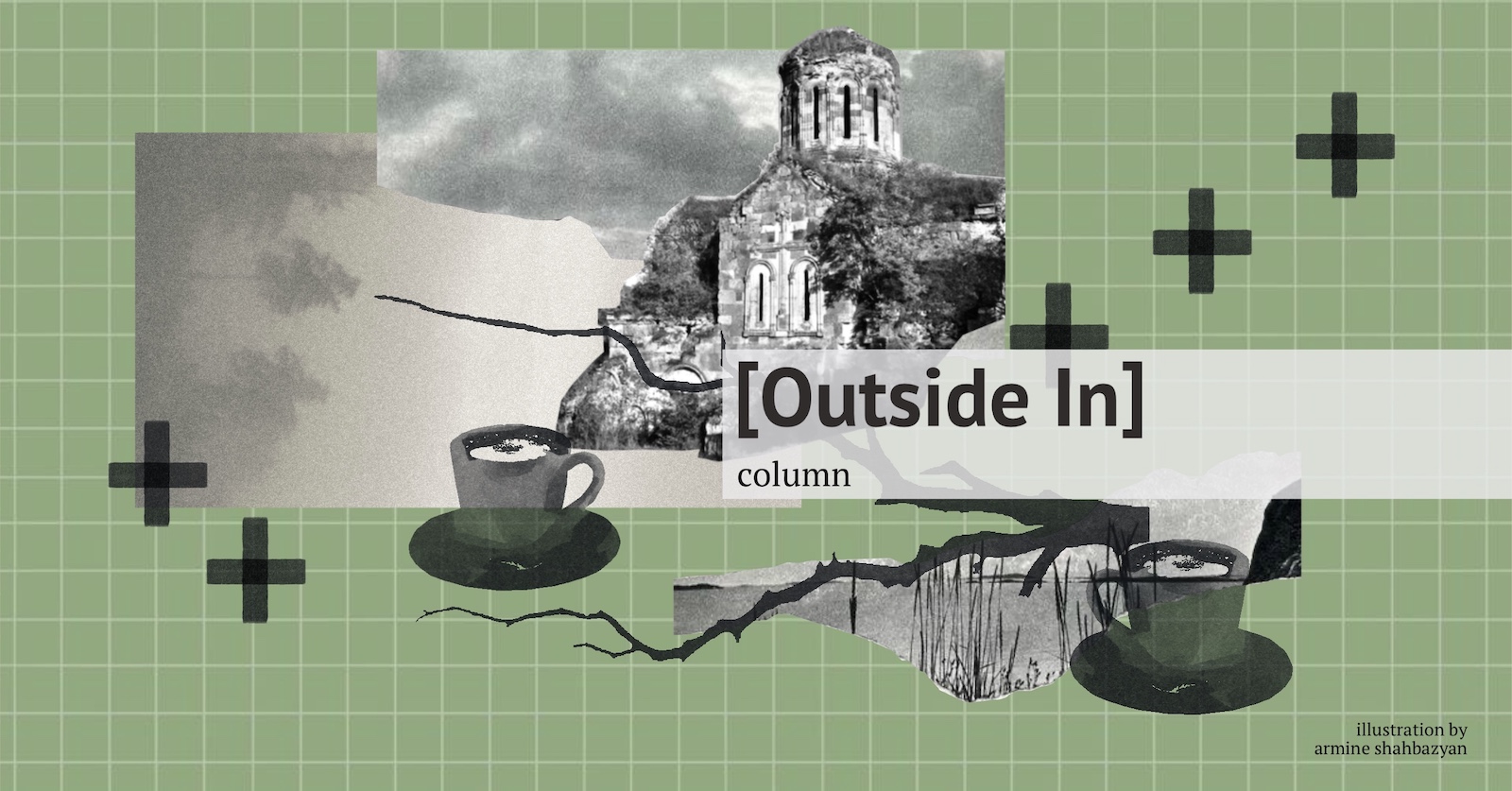
Visiting one post-Soviet state, you can then recognize it in all others – the similar patterns of urban planning and the identical buildings, structures, roads, pipes, wires, tiles, etc. However, an outsider delving inside under the extreme familiarity of the material environment finds an extreme “strangeness” of social interactions and practices. The “Outside In” series is about emplaced paradoxes and nuances. It spotlights the mundane in Armenia’s peripheral locations, where the seemingly unspectacular encounters with people and things allowing us to capture the unique features of the territory.
Outside In
Essay 32
Listen to the AI generated audio article.
Apparently, a good deal of my recent writing has been preoccupied with borders: closed, sealed, mined, invisible, and occasionally marked by a ditch. Being so sure of myself, I have even mocked people who were caught off guard by their presence. But knowing where a border is and knowing where it begins to matter have turned out to be two very different kinds of knowledge. The joke, this time, was on me. And laughing at oneself, I think, is one of the best ways to stay in touch with reality.
Khuchap Monastery (or Khujabi, as it is known in Georgian) is a 12th-13th-century complex dedicated to Our Lady of Iviron, and has been on my to-visit list for a while. It comprises a tetraconch church and several other buildings in varying states of ruin. Judging by the photos, trees and vines have long taken the structure over, wrapping the stones so tightly that the place looks less like a Christian monastery than a temple swallowed by a tropical jungle. Georgian sources tend to place it in Marneuli Municipality, while Armenian ones place it in Lori. A medieval church complex in a borderland claimed by two maps simultaneously. In retrospect, this could have been taken as a warning.
Perhaps it was my assumption that the Armenia-Georgia border was the friendliest of all Armenian borders that made me overlook the fact that this kind of visit still required a border pass, arranged in advance. Having driven to dozens of remote monasteries in Armenia without anyone ever asking why, I did not expect this one to be any different. In preparation for the visit, we took only a thermos of tea and our passports, grabbed at the last moment, which turned out to be the wisest decision of that day.
Choosing the Right Weather
Any serious attempt at an unauthorized visit to a border zone should be made in fog. Ours descended early and did not lift. It was dense and milky, swallowing the road some five meters ahead of the car. The forests on both sides disappeared, then the road signs, then any sense of direction. If there was a border somewhere nearby, we certainly could not see it, which is not an unusual condition of borders. Many of them are invisible until someone tells you otherwise.
And then the checkpoint emerged from the white: a striped barrier and a small building that must have been erected as a temporary structure and has remained so ever since. At first, there was not a soul around, and then, suddenly, several armed young men in uniform began walking slowly toward the car. The only thing missing was ominous music, though the fog did a good job compensating for it. The exchange that followed was short:
Border guard: Are you going to Khuchap Monastery?
Me: Yes.
Border guard: Can I see your documents – passport and pass?
Me: What pass?
The border guard looked at us with the face of someone who has had this conversation many times before and will have many times again. Our passports were taken into the small building; we stayed in the car.
Coffee Pause
Identity verification at a border checkpoint takes time. Somebody has to call somebody, who has to check something in a database, which on a foggy Sunday may or may not be reachable. I was prepared to spend this time in the car, rehearsing explanations. Instead, some ten minutes later, one of the border guards, who seemed to be the one with the most authority, came back and, slightly embarrassed, invited us inside. It was cold, he said, and there was coffee.
Inside, there was indeed coffee, and there was also the person who, as it became obvious within seconds, was the real commander of the post. Let us call her Tikin Sona (Tikin for Mrs in Armenian). She was the cook—a voluminous woman in every sense of the word, in body, in voice, and in the way she occupied the small kitchen and everyone in it. The first thing she asked was whether we had eaten. Before we could answer, the table had Armenian coffee in small cups, a plate of sweets, and an instruction to sit down that was not open for discussion. The border guards, now without their rifles, sat down as well. They clearly knew better than to argue with her.
What followed was a Q&A session: Where are we from? What are we doing in Armenia? Why go to Khuchap in this weather? We told them about our work and our trips around Armenia. They told us about the fog, about life at the post, about other tourists who arrive just like us, convinced that a church on the map is a church you can drive to. Tikin Sona told us about her family and asked, with genuine professional interest, whether we were married. The young commander who invited us in smiled and refilled our cups.
At no point was there any hostility. Not a raised voice, not a suspicious look, not a single question that felt like an official interrogation. There was, instead, apology. The border guards apologized for the wait. They apologized for the procedure. They apologized for the rules, which they had not written, and for the database, which was slow. They apologized that we would not see the monastery today. They apologized so many times that at some point we had to stop them, explaining that it was us who had come without a pass and that, frankly, this was the best coffee we had had in a week. Which was true; it was, at least, my first coffee that week. Tikin Sona accepted the compliment as the only reasonable conclusion and packed us some sweets for the road.
Eventually the phone rang, someone on the other end confirmed that we were who we claimed to be, and our passports came back. We were free to go—though, obviously, not forward. Before leaving, we stood outside with the border guards and smoked one last cigarette together, in that companionable silence that only smokers seem to master. They bid us goodbye as if to old friends, and we turned around, to head somewhere reachable.
New Plan
Not giving up on the idea of visiting some old Armenian stones, we drove to Ardvi, a village not far from Odzun on the plateau above the Debed gorge. The new destination was the Monastery of Saint Hovhannes, associated with Hovhan Odznetsi, the 8th-century Catholicos born in neighboring Odzun. Right next to it lies the Kalantaryan cemetery, the family burial ground of the noble Kalantaryan lineage, with elaborately carved tombstones scattered in the grass, weathered by centuries and, on that day, softened by the fog.
The Kalantaryans were among Ardvi’s oldest noble families, and, as we were told, they were kin to the Loris-Melikovs – the meliks of Lori. The most famous of them, Mikhail Loris-Melikov, had a dazzling career in the Russian Imperial Army and ended up as Minister of the Interior under Alexander II. His brief tenure in 1880–1881 went down in Russian history as the “dictatorship of the heart” – an attempt to fight the escalating revolutionary terror with reforms rather than gallows. His project to involve elected representatives in lawmaking was approved by the emperor on March 13, 1881. On the very same day, Alexander II was killed by a bomb, and the project was buried together with him. Loris-Melikov resigned and died in Nice several years later.
What brings him into this story is, once again, borders. In 1877, during yet another Russo-Turkish war, it was Loris-Melikov who took the fortress of Kars by storm, for which he was made a count. Kars then remained within the Russian Empire for four decades and, briefly, within the First Republic of Armenia, until it was taken by Turkish troops in 1920. The Treaty of Kars of 1921 formalized the new arrangement, drawing the line that remains the Armenia-Turkey border of today.
Epilogue
The borders I have written about so far, including the sealed Armenia-Turkey border and the ditch running between Latvia and Russia in Latgale, had one thing in common. They produced distance. Places that were right beside one another became inaccessible, and proximity turned into a reminder of absence. I have built a modest academic argument on this, with footnotes.
The border near Khuchap also produced distance: the monastery was only a few kilometers away, but we never made it there. But in the meantime, it also produced a very special intimacy. It was the border that brought us to that kitchen table with the slightly embarrassed border guards and Tikin Sona.
Madeleine Reeves, a social anthropologist and one of my professors at Oxford, has written that borders are made of documents, interruption and waiting. They manifest in hours spent in queues that don’t move, in pushed back appointments, and plans made in pencil. Waiting is a reminder that state power operates through delay as much as prohibition; whoever controls the pace of movement controls the people who move. All of this is very true. But in the Armenian version, the waiting might come with coffee. That, of course, does not make the border any less real. Nor does it make the time spent there any less stolen, even long after the encounter itself has passed.
Author’s note. If you are planning to visit Khuchap, do arrange the border zone pass in advance. If not (which I strongly do not recommend), bring something for the table. It is only polite.

Maria Gunko is a DPhil Candidate in Migration Studies, Hill Foundation Scholar at the School of Anthropology and Museum Ethnography University of Oxford. Since 2023, she has joined Yerevan State University as a Visiting Professor. Maria holds an MSc and Kandidat Nauk (Russian post-graduate degree) in Human Geography.
Maria’s research interests lie in the intersection of urban studies and social anthropology, including ethnography of the state, infrastructures, and urban decay with a geographical focus on Eastern Europe and the Southern Caucasus. She is the co-editor of one monograph, author of over thirty scientific articles and op-eds.