
Listen to the AI generated audio article.
Long before I knew who I was, I knew who I was not.
I was born and raised in Los Angeles, the daughter of Armenian immigrants from Lebanon and Iran. In this patchwork metropolis, my own culture competed for influence with myriad others. As the sole Armenian in my high school class, I learned alongside peers whose origins spanned the globe—all our identities hyphenated by that nebulous moniker of “American.”
My upbringing was defined by the markers of suburban Americana—Disney Channel and early 2000’s rom-coms, clothes shopping at fluorescent indoor malls, and dances in grubby gyms before the advent of smartphones. Against this backdrop of assimilation, I developed a hollow sort of pride in my heritage, lacking substantive knowledge about Armenian history and culture.
Yet one aspect of my ancestry had been made clear to me from a young age—I was the great-grandchild of genocide survivors, a member of a global diaspora born from the ruins of this catastrophe. The Turkish state denied its systematic effort to erase Armenian life, and we would fight for recognition of our tragic past. This became a central organizing principle around which the community life and infrastructure of the Armenian-American diaspora developed.
Turkishness was a knife that sharpened my Armenian identity. Collective persecution can be a powerful tool for constructing group consciousness.
It was not until I traveled to the Republic of Armenia in 2017, a place no one in my immediate family had been, that my Armenian identity found something solid around which to form. Here was a land inhabited by passport-carrying citizens for whom being Armenian was self-evident and unquestionable.
Like members of societies everywhere, the people of Armenia contended with life’s grand challenges and everyday banalities, largely free from the existential quandaries that saddled those of us outside. My understanding of Armenianness transcended the ephemeral realm of diaspora and into the hard, unromantic work of sustaining a nation.
For many Armenians, the concept of “home” can be interpreted broadly, to encompass not only the places where we are born and live, but the places where we trace our origins. Despite the profound sense of belonging I gained in Armenia—the symbolic homeland of all Armenians—my own paternal roots lie outside its borders, inside modern-day Turkey. One day, I resolved to visit the state from which my ancestors were expelled more than a century ago.
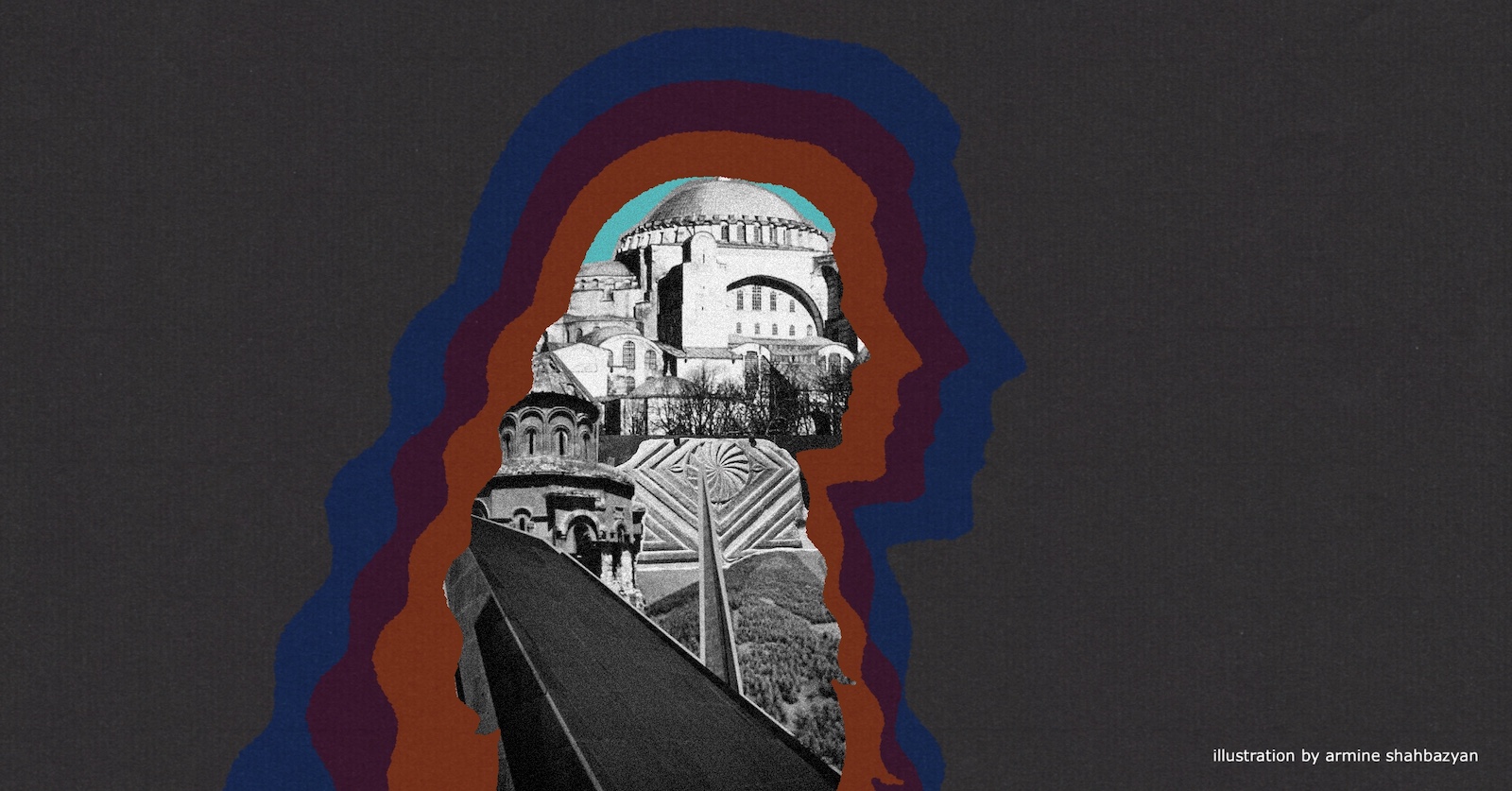
In late June, I touched down in Istanbul with one goal in mind: to find the descendants of those Armenians who never left. Supported by funding from the Calouste Gulbenkian Foundation and accompanied by photographer Alexis Pazoumian, I traversed the city in pursuit of Armenian life.
Over the course of one week, I met community members of diverse professional backgrounds and ages, conducting more than 20 interviews and having numerous informal conversations about what it means to be an Armenian in Istanbul today.
Though a fraction of what it once was, the community boasts 16 Armenian schools and more than 45 churches—Apostolic, Catholic, and Protestant—making it a stalwart cultural hub in the Middle East.[1] Official figures place the Christian Armenian population at approximately 60,000 people, although estimates vary significantly.[2]
From Kurtuluş to Feriköy, traces of Armenian culture could be found everywhere across the urban landscape. Sometimes these discoveries emerged like ghosts of the living, hidden in plain sight. Others broadcast their Armenian origins proudly and unabashedly.
At the Grand Bazaar, an open-air marketplace with the singular hustle and congestion of a commercial district, Armenian jewelers have honed their craft for generations. Many of these Turkophone artisans migrated from their birthplaces in Anatolia to Istanbul, where their children received an Armenian education. Despite not speaking Armenian, one silversmith proclaimed his Sasun roots with a large flag at the entry of his workshop.
Other locals imprinted ancestral pride on their bodies through prominent tattoos of Armenian imagery, including the eternity symbol and the statue of Tatik Papik, Artsakh’s national monument. These were among the many moments that shattered my expectations, with the smallest details often leaving the largest impact.
On the bougainvillea-lined streets of Kınalıada, an island encircled by the sparkling Marmara Sea, the hubbub of central Istanbul was a distant thought. Armenian residents of this small paradise called out to one another from apartment windows in their mother tongue as laundry dried in the gentle breeze. It is a remarkable place where Armenian culture breathes freely in a state that once sought to suffocate its expression.
Back in the Şişli neighborhood, I stood at the spot on the sidewalk where Armenian journalist Hrant Dink was assassinated nearly two decades ago and spoke with staff continuing his legacy at his former newspaper Agos. A vocal advocate for reconciliation between Armenians and Turks, Dink believed that mutual understanding was the only path to peace, and that achieving equality for minorities was central to the larger democratic project in Turkey.
Meditating on Armenian identity, Dink wrote, “For the last century, Armenians have been occupied with trying to keep their identity alive rather than living their identity. Where we stand today, Armenia represents the place where the identity is lived, and the Diaspora the place where one tries to keep the identity alive.”[3]
Where does that leave the Armenians of Turkey, a population Dink insisted should not be regarded as a diaspora, yet is one so often misunderstood, isolated, and marginalized both within their host society and the larger Armenian world?
I decided to name my project The Ones Who Stayed to capture the enduring spirit of an indigenous people.
Coming from a diaspora built on the ashes of genocide and animated by the pursuit of recognition, I tried to imagine the experience of those who stayed put in the wake of immeasurable loss and the long shadow of denial. How could you capture the love of homeland that informed such a choice, and the grit to last generations?
Looking devastation in the eye, the Armenians of Turkey had said, “You will not destroy us.”
In preparing the project’s outcomes—a rich film photography archive and insights from dozens of fascinating interviews—these reflections remain top of mind. Even as countless questions linger, some of which will surely require years and further research to unravel, I am certain of one thing.
The Պոլսահայեր (Istanbul Armenians) are shepherds of our culture, the last living ambassadors of Armenian language and identity in a state that sought to eradicate them but failed. For this contribution they merit the highest respect and understanding from those of us in the diaspora.
Every Armenian should one day visit Istanbul, not for traditional tourism, but for a reclamation of sorts. To set foot in this city as an Armenian is to assert what has been and will remain part of us.
Footnotes:
[1] Papazian, H. Contesting Armenianness: Plurality, Segregation and Multilateral Boundary Making among Armenians in Contemporary Turkey. University of Oxford, 2020.
[2] Ibid.
[3] Dink, Hrant. Two Close Peoples, Two Distant Neighbours. Translated by Nazım Hikmet Richard Dikbaş; foreword by Etyen Mahçupyan. 1st ed., Hrant Dink Foundation and Gomidas Institute, Istanbul, 2014.
Also see

Armenia and the Diaspora: A Situationship?
Armenia and its Diaspora share a bond of love, pride and pain—full of longing, misunderstandings and unspoken truths. Tatev Hovhannisyan explores their complicated “situationship” where memory and survival meet politics, and where distance both deepens and strains connection.
Read more
“Ges-ges”, Half-Hidden, Half-Lost: Talking About Hamshen Armenians Without Labels
Centuries of forced migration, conversion and marginalization have shaped the unique identity of Hamshen Armenians. Öndercan Muti explores their complex history and evolving identity and invites reflection on preservation, memory and belonging.
Read more
The Crossing: Armenians Arriving in Los Angeles via Mexico
There has been a dramatic increase in the number of Armenian nationals crossing the U.S.-Mexico border following the 2020 Nagorno-Karabakh War. This trend speaks to the urgency and desperation of those leaving a country plagued by conflict. Maral Tavitian’s investigation.
Read more
Traversing the Eastern Anatolian Plateau
A descendent of a survivor of the Armenian Genocide travels to the historic Armenian city of Van situated on the shore of the eponymous lake in modern-day Turkey and discovers that the echoes of its Armenian past still remain visible.
Read more