

Listen to the AI generated audio article.
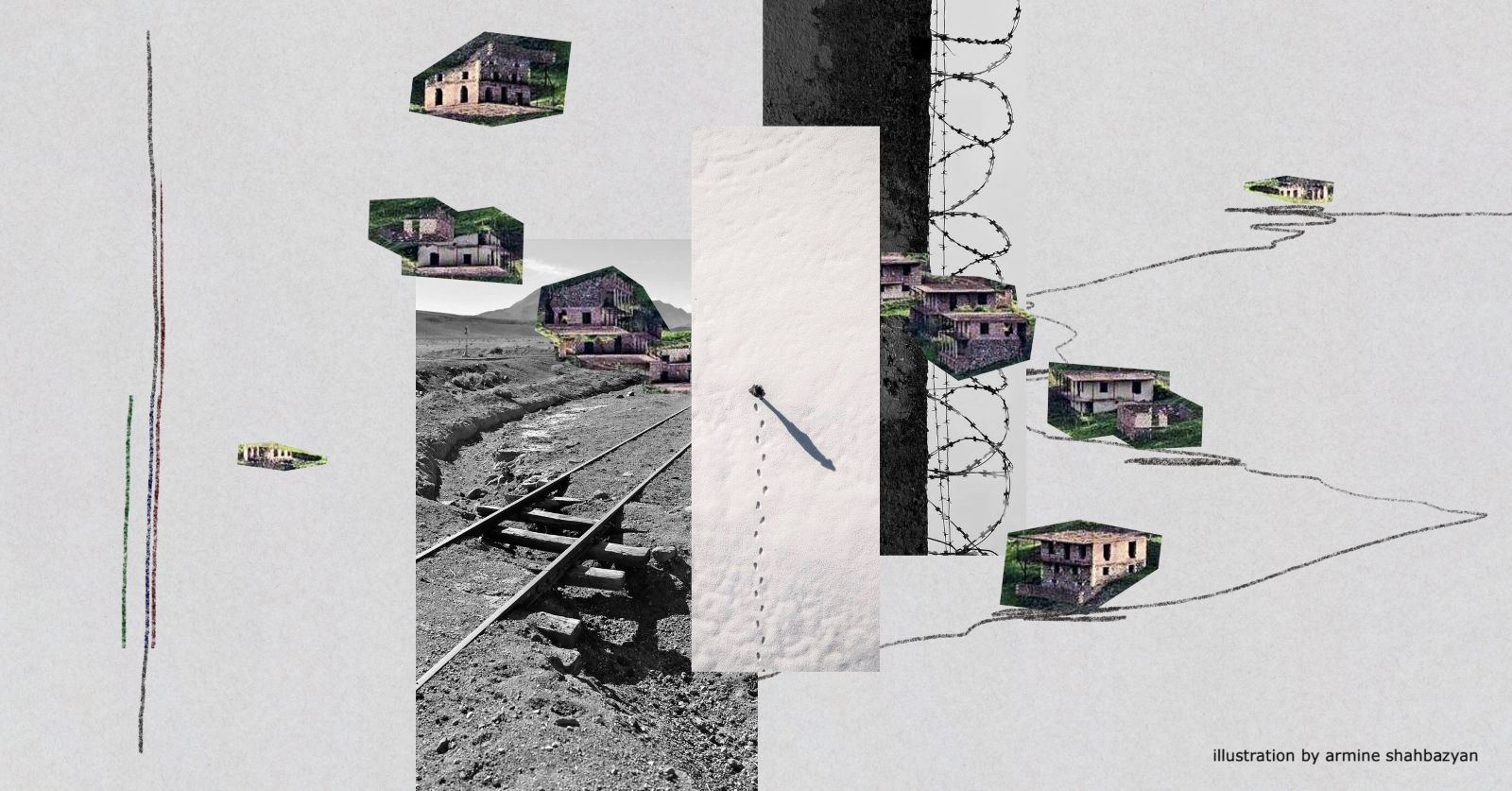
Grass and weeds sprout through the tracks near the Akhuryan train station. It was once the last stop on the Armenian side of the Kars–Gyumri Railway. But trains haven’t crossed here since the border between Armenia and Turkey closed more than three decades ago.
The long-empty depots in the railyard have broken windows, and what machinery remains is rusted and disused. But the station building itself looks to be in relatively good condition. A man smokes sullenly in front of the one-story building. He introduces himself as Sergey and says he works there. Because it’s a border station, he explains, someone has to maintain it, even when it’s not in use. And it’s possible that the Akhuryan train station could operate again in the future. Sergey thinks it will. So do the Poleyans, the family that lives next door to the station.
The border has been closed since 1993, when Turkey joined Azerbaijan in its blockade of Armenia during the First Nagorno-Karabakh War. But as relations between Yerevan and Ankara are starting to thaw, both sides have discussed the possibility of reopening the border (initially for third-country passport holders) and restoring the Kars–Gyumri Railway. Last month, Prime Minister Nikol Pashinyan said the reopening of the border is “only a matter of time.” Ruben Safrastyan, an expert on Armenia-Turkey relations and a professor at the American University of Armenia, says the reopening of the border and the railway is “not an immediate prospect but remains a realistic possibility.” Ankara remains closely aligned with Baku, but if Yerevan and Baku are able to reach a lasting peace agreement, he says, “reopening the border and the Kars–Gyumri railway could become feasible as early as next year.”
Neither Karine Poleyan, 18, nor her brother, Manvel, 15, was alive when the border between the two countries was open. Yet both light up when they talk about the possibility of the railway passing through their village once again. The family believes that if the line reopens, their quiet corner of Shirak region could be transformed. “It will be even better than back then,” says Karine’s grandmother, with whom she shares a name. The elder Karine Poleyan, 66, remembers what life in the village was like when the railway was still running. She recalls a time when the village was “vibrant”, how Turkish railway workers would drink coffee with locals when they came over to the Armenian side. But now, she says, “In the morning, we wake up, and there is nobody.”
Life in Shirak’s border villages can be difficult. The region, which borders Turkey to the west and Georgia to the north, is one of the poorest in Armenia. According to 2022 census data, 45% of people in Shirak are considered either poor or extremely poor. For the villages near Akhuryan station, the closure of the railroad, as well as the destruction of several factories in the 1988 earthquake had devastating economic consequences. The elder Karine Poleyan used to work in the nearby sugar factory, and her husband worked on the railroad. But now, the family grows cabbage, carrots and other crops to support themselves. “It was better back then, when there was a stable workplace with a stable salary,” she says.
Haykadzor is a village of about 400 near the border with Turkey. Karen Gevorgyan, 46, is the principal of the village school. He’s sitting in a parked car on one of the village’s dusty, unpaved roads. Life is hard in Haykadzor, he says, leaning out of the car’s window to light a cigarette. It’s isolated and hard to make a living there.
“For border regions, reopening presents a genuine and urgent opportunity for renewal,” says Safrastyan, noting that this could lead to more cross-border trade, improved infrastructure, and increased people-to-people contact. In fact, it could have “significant social, economic, and psychological benefits” for the whole country, he continues, including connecting Armenia with new trade routes and partners. Some, like the Poleyans, agree. They believe opening the border and recommissioning the railway could be a boon for economic development in their region.
But others living along the border are less optimistic. “What would opening the border do for us?” asks Vahan Tumasyan, a developer and the founder of Shirak Centre, a non-governmental organization. Tumasyan lives in the border village of Bagravan, where he also owns and operates the guesthouse Vahanatun. He gestures to a hill visible through a ground-floor window. Just over that hill is Turkey, he says. Living by the border can take a psychological toll, he says, but he doesn’t think the solution is to open the border. He wants villagers in the region to be able to “live well without opening the border.”
Tumasyan worries Turkey would have the upper hand over Armenia if the border reopened. According to Safrastyan, these fears are valid. “The economic gap between Armenia and Turkey could initially put Armenia at a disadvantage,” he explains. For that reason, the reopening should be part of a “clear, well-prepared national strategy.”
Still others don’t concern themselves much at all with the prospect, viewing it as nothing more than empty political talk. Gevorgyan says he doesn’t expect the border to reopen any time soon. “They’re not doing anything they promise,” he says. But his skepticism doesn’t mean he’s neutral about it. He’s distrustful of his Turkish neighbors, a sentiment that reflects more than a century of conflict between Turks and Armenians. “We can’t live with them,” he says.
Gevorgyan says villagers in Haykadzor are more focused on tending to their livestock or their fields than they are on the future of the Armenia–Turkey border. Making a living through farming here is no easy feat. Though Shirak’s economy is largely based on agriculture, the region is not particularly fertile. Tumasyan says the region’s dry soil and climate make it difficult to cultivate crops other than wheat, barley and potatoes, which require little water to grow.
A barbed-wire fence runs along the Armenian side of the Turkish border, enclosing a buffer zone roughly a kilometer wide. Civilians can enter only with special permission, and thousands of hectares of arable land lie behind the fence, Tumasyan says. He leads an initiative that helps local farmers cultivate those lands, but the process is burdensome: they pass through security checkpoints daily and must renew government permits every year. Tumasyan believes opening the buffer zone would benefit villagers far more than reopening the border itself. Safrastyan, however, expects the buffer zone would likely remain in place even if the border were to open.
The Armenian-Turkish border was once a frontier of the Soviet Union, patrolled then by Soviet troops and now by Russian ones. The watchtower of a Russian border station is visible from the railyard by the Poleyans’ house, and you can see one of these stations from a hill near the village of Haykadzor as well. For residents of both communities, living in the shadow of these border stations is just a fact of life. Manvel and Karine say the Russian presence makes them feel safer. And Gevorgyan says he doesn’t feel anxious about living so close to the border. “Maybe for you it would be a strange thing, but for us it’s normal,” he says.
In addition to doing away with the buffer zone, Tumasyan supports the reconstruction of a bridge that once crossed the Akhuryan River near the medieval Armenian city of Ani, which is now in present-day Turkey. In the late 10th and early 11th centuries, Ani was the capital of the Armenian kingdom, which at the time, covered much of eastern Turkey and present-day Armenia. In the Middle Ages, it was said that whoever controlled Ani would control the whole region. If and when the border is reopened, the reconstructed bridge would serve as a direct pedestrian passageway from Armenia to Ani.
From a hill near Haykadzor, the ruins of Ani are visible. “It’s the one thing we’re proud of,” Gevorgyan says of the village’s proximity to the iconic Armenian city. It’s a bright spot for those who live there. He’s never actually been to Ani, but he walks to the nearby knoll to gaze out at the ruined city most days. There are better views of Ani than the one from Haykadzor, Gevorgyan says. But for that, you’d have to enter the buffer zone.
Also see
The War, Before the Peace
The lack of fear and love for the land in defiance of the Azerbaijani presence nearby is what many Armenians say keeps them in their border villages. Sandra Sadek spent several days in Armenia’s Syunik region this past summer. This is her dispatch.
Read more
Portrait of a Nation: Armenia
From bustling streets to remote border villages, Armenia reveals itself not only through history and hardship, but through the resilience and quiet courage of its people. Sandra Sadek’s portrait captures a nation that remembers, rebuilds and carries its past while daring to hope for the future.
Read more
Growing Up On the Border: Youth Narratives of War, Peace and Home
Drawing on voices from Armenia’s border communities, Gayane Ghazaryan explores how war and displacement shape young people’s sense of home, belonging, and identity, revealing emotional landscapes often overlooked in mainstream narratives of conflict and peace.
Read more