

Listen to the AI generated audio article.
I arrived in Armenia in late May with a notebook, a camera, and a vague knowledge that this country was standing at a threshold. Landlocked and tucked into the folds of the Caucasus mountains, Armenia is trying to redefine itself—politically, culturally, existentially—after decades of war, shifting borders, and uncertain alliances. It is a place where the past is never far, and the future never quite settled.
Like any journalist, I came prepared: I had studied the history, mapped the conflicts, and scanned the headlines. But what I hadn’t grasped – not yet – was how these layers of trauma, pride, loss, and quiet persistence shaped the everyday texture of the place. Over two months of travel, I found Armenia’s stories not in its political declarations and happenings, but in the small towns and border villages, market stalls, cemeteries, and conversations with new friends.
This isn’t a story about war or even resilience. It’s about what remains — and how people move forward with memory as a constant companion.
My first week in Yerevan shattered all expectations I had of a place that had been portrayed as a nation still reeling from its 70-year-long Soviet rule, where modernity lags behind and outdated perspectives are dominant. Much of what I had read painted an outdated, even condescending, portrait of Armenia—and much of it turned out to be wrong.
Life in Yerevan is the complete opposite of the fast-paced life in New York I had just left behind for the summer. Here, the day starts around 10 a.m. and businesses are open late, until 8 p.m., and even 10 p.m. in some places. Cafes with plenty of outdoor seating line the sidewalks, with patrons drinking and dining into the late hours of the night. Fashionable youth walk the streets. Children eat ice cream from the street vendors and play until sundown in the park with no fear. Clean public transportation helps connect residents across town (I grew up some years in Texas, where public transit is virtually nonexistent). The liveliness and warmth I experienced went against all the assumptions I had falsely made about this developing country.
One of my earliest experiences of the joy of life that permeates Armenian society was attending Wine Fest, per my editors at EVN Report’s strong suggestion (I interned at this outlet for the summer of 2025). Hardly a wine connoisseur but an occasional appreciator, other interns and I bought tickets and the mandatory branded glass with little expectations. As the sun began to set, the wine kept on pouring! Our fellow Italian intern, Michele, quickly and unexpectedly befriended a gentleman working at the booth, who ended up gifting him a free bottle of sweet raspberry wine. The language barrier did not stop the vendor from conversing with us, his booming laugh overtaking the DJ music playing in the background. The smell of food filled the air and music possessed every Armenian to join hands and stomp their feet to rhythmic music, bringing on a sense of familiarity to me. Our group decides to call it a day and slowly make our way out of the festival, giddy with wine. As I look back at the main stage, people are ready to dance the night away, intoxicated on joy and wine.
In one of my earliest diary entries of this journey, I described Yerevan as such: “Life seems slower and yet, there remains a vitality that is invigorating. It urges you to seek out new places but also to sit still and take in the historic surroundings […] In some ways, it reminds me of Lebanon [my motherland] but so much more modern and ‘European.’”
However, joy never exists in isolation. It rests on a foundation of memory.
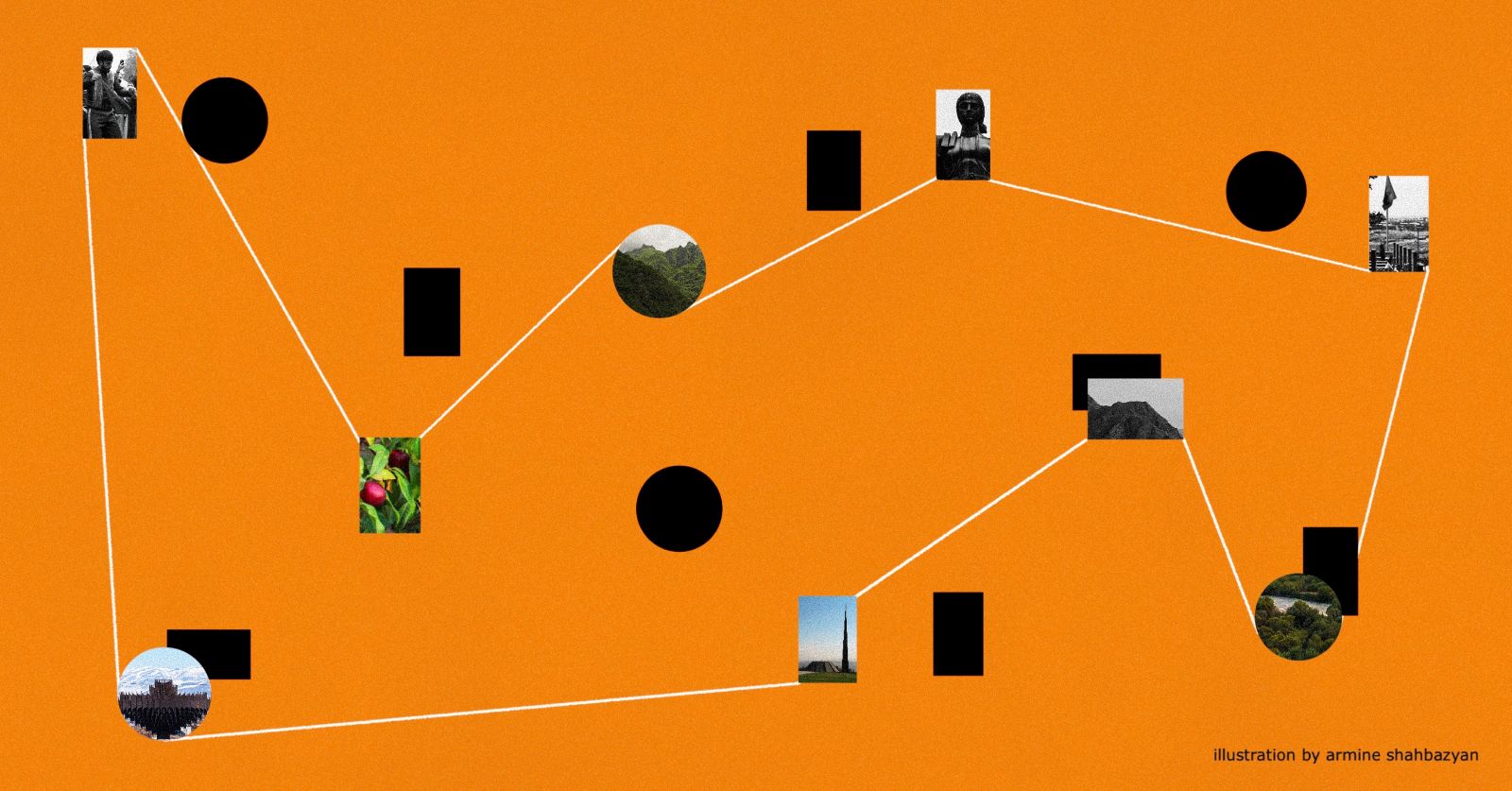
One of my first weekend visits outside the city center was to the Armenian Genocide Memorial. Often dubbed the “forgotten genocide,” stopping here felt obligatory and a good starting point for understanding Armenia.
The site’s main structure is the grey-stone, brutalist memorial, made up of a pointed obelisk-like piece and inclined stones arranged in a circle, similar to a tomb, with a never-extinguished flame in the center. Flowers are laid around the fire as a haunting choir echoes throughout the grounds from a hidden speaker.
Below the memorial is a museum housing decades of archival material and objects of survivors and victims of the genocide and more importantly, real-time documentation of a crime unfolding before the world’s very eyes. A French newspaper from as early as 1903 depicts the oppression of the Armenians under Ottoman rule with the headline, “Under Europe’s impassive eye.”
The heaviness that followed me through each room of the museum is a stark reminder of the world we live in, a world in which the violence that continues to unfold across the world. A quote by German photographer Armin Wegner, who extensively documented the Turks’ crimes against the Armenians and visited the memorial himself in 1968, helped put into words some of the emotions that I experienced once leaving the memorial: “I knelt before the eternal monument of the unburied Armenians and bowed before the everlasting flame that symbolizes the souls of the martyrs… Before my eyes passed the tents of the desert, starving children, victims of the epidemic. Few can understand the depth of my feelings.”
Armenia’s history is complex and no foreigner can begin to comprehend the breadth and depth of a country that is 2,800 years old. Whether historic, Soviet, or independent, Armenia has rarely known peace. Each era has left its mark—sometimes in architecture, sometimes in the people, sometimes in silence.
As I would learn as I made my way through the country’s vast landscape, a lot of the national identity is marked by periods of suffering and oppression. But, the Armenian identity should not be limited to only the dark portions of its history, but rather explored through the vibrant interwoven narratives that continue to shape modern Armenian society.
Although Armenia became independent in 1991 after the fall of the Soviet Union, the era that shaped an entire generation can still be found throughout society. While the country has had a strong derussification process compared to most of the former satellite states, remnants linger in the background, from the Russian-imported goods and the restaurant workers to the architecture and media still present.
It’s easy to find reports, articles and conferences on Armenia’s political and military pivot toward the West, away from Russia’s grip, especially since the 2018 Velvet Revolution that ousted the pro-Russian government in favor of a more European-leaning one still in power today under the leadership of Prime Minister Nikol Pashinyan. But Russia remains one of Armenia’s top trading partners, a vital lifeline to a nation whose borders to the East and West (Azerbaijan and Turkey, respectively) remain closed indefinitely.
That complexity of character—a country pulled between past and future—was nowhere clearer to me than in Gyumri. In Armenia’s second-largest town, the country’s Soviet history is displayed in a way that demonstrates once more the diverse layers that make up the national fabric. While Yerevan is modern and on the edge of innovation, Gyumri offers visitors a window to the past. The city holds a special place in history. It became host to a large influx of Armenian orphans during the genocide. It was home to some of the country’s many artists, making it a cultural hub. It was also home to the devastating 1988 earthquake that crippled its industrial economy and led to the mass migration of residents from the economically depressed city. It remains a hub for politically Russian-friendly Armenians.
The story of Gyumri, I came to realize, is a reflection of Armenia’s own—a place marked by disaster and resilience, where memory lives alongside modern life. Back in Yerevan, the weight of history—so palpable in Gyumri—came into light at Yerablur Military Cemetery.
It’s a Monday morning, just two weeks before my time in Armenia ends, when Maria, the editor-in-chief of EVN Report, our managing editor Roubina, took me and two other interns to the Yerablur Military Cemetery. Inaugurated in 1992, this site has become the final resting place for soldiers who died during the First Nagorno-Karabakh War in the 1990s, and more recently, those killed in combat during the second war in 2020 and the 2023 ethnic cleansing—a conflict that claimed the lives of over 4,000 soldiers, with 187 still listed as missing.
We arrived at the cemetery around 11 a.m., perched on a hill between Yerevan and the holy city of Etchmiadzin, after a 25-minute taxi ride. The sun was blazing. The place was silent, immersed in a solemn atmosphere. A gardener watered the flowers and trees lining the walkways. As we stepped out of the shaded path, rows of marble graves emerged, nearly blocking the view of the capital.
Spanning more than 44 hectares (about the size of Vatican City), the cemetery offers a striking view of the human cost of a conflict between two countries that has dragged on for over three decades. Each grave bears a photo of the deceased, emphasizing the humanity of every life lost, with names inscribed in Armenian. I was unable to read the names, unable to pay tribute, or preserve their memory. All I saw were the faces of young men over and over again. The majority of them are younger than I. The graves are adorned with flowers, fresh and wilted—silent witnesses to the passage of time and the presence or absence of loved ones.
As we each quietly wandered through the rows of graves, I found the editors seated in front of one particular tomb. I hesitated to approach, afraid to intrude on a private moment. Eventually, I walked over to Roubina.
“This grave you stopped in front of… did you know the soldier?” I asked.
“No,” she responded. “But it’s the grave of a young Armenian whose combat photo was shared around the world.”
Roubina was referring to Albert Hovhannisyan, a soldier and second-year university student, whose name and face became famous after a photograph was released by the Ministry of Defense on Sept. 29, 2020. It shows Hovhannisyan firing an artillery cannon. He died just days later, on Oct. 8, 2020, at the age of 19.
“My son, Albert Hovhannisyan, whose photo became widespread all over the world these days, stepped into immortality. My pain and the pain of my family is indescribable,” his father, Artak Hovhannisyan, wrote on Facebook announcing his death.
Immortality. This cemetery has become the only place where these lost men still hold a place in this world. Every day during the 44-day war, coffins were brought back to the cemetery, two by two. Even if you don’t have a personal connection to any of the men buried here, the weight of loss here doesn’t belong to one family—it is communal, national, unspoken but known.
I continued walking past the etched tombstones when a sob suddenly broke the silence that had enveloped the cemetery since our arrival. Sitting on the grave of a man—perhaps a father, a brother—a woman cries, unable to hold back her emotions. I suddenly felt like an intruder, and a deep sadness washed over me. My eyes started to water. I didn’t know this woman. I didn’t know any of the soldiers buried here. And yet, I felt a weight on my chest as I realized that here, even though a ceasefire is in place and the war is no longer raging, death is ever-present. The pain caused by this violence has yet to heal. I stepped away and wiped away the tears, hoping no one saw me. “Only the dead have seen the end of war.” (Plato)
You don’t need to stand among the tombstones to feel the war’s shadow. It clings to walls, to faces, to the silence in border towns. It’s not uncommon to see murals of young men in military uniform in Armenian villages, including the capital, Yerevan. For many, these portraits have become symbols of resilience, but also painful reminders of the human losses that continue to haunt a country still scarred by the conflict with Azerbaijan over the territory of Nagorno-Karabakh (called Artsakh by Armenians). Despite the announcement of a peace agreement between Armenia and Azerbaijan in March 2025, it has yet to be signed. Azerbaijan continues to demand concessions from Armenia while intermittent shooting persists in villages along the border between the two countries.
It was in the border villages of Syunik that I glimpsed another Armenia, one far from the noise of the capital, shaped by simplicity, endurance, and a closeness to the land that felt almost sacred. Toward the end of my stay in Armenia, I spent four days in Syunik, a region that is often misunderstood and misrepresented; its residents live in a constant state where the war has ended, but peace has yet to arrive.
In Kapan, the provincial capital, I met with young students who are eager to contribute to their hometowns. They don’t want to leave for the bigger cities. Why should they? This is their home and no amount of conflict or fear seems to deter them from abandoning everything. I felt silly asking many of the folks there if they ever thought about leaving the region, especially after the 2023 war amid fears that peace is still very far away. One 15-year-old girl named Maria told me, while she is afraid war might break out again, she believes “it is better to live on the soil you were raised on.”
As I ventured out into more rural villages like Nerkin Hand, where Azerbaijani military postings encircled the village on three sides, the land was more than home. Among the many villagers I met, the bond to place is visceral. One of the villagers, Norik, explained how, before the war, the village was full of life and energy. They could grow wheat, fruits and vegetables, and could keep animals. It was full of life and full of energy. After the war, they tried to do some renovations. Fresh, clean water from the nearby forest was cut off. The World War II memorial and cemetery, where their parents and relatives are buried, was left behind or near enemy lines. The local church is also no longer accessible.
“Here, if you think about it, we’re like orphans. Abandoned. We can’t even go visit the graves,” he said.
When I asked if he ever thought of leaving, his answer was immediate. Like the 20 or so families still living in Nerkin Hand, departure wasn’t an option.
“We don’t even want the word ‘leaving’ to be mentioned. Because if we leave this place, then you can count on this territory falling into enemy hands,” Norik said.
My journey south ended in Meghri, Armenia’s southernmost town bordering Iran and the country’s fruit basket. After driving through winding, mountainous terrain, we arrive upon a subtropical climate that allows for all kinds of produce to be grown—from figs, peaches and pomegranates to olives, kiwis and bananas. And the reputation of Meghri’s fruits precedes it. Trade and tourism with Iran are crucial parts of life here and, unlike in the West, Iran is not perceived as a threat, but rather a partner. In a region where two of the province’s borders are shared with Azerbaijan, Syunik’s southern neighbor is a gateway to the rest of the world.
Despite its remoteness in the striking Zangezur and Meghri Mountain Ranges, the town is booming with different opportunities—mining, agriculture, customs and construction. In fact, unemployment is rarely an issue here, one of the locals told me.
I met Zhora Sarkisyan, a native son of Meghri who had recently returned after 45 years in St. Petersburg. We walked through his lush garden, branches heavy with ripening fruit. His home overlooked the Araks River, and just across the water was Iran. The landscape and lifestyle are a complete change from what I had just seen in Nerkin Hand. We ate peaches as the light softened over Meghri, the Araks River between us and Iran reflecting the last of the sun. It was hard to believe that barely 70 kilometers north, people were still living in the shadow of war.
I arrived in Armenia as an outsider, yet some moments—the food, the music, the tight-knit warmth of strangers—felt strikingly familiar. Others, like Yerablur or Syunik, reminded me how much I could never fully understand.
Armenia is a small country, just under 3 million in population. Painting a portrait of this nation forced me to reckon with the complexity of its history that has embedded itself in the fabric of society, both good and bad.
From the streets of Yerevan to the mountains of Syunik, I saw a country marked by survival but stitched together by memory and always rooted in the land. Grief is present alongside resilience and growth. Armenians stay. They rebuild. They remember. And in doing so, they teach the rest of us something about how a nation holds itself together when so much has tried to tear it apart.
Also see
Growing Up On the Border: Youth Narratives of War, Peace and Home
Drawing on voices from Armenia’s border communities, Gayane Ghazaryan explores how war and displacement shape young people’s sense of home, belonging, and identity, revealing emotional landscapes often overlooked in mainstream narratives of conflict and peace.
Read more
Re-reading Philip Marsden’s “The Crossing Place: A Journey Among the Armenians”
Philip Marsden’s “The Crossing Place: A Journey Among the Armenians” is atmospheric, gripping and revelatory. It delves into the seemingly exclusive club of a nation at the meeting point of cultures, writes Naneh Hovhannisyan.
Read moreRecently published
Armenia’s Balancing Act in a Multipolar World
As global power shifts toward multipolarity, Armenia faces profound uncertainty. With Russia’s retreat and ongoing regional pressures, Yerevan is pursuing a “balanced and balancing” foreign policy—deepening Western ties while engaging Iran, India, China and others—in a bold recalibration of its security and diplomacy.
Read more
From Urtsadzor to COP17: Biodiversity at Armenia’s Crossroads
As peace negotiations with Azerbaijan and regional integration projects advance, biodiversity corridors could become vital connectors across fractured landscapes and divided societies. With Armenia preparing to host COP17, the urgency of protecting its extraordinary biodiversity amid mounting ecological and political threats takes center stage.
Read more
Law, Power and Perception: Broadening the Debate on Judicial Independence
Judicial independence in Armenia is more than legal rules; it is a matter of culture, perception and action. Gor Samvel broadens the debate, examining how law, ethics, and societal forces intersect, and calling for rigorous research to inform public understanding.
Read more
The Forced Displacement of Artsakh Armenians: Violated Rights and the Loss of Identity
Over 150,000 Armenians from Artsakh were forcibly displaced through war, blockade and systemic persecution. Examined through international law, these events constitute forcible transfer, violating fundamental rights and undermining the principle of return.
Read more
Hung On a Line
Laundry, suspended on lines, throughout Artsakh once told stories of home, pride and domestic ritual. Amid war, blockade and exile, it became a fragile thread of memory and survival, a line of cloth carrying the weight of loss, resilience and love for a vanished home.
Read more
From the risks and opportunities that the Washington Accords present, to questions of justice after a potential peace agreement, to relations with Iran and the evolving situation in Syria, our August coverage went beyond political developments and their implications. We also examined how Armenia’s tech ecosystem is shaping education and featured podcasts with renowned artists and academics such as Atom Egoyan, Arsinée Khanjian and Cengiz Aktar. Meanwhile, the August issue of SALT, our lifestyle section, immersed readers in the rituals, rhythms and contradictions that shape contemporary Armenian life.