
Listen to the AI generated audio article.
In the sweltering August heat the hills around Urtsadzor look barren at first glance. Dry, sun‑bleached slopes fold into one another, juniper trees etched into nearly every crevice give it a crusted, aged look. This is the Caucasus Wildlife Refuge (CWR) and though it does not look very green and lush, it is one of the most condensed spots of biodiversity not only in Armenia, but in the entire Caucasus region, protecting over 1500 species of flora and fauna. The Refuge Center is first of its kind in the region and serves as a success story and a glimpse into the ecological wealth that will be under the spotlight when Armenia hosts COP17 next year.
What began as a 300‑hectare lease has grown into one of the most important biodiversity sanctuaries in the Caucasus, spanning 35,000 hectares and serving as a vital migratory corridor and a model of connectivity conservation.
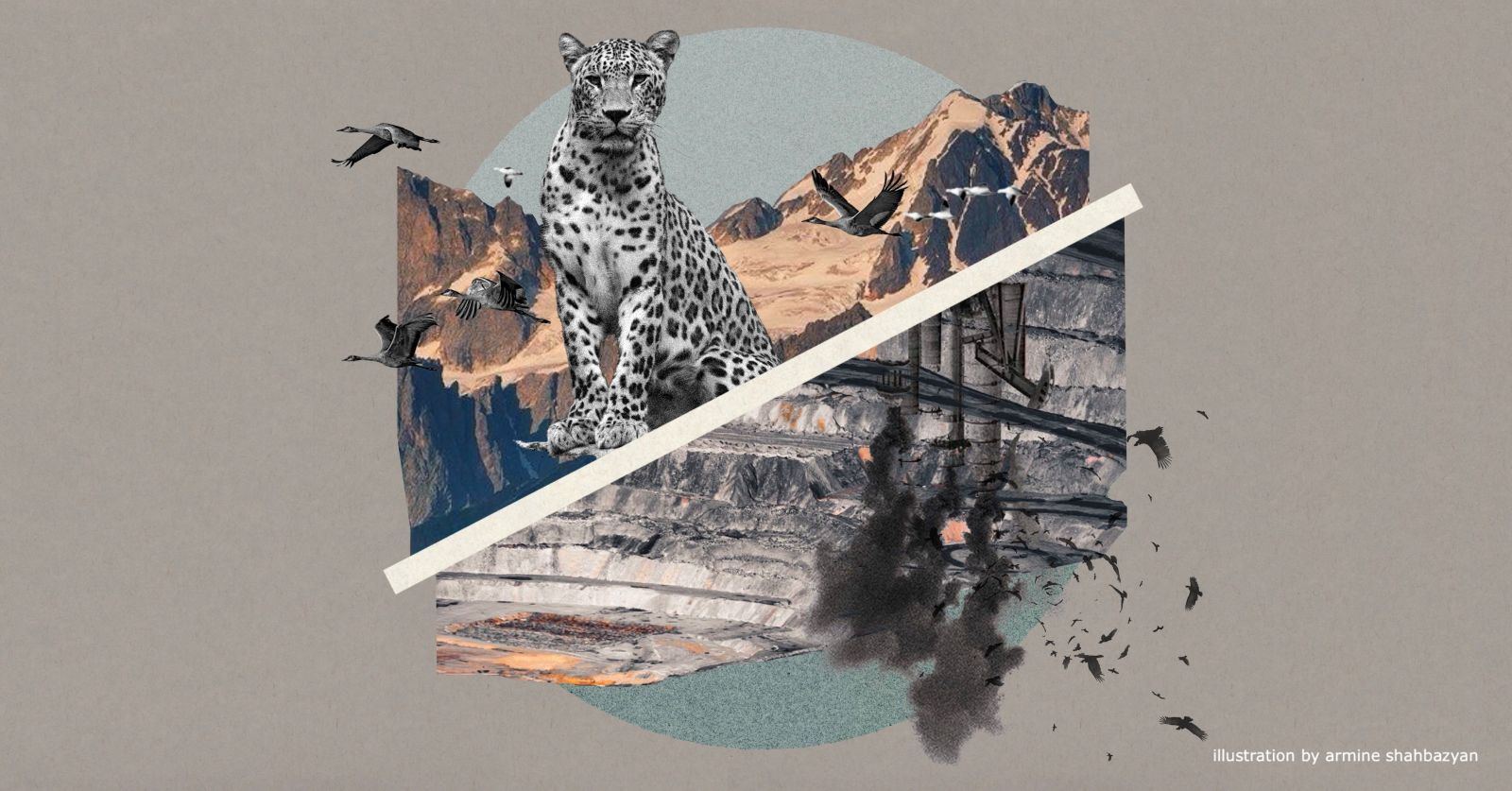
In general, Armenia, though small, boasts extraordinary biological wealth: the country hosts more than 3,800 plant species and over 17,000 animal species, numbers that place it among the most densely biodiverse nations globally. Within the refuge itself, camera traps have documented rare species such as brown bears, bezoar goats, Armenian vipers, bearded vultures, and even the endangered Caucasian leopard, a species perilously close to regional extinction, with only 8–13 left in Armenia.
Embedded within the Caucasus Wildlife Refuge is the Bear Rescue Center, Armenia’s first dedicated facility for the rescue and rehabilitation of injured or illegally held wildlife, especially bears. In partnership with International Animal Rescue (IAR) and SOS Zoo and Bear Rescue, the center launched a campaign to rescue as many as 70 bears that were being held in appalling conditions across the country, sometimes in restaurants, gas stations, private homes, and even factories.
The system makes perfect sense: the integration allows rescued animals to reside within a functioning ecosystem, surrounded by ongoing efforts in wildlife monitoring, community education, and habitat restoration. It is a sanctuary within a sanctuary. And at its heart is Ruben Khachatryan, christened by many as the “Bear Rescuer.” But that is only part of his story. A conservationist of 23 years, Khachatryan began as a documentary filmmaker, quickly learning that nature needed someone to tell its story fully and, by extension, to protect it. He founded the Foundation for the Preservation of Wildlife and Cultural Assets (FPWC), the SunChild Festival and Eco-Clubs, and the Caucasus Wildlife Center (CWR).
“The success [of CWR] is not just about land,” he says, “it’s about trust. It’s about building relationships with communities, proving that conservation can be a shared, long-term commitment.”
That trust has been the foundation of CWR’s expansion. Over the last decade, FPWC has partnered with more than 60 communities across 30,000 hectares of land. These agreements are not symbolic, they involve practical solutions to everyday challenges: reducing human–bear conflict, developing income through honey production or ecotourism, or installing renewable energy in remote schools. FPWC quickly recognized that instead of being outsourced the best solutions often came from the communities themselves.
This model has been recognized abroad, from IUCN’s Category VI designation for Privately Protected Areas to acknowledgment by the ICCA Consortium. Yet inside Armenia, such approaches remain outside formal law. Without recognition, community conservation stays vulnerable. Even if it is celebrated internationally without legal protection it remains fragile at home.
The success or failure of these initiatives is about more than habitats or species. It is also about memory and community. FPWC learned this by walking the landscapes and shaking hands with the people rooted there, villagers whose lives are still closely tied to the soil, as in older times. “Traditionally, Armenians lived in deep harmony with nature,” Khachatryan reflects. “This connection shaped our culture—our dances, our songs, our manuscripts, even the architecture. I take great pride in that heritage. But in more recent decades… we saw a loss of that ecological consciousness. What keeps me up at night isn’t just environmental degradation—it’s this loss of memory.”
That memory is all too obviously still visible in Armenia’s culture: in vines curling across manuscript margins, in uniquely varied birds carved into letters of the alphabet, wild herds weaved into carpets. The danger, Khachatryan warns, is not just the extinction of species but the erosion of the compass that once guided how Armenians lived with nature, not just off it.
This August, Armenia’s Ministry of Environment released a draft National Biodiversity Strategy and Action Plan (NBSAP) for public discussion. The strategy is designed to align with the Kunming–Montreal Global Biodiversity Framework and comes just months before Armenia hosts COP17 in Yerevan. Among its targets: expanding protected areas to 30% of national territory by 2030, restoring degraded habitats, and, crucially, recognizing community-led and privately protected areas like CWR.
The challenge though is that biodiversity here is threatened not only by climate change but by Armenia’s own economic policies. “The most pressing threat comes from within, from policies that prioritize mining and industrial expansion over ecological health,” Khachatryan notes. “Our ecosystems are incredibly sensitive, and many of the proposed mining sites overlap with critical biodiversity areas. This short-term mindset could have irreversible consequences for both nature and communities.”
And of course, conflict compounds the damage.
“During the 2020 war, we witnessed forest fires caused by phosphorus weapons, artillery shelling in natural habitats, and the destruction of fragile ecosystems,” he recalls. “We now see animals like leopards, bezoar goats and bears affected both physically with injuries from mines and behaviorally, as their ranges become restricted by military zones and barbed borders. Migration routes have been blocked. Tensions along the Azerbaijan border have fragmented ecosystems, isolating populations and undermining natural cycles. These are not abstract impacts—we see them daily in our fieldwork.”
Conservation in these borderlands is inseparable from peace. That point has become especially clear as Armenia and Azerbaijan negotiate a peace deal, and as regional integration plans like TRIPP are introduced. Wildlife does not recognize borders: predators roam ranges that cross frontiers, raptors trace flyways from Iran to Georgia, and rivers connect communities on opposite sides of disputes. Without a hint of political will, nature had created the first “connectivity projects” which if embraced and protected communally will genuinely build trust between countries. Not surprisingly, even biodiversity in the South Caucasus is more than just ecology, it is security, diplomacy, and the fragile beginnings of reconciliation.
All of this unfolds as Armenia steps into the global spotlight. By joining the International Union for Conservation of Nature (IUCN) as a State Member and preparing to host COP17, the country has placed biodiversity at the center of its international profile. But as Khachatryan warns, there is a double edge to such visibility: “Hosting COP17 is an incredible opportunity for Armenia to reflect on its relationship with nature. International attention can spotlight success stories and bring much-needed support. But it also puts pressure on us to look good, rather than do good. The real challenge is whether we’ll prioritize our biodiversity not just for the world to see but for ourselves, our children, and their future.”
It is against this backdrop that Khachatryan has put forward his candidacy for IUCN Regional Councillor, representing Eastern Europe, Central, and North Asia. If elected, it would mark the first time Armenia holds a seat on the governing body of the world’s largest conservation network. For a country so often at the geopolitical periphery, this is a symbolic step into global leadership. But for Khachatryan, the candidacy is less about prestige and more about influence. “I want our region’s stories, challenges, and solutions to have a stronger voice in shaping the future of IUCN,” he says.
Armenia’s biodiversity model has long operated at the margins, community partnerships without legal recognition, refuges created through leases rather than state decrees. To bring those experiences into the global arena, to argue that conservation can be community-rooted even in conflict zones, is to place Armenia’s story at the center of a wider struggle: how biodiversity protection must adapt in fragile regions, not just in wealthy or stable ones.
The numbers themselves tell the story: Armenia currently protects just 10% of its terrestrial territory. Under the Paris Agreement and the GBF, it is obligated to secure at least 30%. “Reaching this target,” Khachatryan stresses, “Armenia needs to diversify its protected area models. I do hope that till COP17 there will be enough political will to have changes in the law and recognize and give status to Other Effective Area-based Conservation Measures (OECM) like the CWR.”
The stakes are not abstract. The roots of biodiversity both bind and are bound by everything else that lives, breathes, and functions in this country. “If there were one misconception about biodiversity work in Armenia I wish people could unlearn,” Khachatryan says, “it’s that the environment is a separate topic, something you address after ‘real’ priorities like security or the economy. In truth, biodiversity underpins everything: our food systems, our education, our public health, even our diplomacy.”
That last point echoes beyond Armenia’s borders. As peace negotiations with Azerbaijan and regional integration projects gain momentum, biodiversity corridors could prove to be the connective tissue linking fractured landscapes and divided societies. Conservation thus is one of few forms of politics still possible.
And of course, politics begins at home. The fate of Armenia’s biodiversity depends not only on external conflicts but also on the strength of its own institutions. Without rule of law, mining projects advance into fragile habitats unchecked; without democratic accountability, community voices remain unheard in decisions that affect their land; without transparency, international commitments risk becoming performance rather than policy. In this sense, democracy and biodiversity are bound together: governance shapes the landscape, just as the landscape shapes the lives of citizens. And in their own turn citizens form another crucial branch. Everyday actions, from illegal logging and poaching to waste dumping and overgrazing, accumulate into larger crises. Without a culture of responsibility and stewardship, even the strongest legal protections will falter.
And biodiversity, in turn, is not a single issue but an infrastructure. It underpins food systems, secures drinking water, stabilizes soils, sustains health, supports education, and even extends into diplomacy. Thus by protecting its ecosystems Armenia is not only saving species, it is also reinforcing the very foundations of its economy, its governance, and its security.
“I imagine an Armenia that has embraced its true wealth—not minerals, but ecosystems,” Khachatryan says. “A country known not for what it extracts from underground, but for what it protects above it: clean air, fresh water, rich soils, and the genetic diversity of edible wild plants. If we recognize the power of ecological diversity, Armenia could become a global destination for health and wellbeing—the most precious currencies of our future.”
The other scenario is darker: the continued sacrifice of ecosystems to short-term extraction, and with them the erosion of Armenia’s cultural and ecological memory. Between these futures stands a document on a government website, open for public comment. Its true test will not be in policy language, but in Urtsadzor’s hills, in border villages, and in whether Armenia chooses to value biodiversity as infrastructure—every bit as vital as security, democracy and peace.
Podcast

Ahead of COP17: A To-Do List
2026 is going to be quite the eventful year for Armenia, with parliamentary elections in June and the country hosting global events like COP17—the UN’s biodiversity summit—in October. To understand what COP17 means for Armenia, the preparations required and the challenges involved in hosting global negotiations about the future of the planet, we spoke with Tatiana Der Avedissian, head of business development for Economist Impact’s World Ocean Initiative, and sits on The Economist Group’s sustainability steering committee.
Read moreEnvironment
Subsoil Security: The State of Mining and Armenia’s Mineral Wealth
Could Armenia’s mineral wealth, long dominated by Russian companies, emerge as a strategic asset in the global race for critical minerals? Gibran Caroline Boyce explores how mining now intersects with economic independence, national security and Armenia’s geopolitical diversification.
Read more
Maps Show a Forest, But Where Are the Trees?
Armenia’s forests are vanishing under the pressure of illegal logging and rural dependence on firewood. Lori Youmshajekian follows volunteer rangers in Dilijan who risk their safety to defend fragile ecosystems, exposing corruption, weak enforcement, and the urgent fight to save Armenia’s trees.
Read more