


Listen to the AI generated audio article.
As Armenia enters the last week before election day, EVN Report released its fourth and final wave of voter behavior surveys on the 2026 Parliamentary elections, conducted by the Armenian Election Study (ArmES). The results display improvements in the general trend patterns of voter preferences on the economy, the direction of the country, and the job approval of the prime minister, while results on security remain consistent. When observing response patterns from the first, second, and third waves of polling, the fourth wave displays four important trends: 1) the Prime Minister’s job approval has methodically increased from 36% in the first poll, to 47.2% in the second poll, to 49% in the third poll, to 53% in the current results; 2) approval of the PM’s job performance among undecided/non-committed voters has also undergone a significant increase from 35.4% in first poll to 41.0 % in the current poll; 3) positive public perceptions on the state of the economy demonstrate an incremental increase from 32.1% in the first poll, to 39.5% in the second poll, to 41.7% in the third poll, to 46.4% in the fourth poll; and 4) public perceptions on the direction of the country has robustly shifted, from 34.9% in the first poll to 46.7% in the final poll.
The all-important vote intention response item demonstrated a visible increase for the incumbent party and a marginal increase for the main opposition party, while all the results for all remaining parties remained relatively consistent. Civil Contract increased its broad lead over the remaining opposition parties, while still falling short of securing the necessary majority to form a single-party government when not calculating the preference of non-committed voters. At the same time, the continuous fragmentation of the leading opposition forces creates a threshold problem for both the Armenia Alliance and Prosperous Armenia Party, yet the former appears closer to the threshold than the latter. Strong Armenia remains the only opposition force that surpasses the necessary electoral threshold. The remaining 16 parties competing in the elections, primarily defined by pro-West or third-way policies, demonstrate marginal electoral performance far below the minimum threshold, with all performing less than 2%, respectively.
As demonstrated in the previous three polls conducted by ArmES for EVN Report, the fourth poll is also the first survey of its kind to be applied in Armenia, utilizing sophisticated methodological modeling to disaggregate data on non-committed or so-called undecided voters, which made up roughly 37% of the Armenian electorate in the final survey. Collectively, the results of this fourth wave offer four important observations: 1) non-committed voters have consistently displayed a near 50% leaning for the incumbent party, with the fourth poll showing 49.3% of undecideds leaning towards Civil Contract; 2) an overwhelming majority of citizens displayed trust at the government’s handling of the upcoming elections, as 57.6% trust the government to hold fair and free elections; 3) public perceptions on the TRIPP project have observably increased after undergoing erosion in the third poll, demonstrating the positive effects of the campaign discourse as well as U.S. Secretary Marco Rubio’s visit on the topic; and 4) support for Strong Armenia has undergone a slight increase, very likely at the expense of the Prosperous Armenia Party, which has undergone a similar decrease, while support for the Armenia Alliance has remained remarkably stagnant.
Methodology and Design
The methodological design of all four waves of polling conducted by ArmEs have been structurally designed to replicate the American National Election Studies (ANES), specifically the ANES 2020 Time Series Study. Collectively regarded as “the gold standard” of political behavior surveys in the industry, ANES is a pre- and post-electoral survey that utilizes a mixed-mode design, which includes both telephone and internet-based surveys. With few exceptions, ArmES’ methodological approach resembles its American counterpart. Both ArmES and ANES rely on a combination of panel and fresh sample design, and both are nationally representative. Minor differences include: (1) the use of mixed-mode by ANES and telephone mode by ArmES, and (2) a pre- and post-electoral aspect by ANES, while ArmES is strictly pre-electoral.
The fourth wave of the pre-election survey commenced on May 4, 2026. The telephone survey relied on a random digit dialing technique and sampled respondents in accordance with the population size, socio-demographic characteristics, and regional distribution of registered voters as provided by Armenia’s Central Electoral Commission. The design and development of each question was theoretically grounded to understand the electoral preferences of the Armenian voter through a sociological and socio-psychological lens. The survey consisted of the following sections:
(1) Direction of the Country and Positional Issues
(2) Partisanship
(3) Election & Candidate Evaluation
(4) Sociodemographic & Socioeconomic Indicators
Respondents were asked a total of 23 questions with 14 questions related to the upcoming elections. The survey also asked questions related to the respondent’s socioeconomic and sociodemographic characteristics. The survey concluded on May 31, 2026, with a sample size of 1,157 respondents. At the 95% confidence level, the margin of error is 2.9%.
Results
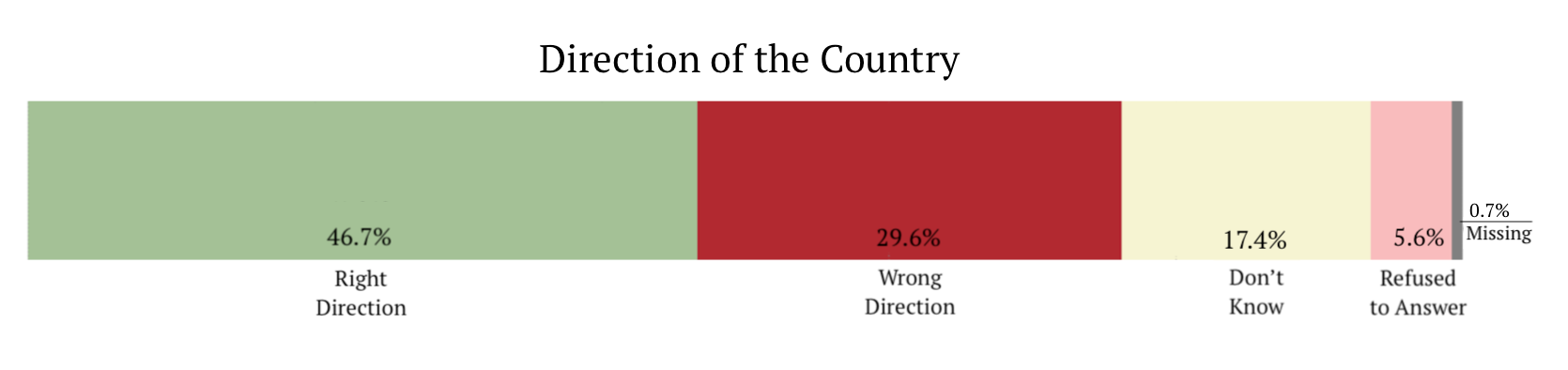
The survey asked respondents if the country is headed in the right direction or the wrong direction, a question consistently applied in voter behavior polling to more accurately observe the public pulse. 46.7% of the respondents said Armenia is headed in the right direction, while 29.6% said it is not, with 17.4% not providing a position. This is a 2.7% increase in the positive response from the third poll and a 1.3% decrease in the negative response, demonstrating a net 4% improvement in public perceptions of the country’s trajectory.
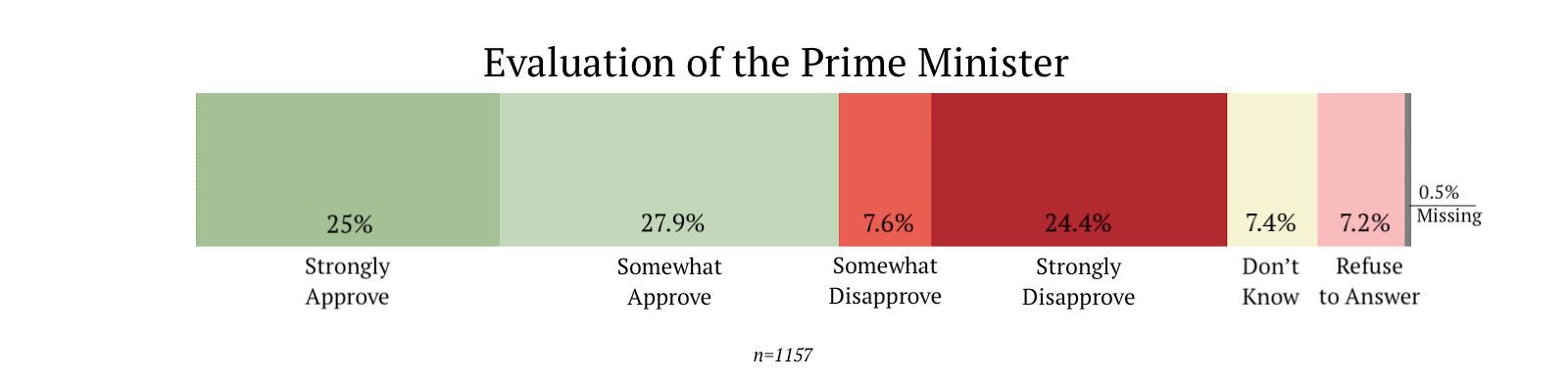
The question on the Prime Minister’s job approval also demonstrates a positive trend for the incumbent party, as 52.9% approve of Pashinyan’s performance, while 32% disapprove, demonstrating majority approval and a 4% increase from the previous poll. Interestingly, the “somewhat approve” remains constant from the previous poll, but the “strongly approve” number displays a 4% increase.
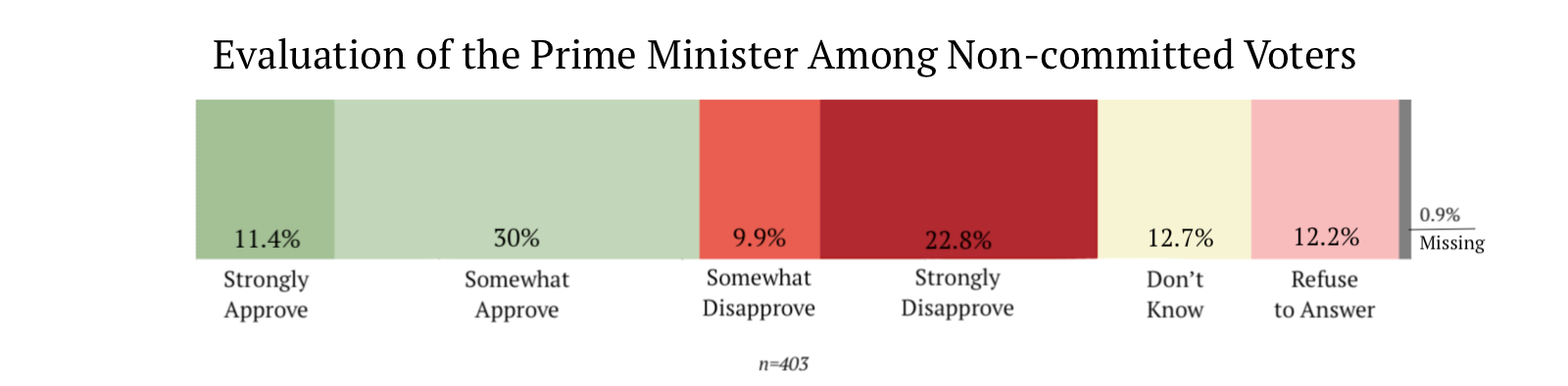
Among non-committed/undecided voters, as shown below, 41.4% approve of the Prime Minister’s performance, not much of a change from the third poll, while 32.7% disapprove, a 1.2% increase in disapproval compared to the third poll. The disaggregated data indicates that the Prime Minister has not made much improvements among undecided voters from the previous poll, but collectively, as his performance with non-committed voters remains strong.
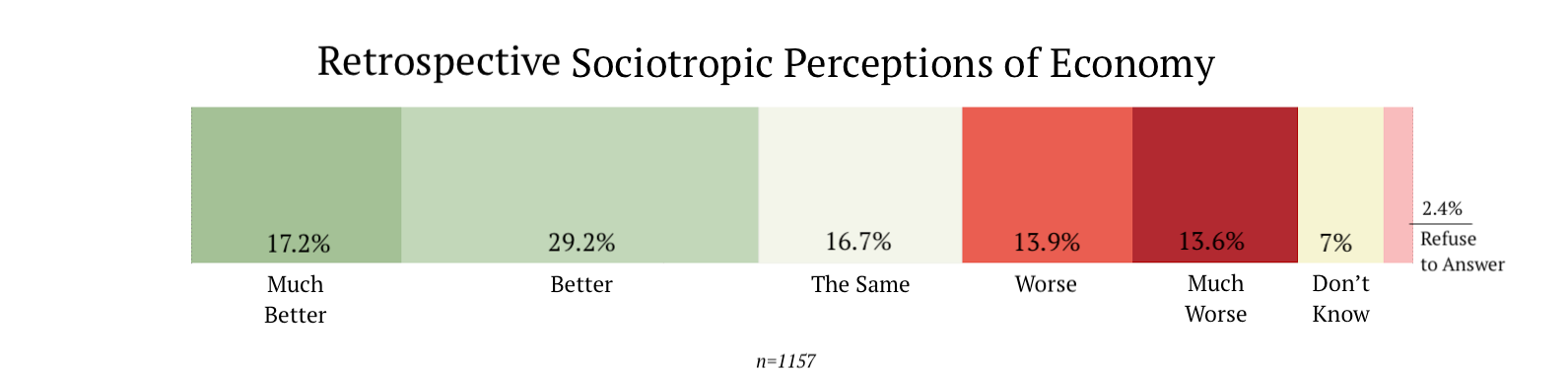
Measuring public perceptions on the state of the economy offers one of the stronger indicators of electoral performance, and to better understand this dynamic, this survey, similar to the previous three, asked two specific questions on the national economy, one retrospective and one prospective. The retrospective question asked respondents how do they qualify the current state of the economy when compared to the previous year, while the prospective question asked what they think the state of the economy will look like one year from the present. On the retrospective question, 46.4% of respondents stated the economy was better now than it was a year ago, an increase of 4.7% from the previous poll. 16.7%% noted it had stayed the same (a 4.9% decrease from previous poll), while 27.5% said it had gotten worse, a decrease of 1%. From the second poll to the fourth poll, the “same” response has methodically decreased, while approval of the economy has increased by approximately 7%, indicating growing approval of the economic trajectory.
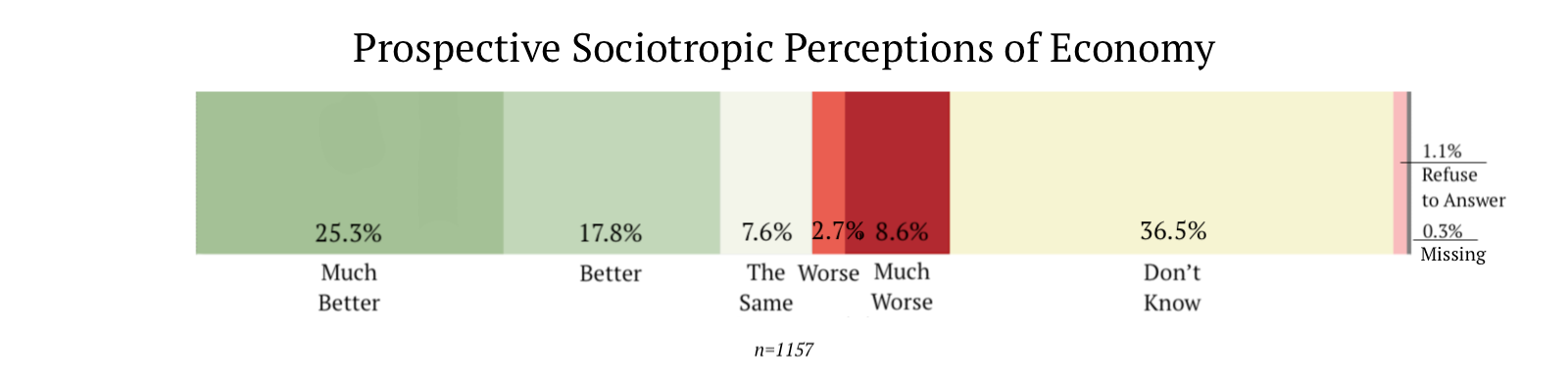
With respect to the prospective question, 43.1% said the economy will be better (an increase of 3% from the previous poll), while 11.3% said the economy will get worse (consistent with previous polling). Contextually, public perceptions of the current and future state of the economy remain consistently positive, ceteris paribus, which demonstrates an alignment both with positive trends on the direction-of-the-country question as well as the improved job approval numbers for the Prime Minister.
Noting the large percentage of non-committed respondents that have been the norm in all surveys conducted in Armenia after the 2020 Artsakh War, including our 2021 pre-election survey as well as in the previous three waves of this series, the anticipation of such a similar pattern for this wave was no different. To address this fundamental problem in polling, and to untangle the problem of understanding the voter preferences of the non-committed electorate, ArmES constructed a series of positional questions, designed as proxies, and employed respondents’ answers as a heuristic instrument to classify and predict their prospective vote choice. Positional questions are used in developing countries and broad-ranging regional survey projects (such as Afrobarometer) to deduce electoral behavior. In this survey, we asked questions to qualify respondent perceptions on justice and accountability, Armenia’s security situation, the TRIPP (Trump Road for International Peace and Prosperity) project, and trust in the Government to hold free and fair elections. Respondents were presented two varying policy positions, with one position aligning the response with the incumbent government and the other with the opposition.
The first positional question asked respondents to specify their stance on the following questions: The current government has or has not undertaken sufficient work to hold previous government officials responsible for illicit activities?
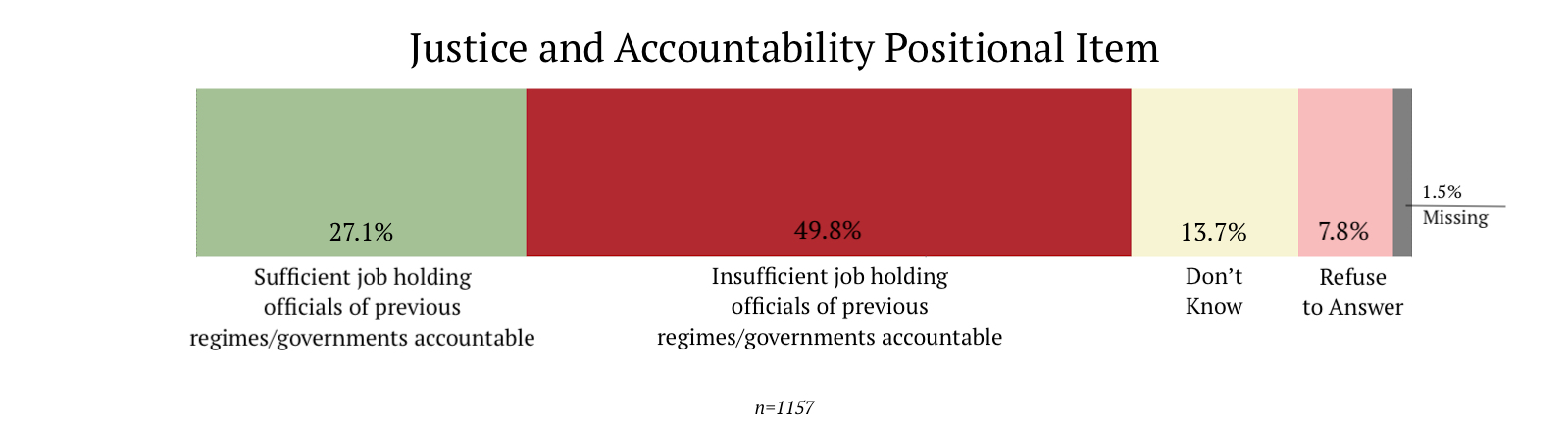
49.8% of respondents said that the Pashinyan Government has not done a sufficient job holding officials of previous regimes accountable for abuse of power, corruption, or other such illicit activities. On the other hand, 27.1% responded that enough has been done against officials of the previous governments. Compared to the previous poll, the disapproval of the Government’s performance on justice and accountability has decreased by roughly 6%, while approval has increased by 3%. So while the results of this positional question strongly indicates that there is broad public support for more comprehensive prosecutorial actions by the government to hold previous regime officials accountable, a growing number of citizens, very likely due to campaign messaging, are demonstrating shifts on this question.
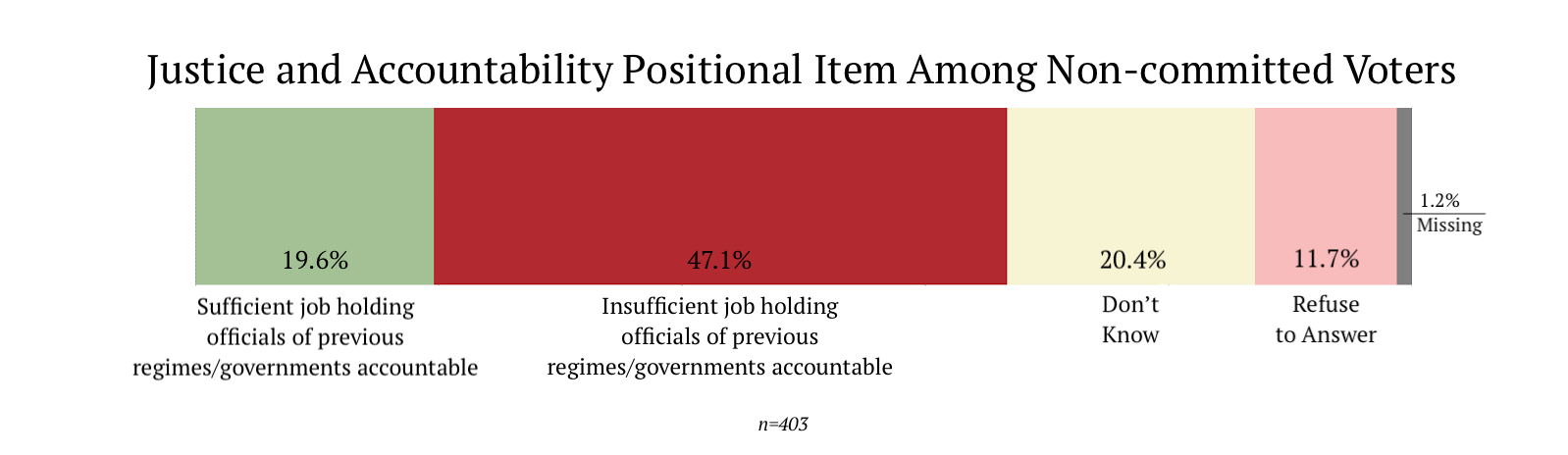
The demand for justice and accountability among non-committed voters, as displayed below, also remains quite strong, as 47.1% believe that the current government has done an insufficient job of legally going after previous government officials, while 19.6% believe that the government’s approach has been sufficient. Compared to the third wave of polling, support for more accountability against previous officials among non-committed voters has decreased by 1.7%, while support for ceasing prosecutorial activities has also decreased by 1.1%.
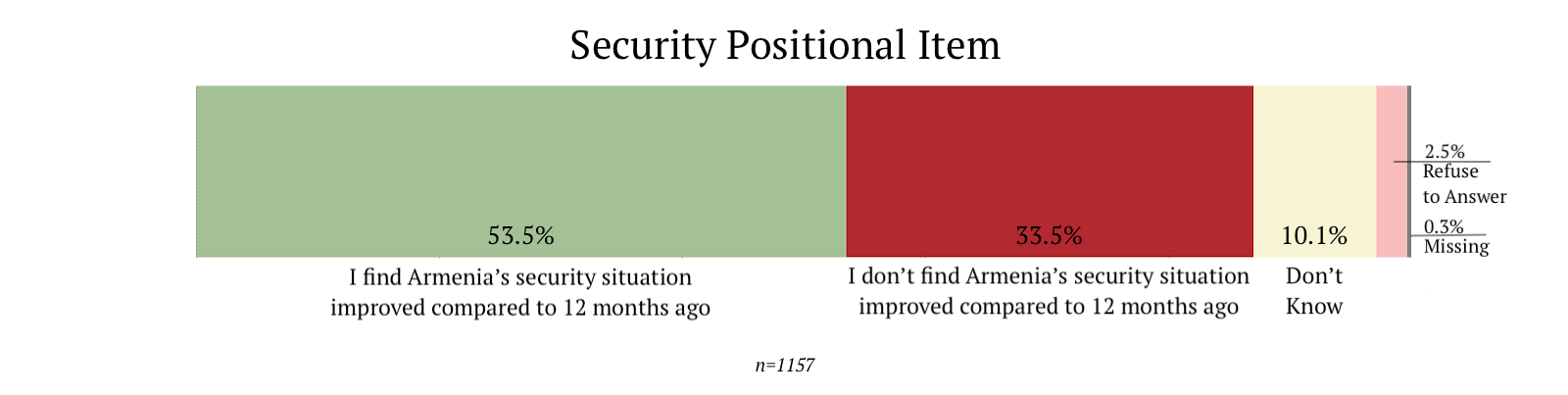
The second positional question asked respondents to disclose one of two positions on the following question: Has the security situation in Armenia improved or not improved when compared to one year ago? A significant majority responded that Armenia’s security situation has improved, demonstrating a consistent positive perception to the state of the country’s security landscape when compared to a year ago. 53.5% of society agree that the country’s security situation has improved (relatively unchanged from the previous poll), while 33.5% do not think there has been an improvement (a 2.4% increase from previous poll).
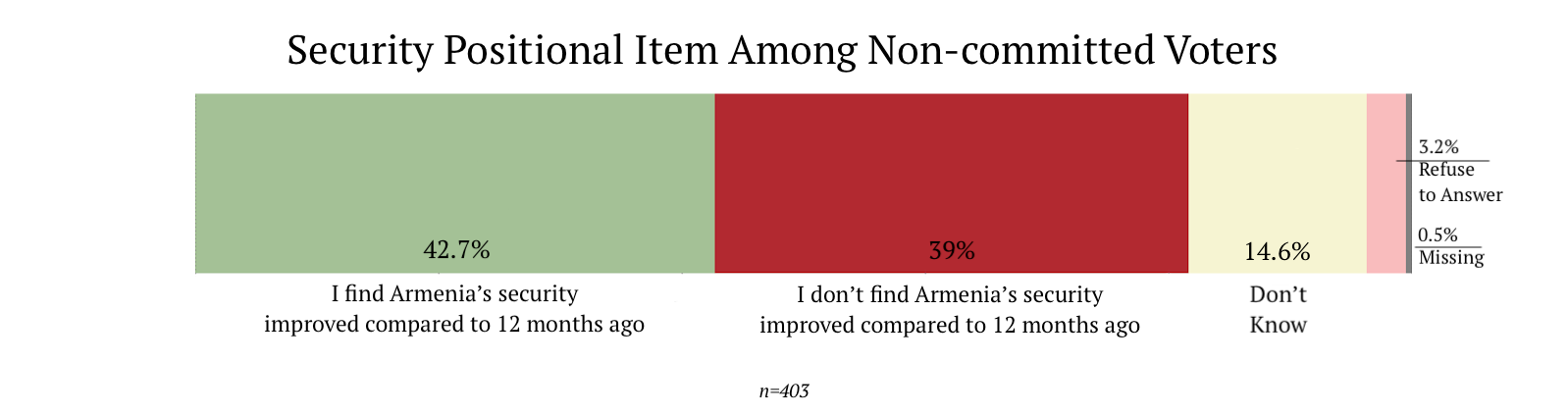
The positive marks for the security environment, while still above water with non-committed voters, nonetheless displays a comparative decline. The disaggregated results demonstrate that plurality of undecideds see collective improvement in the country’s security environment, as 42.7% of non-committed voters hold the position that the security situation has improved, while 39% hold the position that the security environment has not improved. This is a shift of 5.5% in declined approval among undecideds, while nonapproval numbers remain the same.
The third positional question asked respondents what their opinion is of TRIPP, with the two positional statements being framed as follows: TRIPP is beneficial to Armenia because it will bring economic growth and stability or TRIPP is not beneficial to Armenia because it will not bring economic growth or stability?
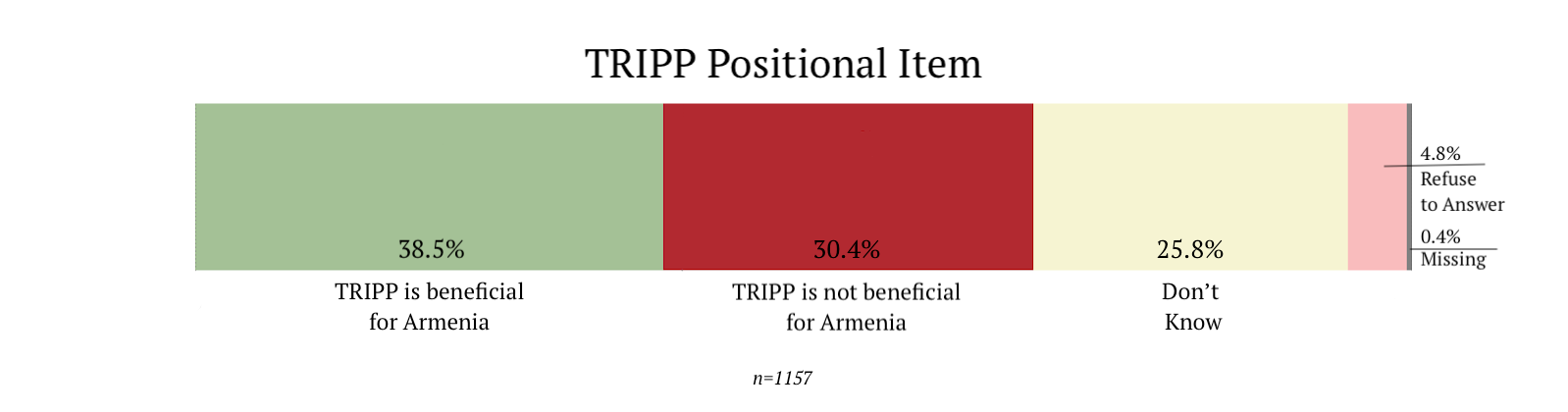
38.5% of respondents view TRIPP as being beneficial to Armenia, while 30.4% do not believe that TRIPP will bring stability and economic growth. 25.8% remained undecided or non-committed. The overall positive plurality of the response is an improvement from the previous poll, where 36.3% did not give positive marks for the TRIPP project. In this context, while the approval response only increased by 0.3%, the disapproval response decreased by almost 6%.
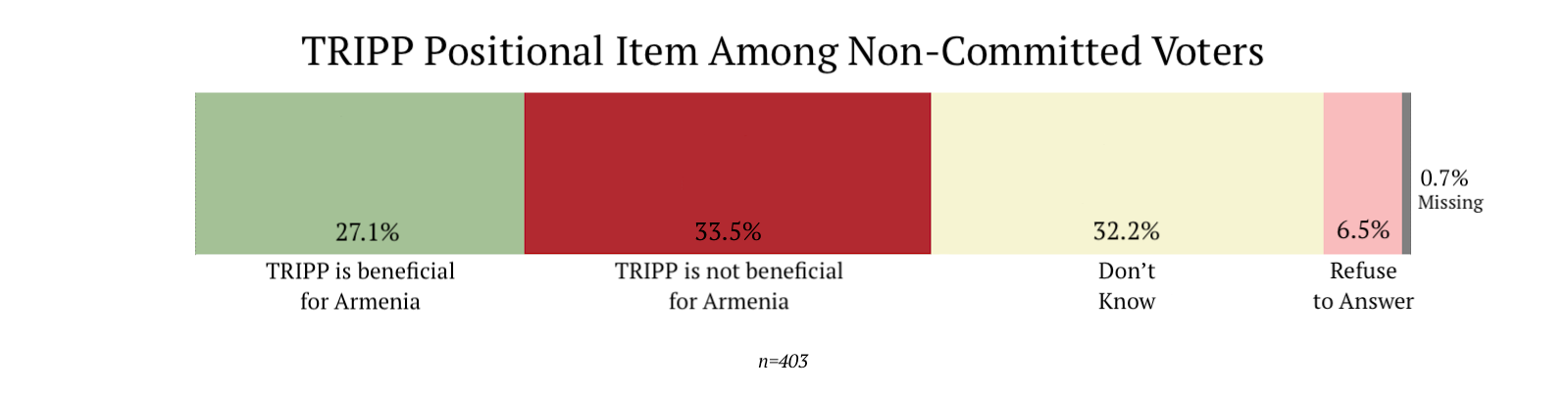
Among non-committed voters, as shown above, the relative negative perceptions on TRIPP remain consistent with the third poll: undecided voters have developed significant scepticism towards the TRIPP project. While the scepticism has decreased by 3% when compared to the previous poll (from 36.5% to 33.5%), TRIPP remains less popular with undecided voters than the general voting public.
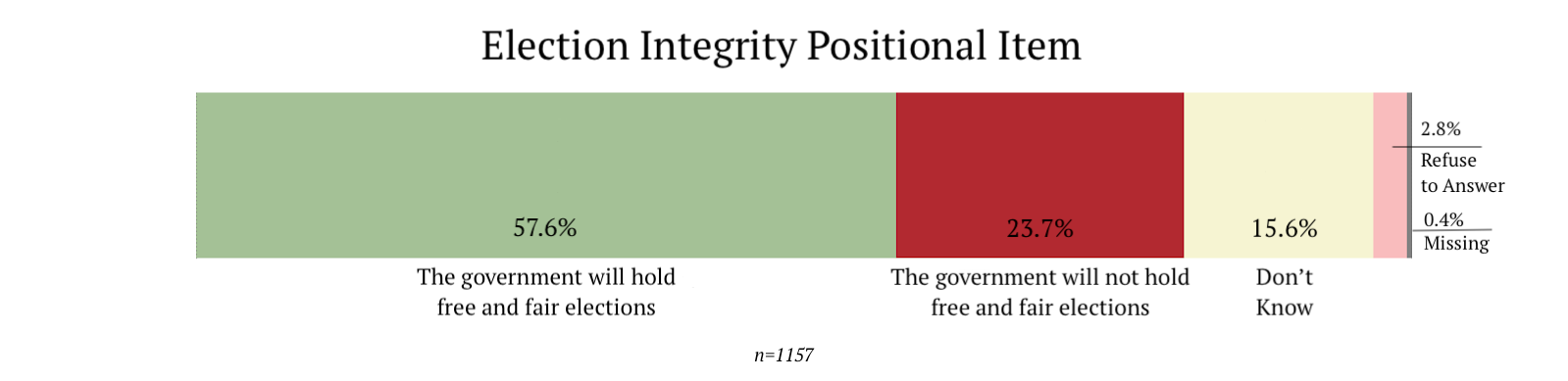
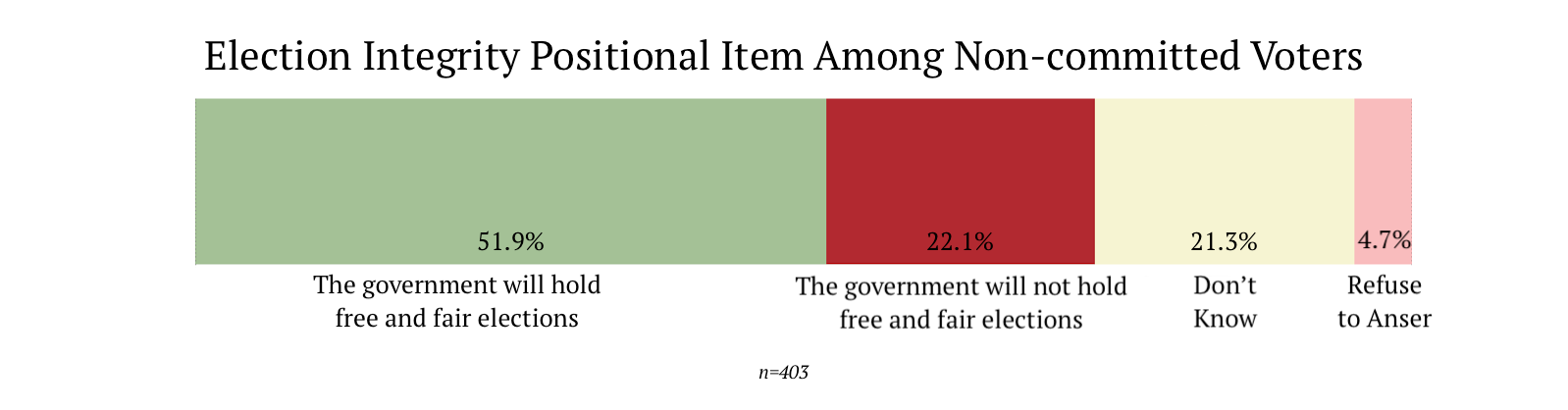
The fourth positional question asked respondents if they believe that the government will hold free and fair elections? As the results below demonstrate, 57.6% displayed trust in the Government to hold legitimate elections, while 23.7% did not. This significant vote of confidence in the Government to hold free and fair elections aligns with general positive responses on the Prime Minister’s job approval, which is more cogently observable when disaggregating the results of undecided voters. 51.9% of non-committed voters believe that the incumbent Government will hold free and fair elections, while 22.1% do not, a fairly strong indicator of trust in the democratic attributes, at least in the electoral domain, of the Pashinyan Government.
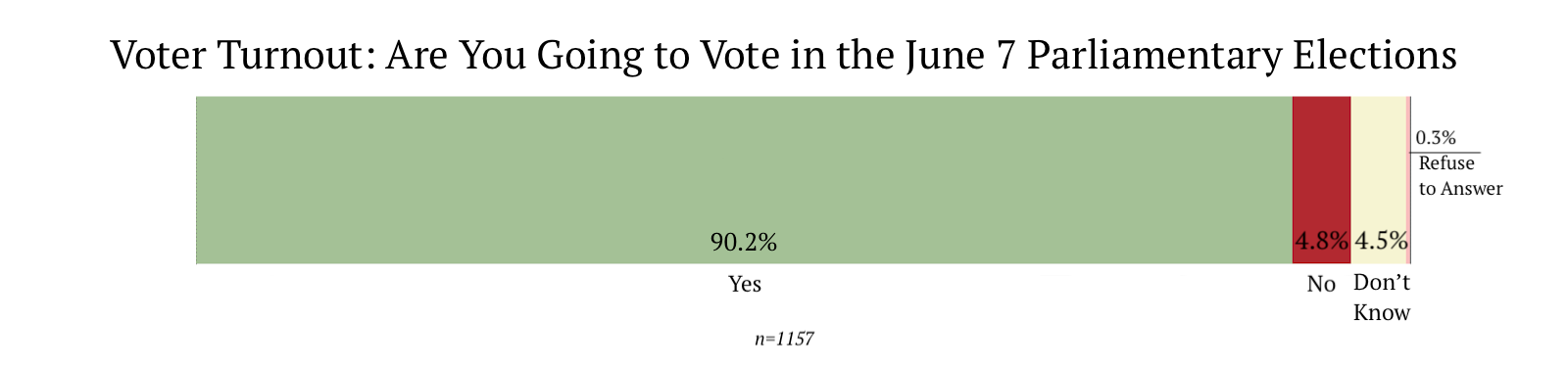
To gauge both voter turnout and vote intention, respondents were asked whether they will be voting in the June 7 Parliamentary elections, and if so, which party or alliance would they vote for. Approximately 90% of respondents noted that they intend to vote in this weekend’s elections (an increase of almost 5% from previous poll), which means that the produced results are modeled off of the premise of a 90% voter turnout. As is the accepted norm in the polling industry, and as addressed in our previous three surveys, this is expected and remains consistent with much of the voting behavior scholarship analyzing the “turnout gap” that exists between self-reported turnout in surveys and actual turnout data. As such, respondent’s intent in voting and actual voter turnout usually differ by a margin of 10% to 30%. For our purposes, the higher turnout percentile in the model allows for a more rigorous and conservative estimate of front-runner or dominant party results.
With respect to vote intention, the first set of results, without including the directional leaning of non-committed voters, shows plurality dominance by Civil Contract at 36.3%, an increase of 3.8% from our previous poll. The increase, to some extent, appears to be correlated with the decrease of undecided voters in this fourth wave when compared to the third wave: 39.5% to 37%. The percentile shift is also noted within the opposition parties. Strong Armenia, headed by Narek Karapetyan as proxy for his uncle, Russian-Armenian tycoon Samvel Karapetyan, comes second with 12.15%, an increase of 2% from the previous poll. The Armenia Alliance, led by former-president Robert Kocharyan, which needs 8% in Sunday’s election to meet the electoral threshold since it is running an alliance and not a single party, comes in third at 4.84%, while Prosperous Armenia Party (PAP) ranks fourth with 3.1%. The marginal increase in the Armenia Alliance vote is correlated with the decrease in PAP’s vote, while Strong Armenia’s 2% increase demonstrates an observable bump from active campaigning. Both Armenia Alliance and PAP do not meet the electoral threshold to enter Parliament, but since Armenia’s constitution requires three political forces, the third party that is closest to the threshold automatically enters. In this context, should the results stand as they are, the Prosperous Armenia Party will enter Parliament as the third force, since their results are closer to the one-party 4% threshold than the Armenia Alliance’s results.
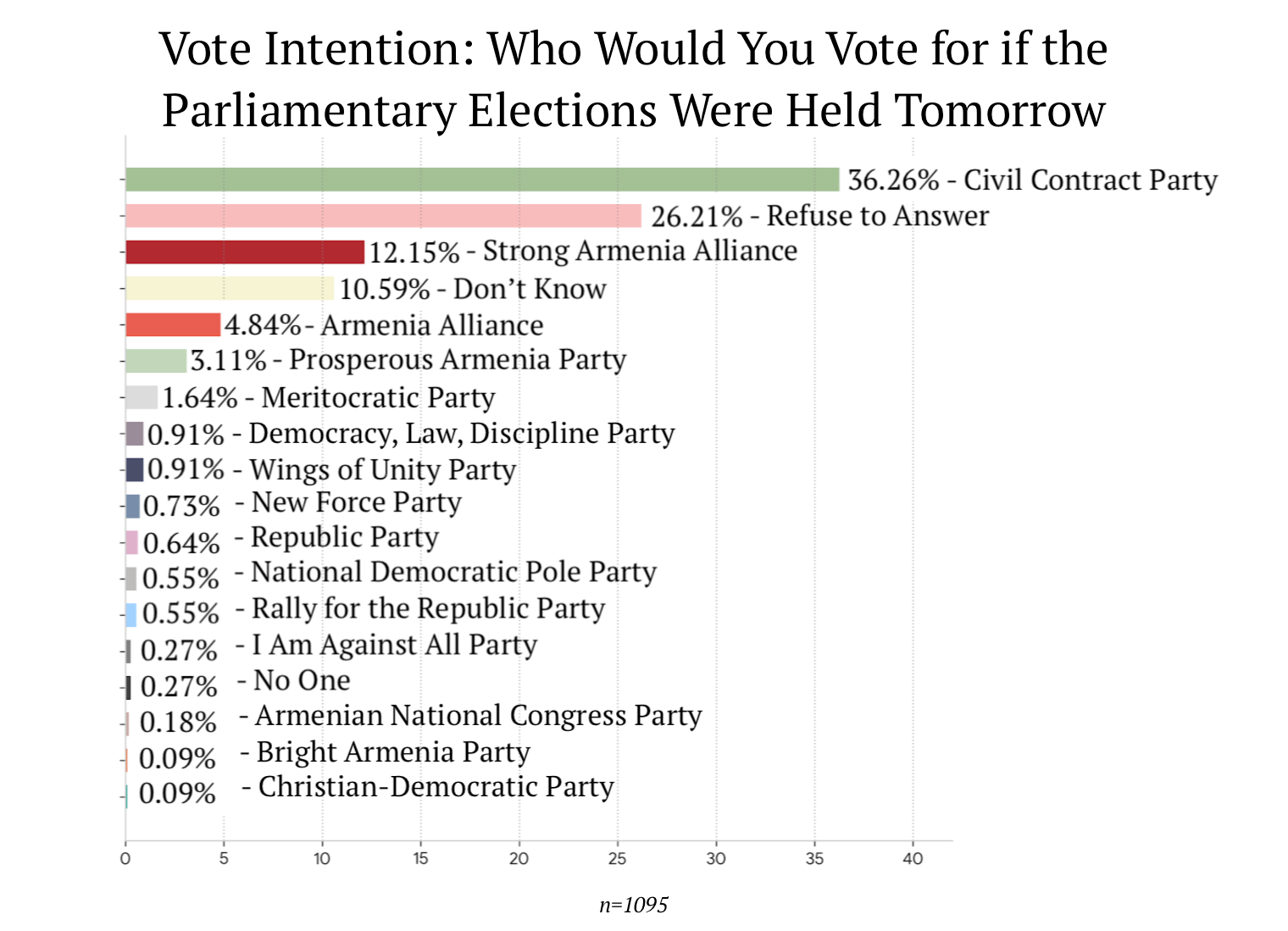
Collectively, none of the parties aside from Civil Contract and Strong Armenia meet the threshold of entering Parliament, especially the parties representing the pro-West factions, such as the Republic Party of Aram Sargsyan or Rally for the Republic of Arman Babajanyan, or the “third-way” parties such as the Wings of Unity led by Arman Tatoyan, Meritocratic Party led by Gurgen Simonyan, or New Force led by Hayk Marutyan. Armenia Alliance, as all four of our polls demonstrate, has been replaced by Strong Armenia as the mantle-bearer of the pro-Russia opposition, and not only has the Armenia Alliance bled votes to Strong Armenia, but the presence of PAP in the field has also led to electoral cannibalism between Robert Kocharyan and PAP leader Gagik Tsarukyan.
Polling results that are unable to account for undecided voters, especially in electoral landscapes such as Armenia’s, only offer a partial and incomplete glimpse into projective electoral outcomes. This is especially acute when considering the fact that nearly 37% of respondents in this poll qualify as non-committed. As such, the most important result in the vote intention category becomes the 26.2% that responded “refuse to answer” and the 10.6% that responded “don’t know.” These two categories, collectively, make up the non-committed in the Armenian electorate, which stands at 36.8%. The distribution of these votes, as has become the norm in Armenian elections, will determine the outcome of the 2026 Parliamentary elections. By discerning the directional leaning of the non-committed/undecided voter, this survey, like the previous three waves, introduces insights and results on the likelihood of how non-committeds/undecideds will vote.
This projective outcome is produced through our application of an empirically-grounded technique called additive index modeling. This approach is common in voting behavior studies, particularly among scholars who seek to analyze the political sophistication of the electorate. In our case, we created a 0-4 additive scale based on responses to the four positional items to denote the proximity of the respondent’s policy positions to the Prime Minister. A score of 4 indicates the highest level of issue proximity, while a score of 0 indicates the lowest. If we posit that the Armenian electorate is gradually casting their ballot based on issues (results from the first two surveys as well as the current poll provide evidence of this), then our additive index can provide predictability into their vote calculus.
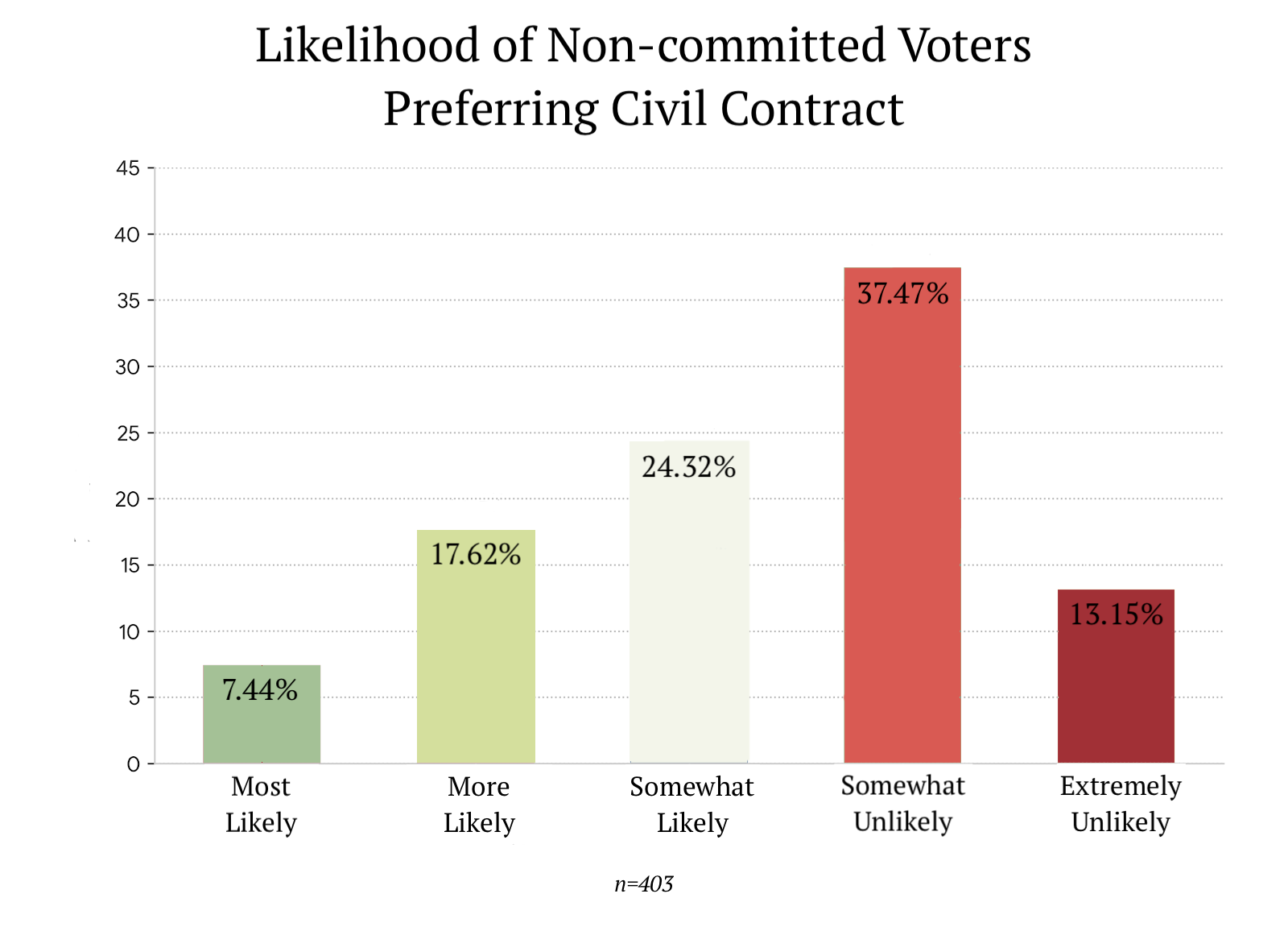
The results of the additive index model demonstrate that 7.44% of non-committed voters are “most likely” to vote for Civil Contract, 17.6% are “more likely” to vote for the incumbent party, while 24.3% are “somewhat likely.” Thus, collectively, 49.3% of non-committed voters lean toward the incumbent party. The directional likelihood of this category of non-committed voters voting for the current government remains statistically significant, and as such, robust. At the same time, 37.5% of non-committed voters are “somewhat unlikely” to vote for Civil Contract, while 13.15% are extremely unlikely.
As shown below, the findings from the additive index translate to a predictive vote intention model, which shows what the vote for the incumbent party will look like if 49.3% of non-committed voters, at the 90% turnout rate, vote for Civil Contract.
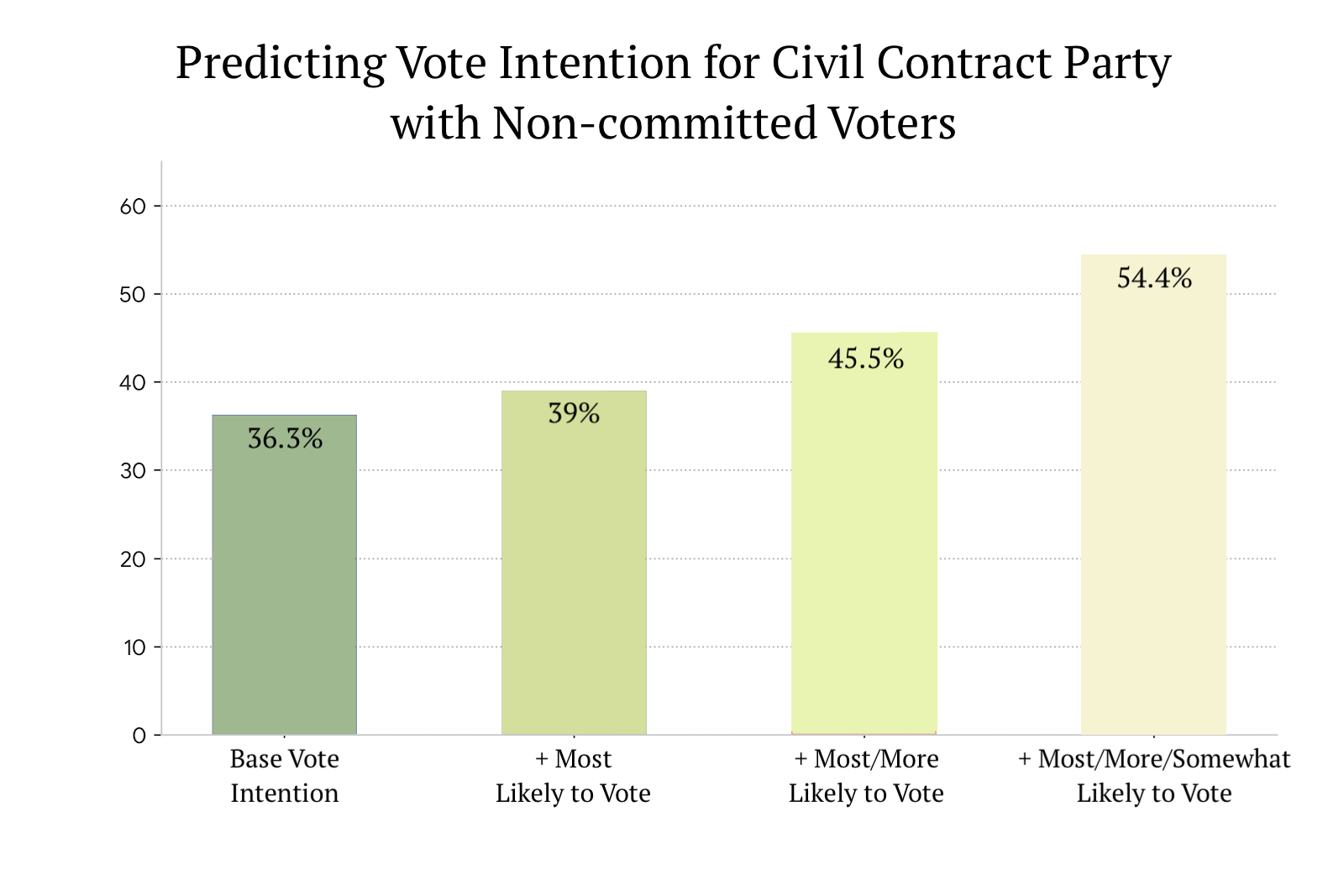
With a conservative estimate of only the “most likely” non-committed voters intending to vote for Civil Contract, the incumbent party’s vote share increases from the base vote intention of 32.5% to 39%. With the total number of “most likely” and “more likely” non-committed voters intending to vote for Civil Contract, the incumbent party’s vote share increases to 45.5%. With the entirety of the “likely” non-committed voters voting for Civil Contract, the party’s vote share increases to 54.4%. Important to note, however, is that the “somewhat likely” vote share, which makes up 24.3% of the undecided voter, while leaning toward Civil Contract, is not a guaranteed vote for Civil Contract. As such, the 54.4% outcome, with a 90% voter turnout, in this model, is a best case outcome for Civil Contract. Thus, statistically speaking, Civil Contract, currently, has a vote share of between 45.5% to 54.4%; meaning, if the elections were held now, and 90% of registered voters turned out to vote, Civil Contract will receive more than 45.5%, but are not guaranteed, at this point, to secure 54.4% with certainty.
About ArmES
ArmES was launched prior to the 2017 Armenian Parliamentary Elections as a mechanism for the scientific inquiry of the Armenian Electorate. Distinguishing itself from other polls and surveys, the framework of ArmES rests on voting behavior scholarship. Each question asked is grounded in empirical evidence. The study’s questionnaire is constructed around the socio-psychological model (SPM) that posits vote intention as a factor of sociological and psychological indicators. Subsequent waves – in 2018 and 2021 – carried a similar methodological approach towards analyzing the Armenian voter prior to the 2018 and 2021 parliamentary elections.
About the authors
Dr. Rafael Oganesyan
Dr. Rafael Oganesyan is the program manager at the Office of Undergraduate Research at the University of Nevada, Las Vegas. His research portfolio includes voter behavior, economics and elections, and post-Soviet politics. Rafael is also the director of the Armenian Election Study (2017, 2018, 2021), a pre-electoral survey of the Armenian electorate. His work has appeared in various academic journals, including French Politics, Journal of Common Market Studies (JCMS), and Journal of Elections, Public Opinion, and Parties.
Dr. Nerses Kopalyan
Dr. Nerses Kopalyan is an Associate Professor-in-Residence of Political Science at the University of Nevada, Las Vegas. His fields of specialization include international security, geopolitics, political theory, and philosophy of science. He has conducted extensive research on polarity, superpower relations, and security studies. He is the author of “World Political Systems After Polarity” (Routledge, 2017), the co-author of “Sex, Power, and Politics” (Palgrave Macmillan, 2016), and co-author of “Latinos in Nevada: A Political, Social, and Economic Profile” (2021, Nevada University Press). His current research and academic publication concentrate on geopolitical and great power relations within Eurasia, with specific emphasis on democratic breakthroughs within authoritarian orbits. He has conducted extensive field work in Armenia on the country’s security architecture and its democratization process. He has authored several policy papers for the Government of Armenia and served as voluntary advisor to various state institutions. Dr. Kopalyan is also a regular contributor to EVN Report.