
Listen to the AI generated audio article.
“You can be Armenian your whole life and still walk into Armenia feeling like you have to prove it.”
When a television crew stopped Karni Keushgerian on a Yerevan street and pointed a camera at her face, she forgot every word of Armenian she had ever known.
It wasn’t a lack of fluency. She had spoken it her whole life. It was the language of her kitchen table in Beirut; the ink she pressed into paper in the Armenian schools where she learned to draw the curls of the Armenian alphabet before she could even write her name—a name she would later be told she was pronouncing wrong. It was the harmony of church choirs, the lessons of Sunday school, and the quiet hours spent reading her great-grandmother’s diary, handwritten in Western Armenian, about surviving a genocide.
She has carried this language across continents, teaching it syllable by syllable to a chamber choir in upstate New York, packing it into her carry-on through airports and across borders. Western Armenian, after all, has spent the last century in transit.
But on that street in Yerevan, with the camera rolling and a reporter waiting, something shut down. The words were there; they just wouldn’t come out.
“In that moment,” she says, “I wished I had my Armenian language teacher in my pocket.”
Keushgerian grew up in Beirut’s Armenian community, where Western Armenian is actively maintained across generations. She didn’t so much learn it as absorb it.
“It feels like I was born speaking it,” she says. “I don’t remember a time before.”
At fourteen, she began to claim it. She read more deeply, tucked Armenian books into her luggage when she traveled, and wrote in Armenian in the margins of her English-language university notebooks, just to make sure she hadn’t forgotten who she was. Armenian was handed to her. At some point, she picked it up herself.
Now she is in Armenia. Working, building a life, trying to find something like home. And she is learning that the Armenian she has carried her whole life marks her as “other”; slightly off… as if she’s speaking Armenian with the wrong settings.
This is not a story about grammar or vocabulary, or about who’s right and who’s wrong. Eastern and Western Armenian are largely mutually intelligible. They’re close enough to follow, but just different enough to trip you up. Speakers of both can understand each other well enough. But “well enough” is carrying this entire conversation on its back.
The two Armenians diverged over a century of radically different histories. Eastern Armenian developed within the Russian Empire and later in the Soviet Union, where it was institutionalized and “ironed out” into a state-approved standard. Western Armenian survived in the diaspora—in Lebanon, Syria, France, Palestine, and the United States—carried by communities that had been displaced and left to preserve a language without a state.
Today, Western Armenian is classified by UNESCO as an endangered language.
But what gets lost between the two is not only structural; it’s social. It lives in the rhythm of a sentence, in the pause before a word lands. In the split second when someone decides it is simply easier to switch to English. That split second is where belonging starts to crack.
This tension is not unique to Armenian. But in Armenia, it carries particular weight. Language here is not just a tool of communication; it’s tied to survival, history and identity. When a shared language begins to signal distance instead of connection, the underlying question shifts. Not who speaks better, but something more existential.
Who gets to belong without having to show their ID at the door?
Linguist Dr. Rafik Santrosyan argues that the divide is often treated as more linguistically dramatic than it actually is.
“The distinction between ‘language’ and ‘dialect’ is not structural,” he says. “The difference is social and political.”
In other words, the tension is not really about whether Eastern and Western Armenian are “real” Armenian. It is about who gets treated as the default setting.
Keushgerian describes speaking in Yerevan the way someone might describe a chronic condition: not dramatic or acute, just always there, running alongside everything else.
“It’s imposter syndrome with my language,” she says. “It doesn’t even need to creep up, because it’s always there. It’s the beginning of every conversation.”
The moments that stay with her are the ones she doesn’t see coming.
Sociolinguists describe this process as code-switching: shifting between languages or dialects depending on context. It’s often framed as a skill, a sign of adaptability.
What people don’t talk about as much is how exhausting it can be.
She is walking down the street. Someone asks for directions and she has no time to build a script in her head, no time to code-switch, no time to prepare.
She is sitting in a meeting. Everyone is speaking Eastern Armenian. She has something to say, she knows she has something to say, but the words don’t come out.
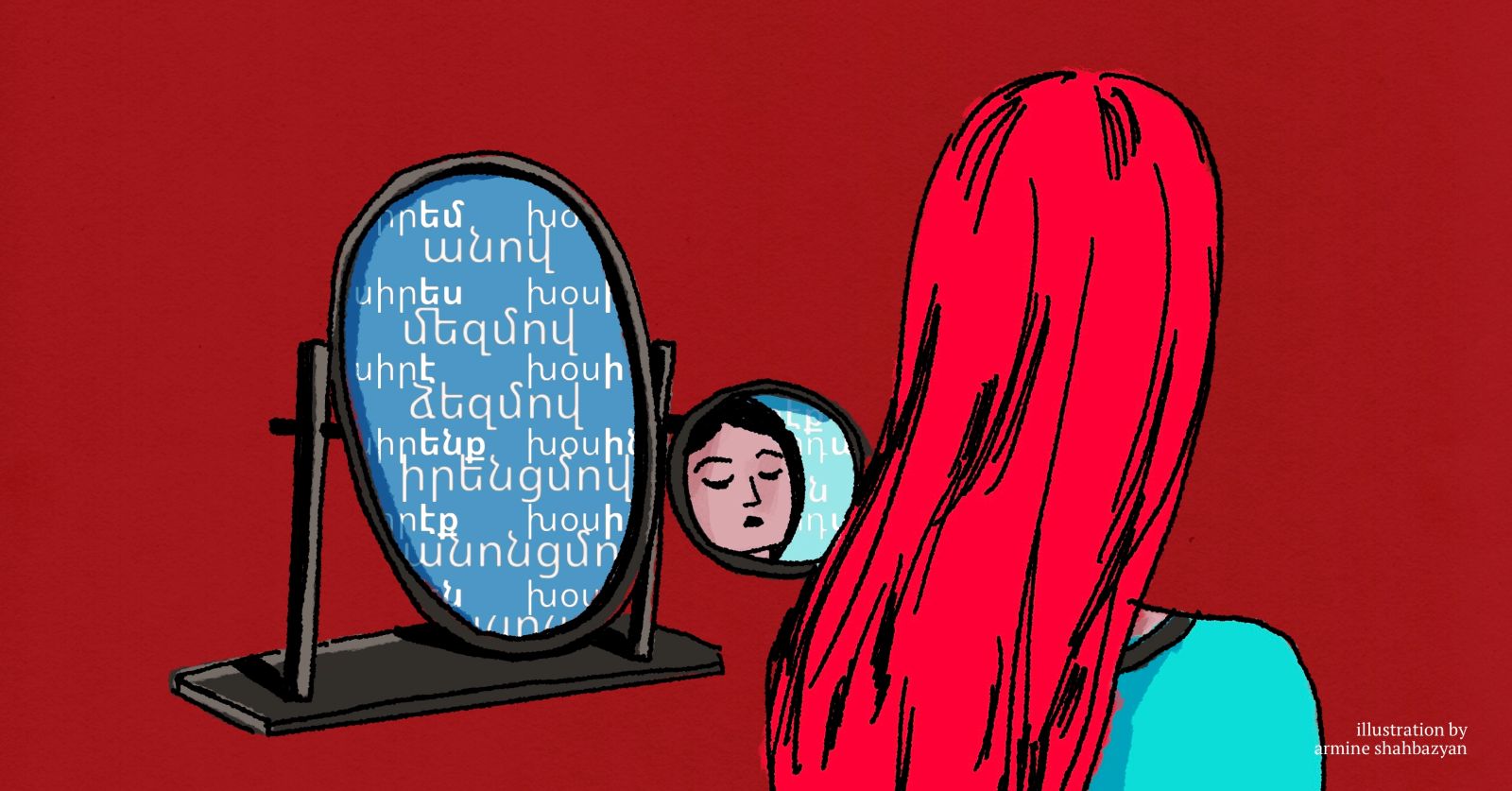
She goes home and says it to the mirror anyway, just to prove the thought still exists somewhere.
“It doesn’t come out,” she says. “So, I don’t say it.”
Over time, she began to adjust.
She avoids certain words, like the suffix -gor, a distinctly Western Armenian vernacular marker, the one that most immediately announces her “diaspora-ness” to the room.
“People warned me,” she says. “They told me that, at some point, I’d have to change my language.”
She didn’t believe them. Now she is learning, firsthand, what linguistic code-switching burnout actually feels like from the inside.
“It’s exhausting to constantly ‘translate’ yourself into a version people find acceptable,” she says.
Santrosyan says code-switching isn’t simply about changing vocabulary.
“You’re not losing your voice,” he explains. “You’re choosing which part of it to use.”
Still, constantly choosing can feel like a performance.
For speakers of Eastern Armenian, the adjustment exists too, but in a different way.
“When I talk to a person who speaks Western Armenian,” says Edgar Martirosyan, a Ph.D. candidate who grew up in Yerevan, “I become more conscious of the colloquialisms that might render my speech incomprehensible.”
The result, he says, is a kind of self-editing.
“A cleaner Armenian emerges,” he explains. “One that avoids Russian or Turkified expressions common in everyday speech.”
But that clarity comes at a cost.
“It becomes very difficult to joke,” he says. “So much in jokes lies in the organic, unprocessed side of language.”
Self-editing, Santrosyan argues, isn’t proof that Armenian is “breaking apart.” The sharper East-West divide people imagine today is “primarily political and historical,” he says, shaped by genocide, Soviet borders, exile, and diaspora life more than by linguistic incompatibility itself.
Something is gained: clarity, mutual understanding, a polite nod…
Something is lost: timing, personality, the luxury of speaking before you’ve had to translate yourself.
Sociologist Yuliana Melkumyan sees these interactions as more than linguistic.
“Language is a living organism,” she says. “It absorbs social changes and histories. Even small interactions: a correction, a glance, a switch to another language. All these carry enormous weight.”
When people adjust the way they speak without being asked, they’re responding to difference. They’re trying to build a bridge, but sometimes they end up building a wall.
“If they don’t have enough in common,” Melkumyan says, “they try to adjust.”
But adjustment is not neutral.
Language operates within power structures: which version is dominant in a given space, which one is expected to be understood, and which one is expected to adapt.
In Armenia, Eastern Armenian is the “default.” That default is rarely announced out loud, but it is reinforced through institutions, media, and everyday interaction.
When one side consistently adjusts more than the other, the exchange may look mutual, but it rarely feels that way.
Keushgerian knows exactly when she is performing: in taxis, in bookstores, in conversations that begin casually and turn, inevitably, into the same question: “So, where are you really from?”
She has learned to anticipate it. And sometimes to delay it.
“There’s a version of Eastern Armenian I perform,” she says. “Not because I’ve mastered it. Because it buys me time.”
Time before explanation.
Time before the “Genocide-to-Beirut-to-Yerevan” narrative.
“Every time someone asks me where I’m from, I have to tell them the story again,” she says. “Why I’m here. Why I left. And it has to sound the same every time.”
Some days, she doesn’t have the energy to tell it, so she switches to English. In Armenia, English carries its own kind of authority, and not everyone speaks it fluently.
“I’d rather sound powerful,” she says, laughing, “than stutter.” If she’s going to be a foreigner, she might as well be one with an accent that commands the room.
But power is not the same as comfort. In Yerevan, the version of herself she can’t access is the one she associates with Western Armenian, back in Beirut.
“In Western Armenian, I’m funnier,” she says. “Looser. More myself.”
For translators, this gap is familiar.
“The gap is only in training,” says Dr. Shushan Avagyan, a literary translator. “Western Armenian was always present in our home. Through books, through voices. It spun itself naturally around Eastern Armenian.”
Some words resist translation entirely. Avagyan recalls encountering the word զգլխիչ while translating Zabel Yesayan’s The Man.
“It struck me dumb,” she says. “It was so precise, so evocative.”
That’s not a failure of language; it’s proof that history leaves accents. And when speakers step outside their linguistic comfort to accommodate each other, something shifts.
“You are no longer operating within your familiar referential field,” Dr. Avagyan says. “You might not be able to express yourself fully.”
In some cases, she adds, “you lose yourself.”
Keushgerian understands that instinctively. When she speaks to her family in Lebanon, her Armenian changes.
“I don’t have to think twice,” she says. “I just say it, because I know it’s going to be received.”
No adjustments. No performance. Just language, doing what it’s supposed to do.
Martirosyan, from the Eastern Armenian side, doesn’t see the divide as fixed.
“I encourage Armenians from Armenia to listen,” he says. “To truly hear Western Armenian, to let it resonate.”
He wants the homeland to stop being so “my way or the highway” about the language.
Keushgerian’s name is pronounced differently in Eastern and Western Armenian. She knows this. When she was 16, she made a decision: she changed the pronunciation she used, shifting toward the Western Armenian version. She began to question why her name was being said in a dialect that wasn’t hers.
Same alphabet.
Same letters.
Different rules for how to be read.
People were hostile to the change. Even other Western Armenians.
Her first encounter with someone from Armenia happened in Lebanon. A visitor heard her name and told her, “‘Karni’ is not a real thing. The correct name is ‘Garni.’”
She was twelve. She hasn’t forgotten. Imagine being told your own name is a typo.
“Imposter syndrome gets to you even when you’re not living in Armenia,” she says. “It’s taught. The systems around you always want to keep you stuck in nostalgia, stuck in something unachievable. Because when you’re chasing something unachievable, you can spend your whole life trying to reach it. And when that stops, what do you have left to fight for?”
When asked what she would take with her if she left Yerevan tomorrow, Keushgerian pauses.
“Any artifact of the Armenian alphabet,” she says. “Because across time and space, between Eastern and Western Armenian, we share the same alphabet. And no one can take that away.”
The alphabet sits at the center of a language that has split, adapted, survived…
For over a century, Western Armenian has been sustained in schools, churches and families, what scholars describe as a “heritage language.” Eastern Armenian, by contrast, developed within a state.
One had a fortress; the other had a suitcase.
Before she came to Yerevan, someone told Keushgerian to bring as many books in Western Armenian as she could. Now she understands why.
Walk into a bookstore in Yerevan and try to find a book in Western Armenian. Watch the pause. Watch the shelves being scanned. Watch the moment your language becomes a special request.
In Beirut, she says, you can walk into any Armenian institution and ask for a book, and they will pull it from under the desk.
Here, it feels like a scavenger hunt.
“We are in a country that speaks Armenian,” she says. “And there are no books in Western Armenian.”
So when Keushgerian walks through Yerevan, she carries a library in her head that the city around her has forgotten to shelve. She possesses a version of herself that is sharper, funnier and more “at home” than the one she presents to the world.
To live in Armenia as a Western Armenian speaker is to live as a ghost in your own history. Surrounded by what’s yours, still being asked to prove it.
“If everyone is speaking Armenian and nobody feels understood,” Keushgerian says, her voice steady but heavy, “the language isn’t the problem. The language is doing its job. We’re not listening.”
Keushgerian is realizing that you can cross the ocean, you can repatriate and you can plant your feet in the soil of your ancestors, but you don’t return the same. You return with a tongue that survived the desert, and you shouldn’t have to swallow it just to be understood.
And perhaps, the greatest power isn’t the English she uses to command a room. It’s the Western Armenian she whispers to her mirror at night; a language that doesn’t need to prove it belongs, because it already knows the way home.

Cover photo by Meghrie Yaacoubian.
LIFESTYLE
Molecules
From Armenia’s overlooked perfume heritage and the invisible border between Eastern and Western Armenian to Vanadzor’s quietly flourishing creative scene and the enduring voice of the duduk, this month’s SALT reveals the many ways that identity is expressed and preserved.

The Laboratory of Scents
Part laboratory, part museum and part classroom, Yerevan's Perfume Museum is more than a collection of antique bottles. It's a working laboratory, a classroom and the culmination of perfumer Sargis Azaryan's decades-long effort to revive Armenia's rich but often overlooked perfume heritage.
Read more