
Listen to the AI generated audio article.
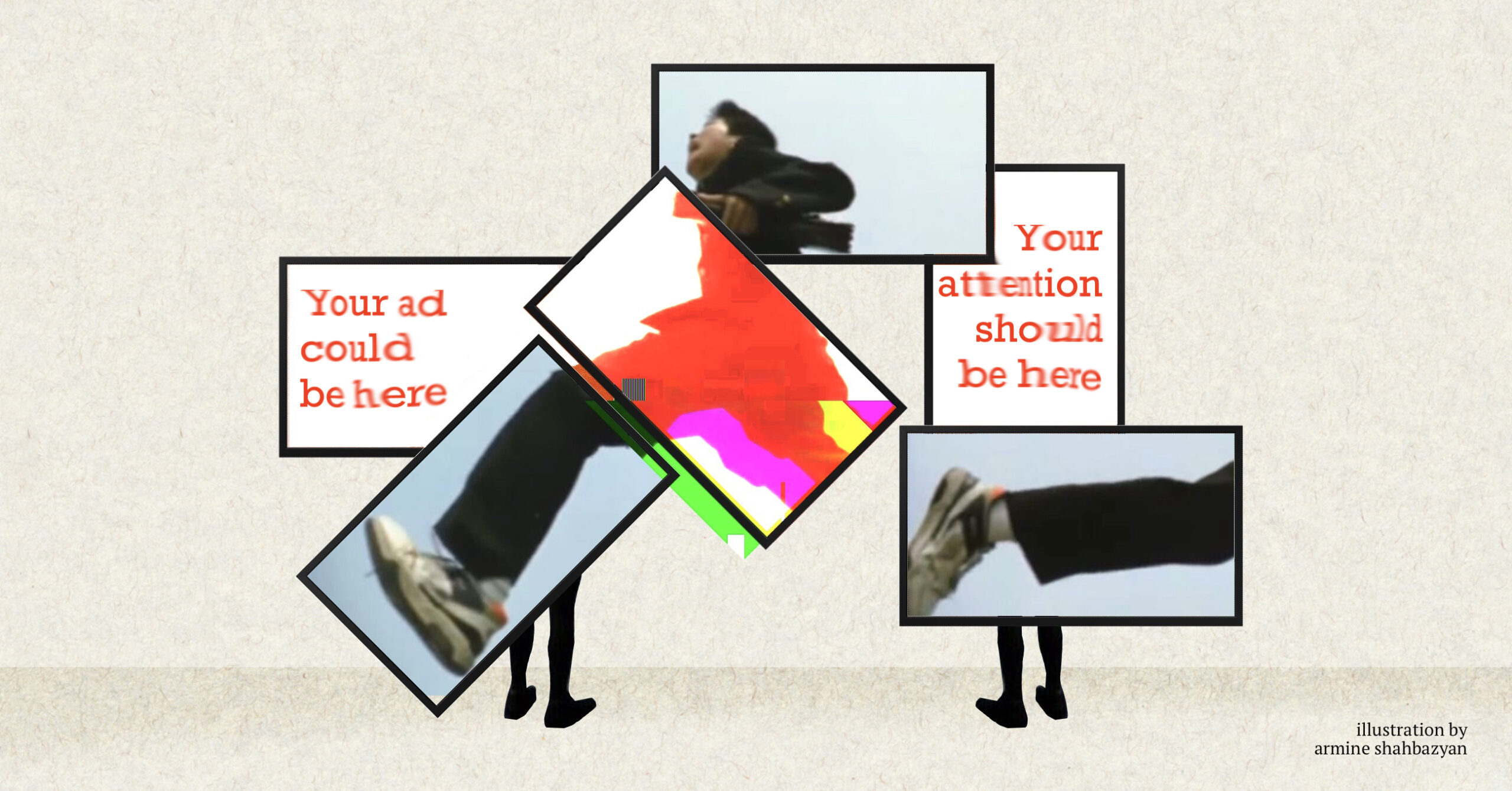
A peculiar sight appeared on Yerevan’s streets this past summer: a fleet of human billboards, clad in red. Seen only between 12-3 p.m. and 6-11 p.m., these “walkers” are a jarring sight for both newcomers and long-time residents. Who are they, and why are they walking?
MoveIt, a local startup that launched operations in March 2026, is behind this new addition to Yerevan’s streets. Similar experiments in contemporary advertising are underway in Moscow, St. Petersburg, and the United States (the founders adopted the idea after a visit to Miami), so this is hardly a phenomenon unique to Armenia. The company presents its walkers as the solution to a problem in Armenia’s advertising, arguing that static billboards visually pollute Yerevan’s historic center and that it is helping the city’s leadership phase out older billboards. Yerevan has been saturated with advertising in recent years, and the growing use of AI-generated content is likely to add another layer of visual noise. It is unclear, however, how moving advertising from billboards to the sidewalk actually solves the problem. If anything, it may simply relocate it, and make it harder to ignore. Yerevan’s recent construction boom has produced far greater changes to the cityscape than static billboards which, by MoveIt’s own argument, people are often able to ignore. The walkers raise a different question: what happens when advertising stops being something we look at and becomes something that moves among us?
The answer begins with the people doing the walking. MoveIt’s exact wage rates are closely guarded, but the work is paid well enough. Co-founder Alex Aslanian assured me he “would have done backflips” for such an opportunity when he was younger, and the workers I spoke to independently had few complaints about their compensation. This isn’t the gig economy, at least not in the manner of Yandex or Glovo, where workers have no guaranteed daily income or protections and compete for each delivery contract. Here, neither precarity nor exploitation characterizes the work. Rather, MoveIt is a symptom of “spectacle”: the human body reduced to a canvas in service of consumption.
We have been here before. The advertising industry has often prompted cultural reflection, and in the 1960s, the Situationists in France spearheaded a sharp critique of its effects and ubiquity. Guy Debord’s seminal 1967 work The Society of the Spectacle, organized as a collection of aphorisms, gave voice to a growing sentiment that advertising was profoundly transforming the world: “In all its specific forms, as information or propaganda, as advertisement or direct entertainment consumption, the spectacle is the present model of socially dominant life. It is the omnipresent affirmation of the choice already made in production and its corollary consumption.”
Reducing the Situationist critique to media and aesthetics risks obscuring their larger political point about spectatorship and passivity. Still, their commentary on modern advertising remains prescient and incisive.
Jean Baudrillard later built on many of Debord’s observations in his theory of the “object”. In The Consumer Society (1970), he wrote: “Strictly speaking, the humans of the age of affluence are surrounded not so much by other human beings, as they were in all previous ages, but by objects. Their daily dealings are now not so much with their fellow men, but rather […] with the reception and manipulation of goods and messages.” Advertising, for Baudrillard, was “the permanent spectacle of the celebration of the object.” People were being replaced by objects and representations.
Now, in Yerevan, they have been replaced by the digital object: LCD screens.
Media and advertising have clearly changed since the 1960s. What remains relevant from this era of cultural criticism is the question of how advertising captures attention by placing itself directly in our field of vision, and in this case, by putting a human body at the center of the process. Walkers are trained to intercept large groups on the pavement; to walk on the shaded side of the street to catch those hiding from the heat; and to stand at crossings with their backs turned, forcing those waiting on the other side to look at them. Even their pace is carefully coordinated, and live GPS tracking ensures that walkers can be diverted in real time to the needs of MoveIt and its clients. This broader approach draws on a long history of advertising techniques designed to capture attention, including the work of Edward Bernays—Sigmund Freud’s nephew—whose influence on modern public relations and advertising dates to the 1920s. Bernays famously helped expand the cigarette industry under the guise of gender equality and later provided cover for United Fruit’s involvement in the 1954 coup in Guatemala. According to the company, sociologists and psychologists were brought on board during MoveIt’s early development as routines of the walkers were being designed. Much more than branding, permits and flashy screens has gone into the development of the phenomenon.
For eight hours a day, MoveIt’s walkers are on their feet, carrying the weight of the commercial world. It isn’t the most physically demanding job, but neither is it easy. After hours under the beating sun, the screen backpacks, however lightweight, make your shoulders ache and back hurt: on this, every walker I interviewed agreed.
This is not the kind of job that becomes a vocation. More often, it is a necessity or stopgap for people who can’t find work elsewhere because of language barriers. They speak Russian, English, Farsi, and sometimes French, but few are fluent in Armenian. It is rare to see a walker without headphones. Sometimes they are listening to music; often, they are listening to language courses or Armenian audiobooks, trying to learn on the job. Many of MoveIt’s workers are recent migrants to Yerevan: Iranians or Russians fleeing conflict, distinct to the recent waves of Indian economic migration that have staffed Yandex.
In some respects, headphones also guard against the noise inherent to the job. MoveIt celebrates being the only outdoors advertising company in Yerevan that incorporates sound. Loops of jingles and assorted noises, though potentially catchy to passers-by, are incredibly grating to those who have to hear them for eight hours a day. The small act of wearing headphones reveals a profound detachment from the work the walkers are supposedly doing. That detachment was further illustrated by the sight of one walker bending and contorting in front of a mirror, trying to see what it was exactly that their body was advertising.
The walkers I spoke to come from a range of professional and creative backgrounds and it shouldn’t need stating that no form of work should be denigrated. But the sight of people with skills and professional aspirations spending their days turning their bodies into advertising space raises a larger question about what we ask people to become part of in the name of advertising.
MoveIt presents its format as a revolution in Yerevan’s advertising. But how effective is it, and what kind of change does it actually represent? The founders told me they have not conducted on-the-spot surveys of pedestrians to gauge interest. Instead, the company relies on footfall statistics and the assumption that visibility translates into engagement. Yet there is an interesting distinction between being noticed and having an advertisement noticed: talk to people on Yerevan’s streets and they will agree: what they notice aren’t the ads that MoveIt’s clients pay to run, but the spectacle of the MoveIt walker. One walker told us they thought the job did more to advertise MoveIt’s own brand than that of its paying customers.
Debord argued in 1967 that the “basically tautological character of the spectacle flows from the simple fact that its means are simultaneously its ends.” If an advertising company that succeeds only at advertising itself isn’t spectacle, then what is?
LIFESTYLE
Lace Up
SALT’s September issue is all about movement: running, cycling, walking, wandering and remembering. From Armenia’s growing running culture and the Tour of Armenia to the human body serving as spectacle, we explore how the city is experienced in motion. We also look back at Yerevan’s memories and uncover a coffee shop hidden behind a secret door.
The Run Is On
Once uncommon in Armenia, running has grown into a vibrant culture of clubs, races and communities. From Yerevan to Gyumri, Vanadzor and Dilijan, runners are reshaping attitudes toward fitness, friendship and outdoor life, turning a once-unfamiliar pastime into a growing part of everyday life.
Read more