
Listen to the AI generated audio article.
It is hard to overstate just how vital Lake Sevan is to Armenia. Covering 4.2% of the country’s territory, the lake is a vast inland body of water in a small, landlocked nation, sitting nearly two kilometers above sea level and surrounded by mountain ranges. Yet over the past century, Sevan has endured a turbulent history of ups and downs.
During the Soviet period, more than 40% of its volume was drained for irrigation and hydropower, leaving the lake ecologically imperiled. The shoreline receded so much that the island became a peninsula. As Armenia industrialized and the need for Sevan’s water for hydropower had largely faded, Soviet authorities reversed course. A nearly 50-kilometer tunnel was constructed to bring additional water to the lake and help restore its levels.
By the turn of the century, the lake was ecologically fragile, but the outlook was optimistic as its level rose by four meters. After a decade of stagnation, caused by factors such as renovation of the tunnel and increased outflow for irrigation, the situation took a downturn. In the summer of 2018, Sevan turned visibly green as an algae bloom spread across its surface, a stark warning that the lake is unwell.
Specialists immediately identified the flow of untreated sewage into the lake as one of the key factors contributing to the situation. While wastewater has undergone mechanical treatment since 2013, there is no infrastructure to treat it biologically before discharge into the lake. This is a major pollutant, which suffocates organisms, including the famed endemic trout known as ishkhan.
Sevan’s wastewater problem is part of a larger pattern of long-term mismanagement of the country’s water resources. Wastewater treatment in general is severely limited with only 8% of the country’s wastewater receiving mechanical treatment and only 0.13% biological treatment. Mechanical treatment only provides screening with grit and grease removal. Untreated or minimally treated urban wastewater is discharged directly into rivers.
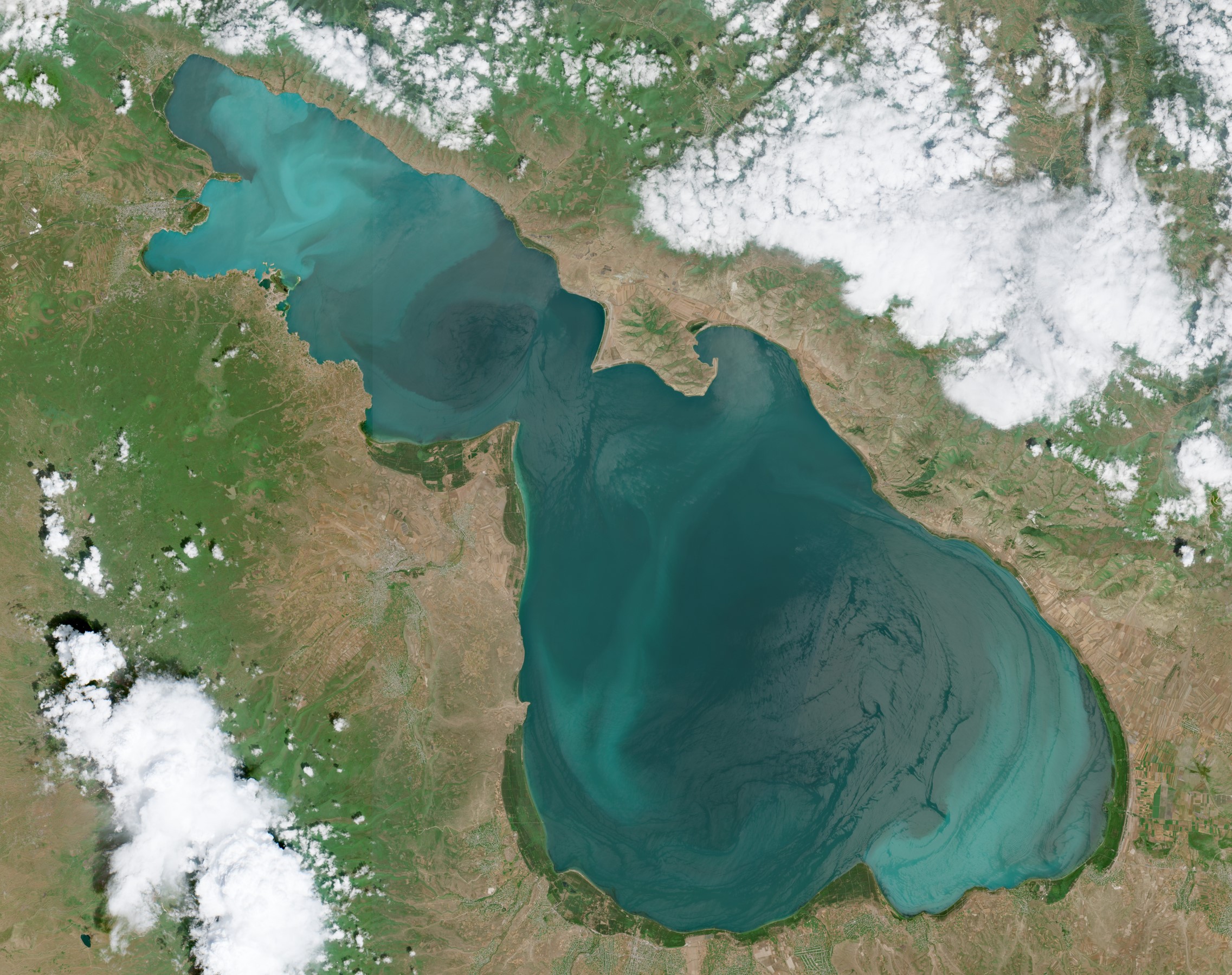
A satellite image of Lake Sevan on August 3, 2026 showing algae bloom (Sentinel-2 L2A satellite, via Copernicus Browser)
By 2019, a hydrogen-sulfide-rich layer had formed in Lake Sevan’s deep waters, accounting for 19% of the lake’s total water volume. The layer was completely depleted of oxygen and nitrate, creating conditions highly hostile to most aquatic life.
Futile Efforts
Plans for biological wastewater treatment date back to at least 2019. Authorities then spoke of the need to establish plants for the cities of Gavar, Martuni, and Vardenis to prevent untreated waste from flowing into the lake’s tributary rivers.
The Pashinyan government’s action plan, adopted in November 2021, envisaged the implementation of a project to protect Lake Sevan over the 2024 to 2026 period. The project aimed to ensure the complete treatment of wastewater discharged from treatment plants across the three cities in the lake’s basin, develop proper sewerage systems in the region’s rural communities, and require local businesses, including restaurants and car washes, to install localized wastewater treatment systems and equipment.
A comprehensive management plan for the Lake Sevan basin, approved by the government in December 2022, proposed several interventions. These included a pilot project that would introduce innovative on-site sanitation in three small villages and building new wastewater treatment plants in larger villages. Most importantly, the existing treatment plants in Gavar, Martuni, and Vardenis were slated for technological upgrades to add proper clarifiers and biological treatment stages, which would allow treated water discharged to the lake to be safe and even potentially reusable for irrigation or technical purposes. Funding, however, was not secured for the project.
Concurrently, in March 2021, the EU and Armenia launched the Environmental Protection of Lake Sevan (EU4Sevan) project, which aimed to enhance the capacities of public and private stakeholders to ensure improved wastewater treatment. A Hetq investigation five years later found that the €5.68 million project, which was supposed to modernize the Gavar wastewater treatment plant, was not realized. Instead, the only tangible result delivered was a much smaller wastewater treatment plant built for a kindergarten in the village of Noratus. The EU4Sevan+ project was launched in December 2025 to continue efforts.
Finally Moving Forward?
It appears that the government is finally set to move forward on the issue with international backing.
Last year, the Asian Development Bank (ADB) conducted a detailed feasibility study on wastewater collection and treatment solutions for the Lake Sevan basin. It studied and identified the technical and institutional issues of wastewater management and the feasibility of transitioning from mechanical to biological treatment at the three existing treatment plants in Gavar, Martuni, and Vardenis.
ADB and Armenia’s Water Committee, the government body responsible for managing the country’s water resources, have agreed on a three-phase investment program totaling $269.7 million. The first phase, valued at $101.7 million (39.65 billion AMD) would modernize wastewater management in the Lake Sevan basin, connecting approximately 104,000 residents to the centralized sewerage system. Of these, around 30,000 already have connections, while 74,000 would be newly connected. The basin is home to approximately 200,000 people.
The project entails building and restoring sewer lines and pumping stations, while the Gavar, Martuni, and Vardenis wastewater treatment plants will be upgraded with the introduction of biological treatment. This will reduce the inflow of phosphorus and nitrogen into the lake and help curb algal blooms.
Financing has not been secured yet. The estimated duration of Phase 1 is five years, with expected completion in early 2032. The details of Phases 2 and 3 are not yet being discussed at this stage.
This July, the Public Investment Committee, a top government decision-making body in the public investment management process chaired by Prime Minister Pashinyan, formally endorsed the project.
The Water Committee’s spokesperson told EVN Report that the government has completed preliminary financial calculations, with partial government co-financing envisaged in the 2027 budget and the remainder expected to come through an Asian Development Bank grant. However, the financing arrangements remain under discussion, no allocation has yet been made, and the program should not be considered finally approved. Unlike previous efforts, however, political will seems to be there to finally make progress on the issue.
The ADB report does flag three high risks: 1) delays completing final household connections, 2) lower-than-expected connection rates reducing wastewater treatment plant operating efficiency, and 3) uncertainty over the post-upgrade operator arrangement.
The 91-page study paints a grim picture if Armenia fails to move forward on the matter. Sevan faces accelerating eutrophication driven mainly by phosphorus pollution since over 70% of urban wastewater in the basin is neither collected nor treated.
The study also documented other factors, including agricultural runoff, cage fish farming, mining effluents (vanadium, molybdenum, tungsten), over 100 unofficial riverside dumpsites, large water abstractions via the Hrazdan river for irrigation, and climate change. Sevan’s basin temperatures have increased by around 1.5°C since 1961, which could possibly rise to 8°C by 2100 under high-emissions scenarios. Further exacerbating the matter are significantly lower projected inflows, by as much as 34%, and increase in evaporation by 36%.
It also makes economic sense to fund the project. Every dollar invested is expected to generate roughly $2.2 to $2.5 in net economic benefits from water quality, nutrient reduction, and ecosystem preservation. Yerevan is set to host the 17th UN Biodiversity Conference (COP17) this month. ADB makes the case that this could “serve as a flagship case of investment-oriented restoration for biodiversity-sensitive ecosystem, which will also contribute to climate-resilience.”
It Has to Be Said
Environment

What the Firebird AI Data Center Means for Armenia’s Environment
Firebird’s $500 million AI data center has been heralded as a major economic breakthrough for Armenia, but what are the environmental implications of a project of such scale? Luan Rogers reports.
Read more
Armenia, Nagoya and the Long History of Who Owns Nature
Armenia's ratification of the Nagoya Protocol and its role as host of COP17 place the country at the center of a global debate over who controls genetic resources, biodiversity and the benefits derived from nature. Davit Khachatryan explains.
Read more
Armenia’s Wildlife Exports and an Indian Billionaire’s Golden Cages
An investigation into the transfer of endangered animals from Armenia to India's controversial Vantara wildlife center reveals troubling questions about transparency, conservation, international wildlife trade and Armenia's role in a global network that blurs the line between rescue and commerce.
Read more
Ahead of COP17, Armenia Remains a Wildlife Laundromat
As Yerevan prepares to welcome the world's largest biodiversity summit, an investigation reveals a stark contradiction: Armenia remains a key transit point for endangered wildlife. Mariam Tashchyan traces the legal, commercial and institutional failures enabling the trade to persist.
Read more
The Unloved Others: Invertebrate Conservation in Armenia
Examining how Armenia’s conservation priorities overlook invertebrates, despite their vital ecological roles, Anahit Ghazakhetsyan explores barriers of stigma, weak research and habitat loss, urging narratives that value the “unloved” species sustaining ecosystems.
Read more