

Listen to the AI generated audio article.
In the summer of 2023, a convoy of trucks pulled up to the back entrance of the Yerevan Zoo. There were no public announcements, no press conferences, and no visible environmental oversight, just an offloading. Fourteen brown bears and 12 griffon vultures, species listed in Armenia’s Red Book of Endangered Species, were loaded and sent to Jamnagar, India. They were destined for Vantara (Greens Zoological, Rescue & Rehabilitation Center), a 1,400-hectare fenced compound associated with Anant Ambani, son of the Indian billionaire Mukesh Ambani.
The public narrative presented Anant Ambani as a wildlife savior, surrounded by rescued animals. But what was featured in those images, and what journey did they endure? This is a story that begins in Yerevan, passes through the shadows of the Ambani empire, and leads to a hub in a commercial network where rare animals are not being rescued, but are simply being put into commercial circulation.
The Transfer
While reviewing Armenia’s official wildlife export and international trade records, one case stood out. In 2023, the Yerevan Zoo sent 14 brown bears and 12 griffon vultures to the Vantara Center in India. These were all protected species in Armenia’s Red Book. The transfer was carried out with little public awareness. However, while the relocation was completed for the bears and vultures, the journey for other species ended right on the zoo’s grounds.
The export plans did not stop there. The zoo had also received permits to send three Turkmenian kulans and four Przewalski’s horses. However, these animals never left Armenia. One kulan and three horses died during the preparation phase for transport. According to mortality records, the official cause of death was listed as “technical problems.” The remaining two kulans and one horse, which were included in the export permit, are not mentioned at all.
It later emerged that the Yerevan Zoo and Municipality had arranged to donate these animals to the Indian facility. At the time, very little independent information was available about Vantara.
A prolonged exchange of correspondence followed, reaching from the Ambassador of India to Armenia to the president of India, the nation’s highest guarantor of nature conservation. The response never changed: silence. That same wall of silence met my outreach to Indian experts and journalists; Ambani’s billions seemed to have preemptively stifled any professional commentary.
According to the Yerevan Municipality, once the donation agreement was signed, the animals became the property of the Indian side and were removed from the zoo’s balance sheet, thereby absolving local authorities of any accountability for the fatalities. It’s as if a living creature’s life and the obligation to protect it ceased the moment the owner’s name changed on a piece of paper.
Yet, this is not merely a matter of property: these are rare species listed on the global Red List. Both Przewalski’s horse and the Turkmenian kulan are classified as endangered by the IUCN. The global population of mature wild Przewalski’s horses, in fact, does not exceed 178. This is a species that once vanished completely from the wild and was brought back only through rigorous scientific breeding programs. When animals with such a unique gene pool die during the logistical stages of relocation, it stops being an internal issue for the zoo. It becomes a global loss, one for which responsibility cannot be absolved by bureaucratic paperwork.
The only official clarifications I received came from the Yerevan Municipality and the Zoo; but rather than illuminating the situation, they appeared determined to obscure it.
Particularly striking is the Municipality’s framing of animals that appeared at the zoo under “unknown circumstances.” According to its statement, 11 brown bears had been kept at the facility for years, yet the archives contain no legal basis or accompanying documentation for their acquisition, nor for their publicly funded upkeep. And while city officials attempted to justify the bears’ presence, their responses were entirely silent on the export of the 12 griffon vultures. The necessity or conservation rationale behind that transfer remains unaddressed.
When one group of animals is categorized as being of “unknown origin” while another transfer is left completely unexplained, it suggests the zoo is not practicing scientific management. Instead, it appears to be simply offloading its collection, using the situation to shed responsibility and administrative burdens.
Vantara
Vantara is the mega-project of Anant Ambani, son of Indian billionaire Mukesh Ambani. Translated from Sanskrit as “the incarnation of nature,” is a vast 3,000-acre golden cage in Jamnagar.
The Ambani family’s wealth is more than a bank account; it is a geopolitical force. For years, Mukesh Ambani has topped the list of Asia’s richest people, with a fortune fluctuating between $110 billion and $115 billion. Their Mumbai residence, valued at $2 billion, is the world’s most expensive private home: a 27-story tower maintained by a 600-member staff. For a family that invites Bill Gates and Mark Zuckerberg to pre-wedding festivities, Vantara is not simply philanthropy—it is a lavish eco-ambition.
In September 2025, the Supreme Court of India cleared Vantara under domestic law, ruling that the animals were acquired under valid permits and that “no violation was found.” Yet international scrutiny often highlights that Vantara sources wildlife aggressively from around the world, assembling one of the largest private collections in the world.
By the end of 2025, several international bodies, including the CITES Secretariat, had raised grave concerns about India’s wildlife import procedures. The Wild Animal Protection Forum South Africa (WAPFSA) filed an official complaint with CITES, challenging both the scale of the transfers and the legality of the animals exported to Vantara. Experts warn that the facility could become a massive breeding factory, condemning animals to lifelong captivity.
Such projects are often textbook cases of greenwashing. While the family’s core businesses—petrochemicals and energy—carry a colossal environmental footprint, Vantara helps craft the image of a nature savior.
Prominent international media outlets, including AFP and Germany’s Süddeutsche Zeitung, have also scrutinized Vantara’s operations. Investigative reporting claims that in 2024 alone, approximately 39,000 wild animals were funneled into the facility. They are kept on arid, scorching plains beside a massive oil refinery complex, with no clear plans for eventual reintroduction into their natural habitats. Amid all this, Vantara also serves as a backdrop for the Ambani family’s lavish weddings, where, amid performances by global pop icons, the rescue of wildlife is reduced to a proprietary, exotic spectacle.
In 2024, as I tried to break through the wall of silence maintained by international organizations, I contacted Poorva Joshipura of PETA International—one of the few who responded to my inquiry. In her reply, Joshipura clearly lays out why even a global animal-rights watchdog cannot guarantee full transparency of Ambani’s project:
“PETA India cannot give a blanket endorsement to this center because we cannot claim to fully know how it operates. We have not seen all the infrastructure, we do not have access to their archives and documents, and we can only rely on the information they provide or what we read in the press. Anant recently told me that he established this center out of his love and concern for animals. PETA India can support this center only to the extent that it pertains to the animals rescued by us, which they take wonderful care of.”
Even the world’s largest animal welfare organizations operate with only partial information when it comes to Vantara. They see and may accept only the final product: the lavish care of individual animals. They have no access to the internal documentation through which the global transit of wildlife is executed. Vantara skillfully leverages its capital to exploit gaps in the global ecological framework, securing, in return, the silence and partial legitimacy of international regulatory bodies.
One of India’s most prominent conservationists and a former member of the National Board for Wildlife, Prerna Singh Bindra, wrote on X: “My views on #Vantara are clear: this is a disaster, not a sanctuary or a conservation facility. It is a rich boy’s whim and a regular zoo.”
International criticism of the Vantara mega-project became more tangible following the publication of an extensive investigation by Daniel Stiles, an illegal wildlife trade expert and investigative journalist. Stiles reported that while the project’s PR campaigns consistently emphasize a 3,000-acre territory, Vantara’s official master plan shows that the zoo’s actual size is just 250 acres.
Stiles notes that, despite presenting itself as a rescue center, Vantara imports animals from highly questionable international suppliers. Annual reports name the UAE-based “Kangaroo Animal Shelter,” whose owner is suspected of illegal exotic animal trafficking. Financial records show that this organization received more than $310,000 from Ambani-linked entities between 2023 and 2024, acting strictly as a commercial intermediary.
Another major supplier is Fauna Zoo de Mexico, which sold 286 animals to Vantara, including hybrid lions and tigers. These animals had been confiscated by Mexican law enforcement from the Black Jaguar-White Tiger Foundation, whose owner is under investigation for animal trafficking and cruelty. Additionally, 531 animals were purchased from South Africa’s “Akwaaba Lodge,” a facility known for organizing commercial lion hunts.
This leads to a clear conclusion: when you have 200 elephants and 400 tigers behind a single private fence, you are no longer a conservationist; you are the owner of the world’s largest private zoo.
Meanwhile, this chain of suspicious international suppliers and commercial intermediaries highlighted by Stiles would be incomplete without a South Caucasian trail that leads straight to Armenia.
The Rescue Myth
This meticulously constructed humanitarian myth collapses once light is shed on its Armenian connections and the true origins of its acquisitions. Vantara, it turns out, sources animals not only from conservation organizations or reputable zoos, but also from a network of commercial companies in Armenia involved in the trade of rare wildlife.
At the heart of this collaboration lies a family monopoly operating out of 148 G. Mahari Street in Yerevan. A review of the documentation reveals an entire chain of entities registered under the names of the same individuals: father (Arthur Khachatryan), mother (Naira Sargsyan), and son (Aram Khachatryan). Although the newest link in this network is named Paradise Animal Shelter and Rehabilitation Center LLC, it functions strictly as a commercial entity and is tied to an individual previously wanted by Interpol on suspicion of smuggling.
The most troubling aspect of this process in Armenia is its institutional and official legitimization. Only two Armenian entities have been drawn into this cooperation with Vantara: a company engaged in the shadowy and suspicious trade of wild animals, and the Yerevan Zoo. Bringing a publicly and municipally funded institution into this very chain directly damages the zoo’s international reputation. The involvement of a municipal structure effectively serves as a legal smokescreen for this international transit, creating a veneer of legitimacy. As a result, the roles of a public institution and a private intermediary operating under suspicious circumstances converge, ultimately serving the same private collection.
According to CITES permits, Vantara, ostensibly a “rescue” center, acquired and transported large shipments of rare wildlife to India from this private commercial Armenian entity.
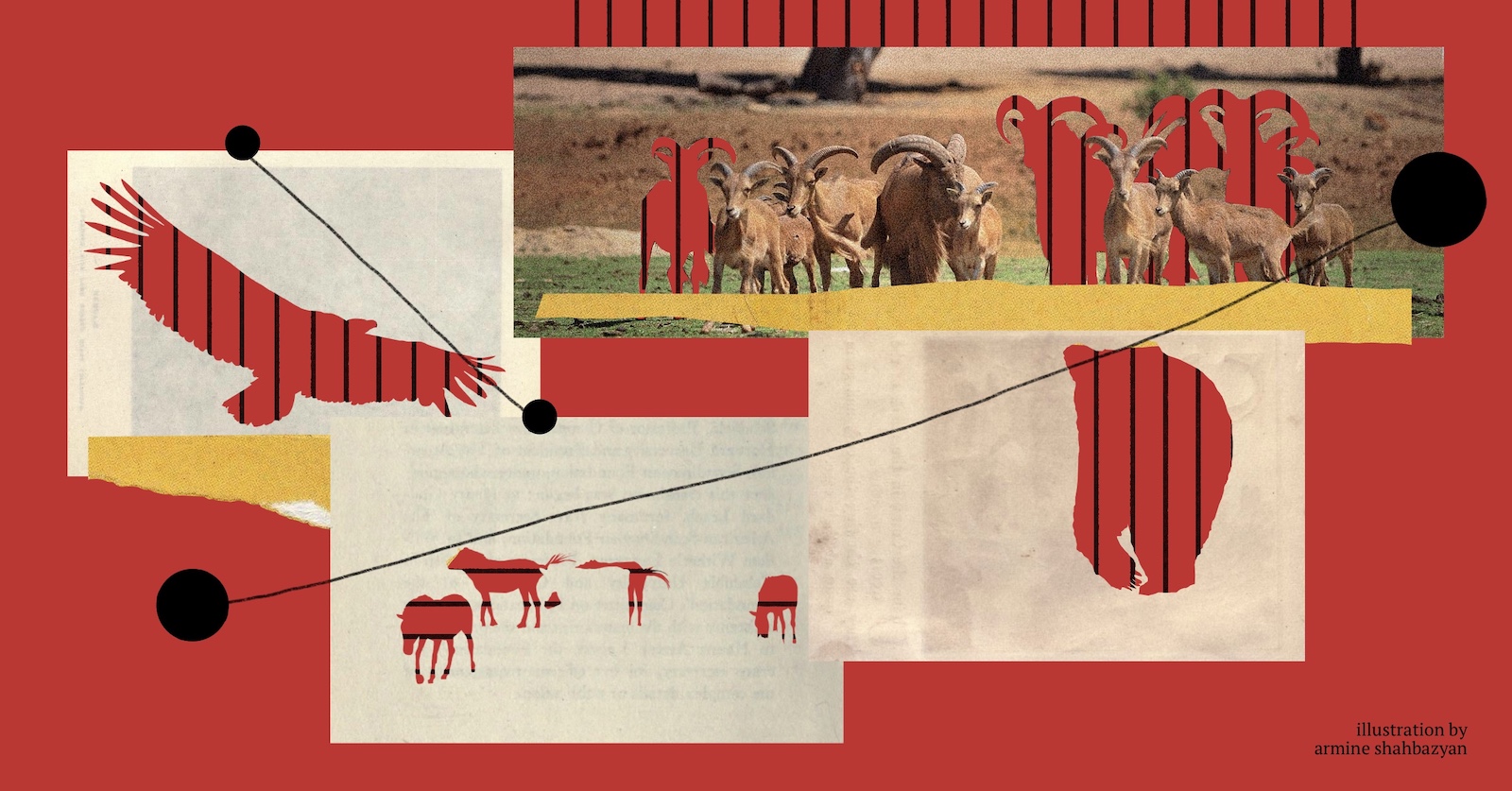
These shipments included 10 steppe eagles (Aquila nipalensis), an internationally protected and endangered species; eight wolves—four Arctic wolves (Canis lupus arctos) and four Northwestern wolves (Canis lupus pambasileus); and two brown bears (Ursus arctos) born in captivity and assigned an “F” source code. This code is crucial documentary evidence: it indicates that while the animals themselves were born in captivity, their parents were taken directly from the wild. The transfer also included two red wolves (Cuon alpinus), a species on the brink of extinction. Even for this exceptionally rare species, the documents feature the same captive-bred origin code—further evidence that these animals are being treated as commercial commodities. Thirty Barbary sheep (Ammotragus lervia), another vulnerable species under special international protection, were also dispatched. Such large-scale shipments, especially under re-export status, suggest that the Armenian company functions as a transit hub for wildlife trade, rerouting animals imported from other nations directly to Vantara.
Genuine conservation or rescue centers do not collaborate with shadowy, constantly rebranding private entities engaged in wildlife trading or breeding—much less import animals from them. This is not a rescue of animals from the wild or from disaster. It is an organized transfer in which an Armenian commercial network acts as a supply hub for rare species, and the Indian mega-project serves as the final destination for this commercial commodity.
Rules for Everyone Except…
For years, the Yerevan Zoo has sought to align itself with the standards of the European Association of Zoos and Aquaria (EAZA), the region’s most authoritative conservation body. EAZA sets the highest benchmarks for animal welfare and strictly prohibits its members from offloading wildlife to unaccredited private collections.
Yet when I sent official inquiries to EAZA’s leadership seeking an evaluation of this transfer from Yerevan to India, the association offered only informal, incomplete responses. Its emails stated it was “investigating the issue raised” and would get in touch “once additional information becomes available.” More than two years have passed since that first inquiry, but EAZA has not provided a definitive answer or issued any official public stance.
By contrast, the World Association of Zoos and Aquariums (WAZA) maintains rules that ban the mass intake of animals from the wild or other zoological facilities unless it occurs within explicit scientific or species-preservation programs. Vantara’s hoard of tens of thousands of individual specimens in a single private compound fundamentally contradicts the global tenets championed by WAZA.
The Yerevan Zoo and the Municipality relied on local legal mechanisms—such as a donation agreement—but that does not absolve the zoo of its international ethical and professional obligations to EAZA. From the perspective of international law, a paper transfer of ownership does not rectify a failure of due diligence.
The Municipality’s assertion that “from the moment the donation agreement was signed, the animals became the property of the Indian side” directly contradicts EAZA’s Population Management Manual (Chapter 4.2). An EAZA member or candidate has no right to dispose of an animal “blindly” by shifting liability to a third party on paper. The Yerevan Zoo was obligated to conduct a thorough evaluation to ensure the receiving facility was specialized and licensed. A private exotic collection unrecognized by international associations does not meet these standards.
This points to a deeper problem: the ideological rift between municipal officials and international wildlife conservation standards. The explanations provided by both the Municipality and the zoo demonstrate that decision-makers, apparently influenced by Vantara’s external PR campaigns, applied standard municipal property disposal procedures without considering or understanding the ethical and professional mandates of EAZA and WAZA. As a result, at the local level, the animals were treated merely as a budgetary burden. This managerial approach allowed local institutions, hiding behind bureaucratic paperwork, to become a convenient link in a global shadowy chain.
Epilogue
Fourteen bears and 12 vultures from the Yerevan Zoo ended up in Jamnagar, while several Przewalski’s horses and kulans appear only in mortality records. Dozens of rare animals, backed by CITES permits, found themselves behind a private fence through an Armenian commercial network. The documents are everywhere: donation agreements, mortality records, export licenses. Everything is finalized; everything is signed.
EAZA is investigating. WAZA has principles. The Municipality has offered explanations. A company tied to an individual once wanted by Interpol continues to operate. Vantara continues to receive.
This is the most damning testament to institutional blindness. Where municipal authorities see budget offloading and the disposal of animals of “unknown origin,” what we witness is a systemic failure.
Environment
Ahead of COP17, Armenia Remains a Wildlife Laundromat
As Yerevan prepares to welcome the world's largest biodiversity summit, an investigation reveals a stark contradiction: Armenia remains a key transit point for endangered wildlife. Mariam Tashchyan traces the legal, commercial and institutional failures enabling the trade to persist.
Read more
The Unloved Others: Invertebrate Conservation in Armenia
Examining how Armenia’s conservation priorities overlook invertebrates, despite their vital ecological roles, Anahit Ghazakhetsyan explores barriers of stigma, weak research and habitat loss, urging narratives that value the “unloved” species sustaining ecosystems.
Read more
Yerevan’s Air Crisis: Inside the Pollution Emergency
Yerevan’s worsening air pollution has moved from background concern to a public health emergency. Hovhannes Nazaretyan examines the main drivers including construction, quarries, transport and waste and why government responses have so far fallen short.
Read more
System Failure: Draining Strategic Aquifers for Short-Term Profit
Armenia’s most vital aquifer is collapsing under decades of unchecked fish farming, illegal drilling and political neglect. The Ararat plain’s groundwater, critical for drinking water and agriculture, is being drained faster than it can recover, forcing the government into a race against ecological collapse. Hovhannes Nazaretyan explains.
Read more
The Queen, Armenia’s Forests and Bureaucratic Hurdles
A royal visit spotlighted Armenia’s forests, but also exposed how bureaucracy, competing land interests, and weak governance continue to undermine reforestation. As Armenia prepares for COP17, ambitious pledges collide with stalled permits, mining pressures and a system struggling to turn promises into forests. Hranoush Dermoyan reports.
Read more
Unconventional Grief: Armenia’s Landscapes Lost to Mining
In Teghut, Armenia, as mining transforms forests into pits and rivers into waste, villagers like Yegishe mourn landscapes lost to industry, naming their sorrow solastalgia—the homesickness felt while still at home.
Read more
Solar Takes Off: Can It Fuel Armenia’s Energy Independence?
Armenia is rapidly embracing solar power, with rooftop and utility-scale projects driving energy independence and sustainability. Hovhannes Nazaretyan examines the country’s growing capacity, landmark farms like Masrik-1, future wind ambitions, and the challenges of integrating renewables into the national grid.
Read more
From Urtsadzor to COP17: Biodiversity at Armenia’s Crossroads
As peace negotiations with Azerbaijan and regional integration projects advance, biodiversity corridors could become vital connectors across fractured landscapes and divided societies. With Armenia preparing to host COP17, the urgency of protecting its extraordinary biodiversity amid mounting ecological and political threats takes center stage.
Read more
Subsoil Security: The State of Mining and Armenia’s Mineral Wealth
Could Armenia’s mineral wealth, long dominated by Russian companies, emerge as a strategic asset in the global race for critical minerals? Gibran Caroline Boyce explores how mining now intersects with economic independence, national security and Armenia’s geopolitical diversification.
Read more