
Visiting one post-Soviet state, you can then recognize it in all others – the similar patterns of urban planning and the identical buildings, structures, roads, pipes, wires, tiles, etc. However, an outsider delving inside under the extreme familiarity of the material environment finds an extreme “strangeness” of social interactions and practices. The “Outside In” series is about emplaced paradoxes and nuances. It spotlights the mundane in Armenia’s peripheral locations, where the seemingly unspectacular encounters with people and things allowing us to capture the unique features of the territory.
Listen to the AI generated audio article.
Outside In
Essay 29
There was a bathtub in the middle of my hotel room in Stepanavan: freestanding, steep-sided, and sterile white. It faced the room’s tall windows. But those windows opened onto the street, and this was only the second floor, at a height that intersects precisely with the eye line of anyone walking by on errands or at leisure. This was hardly a view worth admiring while soaking so much as a view (of me) that others might admire instead. The bathtub simply stood there in full sightline of the street, a sculpture with taps and, apparently, an audience.
I stared at it for some time, then opened my notebook and started writing, taking this ambiguous object too seriously and asking it to answer for an entire social order. Why was it in this exact room, in this particular configuration, serving no practical purpose whatsoever?
During the “dark years” of the energy crisis, when electricity arrived for an hour or two a day, if at all, and water pressure was a rumor rather than utility, the bathtub became one of the few genuinely reliable objects in an Armenian home. Not for washing—there was rarely enough hot water for that, and rarely enough cold water on any predictable schedule. The bathtub became a reservoir. Families filled it whenever the taps produced anything, stockpiling water against the hours, sometimes days, when nothing came out of them. It was an insurance policy, a hedge against a state that could no longer guarantee the most basic infrastructural promise: that water would come when you turned the tap. My interlocutors of a certain age, across different Armenian cities and towns, still describe checking the tub the way you might check that you had locked the front door. It became an unconscious domestic reflex, a remnant from a decade when forgetting to fill the tub could mean a day without water for cooking, for the toilet, for washing a child.
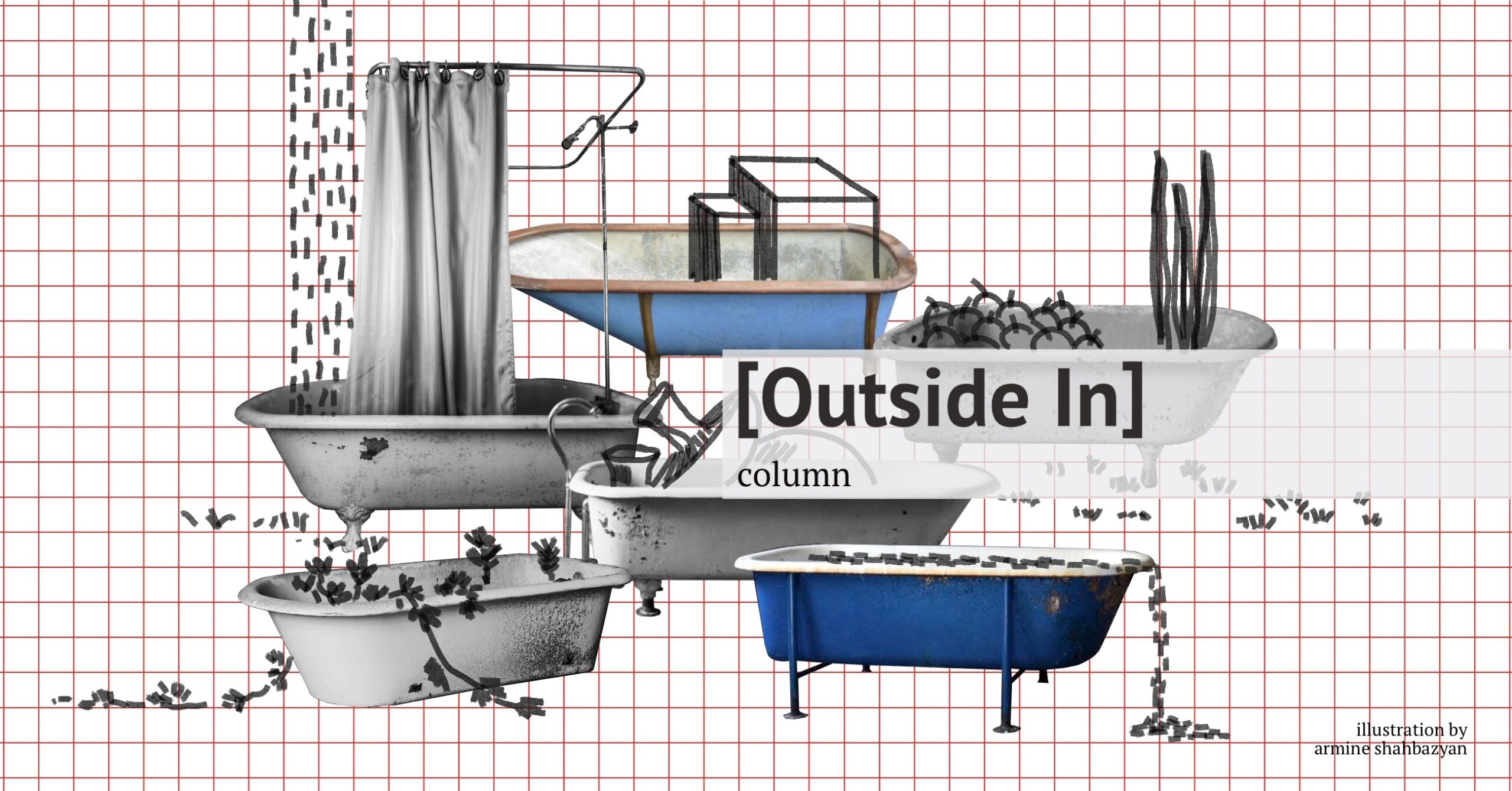
During the 1990s, the bathtub stopped being part of bathing infrastructure and became a place for storage. Once an object crosses a threshold of reuse it usually cannot return to its original function cleanly. Looking closely at one of these tubs today, you can read its material history. The white surface is rarely white anymore. A brown tide line records the exact height at which water used to sit for days at a time, depositing minerals that no amount of scrubbing can lift. Along the bottom, the enamel has worn through in patches to the grey cast iron beneath, scratched by decades of buckets and sacks set down without ceremony. In Armenia, I have seen bathtubs pressed into service as vegetable stores over winter, as the place where the laundry basin lives permanently, and as water holding tanks for houseplants and animals.
Such multitasking of the tub was not a surprise to me. Back in Russia, my paternal grandmother had a cast-iron bathtub in the garden for irrigation water left to warm in the sun so that the tomatoes, cucumbers, and peppers in the greenhouse would not be shocked by a cold hose. In my own family’s apartment, my father used the bathtub to sort mushrooms gathered in the forest, rinsing them of soil and pine needles. Fish pulled from the lake were cleaned there too because the kitchen sink was too small for the volume a hungry household needed to process at once. In the wake of state socialism’s collapse, when salaries stopped arriving and the shops emptied out, many families just like mine fell back on whatever the surrounding landscape still provided. Across the wider post-Soviet landscape, the bathtub became less a fixture than a chassis: a large, watertight, faintly absurd object repurposed to meet whatever need a household faced at the time.
This brings me back to the tub in Stepanavan’s hotel room, gleaming and entirely, magnificently useless. The tub performs no labor. It couldn’t, even if asked. There is nowhere to set a bar of soap, a phone, or a glass of wine—no ledge, no recessed shelf, no concession to the fact that a body in a bathtub has hands that need somewhere to put things down. The sides slope inward at an angle clearly designed by someone who has never sat in a bathtub for longer than several minutes; leaning back means either sliding slowly downward into the water or bracing your feet against the far end like you are holding a position in a kayak. There is a folded towel on an improvised stool half a meter away because there is, of course, nowhere closer to put it. And there is the window, which someone in the design process clearly imagined as a soft-focus feature without imagining a body actually inside the tub, visible from the pavement to anyone who happens to look up. The whole object performs a kind of aspirational bathing nobody in this room is expected to actually do. It is there to be photographed and to signal a category: boutique, niche, worth the extra per night, rather than to hold water against any real need, domestic or otherwise. A few decades and a few kilometers away, the bathtub meant almost the opposite.
Outside the boutique hotel, Stepanavan carries on with its earthquake-shifted grid, its remnants of industry overgrown with grass, its small shops and amenities catering to a long practice of making do with what arrives or does not. Here, the bathtub earned its keep through multitasking. Inside the hotel, it has been stripped of every function, becoming the least functional object in the room. The 1990s in Armenia produced a bathtub that did too much. Contemporary hospitality has produced one that does, deliberately, almost nothing, having never once in its short life been asked to hold water for anyone who actually needed it, and charges you for the privilege of admiring it.
Perhaps, I am utterly unfair to the designers and the bathtub itself. Perhaps, growing up amid collapse and a DIY culture, I developed an intolerance for useless objects taking up space. Perhaps I should welcome them instead, because being able to afford uselessness is itself a sign of increasing wellbeing. Though that wellbeing remains unevenly distributed. Many of the objects that continue to shape everyday life in Armenia still earn their place through hard work. They store, preserve, improvise, compensate, and endure. The hotel bathtub, by contrast, asks only to be looked at. It is an object that performs luxury rather than utility, signaling abundance by freeing itself from the obligation to be useful. In another context, perhaps I would admire that. In Stepanavan, where the memory of infrastructure failure still lingers in ordinary domestic routines, I found it difficult to do so. The old bathtubs I had encountered elsewhere in Armenia seemed, somehow, more luxurious precisely because they had survived long enough to acquire biographies. This one had only a price tag.
See all [Outside In] articles here

Maria Gunko is a DPhil Candidate in Migration Studies, Hill Foundation Scholar at the School of Anthropology and Museum Ethnography University of Oxford. Since 2023, she has joined Yerevan State University as a Visiting Professor. Maria holds an MSc and Kandidat Nauk (Russian post-graduate degree) in Human Geography.
Maria’s research interests lie in the intersection of urban studies and social anthropology, including ethnography of the state, infrastructures, and urban decay with a geographical focus on Eastern Europe and the Southern Caucasus. She is the co-editor of one monograph, author of over thirty scientific articles and op-eds.