
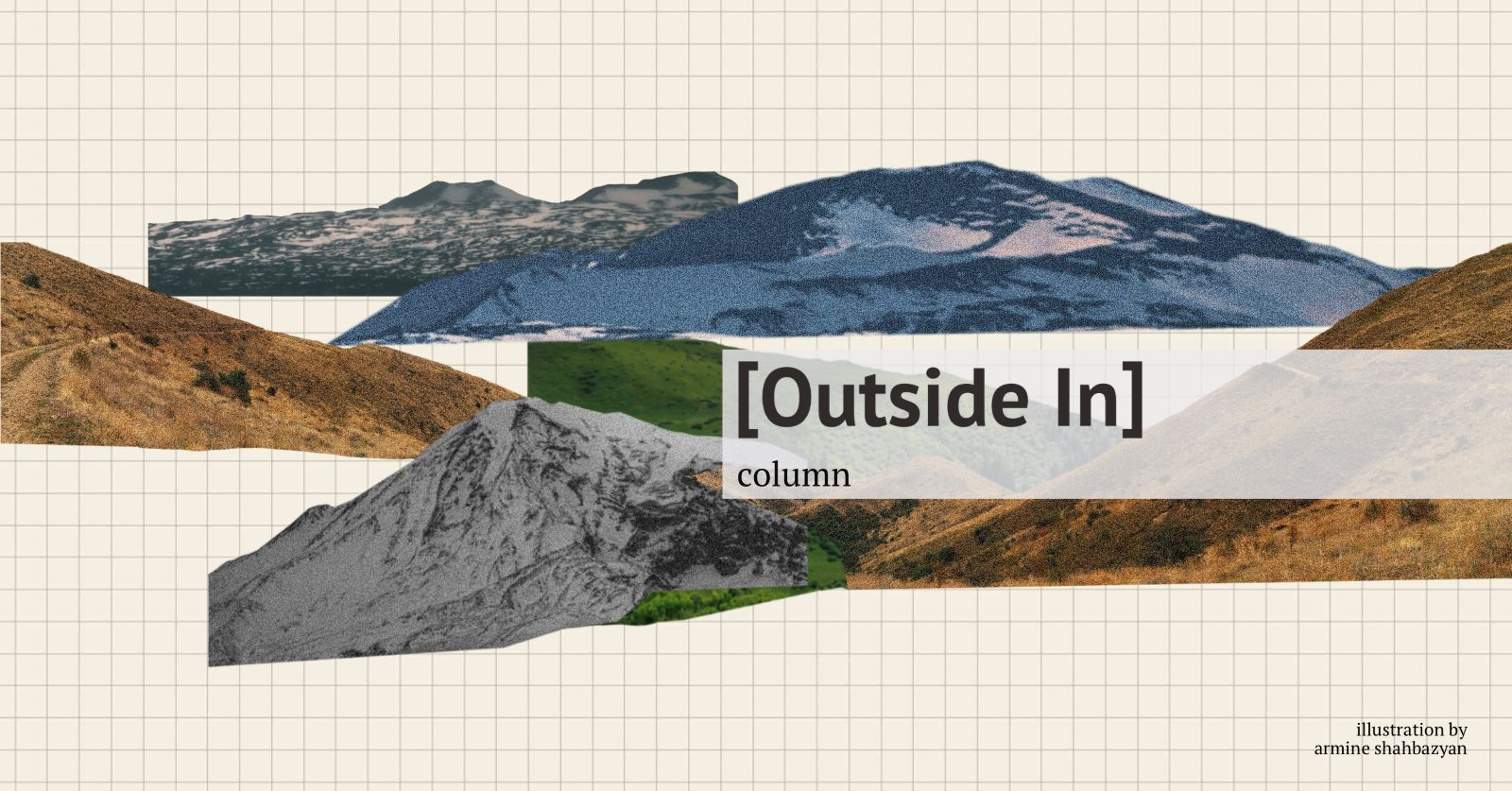
Visiting one post-Soviet state, you can then recognize it in all others – the similar patterns of urban planning and the identical buildings, structures, roads, pipes, wires, tiles, etc. However, an outsider delving inside under the extreme familiarity of the material environment finds an extreme “strangeness” of social interactions and practices. The “Outside In” series is about emplaced paradoxes and nuances. It spotlights the mundane in Armenia’s peripheral locations, where the seemingly unspectacular encounters with people and things allowing us to capture the unique features of the territory.
Listen to the article.
Outside In
Essay 28
Over the mountain, through the valley,
along the river’s flow, with the breath of the wind
[Armenian folk song, excerpt translated by the author]
There exists a particular kind of exhaustion that no amount of sleep resolves. It accumulates not in the body but in the mind, in the precise spot where the news lives, where unanswered emails nest, where the low-grade hum of global anxiety settles and refuses to be evicted. Since the early 2020s and especially since 2022, when my world went to hell in a basket, I found myself in possession of this exhaustion in abundance. The antidote was verticality.
Armenia is not a country where one can meditate on flatness. The lowlands are brief; the horizon is mostly a fiction interrupted by peaks. Roughly 80% of the country lies more than a thousand meters above sea level. Even the national coat of arms pays homage to the mountains. However, paradoxically, most Armenians do not really go to the mountains. Not for leisure, I mean, not in the way that Nordic or Alpine cultures have built entire identities around summit-seeking. The mountains are present in every direction, visible from most windows, referenced in poetry and embossed on state symbols, and largely left alone as a destination. They are a backdrop, not an itinerary. Which makes being part of the growing hiking community here feel quietly exquisite, like having stumbled upon a room in a well-known house that nobody else bothers to enter.
I have spent several seasons doing exactly that—renegotiating perspective on the forested trails of Lori and in the gorges of Vayots Dzor, on the slopes of Azhdahak, Arteni, Arailer, Hatis, Dimats, Gutanasar, Mets Maymekh, and, most recently, Tezhler. Each mountain has taught me something different. Some of these lessons were about Armenia. Most were about myself, which I suspect was the point all along. I will not go through every one of the numerous hikes but mark some important thresholds.
Lori: On Beginning
The trails of Lori were my first encounter with Armenia’s rugged terrain; the forested gorges of the north, where the Debed and Pambak rivers have cut deeply into the landscape and the trees close overhead with an almost conspiratorial density. After the tufa and concrete of Yerevan, stepping into Lori felt like entering a different place and living in a different temporality. In autumn, light filters softly through the broadleaf mountain forests in broken fragments. The root-laced path is soft with decades of accumulated leaves. Every step requires attention to the ground and to grade. The mind narrows to immediate necessity. But this narrowing is not a kind of impoverishment. It is a relief.
Lori set the terms of everything that came after. It established that hiking in Armenia is never purely recreational, it is always also an encounter with depth, whether geological, historical, or simply the depth of a ravine dropping away beside the trail.
Azhdahak
Azhdahak is the highest peak in the Geghama range at 3597 meters, named after the evil dragon-king of Armenian mythology. I climbed it twice, the first time in the summer of 2023 while nursing a hangover. Heavy-headed and battling the loose rocks slipping beneath my feet, the mythology felt entirely appropriate.
The hangover was of the geological kind; deep and layered, the product of accumulated decisions made the previous evening with the confident stupidity that very good wine enables. While climbing, approximately once per switchback, I questioned every choice I had ever made in my life that had got me on that trail. I cursed, comprehensively and without restraint, in three languages, mostly in Russian, given the wide range of options it provides. My companions found this entertaining. I did not share their assessment.
The crater at the summit of Azhdahak holds the largest alpine lake in Armenia, and when I finally arrived, I lay down beside it and slept while my companions celebrated and, treacherously, finished the pre-prepared chashushuli and a bottle of Pet Nat, a sparkling rosé dry wine. Yes, my dear hiking fellows of that trip, if you are reading this, know that I still remember. When I woke up, there was only boiled buckwheat and a sip of cognac left. I did not see the view. I did not care. The mountain had extracted everything from me, allowing me to rest.
The second ascent of Azhdahak was different in almost every possible way. It was 2024, and I went with geologists from the Geological Institute of Armenia’s National Academy of Sciences. They moved slowly, stopping frequently, crouching over outcrops with the concentrated attention of archivists.
One of the geologists explained the mountain’s formation to me. Azhdahak is a stratovolcano, built over countless eruptions, each one recorded in the rock as legibly as a date in a ledger. By standards of the region, the Geghama highlands are geologically young; volcanic activity occurred here as recently as several thousand years ago, recent enough that the landscape still carries the rawness of the aftermath. Hiking with geologists, I was slowly pondering rock formations instead of being concerned with reaching the summit in time for lunch, as I usually do. My hiking companions always joke that the only reason I hike is for food with a view (and this is partly true; I only allow myself the guilty pleasure of a Snickers bar on the mountain peaks).
I had been to that summit before and survived it badly. Now I was enjoying reading it. The crater lake caught the afternoon light. The rim, which I had crossed in a fog the first time, turned out to have a particular shape, a particular color, a particular relationship to the sky. The dragon-king, I thought, chose his mountain well.
Arteni and Arailer
Arailer and Arteni are volcanic neighbors standing west and northwest of Yerevan respectively, part of the same geological restlessness that shaped the entire region.
Where Azhdahak demanded my attention with rocks and lava flows, Arteni taught me to read time differently through fortress walls and the outlines of things that were once cities. The mountain sits close to the Turkish border, and history here is embodied. It is in the ground, in the names of villages, in the direction people do not look when they stand at certain ridgelines. On Arteni’s slopes, the remnants of an ancient fortress emerge gradually from the terrain, with walls that have become so much a part of the mountain that you are not always certain where the geology ends and the archaeology begins. Someone built here, fortified here, lived and kept watch from this exact ridge. That someone is long gone, but the wall remains. It was there, looking west, that I first began to long for Ani. And it was there that I first properly encountered Yereruyk, a magnificent early Christian basilica, which has been a ruin longer than most countries have existed, still holding its shape against the sky and a closed border. The Arteni hike taught me something about the Armenian relationship with loss that no amount of reading had quite conveyed. This loss is not passive, not resigned, but always facing the direction of what is absent.
I climbed Arailer in October 2025, when the slopes were the particular gold and rust of a season in the act of ending. The summit opens toward Aragats, Armenia’s highest peak, or rather four peaks, broad and unhurried on the horizon, and toward the wide Ararat valley below. It is one of those panoramas that produces silence. Not because there is nothing to say but because speech seems excessive. From that ridge, with Aragats filling the northwestern sky, the Ararat vs Aragats political debate feels suddenly embodied. There are those who argue that Ararat should be removed from Armenia’s state symbols entirely, that a nation cannot build its identity around a mountain it does not possess, that longing is not a political program, and that Aragats, sovereign and actually present here, deserves the central place. I am not Armenian, and this is not my grief to adjudicate. But I have spent enough time here, looking at enough horizons, to have developed a position of my own, which may not align with that of the reader. Aragats is magnificent and real in all possible ways. And yet every time I turn toward Ararat, sitting to the West on the horizon, I find I cannot side with those who argue for its removal. Some symbols earn their place not through possession but through historical and cultural significance. Giving up and erasing such symbols is like erasing a part of who one is.
What the Mountains Keep and What They Give
My hiking companions have been various over the years: geologists and architects, shepherds encountered unexpectedly at high altitude, students who treated the whole enterprise as an extension of fieldwork, a friend and colleague from Ukraine who required significant convincing that Armenian mountain distances were being quoted in local spiritual units rather than metric ones. Each group created its own version of the mountain we hiked, while the mountain was indifferent to all of those versions.
There is something the mountains keep, which is the memory of everyone who has crossed them. Silk Road traders. Medieval pilgrims. Soviet geologists with their equipment and measurement enquiries. Refugees moving in various directions at various moments of various catastrophes. Contemporary hikers with their digital maps and emergency foil blankets. All of them left something behind, whether footprints that lasted only a morning or fires that left charcoal marks on the earth a little longer. The mountains absorbed all of it.
People ask, sometimes sceptically, what a geographer researching urban space does in the mountains. The question suggests a misunderstanding about the nature of geography as a broad discipline. Cities do not exist separately from the landscapes that produced them. Yerevan is pink because the tufa is pink. The tufa is pink because of volcanic activity. Everything is connected, and standing at altitude occasionally allows you to see the connections more clearly than you can from street level. But there is also a less academic answer; I go because the mountains are one of the few places where the accumulated noise of contemporary existence becomes genuinely inaudible—not just a lack of cell signal, but the broader signal of news cycles and the low roar of the global attention economy.
I return to the mountains when the world becomes too loud, which at the current historical moment is frequently. The most recent occasion was Tezhler, on a day when Yerevan Wine Days had collided with parliamentary elections, when the city was simultaneously drunk, civic-minded, and extremely loud about both. Not having the privilege (or burden) of civic duty to participate in elections, my choice was obvious. The mountains offered the opposite of everything the streets were providing. As I came down from Tezhler, I felt better equipped to receive the news than I would have been had I spent the day refreshing a screen.
Each time I arrive at a summit, aching and out of breath but disproportionately satisfied, I carry with me all the small panics of the week below. Each time, the altitude gently confiscates them. Not permanently, but for long enough. The view is large. The problems, in the view, are proportionate. This is what Armenia’s mountains have given me, season after season; being more attuned to thinking across scales.
According to the legend, the dragon-king Azhdahak was eventually defeated. The mountain bearing his name remained. It will continue to remain, indifferent and magnificent, long after whatever currently constitutes my inbox anxiety has been forgotten entirely. My list is not finished. Spitakasar, Aragats, Khustup are next. These hikes are already planned and already anticipated. And then, eventually, Ararat. The last mountain on the list is also the one visible from my window every clear morning, enormous and patient, neither inviting nor refusing. Perhaps it is fitting that it comes last. Some things are worth the long approach. And then, I will start over.
The anthropologist Tim Ingold, in his collection of essays Correspondences, argues that a mountain is never fully conquered, that to think of a summit as something to be taken, checked off, defeated, is a fundamental misreading of nature. “One can not enter the same river twice” – everything around us is in a state of flux. A mountain is not a fixed object awaiting your arrival but an ongoing process, changing with seasons and weather and light, with the moss that inches across the rock face and the glacier that retreats by meters each decade. It meets you differently every time because it is, in the most literal sense, not the same mountain. And neither, of course, are you. This is, I think, the only honest way to end an essay about mountains, with the knowledge that the next ascent will be a first ascent, and the one after that, and all the ones that come after that will still be the first.
See all [Outside In] articles here
Maria Gunko is a DPhil Candidate in Migration Studies, Hill Foundation Scholar at the School of Anthropology and Museum Ethnography University of Oxford. Since 2023, she has joined Yerevan State University as a Visiting Professor. Maria holds an MSc and Kandidat Nauk (Russian post-graduate degree) in Human Geography.
Maria’s research interests lie in the intersection of urban studies and social anthropology, including ethnography of the state, infrastructures, and urban decay with a geographical focus on Eastern Europe and the Southern Caucasus. She is the co-editor of one monograph, author of over thirty scientific articles and op-eds.