

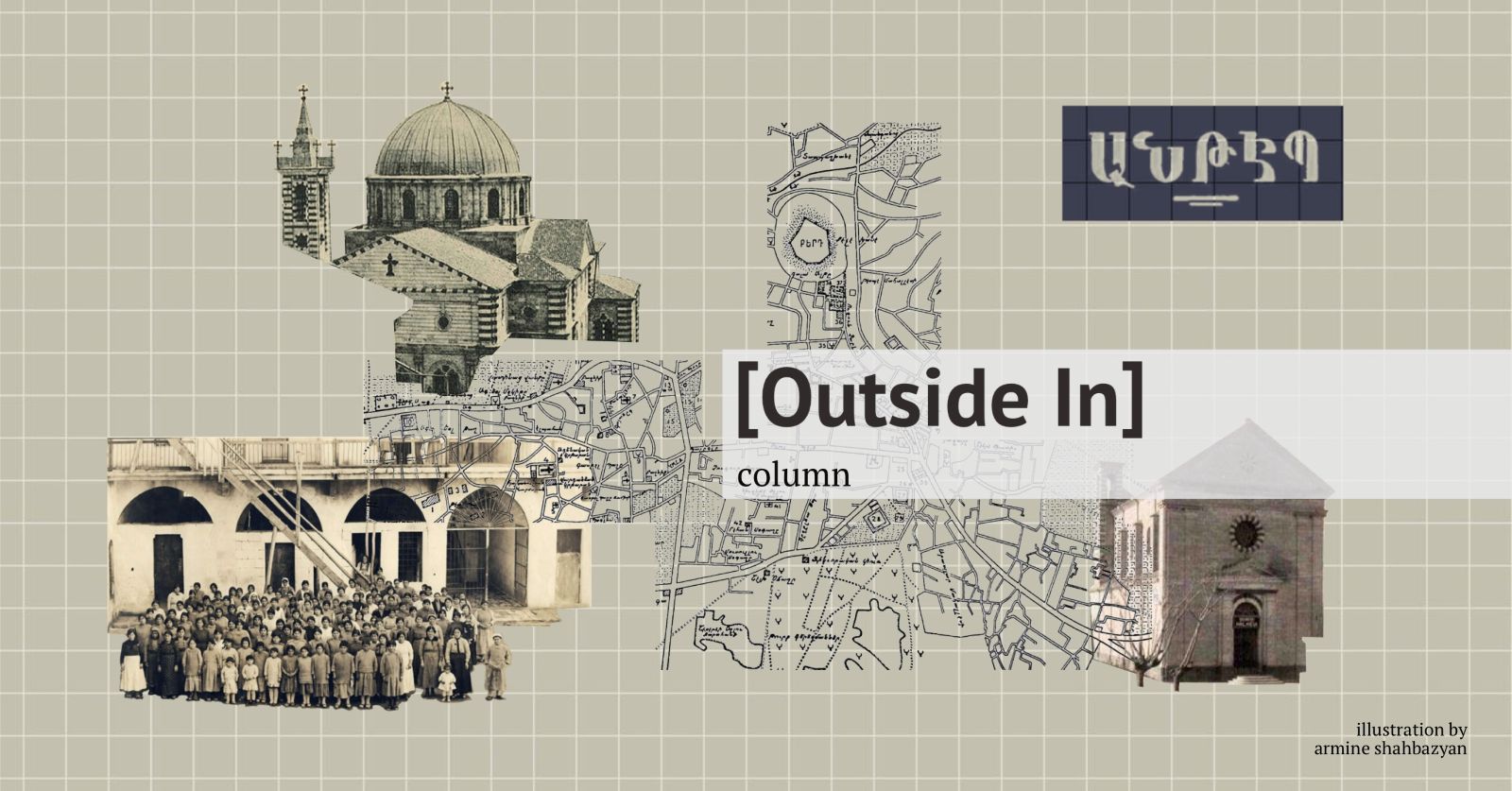
Visiting one post-Soviet state, you can then recognize it in all others – the similar patterns of urban planning and the identical buildings, structures, roads, pipes, wires, tiles, etc. However, an outsider delving inside under the extreme familiarity of the material environment finds an extreme “strangeness” of social interactions and practices. The “Outside In” series is about emplaced paradoxes and nuances. It spotlights the mundane in Armenia’s peripheral locations, where the seemingly unspectacular encounters with people and things allowing us to capture the unique features of the territory.
Listen to the article.
Outside In
Essay 30
Mal sahibi, mülk sahibi, hani bunun ilk sahibi?
(Landlord, property owner, where is the original owner?)
Turkish proverb, as recorded and translated by Ümit Kurt
Over the years, I have been to several restaurants whose names reference the toponym Ainteb/Anteb.* The menu is more or less familiar – muhammara and hummus, lahmajoun, a variety of kebabs followed by a variety of baklavas, as if the meal is not legally over until the savory and sweet were shaken and stirred together in the stomach. What was always less clear was the origin of the owners. The name on the awning gave nothing away. Ainteb, before it became Gaziantep (i.e.veteran Anteb), was home to Turks, Armenian, Greeks, Syrians, Assyrians, Jews, among the most prominent ethnic groups. Any restaurant that borrows the name seems to borrow that ethnic ambiguity along with the recipes.
Researching Armenia, one is never limited to its current borders. My interest in Ainteb as a culinary experience was further piqued when an Armenian friend went to the city and returned with a collection of visuals depicting old, narrow cobblestone streets and magnificent beige and black buildings. I finally went to Ainteb this August, but before I went, I read. Specifically, Ümit Kurt’s The Armenians of Aintab: The Economics of Genocide in an Ottoman Province, and Garine Boghossian’s online project Armenian Atlas.*
Ümit Kurt, a historian currently based in Australia, grew up in Gaziantep and only discovered as an adult that his hometown had once had a large, prosperous Armenian community. He has spent much of his career accounting for what happened to that community’s wealth after it was gone. The word feels apt given how much of his research is literally accounting. In his twenties, Kurt wandered into a café in the old Kayacık quarter, noticing letters carved above the gate he assumed were Ottoman, he asked the owner, more or less by accident, who had lived there before him. The owner told him his grandfather had inherited the property:
And before that?
There were Armenians here… [and then] they left.
According to different records, between 15,000 and 19,000 Armenians lived in Ainteb in the 1910s and early 1920s, who then “left” (as per the Gazianteb war museum) in the framework of the “Temporary Law of Deportation” passed by the Ottoman Council of Ministers on May 27, 1915.
Kurt later discovered that the building where the café was had belonged to Nazar Nazaretian, honorary consul to Iran and patriarch of one of Ainteb’s wealthiest families. I went looking for that café and found it closed. This turned out to be the right kind of limitation for the essay I wanted to write, one about tracing ghosts. I had only what was already written down, on paper and in stone – what Kurt’s and Boghossian’s own patient accumulation of data provided me, standing in for all the conversations I couldn’t have myself.
I had come to Gaziantep – Antep to the people who love it, Ainteb to the people who were forced out of it – to get myself immersed in the built environment financed, in no small part, by the emptying of the city’s Armenian population. The local vocabulary has learned to describe that disappearance almost entirely through intransitive verbs: “Armenians simply left the city, the way water leaves a glass.” What follows is an account of walking the city backward through what is not there anymore, with Kurt’s book in one hand and the Armenian Atlas on my phone in the other.
The Paper Trail
Kurt’s book is an accounting document, and its subtitle says so plainly: The Economics of Genocide in an Ottoman Province. His real subject is not the deportations themselves, but who profited from them, by how much and how that wealth was laundered into legitimate civic wealth within a generation. He traces, family by family, how Ainteb’s Armenian properties changed hands after 1915 and the subsequent deportations.
A former employee of the Nazaretian family, Daizâde Mahmut, bought Garabed Nazaretian’s house from the Gaziantep Municipality in 1923 despite a formal objection filed by Nazaretian’s own daughters through the Iranian embassy. This objection was received, forwarded and ignored. The Kara Nazar Inn, once the centerpiece of Nazaretian wealth, was transferred to the state as a “national estate” and sold to the same Daizâde Mahmut for a token sum.
Municipal auctions ran through the 1930s and were duly reported in the local papers, which printed the previous owner’s name, the property’s assessed value, and the price it actually fetched, always far less. Kurt also recounts a scene at Tuz Hanı, the salt caravansary, where returning veterans of the Turkish-French War were handed house keys from a rug, two apiece: spoils of the vacated Armenian quarter distributed like a bonus.
None of this destruction required actual bulldozing. Continued use is cleaner, and the provenance simply drops out of the paperwork somewhere between the municipal auction and the current deed. Consider Kurtuluş Camii, the Liberation Mosque, which dominates Ainteb’s skyline over Tepebaşı. It has a plaque, but, of course, it does not say that the building was originally as Surp Asdvadzadzin, the Cathedral of the Holy Mother of God, designed in the workshop of the Balyan family – that same Armenian architectural dynasty that designed several of the Ottoman sultans’ palaces on the Bosphorus. The cathedral served Ainteb’s Armenian community for barely two decades before the deportations that emptied the neighborhood around it.
Circling the building’s perimeter, I kept returning to the idea of ruination as an active, ongoing process rather than a finished state: the sense that some structures are kept in a condition of permanent, low-grade erasure precisely because full demolition would draw more attention than continued, unexplained use. Kurtuluş Camii is not a glorified ruin, nor a pile of rubble. It is something useful to a certain kind of forgetting; a building in excellent repair whose biography has simply been edited down to the sentence that suits its current occupant.
Memory Maps
Kurt’s archive is written in the vocabulary of deeds and lira. There is a second archive, a cartographic one that records the same erasure from a different direction. It is not concerned with who bought what, but where everything used to be. The Armenian Atlas is an ongoing, open-source mapping project that collects what it calls memory maps – hand-drawn reconstructions of Ottoman towns with a large Armenian population made from memory. They are made by the Genocide survivors scattered across the diaspora, decades after they had last walked the streets they were drawing. The Atlas’ own framing is unambiguous about the stakes. These are exercises in counter-mapping that resist Genocide denial and revisionism, an attempt to recover geographies that the built environment itself no longer acknowledges.
Ainteb’s entry is a map drafted in Aleppo in 1955 by Kevork Barsoumian and Garabed Nazarian. The map covers roughly six square kilometers of a city neither man would ever see again, reconstructed from memory with a density that reads as an act of will: churches and schools clustered at the core, larger colleges to the west, a commercial street to the east, cemeteries and quarries to the south, agricultural land to the north. Read against the Gaziantep of today, the Atlas’ own annotations do the same work Kurt’s deeds do, only spatially. They show what infrastructural, architectural, and urban interventions have done to the Armenian quarter, now folded into the narrative of tourist “old city.”
I tried walking the map, but the comparison mostly humiliated the phone. GPS is a poor collaborator for a source that predates it by decades. Where the 1955 hand had drawn a continuous street of houses, my screen insisted that I turn right into what was in fact a retail unit selling phone cases. I kept going anyway, the way you keep watching a film you already suspect will end badly, matching corner to corner, until the discrepancy stopped being amusing and started being the entire point. Everywhere the two maps failed to agree was, without exception, a place where something had been removed and something else installed.
Some of what the map records has simply been erased outright. Adil Özbek Street, cutting through the district in 2005 as a new north-south axis, was made possible through the demolition of schools and cultural buildings along with hundreds of former Armenian houses, severing what remained of Surp Asdvadzadzin’s relationship to the neighborhood once surrounding it.
Other sites survive in an uncomfortable half-life—reused, renamed, unmarked. The Armenian Catholic church of St. Bedros, the same building Kurt’s essay tracks from confiscation into a state-run textile factory, is, per the Atlas’s independent documentation, now the Ömer Ersoy Cultural Center. The Latin, or Kendirli, church at the district’s northern edge is currently the Kendirli Gazi Cultural Center, slated for a further conversion into an Anatolian-Turkish Archaeology Institute. It is heritage repurposing heritage, with the middle term simply omitted. And then there are mansions. For instance, Dr. Avedis Jebejian’s house, which Kurt’s essay traces into the Konukoğlu family’s hands and eventually into municipal ownership, is confirmed by the Atlas as the building now known as the Gaziantep Atatürk Anı Müzesi. Nigoghos Agha Nazaretian’s mansion has been demolished outright; what stands on the site today operates as the Tarihi Çınarlı Kahvesi coffeehouse.
Epilogue
I don’t think Gaziantep’s residents are, in a simple sense, lying when they tell a visitor that the Armenians left. In the narrowest legal reading, they did: they were deported, resettled in Aleppo and Beirut and points further. The passive-sounding verb does the work of “expelled” or “dispossessed” quite well. The city can be transformed over a century of vacated houses’ reoccupation, cutting new streets, renaming cathedrals, and still not fully absorb the past. Something remains stubbornly, structurally undigested in a roofline and in a missing nameplate two independent scholars happen to agree on.
Somewhere between the city walks, I also ate. Katmer, ordered on instinct from a stall; baklava in fancy cafes; alinazik kebab that exists under several different names, for several different populations. These were made based on recipes passed down through generations. I do not know whose grandmother taught whose. Nobody at venues I visited did either. That unknowing is the most honest thing I encountered in Gaziantep. Looking at absences and at what remained unsaid, I kept finding traces of a presence that official Turkish history simply declined to name. Perhaps the omission itself matters less now than the evidence that survives it: undeniable figures in tables, property records and maps, and the recipes that have outlived the people who first made them.
*The essay uses the Western Armenian version of the toponym “Ainteb” [Այնթէպ]
**Ümit Kurt The Armenians of Aintab: The Economics of Genocide in an Ottoman Province (Harvard University Press, 2021); Garine Boghossian An Armenian Atlas at https://www.armenianatlas.com/
See all [Outside In] articles here

Maria Gunko is a DPhil Candidate in Migration Studies, Hill Foundation Scholar at the School of Anthropology and Museum Ethnography University of Oxford. Since 2023, she has joined Yerevan State University as a Visiting Professor. Maria holds an MSc and Kandidat Nauk (Russian post-graduate degree) in Human Geography.
Maria’s research interests lie in the intersection of urban studies and social anthropology, including ethnography of the state, infrastructures, and urban decay with a geographical focus on Eastern Europe and the Southern Caucasus. She is the co-editor of one monograph, author of over thirty scientific articles and op-eds.

I visited Aintab in 2014 with the Pilgrimage to Historic Armenia group. We were able to enter in the cafe that used to be the Nazarian house, with the family initial over the entry door. The upper room was, at that time, well preserved.
Your essays capture, what ordinarily, might go unseen. While I look forward to the every edition of the Outside In, this one I had to read twice, once for me and once for my Այնթէպցի mum.