
From emerging Armenian artists across the globe to Armenian-American talent in the United States, [Art Speak] will spotlight the dynamic and diverse Armenian art world and more.
Listen to the AI generated audio article.
Perhaps the single most important exhibition of its kind to date, Topographies of Dissent at the Zimmerli Art Museum acts as a fine survey of post-Soviet Armenian art beginning in the late 1980s. In this sense, it complements the Metropolitan Museum’s 2018 exhibition Armenia!, which traced the country’s artistic legacy only up to the Middle Ages and was largely focused on religious and ethnographic art. Curator Julia Tulovsky, with the help of guest curators Lilit Sargsyan and Armen Yesayants, use the large modern space at Rutgers University to good advantage, showing pieces that are at once aesthetically pleasing and theoretically informed. Soviet Armenia, where the first Museum of Modern Art in the Soviet Union opened in 1972, benefitted from being geographically on the edges of the Soviet sphere, while also having a culturally active diaspora and a millennia-old culture to draw upon. In exhibitions both official and underground, and in movements such as 3rd Floor (“Yerort Hark”) and Bunker Art, Armenia has produced a prodigious amount of often cutting-edge works—especially for a nation of just four million (Soviet census).
An economics professor at the University of Maryland, Norton Dodge amassed one of the world’s largest collections of nonconformist art from Russia and the Soviet republics, over 20,000 often stunning works, bequeathing them to the Zimmerli Museum after his death. Like the better-known Armand Hammer, Dodge collected Soviet art at an almost frantic pace, mainly in the 1960s and 1970s. And while he credited Warren Buffet’s financial advice as the source of his small fortune, details of his life lead many to surmise that he may indeed have had links to the CIA, especially given the size and quality of his collection. Among other tantalizing details of his collecting life, was his friendship with French-Armenian dealer Garig Basmadjian, who often acted as his intermediary. Basmadjian disappeared from his Moscow hotel room in 1989, never to be seen again, most probably murdered by the KGB.
Be that as it may, the Dodge Collection covers such a wide variety of works that the Zimmerli has wisely appointed a full-time curator. Past exhibitions culled from the collection include the tantalizing The Sum is Greater Than Its Parts, (2001) composed uniquely of collage and assemblage, and the cleverly titled Locating Georgia, (2023) as well as a landmark show A Lesson in History (also 2023) which covered work by the celebrated artistic duo Komar and Melamid.
The Zimmerli’s airy open rooms, high ceilings, and brick and stone architecture provide the perfect setting for the current exhibition. What first strikes the viewer—and it is an impression that only deepens upon a second and third viewing—is the remarkable diversity in Armenian art of the period. The term “dissent” in the exhibition title differs from the more overtly political statements that it sometimes implies—here it merely refers to works that went against the Soviet grain of party-approved social realism. By dividing the pieces into five easy sections, the curators have delivered an easy-to-follow exhibition, particularly for those visitors who know little about Armenian art—one assumes most museum goers. From over 1,000 Armenian works in the collection, the curators selected 55 pieces by 37 artists—not easy choices to make. As Sargsyan notes: “I had to identify the key tendencies within the collection and highlight them. These five sections illuminate the main stages and directions in the development of Armenian modernist and contemporary art, as well as the attitudes of the artists toward the decaying Soviet reality of the late period.”
The first part of the exhibition National Landscape: Land, Identity, Dream begins with the work of Martiros Saryan, the father of Armenian modernism who painted pastoral scenes and traditional churches in vivid colors reminiscent of Gauguin and Matisse. Artists here include Sergey Hovsepyan, and repatriates Armine Galents and Hagop Hagopyan. Galents’s Katoghike Church in Talin, Armenia (1983, oil on canvas, 22 ¾ × 30 11⁄16 in.) perfectly captures these qualities. This section is followed upon by Facets of “Formalism,” which emphasizes different experimental styles including cubism and collage. Robert Elibekyan’s 1986 small gouache and watercolor on paper Crucifixion (25 ½ x 19 11/16 in.) uses muted tones of green—a color often associated with life itself—to portray a mournful Christ, and/or perhaps a symbolic reference to the travails of the Armenian people. Other artists of note in this section include Aram Kupetsyan, Giotto (Gevork Gevorkyan), Henry Elibekyan, Valmar (Vladimir Markaryan), Ruben Adalyan and Van Soghomonyan.
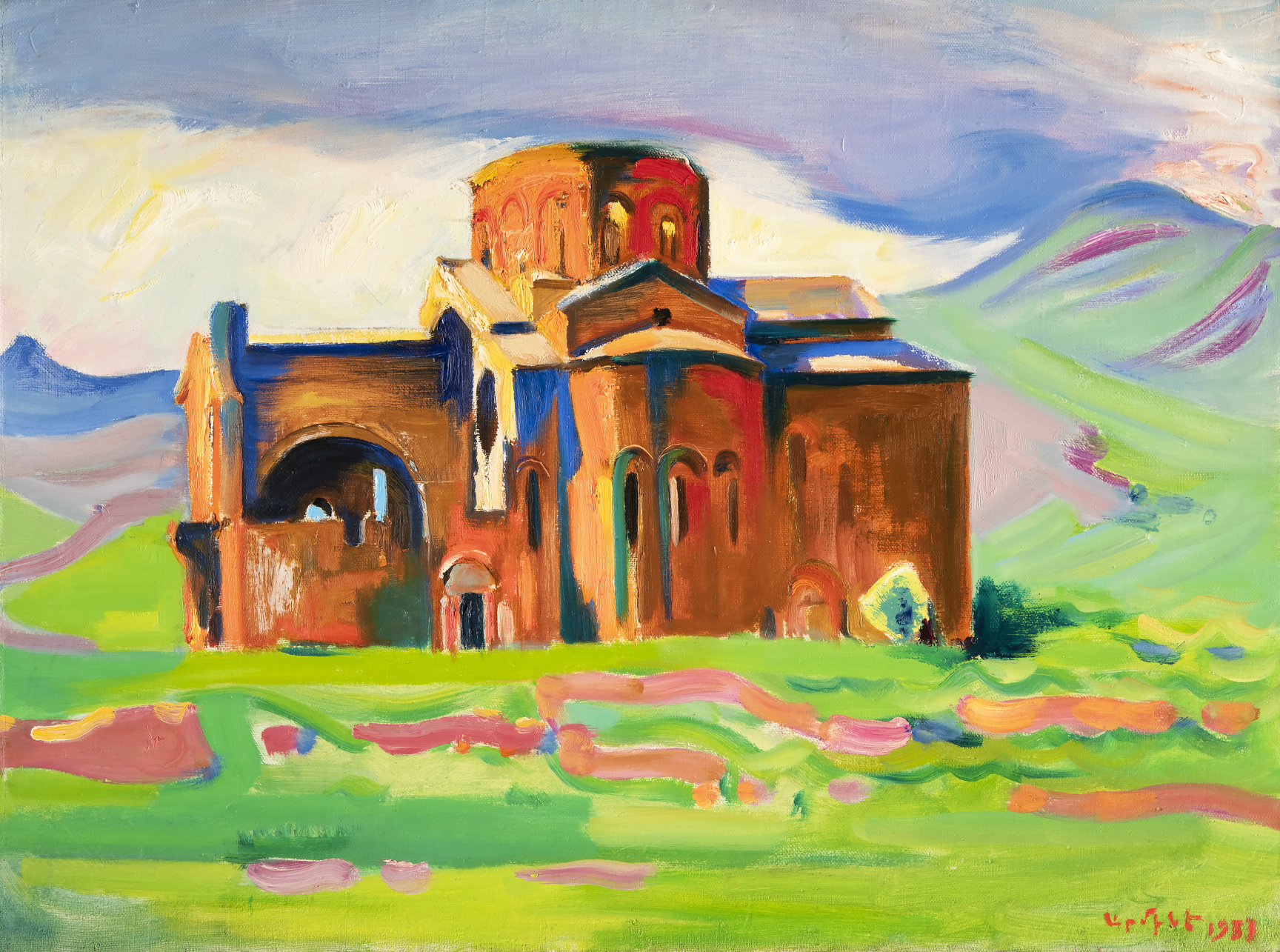
Armine Galents, Katoghike Church in Talin, Armenia, 1983. Oil on canvas. Overall: 57.8 x 78 cm
(22 3/4 x 30 11/16 in.) Norton and Nancy Dodge Collection of Nonconformist Art from the Soviet Union.
The next section, simply titled Abstraction displays work mainly from the 1960s and 1970s. As the curators note, the overwhelming influence here is Abstract Expressionism, particularly the work of Arshile Gorky, perhaps the best-known 20th century Armenian artist. Seyran Khatlamajyan’s 1972 Apricot Tree (oil on canvas, 21 ¼ x 28 ¾ in.), with its swirling shapes and vivid orange shades, flows most directly from this tradition, recalling the Armenian master’s Garden in Sochi. There are also powerful works by members of 3rd Floor and Bunker artists such as Vigen Tadevosyan, Henry Elibekyan and Armen Rotch-Hajyan. As for the huge (73 ¼ x 90 3/16 in.) abstract 1986 tempera on canvas by Kiki (Grigor Mikaelyan) in black and purple—it stands with the best Krasners or Pollocks and constitutes one of the nicest finds in Topographies in Dissent.
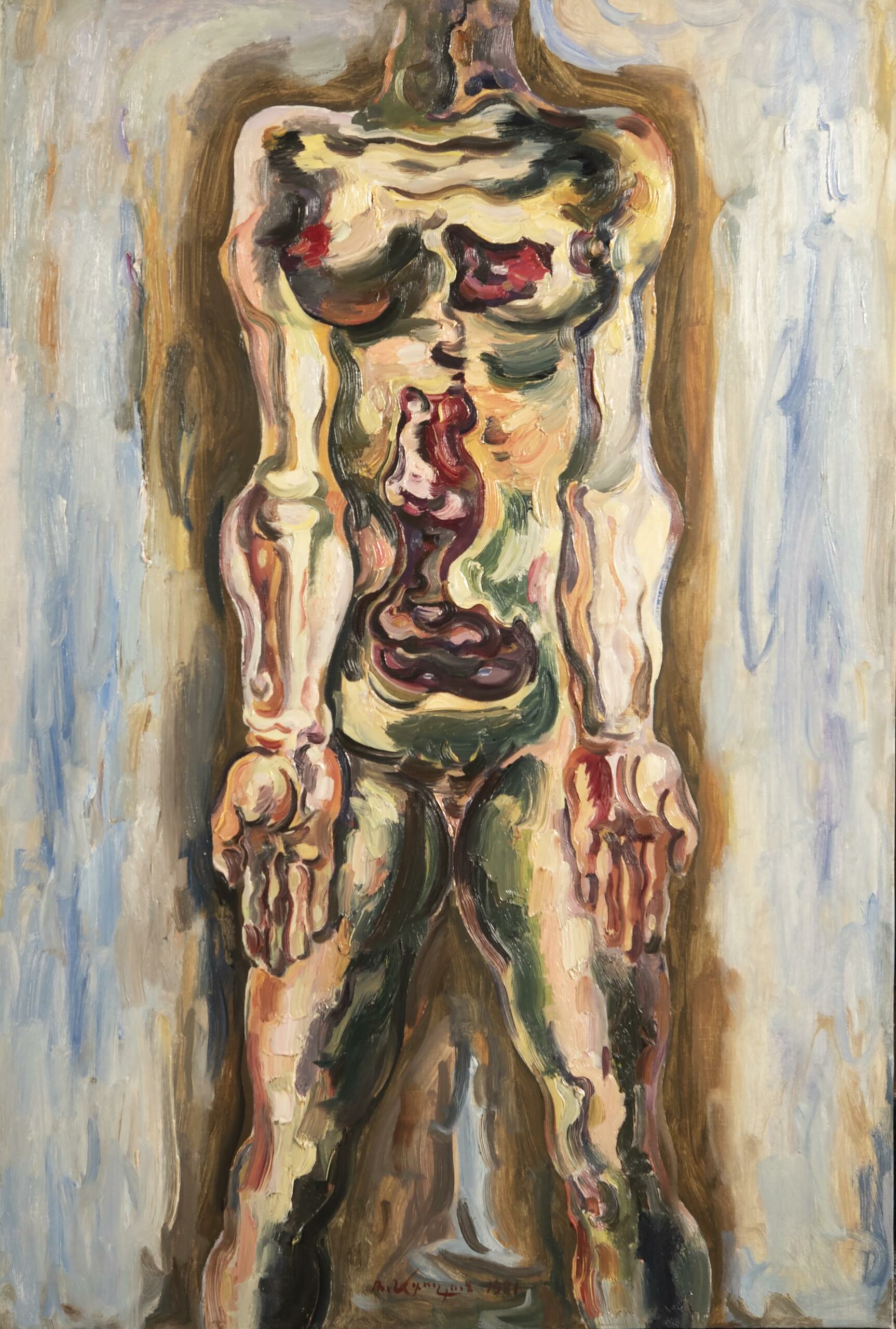
Ruben Adalyan, from the series Melancholy, 1981. Oil on canvas. Overall: 86.5 x 59 cm (34 1/16 x 23 1/4 in.)
Norton and Nancy Dodge Collection of Nonconformist Art from the Soviet Union.
Dystopias of the Evil Empire, the most surprisingly named part of the exhibition, takes the viewer into the 1980s and the final years of the Cold War. Postmodernism is perhaps the key influence here, with a superb 1981 Ruben Adalyan oil on canvas reminiscent of Francis Bacon (Untitled, 25 ½ x 19 11/16 in., from the series Melancholy), which superimposes an anguished or simply depressed face over a headless human body. Also superb, a 1975 oil on canvas by the Tbilisi artist Gayaneh Khachatryan titled Requiem, Bloody Moon (29 13/16 x 51 15/16 in.), in which a floating white horse supernaturally sucks a woman and the surrounding landscape into its giant mouth. Other names to retain from this period include Sergey Hovsepyan, Evrika Zatikyan, Suren Harutyunyan and Raffi Adalyan.
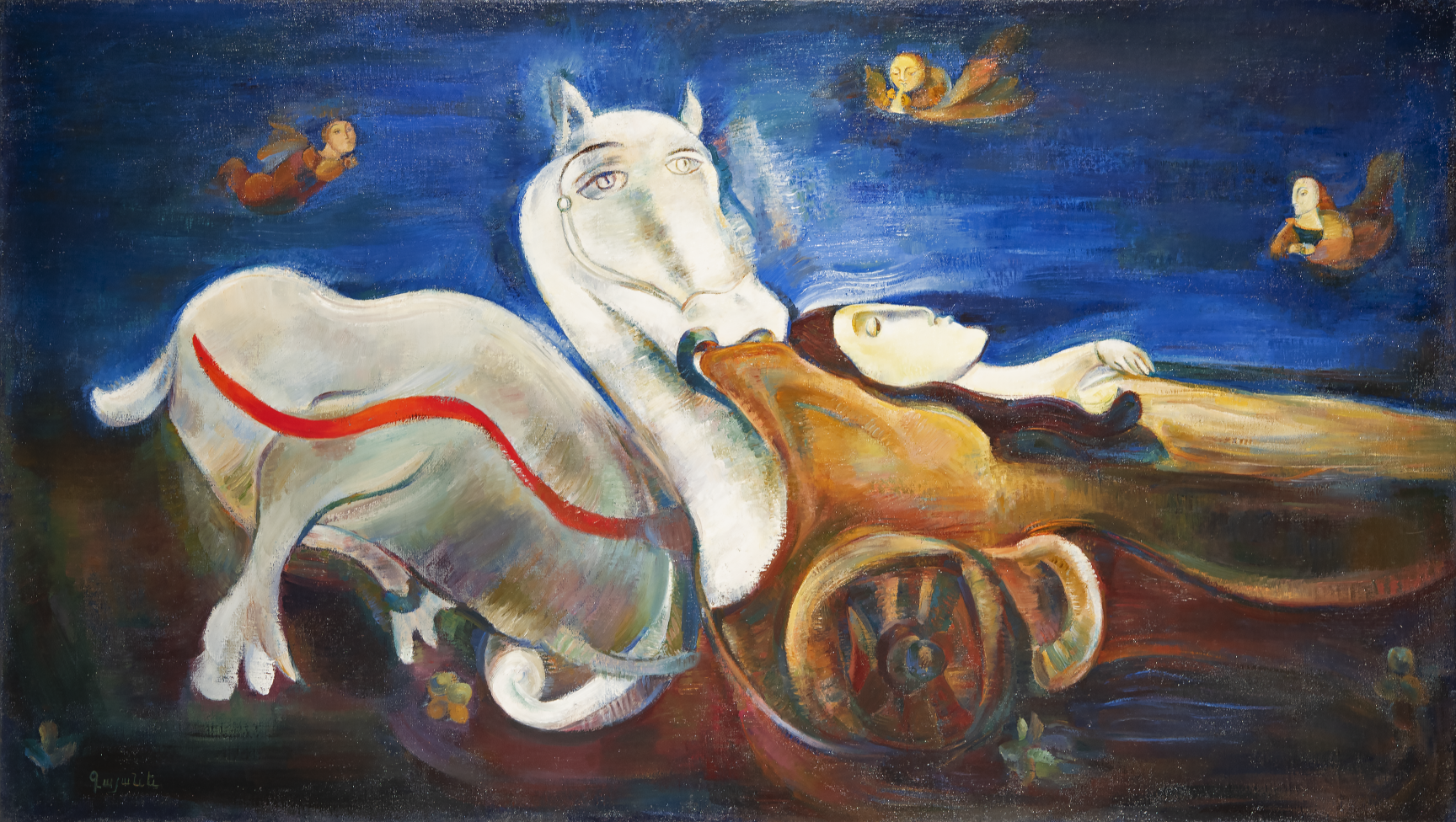
Gayaneh Khachatryan, Requiem. Bloody Moon, 1975. Oil on canvas. Overall: 75.8 x 132 cm (29 13/16 x 51 15/16 in.)
Norton and Nancy Dodge Collection of Nonconformist Art from the Soviet Union.
Finally, and somewhat wistfully, the exhibition ends with a whiz bang of satirical color and text and more work from 3rd Floor. Subtitled Pop Art, Hyperrealism, and Neo-Dada it will perhaps surprise viewers the most, for its rich appropriation and original remastering of Western Pop Art, both in the sense that a DJ remasters music and in the facile way in which these clever artists such as Edward Enfyajyan, Sev, Achot Achot and Offenbach—freed of Soviet shackles— played with the dictates of American pop art and made them their own. In her 1985-86 Half-Hourly Difference (oil on canvas, 57 11/16 x 57 7/8 in.) Karine Matsakyan toys with the dubious promises made by cosmetic companies, reproducing the same images of a woman’s face, legs and torso en abyme, à la Andy Warhol. And Paris-based Achot Achot is represented by masterful geometric works from 1986 in pencil, graphite and watercolor on paper, all under 12 by 9 inches: 12 Closed Gospels (1986); Angel Supporting the Kingdom of Heaven, and Three Gospels Opening, as well as the slightly larger The Kingdom of Heaven, also from 1986 (12 1/16 x 16 15/16 in.). These form part of the artist’s Art Dévotionnel—Art Permanent or AFACTUMs, which hold a highly spiritual meaning. As Achot relates: “Devotion is everlasting and cannot be considered a fact (factum) tied to the material world. For the same reason, the material fact is immediately destroyed, as opposed to the spiritual.” Achot’s works here also stand out for their precise, mathematical beauty. Another work, the late Arman Grigoryan’s wonderfully bifurcated Das ist Fantastisch also steals the show. Originally presented at 3rd Floor’s 1994 Pacifica exhibition in Yerevan, it humorously showcases monks from the Order of the Cross of Malta peering over wistfully at a bunch of young swimmers to the right and a funky torso nu skateboarder above, while a cartoon blurb below in Armenian reads: “Oh, what a foolish thing it is to be a Maltese knight. I envy these children—they live in Paradise.” This very piece influenced a young Lilit Sargsyan when she attended the exhibition as a college student, and it is safe to say that it helped to introduce a new vocabulary for others in Armenia as well.
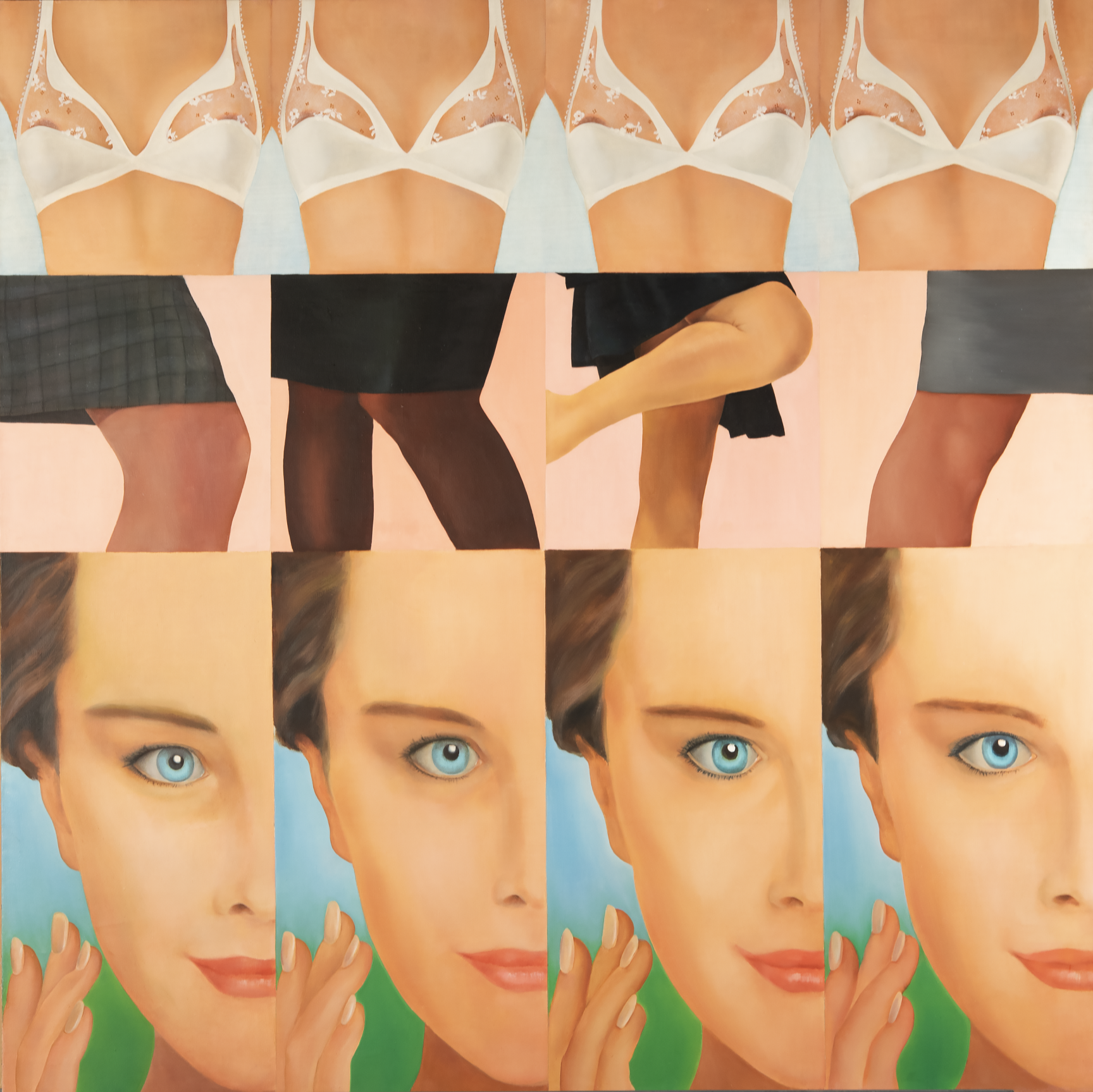
Karine Matsakyan, Half-Hourly Difference, 1985-86. Oil on canvas. Overall: 146.5 x 147 cm (57 11/16 x 57 7/8 in.)
Norton and Nancy Dodge Collection of Nonconformist Art from the Soviet Union.
Egyptian-born Hagop Hagopyan’s No to the Neutron Bomb! serves as both the physical and theoretical centerpiece of the exhibition. Painted in his signature earth tone colors, this 1977 oil on canvas spans some 76 3/8 by 117 5/16 inches. Hagopyan moved to Armenia in 1962 following the great repatriation movement that spanned from the 1940s to the early 1960s, when over 100,000 Armenians from around the globe moved back to their supposed homeland. Faced with the brutal reality of Soviet life, the artist stopped painting for several years before going on to produce important works in his signature spare style. As Tulovsky notes: “Hagopyan originally conceived the painting as a critique of the Soviet regime, never expecting it to be shown publicly. He reworked one of his recurring motifs—empty clothes—to create a powerful image of a soulless, faceless society shaped by a totalitarian machine. After reading in the foreign press about the development of the neutron bomb, he reframed the work as an antiwar statement and titled it No to the Neutron Bomb! And as Sargsyan seconded in the post-opening talk, this was a clever way around official Soviet censorship, since the neutron bomb issue was part of anti-American propaganda.
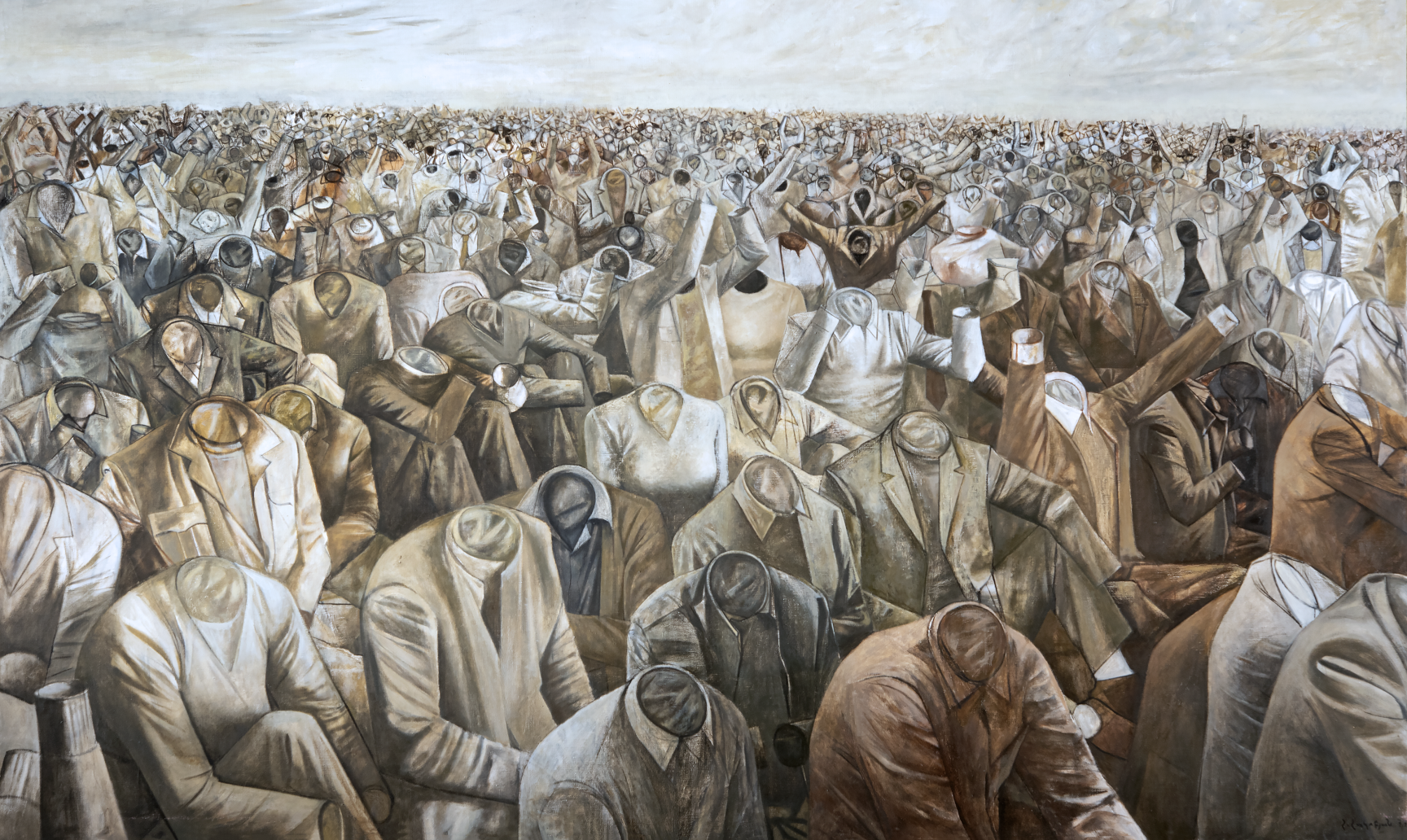
Hagop Hagopyan, No to the Neutron Bomb!, 1977. Oil on canvas. Overall: 194 x 298 cm (76 3/8 x 117 5/16 in.)
Norton and Nancy Dodge Collection of Nonconformist Art from the Soviet Union.
As previously noted, Hagopyan and several other artists in the exhibition were born in the far-reaching Armenian diaspora, and the artworks in Topographies of Dissent were amassed outside the borders of present-day Republic of Armenia. This is perhaps all for the good, given the current state of museums there and the lack of a serious internal art market. And as Sargsyan averred in a private conversation, the works here were not actually plundered by foreigners or Western dealers, as is the case unfortunately with a good deal of African and indigenous art. It was instead purchased directly from the artists themselves—though probably at low prices—so that the post-colonial critiques levelled at some other collections lacks weight in the case of the current exhibition. One still hopes, however, that some of these works may one day return to Armenia, if at least on loan for a significant period.
In the end, the exhibition’s greatest strength lies in the curators’ aesthetically judicious choice of images. As New York-based artist and musician Ron Anteroinen notes: “It isn’t often that one experiences an exhibit which, piece by piece, conveys an atmosphere wherein the emotional characteristics and experiences of a culture and its political milieu are brought into a collective focus. This exhibition operates as a concretized critique of Soviet life.” Topographies of Dissent is more than simply an art exhibition, as Tulovsky explains: “Our collaboration with Lilit began when I invited her to participate in a project devoted to the creation of a new website dedicated to the Norton and Nancy Dodge Collection. The site is envisioned as an encyclopedia, featuring biographical entries on the artists represented in the collection. The work on the website eventually led to the development of the exhibition.” This is good news for Armenian art and Armenian artists around the globe. There are to date only a handful of serious collectors of contemporary Armenian art, in the Republic of Armenia or elsewhere. This exhibition, by exposing the public and collectors to its many riches, may represent a small if crucial step in helping to create an international market for artists who deserve to be celebrated outside the Soviet and post-Soviet contexts.
Zimmerli Art Museum, Rutgers University
September 27, 2025 – July 31, 2026
Link to Topographies of Dissent Exhibition
Link to the unofficial landmark 1994 Pacifica 3rd Floor exhibition video