

[Beyond Borders]
This column explores the key issues shaping life in the South Caucasus, focusing on how the divergent paths of Georgia, Armenia and Azerbaijan reflect the region’s complex histories, economic developments, and political shifts. While new generations in these countries grow more isolated from one another due to language barriers and conflicting national trajectories, the same is true for local policymakers, who are often more familiar with distant capitals than their immediate neighbors. Each nation seeks its own path, sometimes in conflict with others, while international actors often treat the region as a whole, reluctant to craft policies specific to individual states. Drawing on personal experience with the region’s revolutions, conflicts and transformations, Olesya brings you Beyond Borders—a column exploring how decisions made in one corner of the South Caucasus impact all who live there.
Listen to the AI generated audio article.
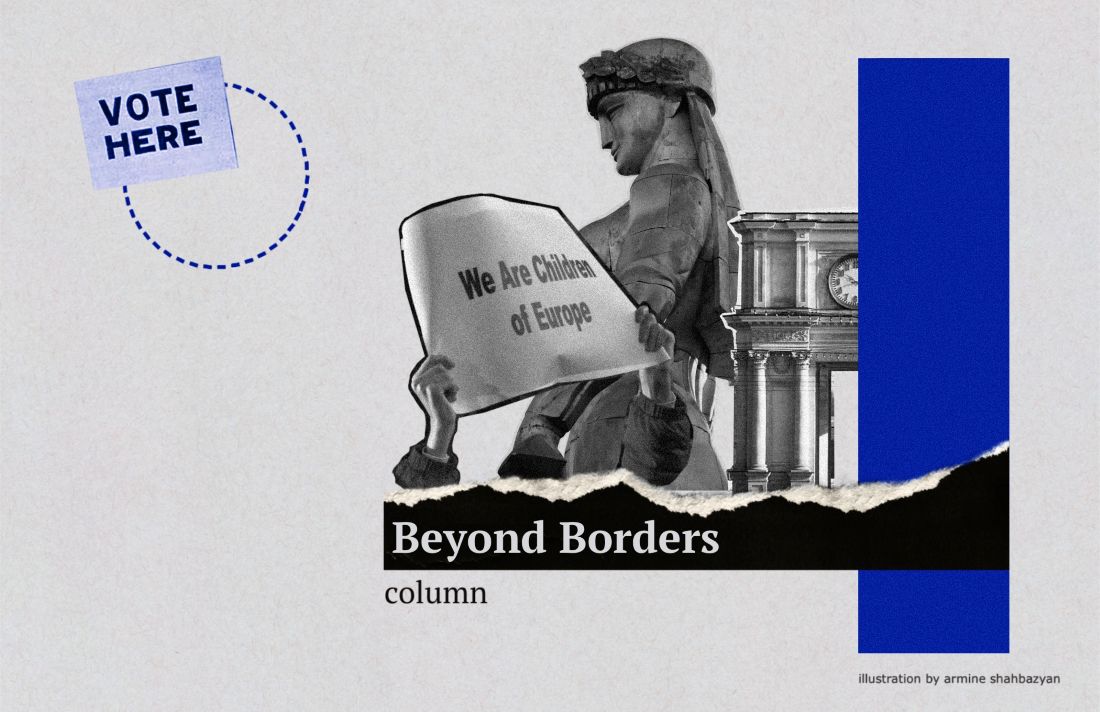
The recent elections in Moldova and Georgia marked the end of their respective electoral cycles. In Moldova, September’s parliamentary vote consolidated the government led by Maia Sandu, following last year’s presidential race. In Georgia, with its recent local election, the ruling Georgian Dream failed to resolve the political crisis that has persisted since last year’s parliamentary vote, leaving the country mired in tensions both with Western partners and its domestic opposition.
It was a hard-fought battle that will shape both countries for at least the next three years, until new elections are held. In Moldova, the outcome cemented a pro-European trajectory. In Georgia, it froze the political divide and halted the country’s progress toward European integration.
Together, these trajectories offer a glimpse into the region’s political landscape, one which Armenia, now entering its own pre-election cycle, should study closely. With parliamentary elections scheduled for next year, the lessons from Chișinău and Tbilisi may prove vital in understanding how to preserve stability and avoid pitfalls that could determine the country’s direction for years to come.
The Threat of War
The dominant theme in both Moldova’s and Georgia’s elections this past year was the invocation of war. It is hardly surprising, given the fourth year of brutal fighting in Ukraine, where hundreds of towns and villages have been reduced to rubble and hundreds of thousands of lives have been lost. Both Moldova and Georgia have lived through wars of their own and still carry the burden of unresolved conflicts and a continued Russian military presence within their borders.
The specter of war can push people to set aside ideals. Fear of violence can silence debates about rights, justice and the future—all in the hope that submission to a stronger and more aggressive neighbor might somehow spare them the fate of Ukraine.
This was precisely the narrative advanced by Georgia’s ruling party. Last year, in the run-up to the vote, Georgian Dream plastered the capital with images of bombed-out Ukrainian cities and inundated television and social media with ominous videos warning that a vote for the opposition meant war.
In Moldova, the opponents of Maia Sandu tried a similar tactic but failed. Her team managed to dismantle the false narrative with clarity and confidence that resonated with voters. They explained in simple and direct language that the “threat of war” was not determined by which politicians Moscow liked or disliked but by a host of other factors: Russia’s ability to fight on multiple fronts, the wider geopolitical context, and even Moscow’s looming state budget deficit.
Moldova’s success highlighted how misguided the Georgian opposition’s strategy had been. Rather than confronting fear-based manipulation, they ignored it, a mistake that still haunts them. Even in the most recent local elections, Georgian Dream once again turned to the same rhetoric of war and insecurity.
The first and perhaps most crucial lesson is this: the language of fear cannot simply be dismissed. It must be addressed, unpacked, and answered with reason. People are not naive. They can tell who is lying and why.
The Machinery of Manipulation
In the otherwise dry conclusions of international observers on Moldova’s elections, three words appeared again and again: unprecedented, manipulation and hybrid. They described a campaign that stretched far beyond the conventional struggle for hearts and minds.
When I visited Chișinău this summer, months before the vote, the atmosphere was already charged. Posters and banners covered not just the capital but also provincial towns. Later investigations revealed underground networks working to discredit President Sandu, financed through Russian bank accounts, cryptocurrency and channels linked to the Moldovan diaspora in Russia.
The media landscape resembled a battlefield. Fake news outlets mimicked respected publications. Social networks were flooded with bot-driven comments and Telegram channels that appeared and disappeared overnight. Even the Orthodox Church was drawn in, with priests from the Moldovan Church affiliated with Moscow, urging their congregations to vote a certain way.
Yet despite the scale of these efforts, Sandu’s party not only won but did so decisively, securing the ability to govern without coalition partners. Few expected such a result, given the resources arrayed against it.
Their victory points to the second lesson: success depends on preparation, coherence and endurance. Sandu’s team began early and fought on multiple fronts. The campaign was not built around one personality alone but around a collective effort marked by discipline and clarity of purpose. Persistence, more than anything else, brought victory.
Understanding the Cost of Crisis
With her parliamentary majority, Maia Sandu now has a mandate to push forward with reforms aimed at deeper integration with Europe, including those that may prove unpopular in the short term. EU membership remains a distant goal, but the reforms promise stronger institutions and greater economic stability.
In Georgia the story could not be more different. Last year’s elections plunged the country into a prolonged political crisis. Instead of seeking compromise, Georgian Dream chose confrontation, imprisoning opponents, weakening civil society and driving many talented people out of the country.
These repressive moves have done nothing to resolve the crisis. If anything, they have deepened it. In early October, tens of thousands again took to the streets on local election day, while voter turnout fell sharply compared to previous years. Confidence in the political process continues to erode.
Externally the crisis has strained relations with the European Union. Brussels is now reconsidering visa-free travel and trade agreements with Georgia. The political turmoil has also damaged the country’s international standing, leaving it increasingly isolated at a time of global uncertainty.
This is the third lesson: a prolonged political crisis is not just about politics. It’s about loss. It erodes trust, damages the economy and alienates partners. In a region already marked by instability that is a price few can afford to pay.
What It Means for Armenia
All three lessons matter for Armenia as it moves toward its own elections. The Washington-brokered agreements with Azerbaijan have created cautious hope for stability. Yet the borders remain a frontline, and in some places soldiers still stand only meters apart. The potential for manipulation through fear, misinformation and nationalist rhetoric remains high.
That is why it will be crucial to maintain momentum toward normalization and to implement existing agreements. Each tangible step will continue to dispel the enduring narrative that only Russia can bring peace to the region, a notion now challenged by the recent U.S.-brokered accords.
Armenia, like Moldova, is a small country with deep historical and social ties to Russia. Moldova’s experience in countering manipulation offers valuable insight, not only in tactics but also in recognizing how fear and disinformation can shape public perception.
These lessons are not meant to favor the current Armenian leadership, which seeks a strong mandate in the coming vote, nor to undermine its opponents. They apply to all sides. The integrity of the electoral process will determine whether the country wakes up stable or divided the day after the vote.
Echoing the story of the Georgian crisis, Armenia’s diverse political forces, with their different ideologies and constituencies, may at some point have to recognize a simple truth: compromise must prevail. However fierce the campaign becomes, there will come a moment when the country’s stability, and perhaps its very future, must take precedence over victory.