

[Beyond Borders]
This column explores the key issues shaping life in the South Caucasus, focusing on how the divergent paths of Georgia, Armenia and Azerbaijan reflect the region’s complex histories, economic developments, and political shifts. While new generations in these countries grow more isolated from one another due to language barriers and conflicting national trajectories, the same is true for local policymakers, who are often more familiar with distant capitals than their immediate neighbors. Each nation seeks its own path, sometimes in conflict with others, while international actors often treat the region as a whole, reluctant to craft policies specific to individual states. Drawing on personal experience with the region’s revolutions, conflicts and transformations, Olesya brings you Beyond Borders—a column exploring how decisions made in one corner of the South Caucasus impact all who live there.
Listen to the AI generated audio article.
Your home region is like a first love — no matter where life takes you, no matter what happens, you carry a quiet warmth for it close to your heart. That is how I feel about Javakhk, as Armenians usually call it. For the rest of Georgia, it is Javakheti, the official name you will find in maps and documents.
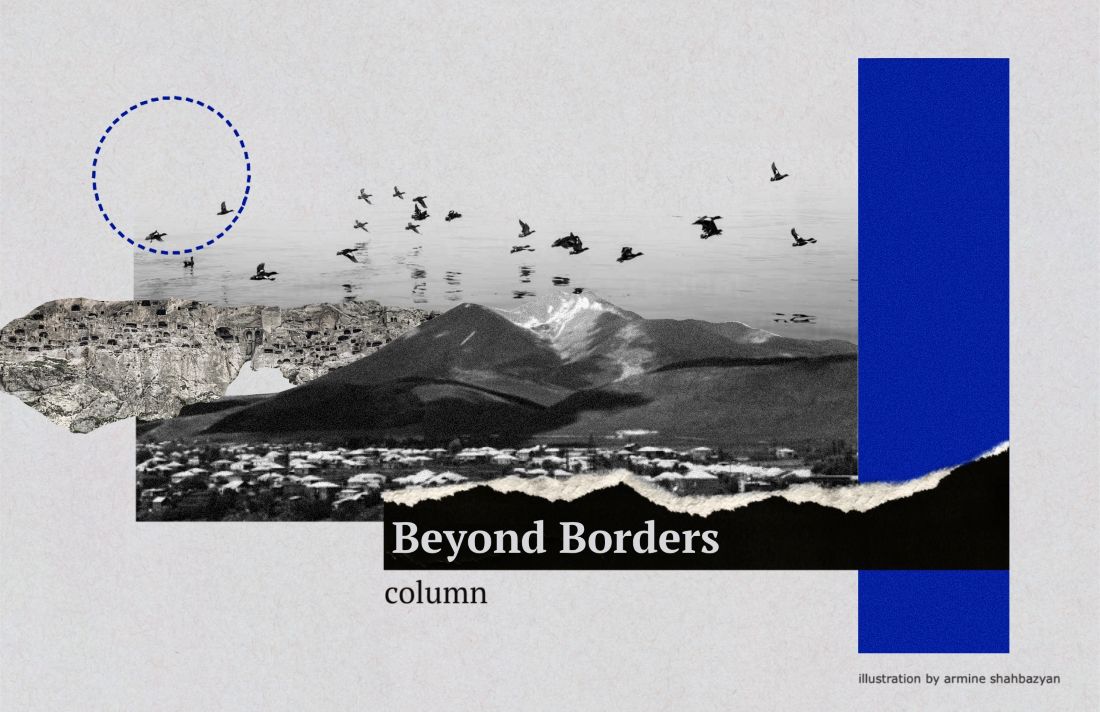
This is a highland plateau, rising nearly 2000 meters above sea level, pressed up against the borders of Georgia, Armenia and Turkey. There are several lakes that draw migrating birds from distant corners of the world. Winters here are long and brutal, the kind that freeze your eyelashes, while summers are cool and softened by sweeping mountain breezes.
For most people outside the region, Javakhk is known for its potatoes and cheese, and the honed skill of shaping dried manure into bricks to fuel stoves through the endless winter nights. Some know it because of its famous sons, poet Vahan Teryan or the ashugh Jivani. But for me, it is simply home, the place where I finished school, where my family comes from. Every street corner and crumbling facade carries the weight of childhood memories.
For the last two decades my visits have been brief and infrequent. This summer, though, I stayed nearly a month. Long enough to see old friends and drive from village to village, meet enterprising locals and witness the quiet transformations of this place.
Through Hard Times
The first thing you notice now are the roads: smooth asphalt leading to even the most remote villages. Streetlights glow in the evenings. Few are surprised anymore to have running water, gas lines, even sewage systems.
But it wasn’t always like this. I remember childhood nights lit by kerosene lamps. I remember when local potatoes and cheese became the main currency because wages went unpaid for months and there was no cash to be found.
Entire villages began to empty then. Windows were boarded up, doors locked and people set off for Russia in search of work. Even today, you can still find places deep in Russia where whole settlements trace their roots back to Javakhk.
Things began to change in the early 2000s. Today, roughly 67,000 people live in the region—about 40,000 fewer than at the collapse of the Soviet Union, but close to the numbers reported two decades ago. Most of them are Armenians, though Georgians and Russians also live here. There are Orthodox Christians, Armenian Apostolics, Catholics, even a small community of Georgian Muslims.
The Separatist Moment
Like many regions with a largely homogenous population, Javakhk faced its own uncertainty in the early 1990s. After the collapse of the Soviet Union, when no one seemed to know who exactly held power in Tbilisi, locals began speaking about greater autonomy.
The Georgian government, meanwhile, encouraged resettlement of vulnerable ethnic Georgian families displaced by landslide-stricken mountain regions into Javakhk. In response, Yerevan supported programs to help Armenians purchase homes, ensuring they would not be “lost” to others.
My clearest childhood memory from that time is of men, some armed, walking down the main street. It was frightening, but also strangely exciting in the way only a child can feel. Nothing turned violent, though in retrospect, it seems more the result of luck than any wise policy. For years there was hardly any real governance in this region.
Looking back now, it is clear that more than local restraint played a role. Clashes had already erupted in Nagorno-Karabakh, threatening to destabilize the region further. Neither Yerevan nor Tbilisi wanted a new front—Armenia could not risk losing its northern lifeline to Russia and the Black Sea ports, while Georgia was already overwhelmed with conflicts in Abkhazia and South Ossetia.
Javakhk was spared. There was no war, no mass displacement, no headlines forcing foreign newscasters to learn how to pronounce its name. The region still has its problems, but it never drowned in conflict the way, for instance, Karabakh did.
Challenges Today
That doesn’t mean old grievances were forgotten overnight. I remember being in Javakhk in August 2008, when Russia recognized Abkhazia and South Ossetia. I found myself surrounded by former leaders of the local autonomy movement. One of them clapped his hands in frustration: “We too could have been celebrating today, if only we hadn’t stopped back then.” His words shocked me, but the nodding of the men around us showed he was not alone in his thinking.
Younger people usually react differently. Around 15 years ago, Tbilisi introduced a program making it easier for local students to enter top Georgian universities. The result is that today most graduates head to Tbilisi, not Yerevan—a complete reversal from my own school days.
Along with education came new ties—business connections, friendships, marriages—that are pulling Javakhk deeper into Georgia’s orbit. Knowledge of the Georgian language is now normal among the young. Many go to Europe to work rather than to Russia, as their parents did. Public sector salaries here are even higher than in provincial Armenia.
At the same time, the greater use of Georgian in schools and official documents has been met with unease among the older generation. Questions over how Armenian history and literature are taught remain a point of tension, often surfacing at family gatherings.
And even when young people master Georgian and earn degrees, they still struggle to be accepted in Tbilisi as equals. Many cannot find work outside the region. If they have bigger ambitions, they often leave the country altogether, increasingly heading for Europe rather than Armenia.
The Quiet Outcome
Does this make local Armenians somehow “lesser”? Some say yes, insisting that their rights are still not fully guaranteed. But others tell me they don’t want a new conflict; they escaped war once and would rather live in peace, even with lingering misunderstandings.
I think of a classmate who, years ago, buried his father in Armenia rather than in Javakhk. “I don’t believe Armenians will stay here,” he told me back then. Today, he and many others visit regularly. Some are even repairing their family homes, perhaps preparing to retire there.
I have watched a story unfold here that became possible precisely because of what didn’t happen. Because Javakhk did not descend into war, it still lives its quiet, sometimes difficult, but peaceful life.


I want to say that this is a great article—I really enjoyed it and learned a lot about an historic Armenian region I had long been curious about but didn’t know where to find reliable information. Just one little thought: it would be wonderful if future pieces could also touch on Armenian cultural landmarks and cultural institutions in Javakhk, since they’re such an important part of the region’s identity. For instance, sites like the Gandza and Kumurdo Cathedrals, Tmogvi and Abuli fortresses, the churches of Akhalkalaki and Akhaltsikhe, as well as cultural institutions such as the Vahan Teryan House-Museum or the Jivani Cultural Center, all carry deep meaning for locals and for Armenians more broadly.