

Visiting one post-Soviet state, you can then recognize it in all others – the similar patterns of urban planning and the identical buildings, structures, roads, pipes, wires, tiles, etc. However, an outsider delving inside under the extreme familiarity of the material environment finds an extreme “strangeness” of social interactions and practices. The “Outside In” series is about emplaced paradoxes and nuances. It spotlights the mundane in Armenia’s peripheral locations, where the seemingly unspectacular encounters with people and things allowing us to capture the unique features of the territory.
Listen to the AI generated audio article.
Outside In
Essay 24
For someone who thinks about food constantly, who plans days around meals, and memorizes restaurant recommendations, I have been strangely silent about it here. It took a cow’s head in Gyumri to make me realize that the time has come to talk about Armenian cuisine. Not in general but through its most unusual, unapologetically graphic dishes. But first, let me set the scene.
I have always been the kind of person who seeks out the unfamiliar, who views the local food market and small eateries as captivating as museums (if not more). What began as adventurous curiosity, a way to collect experiences and stories, transformed once research entered the picture. Meals were no longer just about personal discovery, but a methodological necessity. There’s an occupational hazard to doing fieldwork: every meal becomes an investigation; every bite transforms into data. This isn’t romanticizing but recognizing that eating is one of the most fundamental ways we access cultures. The patterns that structure daily life, the hierarchies of value, the boundaries between inside and outside – these often reveal themselves most clearly at the table.
I eat unusual things as part of my job, and since the boundary between “work” and “life” of a geographer/anthropologist is increasingly vague, I eat them whenever an opportunity presents itself. Refusing them creates an artificial barrier between me and the world I dwell in and try to understand. When you are serious about getting to know a place, you cannot simply choose which aspects of life to engage in, even if some are profoundly unsettling. This is what I tell myself, anyway, to justify poor choices.
My education in culinary discomfort has been international. In Japan, I consumed shirako (fish sperm sacs), which required quite a lot of sake beforehand. In Scotland, there was haggis – sheep’s offal mixed with oats, suet, onion, and spices, cooked inside a sheep’s stomach. Strangely, I came to love this dish and occasionally even cooked it for breakfast while living in the UK. Swedish surströmming (fermented Baltic Sea herring) made me literally cry from disgust. In Los Angeles, I enthusiastically took several bites of rattlesnake sausages from a food truck. On my honeymoon in Chile, we ate piure, a sea creature that resembles a bleeding rock and tastes like iodine slime. During fieldwork in the Russian Far North, I was served battered reindeer brains. Each of these dishes carried within them the constraints of origin. They are not “weird” for the sake of distinction but are simple, practical solutions to environmental conditions, which brings me back to Armenia. In Armenian cuisine almost nothing is wasted, flavor is built through time, and the most prized dishes are often those outsiders find disturbing. This is food born of necessity, refined through centuries of adaptation to a landlocked, mountainous terrain where resources have never been abundant.
Consider tjvjik, a dish made from organ meats – liver, heart, kidneys – cooked with onions, tomatoes, and herbs. Or kololik, meatballs made from meat and fat that clings to lamb intestines, creating a texture unlike any other meatball – slightly chewy and intensely savory. However, the two dishes that most encapsulate the “zero waste” philosophy are khash and kjalla. Both involve, so to speak, “unconventional” parts of the cow and are both consumed with specific rituals.
Ritual of Khash
Khash occupies a peculiar position in Armenian cuisine. It is simultaneously humble and celebratory, medicinal and social, ancient and absolutely contemporary. At its most basic, khash is boiled cow’s feet and stomach, slow-cooked overnight until the broth becomes golden and thick with gelatin and the meat falls off the bone.
Khash is morning food, usually served during the cold season, believed to have medicinal properties. What makes it really special though is the social context – to eat khash is to participate in a collective ritual that cannot be performed alone. The protocol is precise. Steaming broth is ladled into deep bowls. Dried lavash is broken into pieces and added, where it absorbs the liquid and creates texture. Fresh garlic, crushed and mixed with a bit of broth, is added according to preference. Some also like to add vinegar for acidity. Accompanying khash, vodka is not optional but mandatory, served in small glasses that are emptied and refilled throughout the meal. The alcohol, it is explained, helps digest the rich, fatty broth. Whether this is medically accurate or a convenient justification for morning drinking is beside the point.
My first and only experience of khash was challenging, to put it mildly. The smell of a cowshed, the dissolving texture of meat combined with the thick, gelatinous broth created a mouthfeel my palate found off-putting. It was similar to the Slavic kholodets, the ill-famous among foreigners meat jelly, only smelly, liquid and hot. You cannot cut the meat with a knife. Instead, you must pull it away from small bones with your fingers or teeth, navigating various textures – soft meat, tender cartilage, occasional bits of bone. There is no way to eat khash elegantly, it brings out the beast in you.
I was in great company at a good Yerevan restaurant, but truthfully, only abundant vodka reconciled me with reality. Don’t get me wrong, I absolutely loved the ritual. Hands-on, messy, intimate. But either you fall for khash, or you don’t. There seems to be no middle ground. I honestly paid my dues, but that once was enough. “Baby, hush, hush” still haunts me.
Kjalla Encounter
If khash is challenging, kjalla is its more extreme relative. I first came across the name kjalla in the menu of GWOOG café in Gyumri. The menu offered no explanation, only mysteriously noting “to be ordered in advance,” a line that is an unmistakable marker of authentic food. My brief Google search revealed it was a cow’s head. The Head, my mind wandered to the eponymous series about a massacre at an Antarctic research station that I watched during the pandemic. This was the most unusual Armenian dish I heard of. Without hesitation, the challenge was accepted. But first I needed to find company for this questionable endeavor.
Luckily, one of my closest friends visited Armenia with a special request to spend a weekend in Gyumri. As a trained anthropologist of the North who tried blood soup, raw reindeer meat, walrus intestine, and even kopalchen (fermented meat that releases cadaveric venom during production), she was my perfect partner in crime. I called GWOOG, reserved a table, ordered kjalla, and prepared for the show.
On a sunny Saturday afternoon in mid-October, admiring the yellow and red leaves, and feeling absolutely ridiculously happy, we entered GWOOG. A charming middle-aged Armenian woman showed us to our table. When I mentioned kjalla, she gave us a skeptical gaze but said nothing. Clearly, she underestimated our scientific interest and fieldworker persistence. We opted for several vegetable salads and settled in to wait for the main dish.
What emerged fifteen minutes later was exactly what I expected – a cow’s head split lengthwise, boiled until tender, and served whole. It arrived on a large metal platter, still steaming, with completely visible skull architecture. Blind eyes in sockets, nasal cavity, jaw complete with teeth – nothing was hidden. Alongside came fresh lavash, raw onions, herbs, coarse salt, and a small bowl of cooking broth, thick and shimmering with fat.
The café suddenly fell silent. Other guests, all of them Armenian men, had stopped their conversations. Not obviously, not rudely, but with awareness that something interesting might happen. Would these Slavic girls actually eat it? Or just take pictures and leave? Of course, first we took pictures of both the kjalla and ourselves. Then the lady, who served us the dish, took it back to the kitchen for carving the meat and placing its different parts – from cheeks, to tongue, brains, and eyes on plates, which, alas, precluded our hands-on experience. Apparently, we were not trusted to perform a full autopsy.
When the plates were served, we started with the cheek meat, which I had been told was the prize. We wrapped it in lavash with raw onion and herbs, creating a small bundle. The meat was rich and delicate, absolutely delicious. The sharp onion cut through the fattiness, the lavash provided structure. Around us, I sensed approval. The old man at the next table raised his vodka glass in a barely perceptible salute.
Tongue came next. Smoother than cheek meat, almost velvety, with less assertive taste. Then time came for the parts that required internal negotiation – eyes and brains. There is something primal, savage about eating an eye. My more courageous friend took a bite. “Tastes like pure fat,” she said with professional detachment. I dared the smallest possible piece. Everything in me protested. I closed my eyes, tried to switch off, but eventually just swallowed without letting myself taste it. Still, I was proud to overcome nausea and disgust, which is apparently what passes for an achievement. Brains met less opposition; I had tried them before. Soft as pâté, remotely reminiscent of liver.
We meticulously worked through the kjalla, discovering different textures and flavors. The jaw meat was stringier. Small pockets of fat melted on the tongue. The broth added a layer of richness. The meal became meditative in its repetition: take the meat, wrap it in lavash, add onion and herbs. Dip into broth. Eat. Repeat. The other guests had returned to their conversations, but the invisible barrier that typically separates outsiders and insiders had slightly thinned. Finally, we admitted defeat, over three kilos of meat were too much. The host, anticipating this, brought a plastic container without my asking. “Take it home,” she said. “It will be even tastier the next day.”
Over the next few days, that leftover kjalla became my primary meal. I ate it for breakfast, for lunch, and dinner, creating different combinations with herbs and onions from the market, each time discovering new appreciations. “Engaging with a culture is not always comfortable, but discomfort is the price of access,” I thought to myself, chewing with relief on the last remaining pieces of kjalla. I’m pretty sure, my paternal grandmother would have approved of my thrift, if not my choice of leftovers.
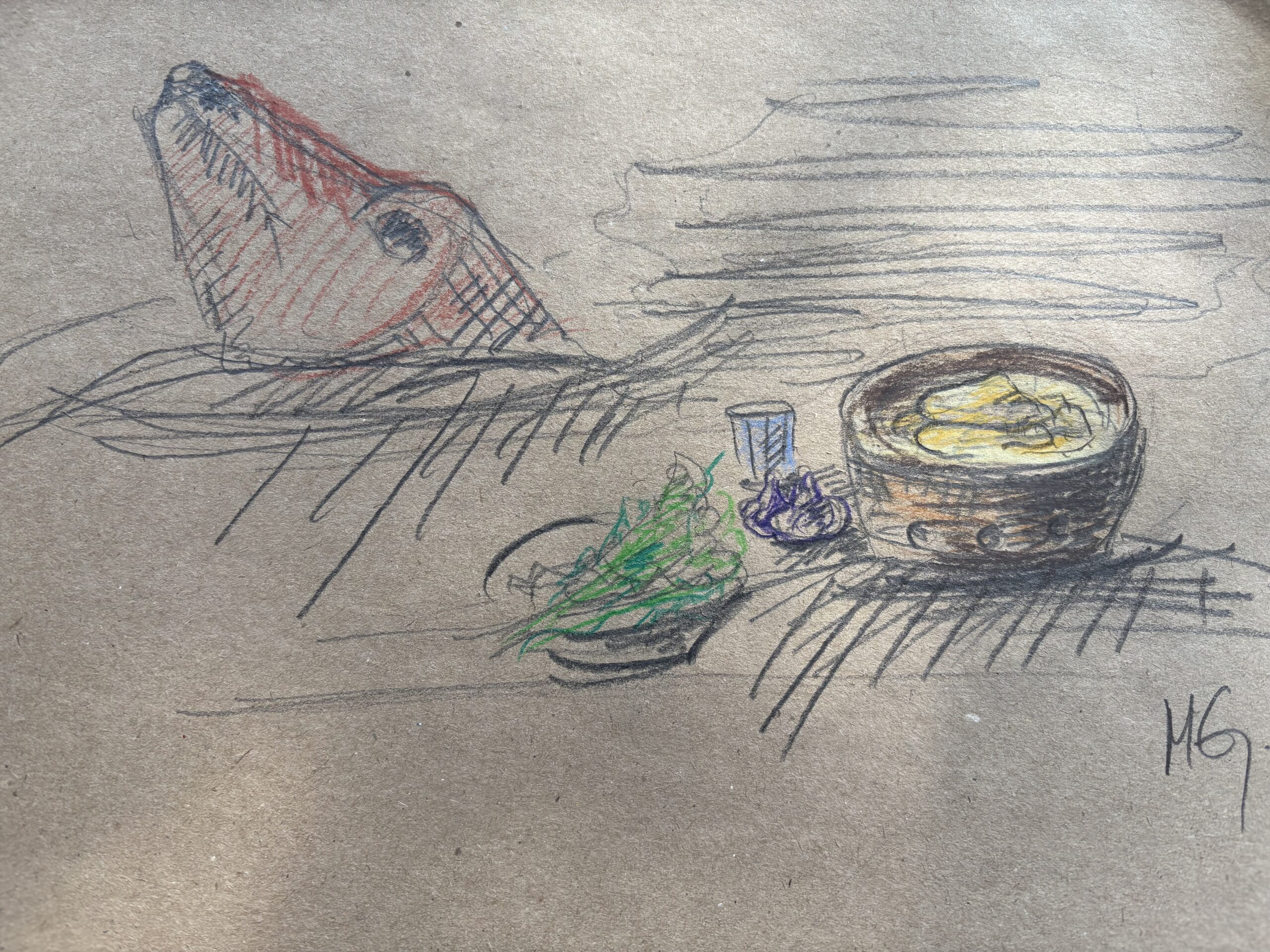
Drawing by Maria Gunko.
See all [Outside In] articles here

Maria Gunko is a DPhil Candidate in Migration Studies, Hill Foundation Scholar at the School of Anthropology and Museum Ethnography University of Oxford. Since 2023, she has joined Yerevan State University as a Visiting Professor. Maria holds an MSc and Kandidat Nauk (Russian post-graduate degree) in Human Geography.
Maria’s research interests lie in the intersection of urban studies and social anthropology, including ethnography of the state, infrastructures, and urban decay with a geographical focus on Eastern Europe and the Southern Caucasus. She is the co-editor of one monograph, author of over thirty scientific articles and op-eds.