
From emerging Armenian artists across the globe to Armenian-American talent in the United States, [Art Speak] will spotlight the dynamic and diverse Armenian art world and more.
Listen to the AI generated audio article.
The title of Linda Ganjian’s recent exhibition at Front Room Gallery—Her Memory, A Metropolis—deftly captures how memory can not only span centuries, but also cover vast cityscapes of geometry. The work presented, all created over the past three years, pays homage to Ganjian’s deceased grandmother, Mari Imirze. In these intricate, beautifully lush paintings with collage elements, the artist partially reconstructs her grandmother’s life as well as her own personal memories of her. This universe encompasses Imirze’s native city of Amasya from which Armenians were deported during the 1915-1923 Armenian Genocide and Istanbul, where Imirze became part of the small Armenian community which regrouped there after the killings abated. In the intricate collages that line the walls of the gallery, Ganjian includes reproductions from her grandmother’s prayer books. The bold geometric patterns recall Imirze’s renowned work as a dressmaker, as well as Art Deco modernist patterns that echo film director Fritz Lang’s 1927 masterpiece Metropolis. Ganjian’s work owes a debt both to the American Arts and Crafts movement, as well as to the Armenian spiritual and artistic traditions that were dear to Imirze. Elsewhere, Ganjian has said: “(This work was) partly inspired by medieval reliquaries (…) known for their ornate decorative details and their devotional appeal.” In the series, which Ganjian has titled “Future Monasteries,” she has created a devotional space that includes altars, totems, cathedral spires, rose windows and much more.
In her geometric paintings, Ganjian combines centuries-old patterns with modern futuristic-looking arrangements of art deco or art nouveau patterns in lush deep oranges, reds and blues, surrounded by grey and silver tones that remind one of industrial designs. Two large-scale recent works display the artist’s signature aesthetic refinement and concern with historical memory. In “Light Rising, Light Falling” (40”x30”/mixed media: ink, watercolor, origami paper, patternmaking paper, giclee on paper) temple-like structures open one inside the other like Russian matryoshka dolls, forming what could be leaves but which also resemble outstretched wings or arms. On each side objects appear that, at first glance, resemble lamps: rounded rectangles with a thin perpendicular neck descending into beautiful golden disks, but upon closer examination, the viewer notes that each rectangle contains excerpts from medieval Armenian prayer texts in Armenian lettering. These disks are also reproduced in the background of the painting, smaller versions clumped together like flowers and placed in blue and orange receptacles, like stunningly aestheticized flowerpots. Below more patterns, and in one row light blue silk flows out of a Near Eastern hat, somehow, they also convey a religious feeling. And at the bottom a trapezoid with brown horn-like shapes sprouting on each side recall some fantastical sci-fi alien—then the next minute one views them as “just” geometry again! Ganjian uses repetition of shapes, changing the size and hue of patterns and forms to create an almost moving tableaux. Each viewing is different and reveals another novel element—light rises in the form of the gilded disk and descends again into darker zones. Her mastery of perspective and depth creation gives the work an almost three-dimensional aspect.
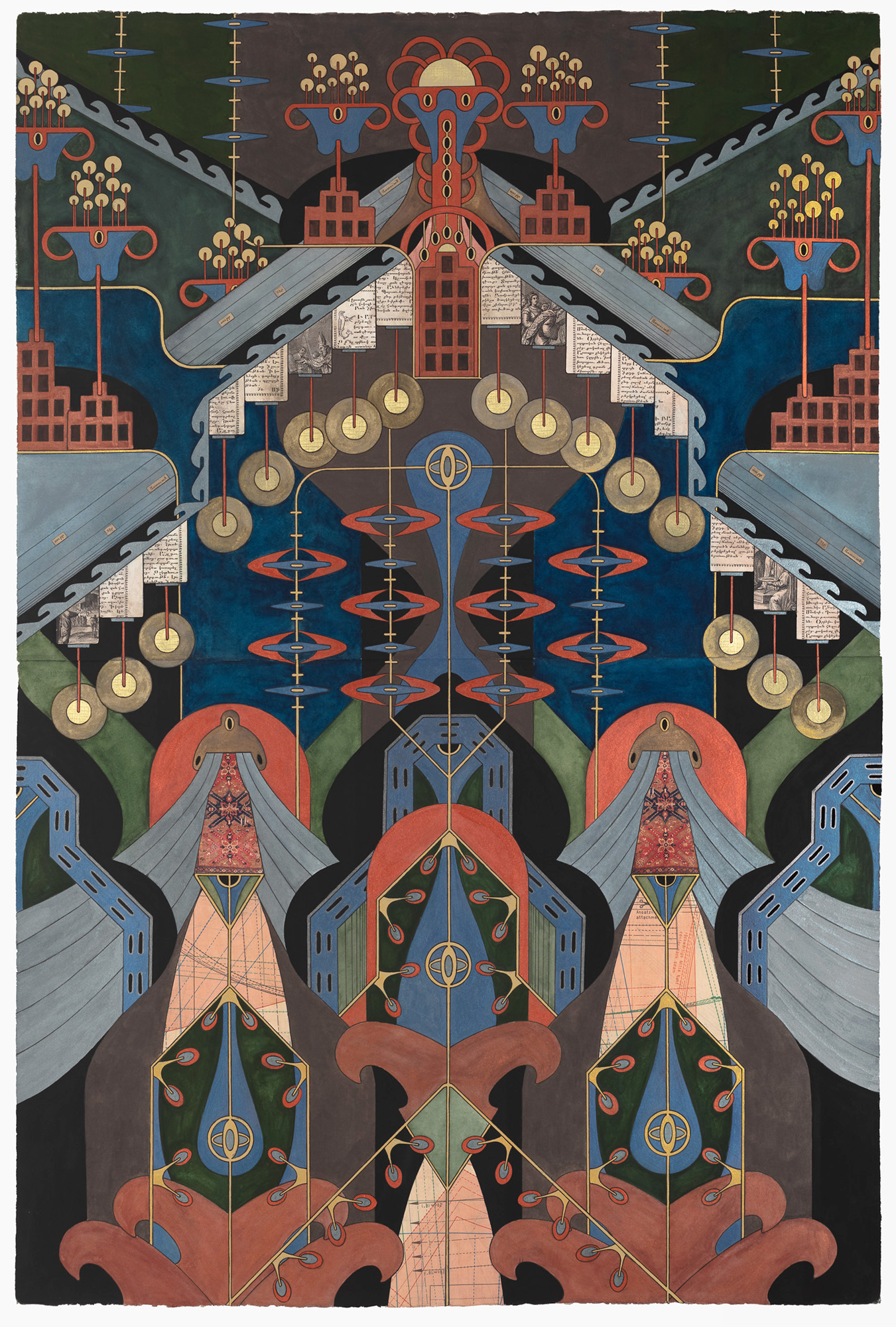
Linda Ganjian, Light Rising, Light Falling, 45 x 30 in, mixed media (ink, watercolor, mica, origami paper, pattern-making paper, giclee prints on paper), 2025. Photo by Kevin Noble.
“Tree of Modern Life” (45”x30”/mixed media: ink, watercolor, origami paper, patternmaking paper, giclee on paper) follows in a similar technique and composition, except here rather than rounded forms, there are more triangles and rectangles and pointed abutments. The thin orange rectangles are subdivided by smaller white triangles, which makes them look like skyscrapers, each floor lit, rising like a modern city. Delicate cobalt-blue flowers sprout in every direction (but always symmetrical, always part of a greater whole) to each side of the painting and upwards to the top where the stems emerge out of beautiful vases, painted white with light blue borders. Look closer, and one discovers Armenian text inside each vase. Their placement at the top of the composition seems to suggest that Armenian culture has somehow flourished despite the will to extinction that it has faced and that Mari Imirze’s efforts to safeguard her culture have also borne fruit. Ganjian and her work are proof of this glorious rebirth.
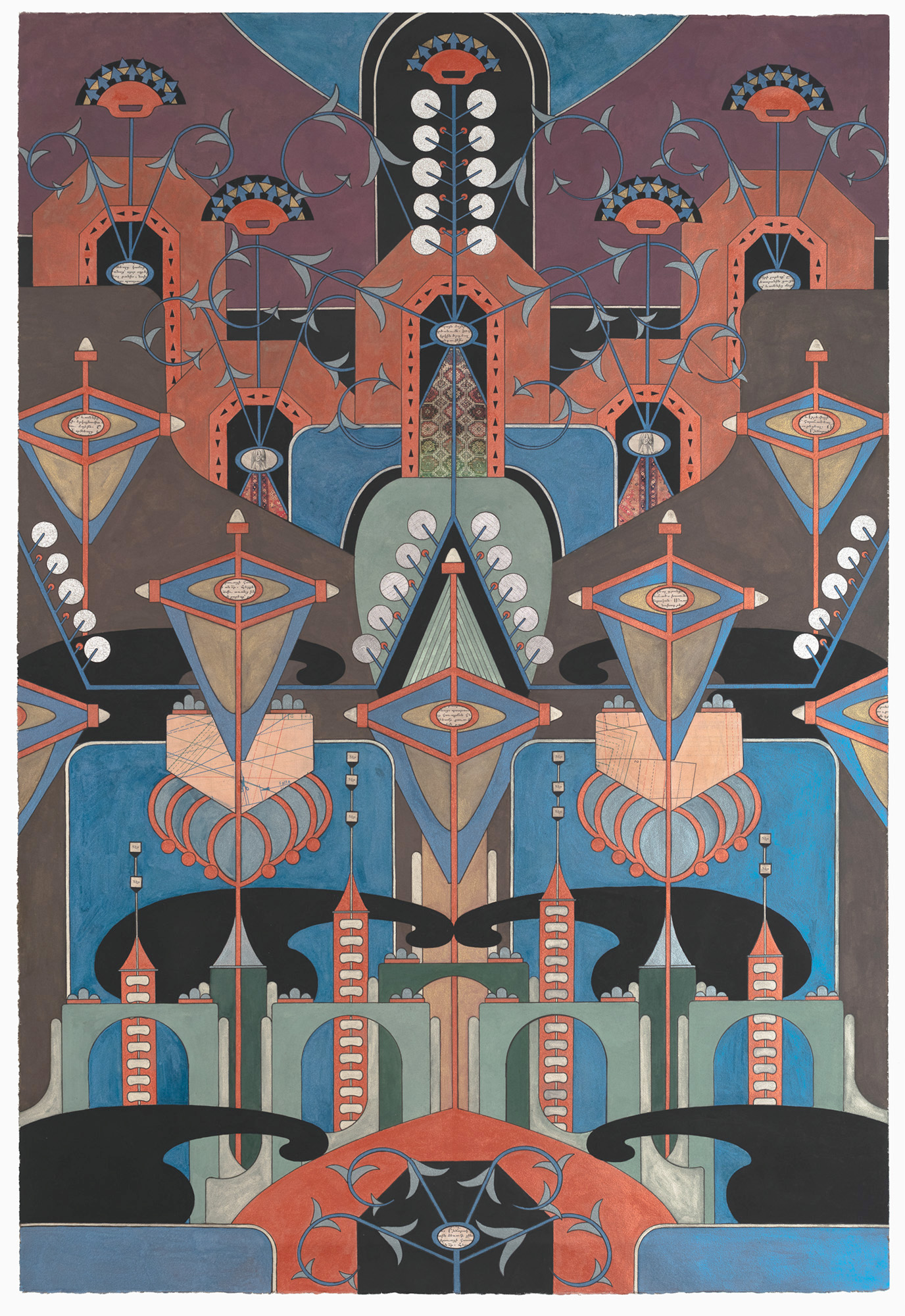
Linda Ganjian, Tree of Modern Life, 44 x 30 in, mixed media (ink, watercolor, mica, origami paper, pattern-making paper, giclee prints on paper), 2025. Photo by Kevin Noble.
The ludic quality of these two paintings, and also of previous, smaller works like “Istanbul Rising”, “Sun Goddess” and “Pious Pistons”, makes them remarkably layered. They can function purely as aesthetic creations, but they also take the viewer into hidden histories or remarkable stories of survival. In “Istanbul Rising”, a fragment of a photograph shows ships leaving Istanbul harbor for Kinali, one of the Princess Islands in the Sea of Marmara, where Armenians still congregate today as they did centuries ago. Finally, they may also project us into an imagined and as yet unrealized future, like Metropolis the film, they are a reminder of both human hardship and eventual transcendence.
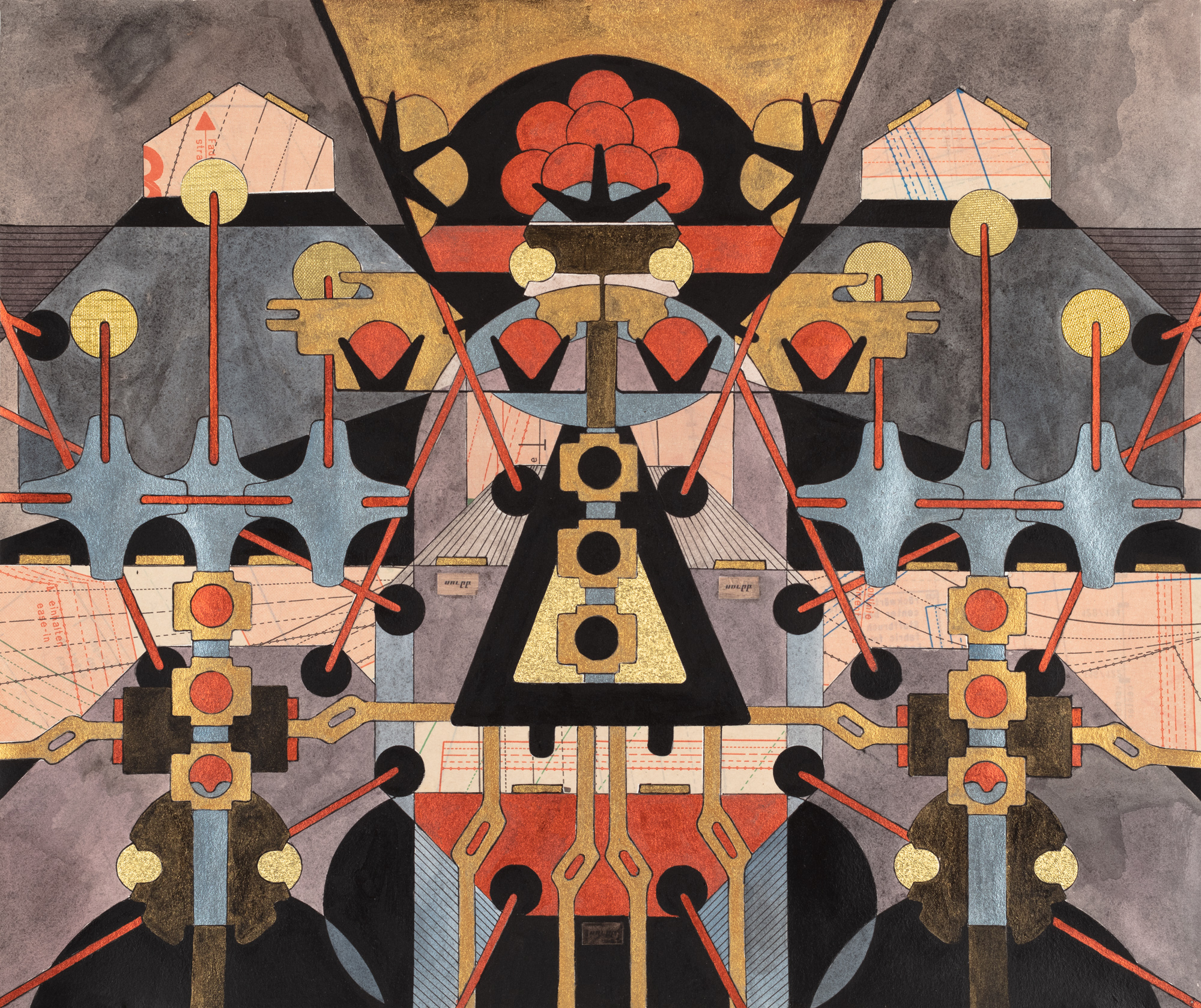
Linda Ganjian, Sun Goddess, 15 x 18 in, mixed media (ink, watercolor, mica, origami paper, pattern-making paper, giclee prints on paper), 2022.
Photo by Kevin Noble.
Linda Ganjian, Istanbul Rising, 12 x 9 in, mixed media (ink, watercolor, mica, origami paper, pattern-making paper, giclee prints on paper), 2024.
Photo by Daniel Aycock.
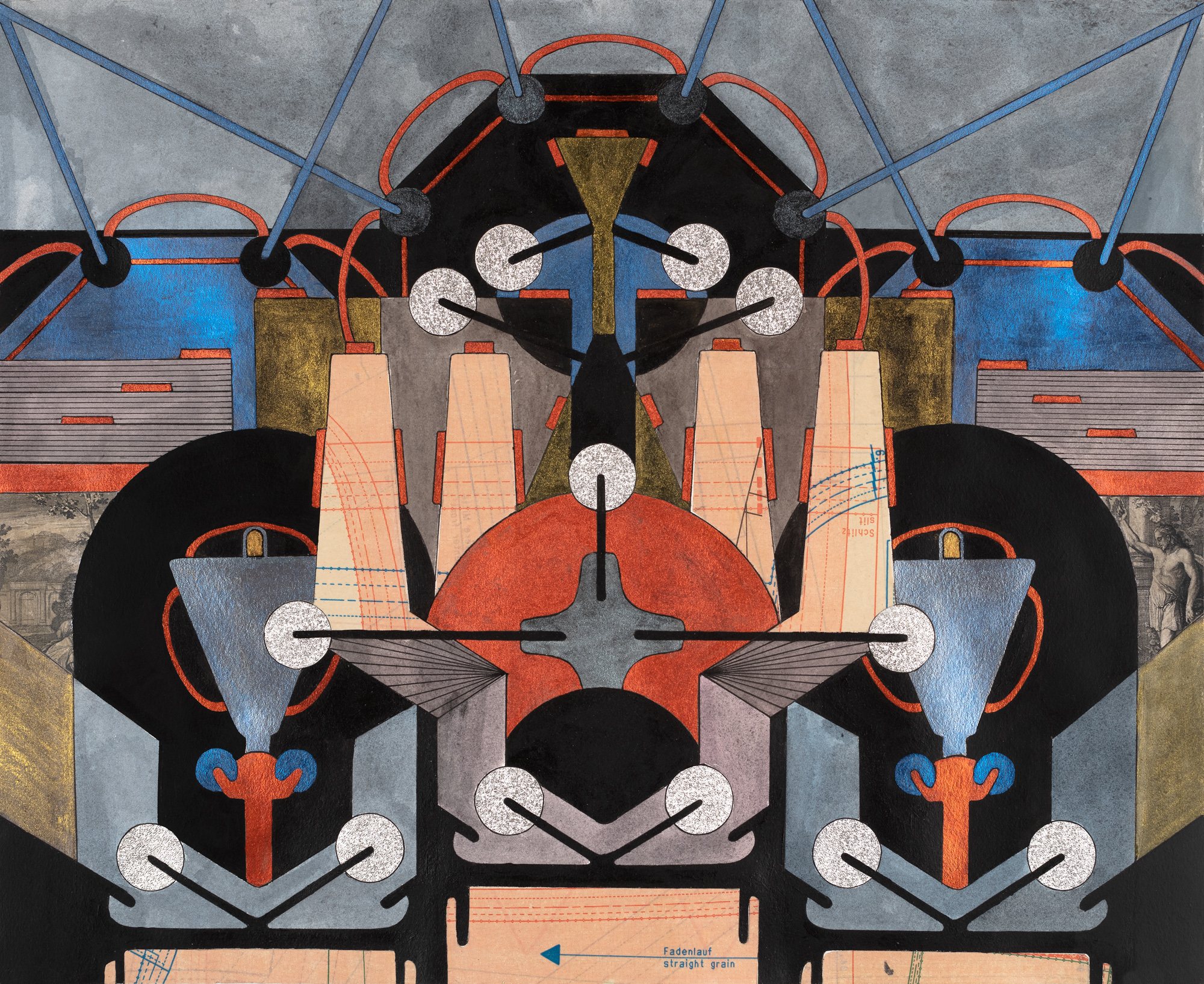
Linda Ganjian, Pious Pistons, 15 x 18 in, mixed media (ink, watercolor, mica, origami paper, pattern-making paper, giclee prints on paper), 2022.
Photo by Kevin Noble.
On a grander scale “Her Hands, My Hands” (2023, mixed media, 60 x 84 x 14 in. on 12 in. high pedestal) combines sculpture and painting and recalls the scale of Ganjian’s previous carpet-like tabletop sculptures, works she has been creating since the early 2000s. Mannequin hands emerge both beautiful and eerie to form a wonderfully complex imagined urban landscape filled with rows and columns of wood, velvet, polymer clay, and sewing pins. The piece merges the aesthetics of medieval reliquaries with urban planning, forming dozens of “plazas” from hundreds of smaller elements. The red and gold accented velvet employed refers to the Armenian Apostolic Church’s use of these colors. The whole could be a fantastical lost city, or a futuristic circuit board of sorts, or/and a reference again to a large Armenian prayer book.
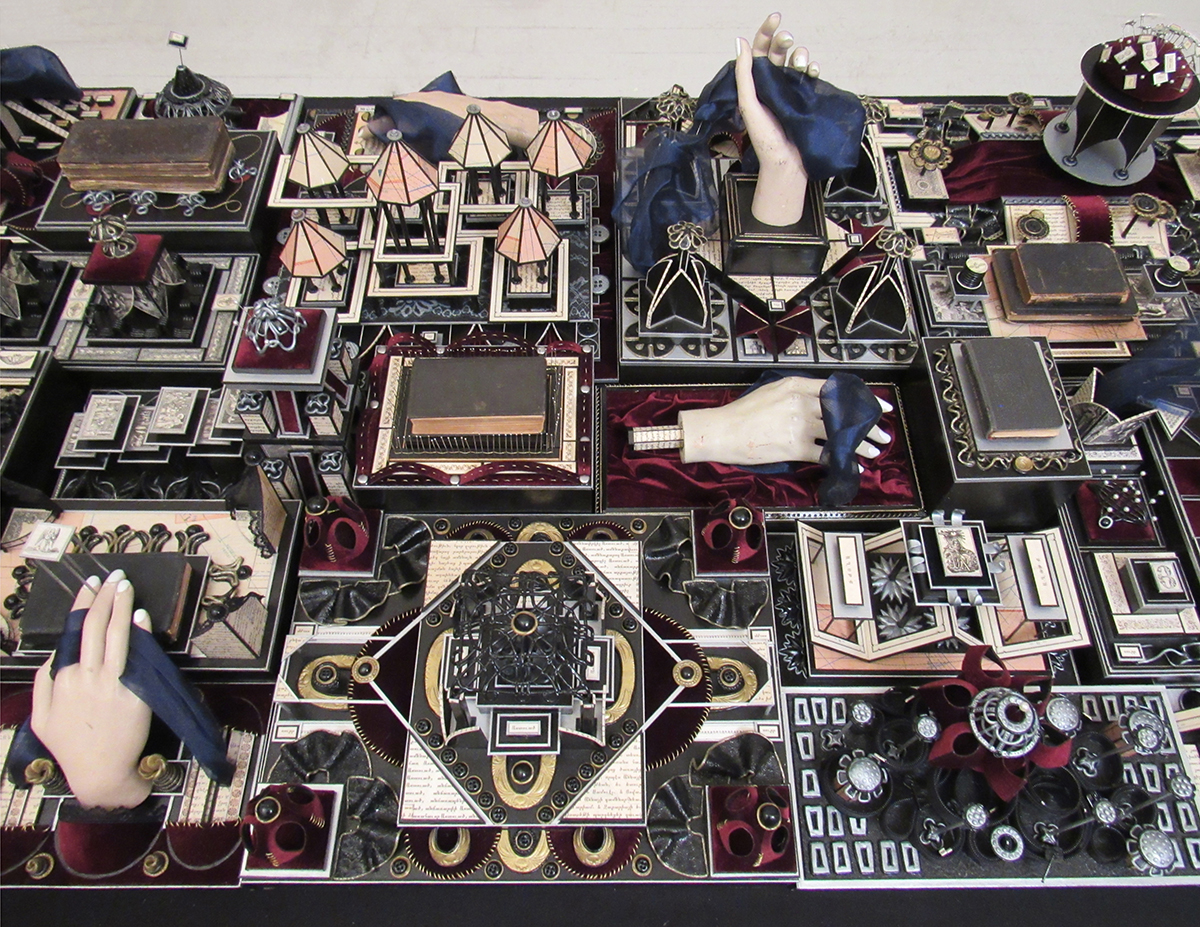
Linda Ganjian, detail, Her Hands, My Hands, 40 x 70 x 12 in (on 12 in high pedestal), mixed media, 2023.
Ganjian’s pieces convey complex narratives. They owe much to the Pattern and Decoration movement and pioneer artists such as Joyce Kozloff. As Ganjian explains: “With its focus on non-Western cultures and approaches to art making, ornamentation and craft was a big influence…The movement dovetails with the Feminist Art Movements of the 1970s, which were also eye-opening to me, and gave me permission to make things in the way that I do. I remember reading this coffee table book called The Power of Feminist Art after graduate school, and being very influenced by it.” Ganjian lists Petah Coyne and Sonia Balassanian, as well as contemporaries like Silvina Der Meguerditchian, Dahlia Elsayed, Andrew Demirjian, Kevork Mourad, and Diana al-Hadid among those artists she admires and who have helped to shape her own work. I couldn’t help but be reminded as well of Italo Calvino’s “Invisible Cities,” a novel which is framed as a conversation between the Mongol emperor Kublai Kahn and Marco Polo that tells of the merchant’s journeys through fantastical cities entirely made up by Calvino himself. In Invisible Cities, each city is associated with a different woman’s memories, desires or experiences, hence the inevitable link in my mind with Mari Imirze. Her memories are personal memories, but communal as well, shared by countless other Armenians who endured traumas during the Genocide. This resonates with the artist who told me: “I think this idea of symbolic architecture is critical to all my work, from the series of tabletop sculptures to the spaces within these collages.”
And what of Ganjian herself? A native of Belmont, Massachusetts she has made her home now for several decades in Queens, NYC where she is active as both an artist and community activist, having founded the artist talk series JH Art Talks in 2016. Ganjian works in a variety of materials, from clay to cement to paper and has exhibited her work in New York and abroad, including the Brooklyn Museum of Art, the National Academy of Design and the Queens Museum. Internationally she participated in the exhibition Grandchildren at the renowned Depo in Istanbul, and showed her work at Stedelijk Museum de Lakenhal, in Leiden, the Netherlands. In New York City, she has completed commissions for the MTA and the NYC School Construction Authority, while her ceramic murals grace the walls of JFK Terminal 8 and 4.
One issue with artists influenced by crafts is how to make their own work edgy. Ganjian has partly resolved this issue by merging the purely decorative in her work with larger, more important issues. This latest exhibition at Front Room Gallery in Hudson is perhaps her most ambitious to date. It announces an artist who has not only mastered a unique and meticulous visual vocabulary, but who is now able to execute at the highest levels of artistic expression.
The Front Room Gallery • 205 Warren St. Hudson, NY 12534
(718) 782-2556
May 24 – June 15, 2025