

Visiting one post-Soviet state, you can then recognize it in all others – the similar patterns of urban planning and the identical buildings, structures, roads, pipes, wires, tiles, etc. However, an outsider delving inside under the extreme familiarity of the material environment finds an extreme “strangeness” of social interactions and practices. The “Outside In” series is about emplaced paradoxes and nuances. It spotlights the mundane in Armenia’s peripheral locations, where the seemingly unspectacular encounters with people and things allowing us to capture the unique features of the territory.
Listen to the AI generated audio article.
Outside In
Essay 22
The French philosopher Michel Foucault argued that power rests on knowledge. But, the same is true of love. To love a land is to know it. Not through curated pictures in the media, fragments of nostalgic stories, or fevered dreams of greatness, but through the accumulated weight of its stones, crooked paths in the woods, strength of river currents, vibrant hum of cities. Love for a land without knowledge of it is merely tourism with commitment issues. Grounded in a projection of one’s own desires onto an empty canvas, it confuses longing with understanding and falls apart at contact with reality.
We live in an age of performative attachments, where loving someone or something often means fitting into an aspired model. But genuine love requires courage to see clearly, to move beyond first enchantment and disillusions (that ultimately lead to disappointment), to embrace what is upsetting and infuriating. Genuine love for a land comes through patience: learning its contradictions, accepting its scars, choosing to remain despite, or because of, its imperfections.
There is a profound difference between knowing the land of your birth and coming to know a place as an adult immigrant. The former enters you like mother’s milk—unconsciously and completely. But to learn a new land as a grown person is deliberate labor. One must excavate meaning from unfamiliar soil, decode the grammar of a new landscape, and earn a place in stories that began long before their arrival. Yet, there is something uniquely precious about choosing to love a land rather than inheriting that love.
I learned to love Armenia through travel. Ten regions, 49 cities. End to end it is approximately an eight-hour non-stop drive. Eight hours to cross an entire country, experience multiple climate zones, geological and historical epochs—this thought still fascinates me, as in my country of birth in eight hours you might traverse just one region without a single change in the landscape. In Armenia, you can reach a very particular geographical intimacy, where the totality of land can be held in your mind like a detailed map, each place is accessible and could be meticulously studied.
A Road Trip Through Armenia
The problem with geography as typically taught is that it treats countries and places as abstractions. Apparently, real geographical knowledge can only be acquired through being in the world. Sometimes, when I am particularly disappointed by the poor geographical knowledge exhibited by my students at Yerevan State University, I start planning a road trip through Armenia with a hope that one day I will find funds to shove them into a bus taking them from north to south.
The road trip would start on an early September morning from the border between Georgia and Armenia in Lori region (Guguti–Gogavan crossing). Here, at Armenia’s northern edge, mountains roll in gentle waves before sharpening into dramatic peaks, the landscape is green and shady thanks to abundant forests. In Tashir, wooden houses remain from Slavic settlers, with windows adorned by carved architraves and roofs covered by red tiles like fish scales. In Stepanavan, the house of Stepan Shaumyan sits preserved under the roof of the local history museum. A venture to Lori Berd perched atop the Debed river canyon reveals a fortress which has defended people for centuries. It is weathered but unbroken. The 7th-century monastery at Odzun emerges like a prayer carved in stone – walls tell stories of faith surviving conquest and of humans who produced art even during the darkest times.
Before the last tunnel leading to Vanadzor, there is a kebab corner “Lorva dzor” which offers the tastiest kebabs, if not in Armenia, then in Lori for sure. Sometimes the most profound geographical knowledge comes through most unexpected places, from taste rather than from visuals.
Vanadzor sprawls across the Pambak River valley with its particular nostalgic post-Soviet melancholy. Its industrial architecture speaks of five-year plans and a bygone social order, of a time when this was Kirovakan and progress meant smokestacks. The old factory buildings stand like monuments to unfulfilled promises and an indefinitely postponed communist future. A detour to Fioletovo reveals one of Armenia’s unique settlements: a Molokan village where Russian “spiritual dissenters” found refuge in the 19th century and preserve their identity till today – religious, architectural, and linguistic. Men with long beards, women in floral skirts and scarves covering their hair all speaking like in old Russian novels.
Those lucky enough may be able to access the only open to the public house of Fioletovo – have tea from a “samovar” with freshly baked pastry and listen to stories Molokans tell about themselves.
The route continues along the shores of Lake Sevan with a brief tour around Sevanavank and the pearl of Armenia’s modernist architecture – Sevan Writer’s Resort.
Here you can have coffee and fresh gata with a breathtaking view of Sevan.
The road further south through Martuni follows ancient trade routes, past fields where farmers still practice traditional cultivation. In the background is the gorgeous Gegham volcanic mountain range with slopes shifting in color from burgundy to greenish. The Selim Pass offers the journey’s first serious test of the vestibular system. The mountain road coils and unwinds, revealing Armenia’s geological biography: the folds of the Earth’s crust, volcanic peaks, and flat alpine meadows. Here, an ancient caravanserai reminds us that the mountain pass has for centuries been a highway of connectivity and exchange.
From the sublime down to earth, Vayk’s large food court offers good quality meals at affordable prices, a must stop for lunch/dinner or simply coffee before the journey continues.
Syunik greets with its brutal gates of gray stone, thresholds between the cultivated valleys below and the wilderness of the lands above. Along the Spandaryan Water Basin, an artificial lake so integrated into the landscape it seems natural, the road takes to Goris. The city announces itself through extraordinary rock formations – tall, pointed stone pillars that rise like a geological cathedral. The old cave dwellings testify that humans have always been resourceful and always found ways to make even challenging landscapes home.
Consider staying the night. As argued by one of my Armenian friends, “there are no decent hotels past Goris” – referring to the posh Mirhav and Red Roof.
From the picturesque abandoned Old Khot village with buildings from various eras, the Vorotan River becomes the guide, cutting a deep gorge and exposing beautiful hidden caves which can be reached by swimming. Tatev Monastery emerges on a cliff edge like a picture from a manuscript. Built in the 9th century when architectural drama was considered a feature rather than a bug, it was once a center of learning that attracted scholars from across the medieval world. The “Wings of Tatev” cable car journey adds a surreal contemporary element to the route.
The road south to Kapan threads through increasingly wild terrain. This is Armenia’s mining heartland, where copper and molybdenum deposits have been worked since antiquity. Romans, Byzantines, Ottomans, Romanovs, and Soviets all extracted metals here. This is a place where industry and natural beauty have a long history of uneasy cohabitation. A must stop in Kapan is the renovated building of the railroad station which now hosts one of TUMO’s campuses. An exceptionally good example of adaptive reuse. Further south, Kajaran presents Armenia’s industrial face without apology. This Soviet-era mining town was built for a single purpose – to extract metals from an enormous open-pit mine that dominates every horizon.
The final descent toward Meghri brings one of the journey’s most dramatic natural transformations. The forested mountain landscape gives way to a semi-desert. Within a couple of hours, you move through multiple climate zones, proving that climatic consistency is no more endemic to Armenia than historical simplicity. In Meghri, paintings on church walls tell Christian stories in a distinctly Islamic style. In Agarak, at the very edge of Armenia’s borders adorned with Soviet ruins, the Arax River forms a frontier with Iran. Every journey ends at someone else’s beginning.
Rhetorical Questions
You cannot love Armenia merely for its ancient churches after seeing the environmental impact of its mines. You cannot love it only for natural beauty after witnessing rural precarity. You cannot love it purely for cultural achievements after grappling with its considerable political challenges, cronyism, and entangled bureaucracy. But does complexity diminish love? If love is genuine, then flaws do not make you love someone or something less but make your love more realistic and therefore sustainable.
The contradictory place where beauty and difficulty coexist, where social norms are at times puzzling (and uneasy to embrace), where landscapes are unruly and cityscapes are chaotic is the true Armenia. And the present-day geopolitical irony is exquisite: after generations of Armenians learning to navigate between empires to survive, after finally re-establishing their own statehood, they are told that “peace” apparently requires handing over territorial control to yet another foreign power. How is it possible to stay integral yet love a country that must constantly negotiate its sovereignty, change borders, de- and reterritorialize?
A foreigner’s love of land is always suspected of being superficial. Yet when you have to learn to love a place consciously and in detail, you become very sensitive to loss. How to describe the chilling and paralyzing sensation when the land you know intimately becomes a token in someone else’s geopolitical games? Do you even have the right to speak and to express concerns? Perhaps, the answer lies in the questions themselves, in the willingness to keep asking what love for land means when the ground beneath your feet is constantly being renegotiated by powers beyond your control. Indeed, love rooted in bloodlines varies from the one based on deliberate choice. But does this matter for resisting a place being turned into a transient and anonymous non-place, homeland reduced to a bargaining chip or transit corridor?
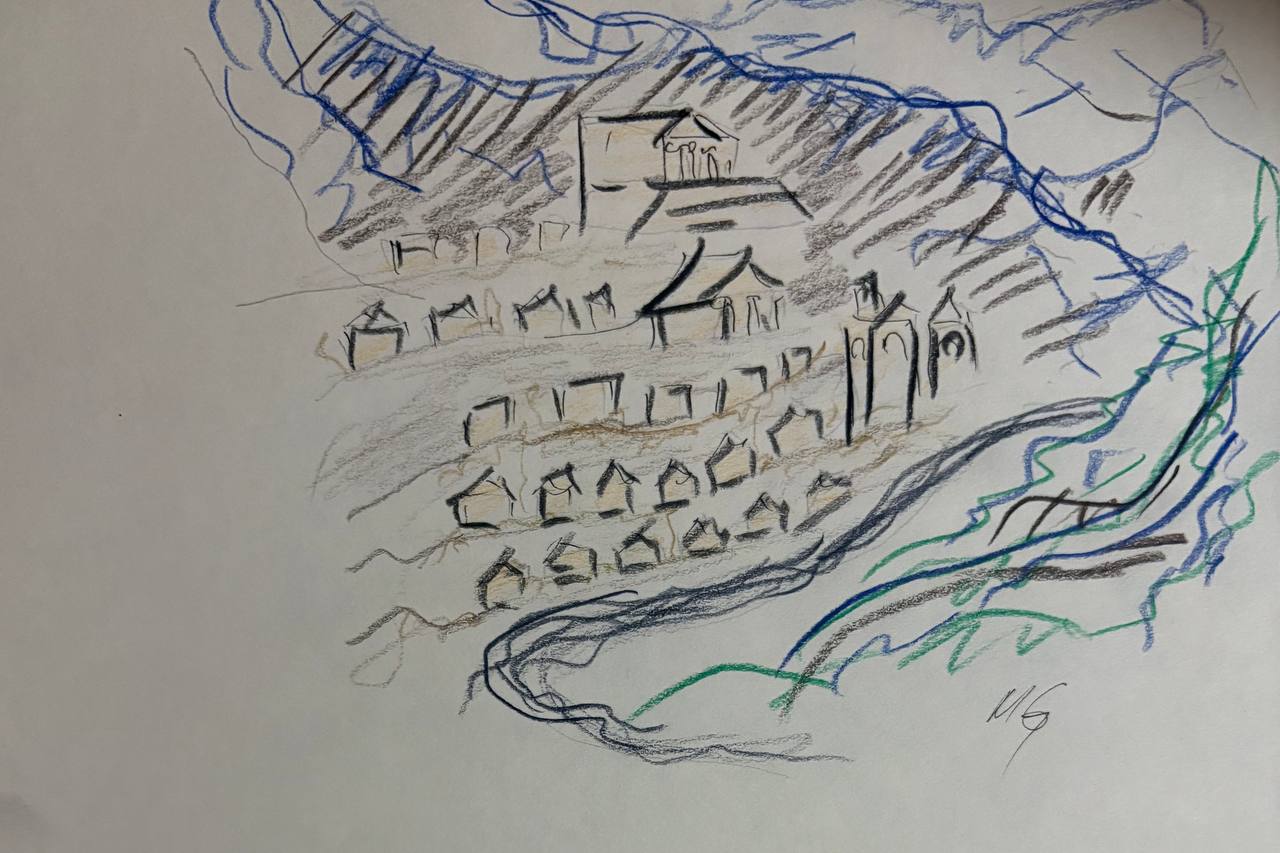
Drawing by Maria Gunko.
See all [Outside In] articles here

Maria Gunko is a DPhil Candidate in Migration Studies, Hill Foundation Scholar at the School of Anthropology and Museum Ethnography University of Oxford. Since 2023, she has joined Yerevan State University as a Visiting Professor. Maria holds an MSc and Kandidat Nauk (Russian post-graduate degree) in Human Geography.
Maria’s research interests lie in the intersection of urban studies and social anthropology, including ethnography of the state, infrastructures, and urban decay with a geographical focus on Eastern Europe and the Southern Caucasus. She is the co-editor of one monograph, author of over thirty scientific articles and op-eds.