

[Beyond Borders]
This column explores the key issues shaping life in the South Caucasus, focusing on how the divergent paths of Georgia, Armenia and Azerbaijan reflect the region’s complex histories, economic developments, and political shifts. While new generations in these countries grow more isolated from one another due to language barriers and conflicting national trajectories, the same is true for local policymakers, who are often more familiar with distant capitals than their immediate neighbors. Each nation seeks its own path, sometimes in conflict with others, while international actors often treat the region as a whole, reluctant to craft policies specific to individual states. Drawing on personal experience with the region’s revolutions, conflicts and transformations, Olesya brings you Beyond Borders—a column exploring how decisions made in one corner of the South Caucasus impact all who live there.
Listen to the AI generated audio article.
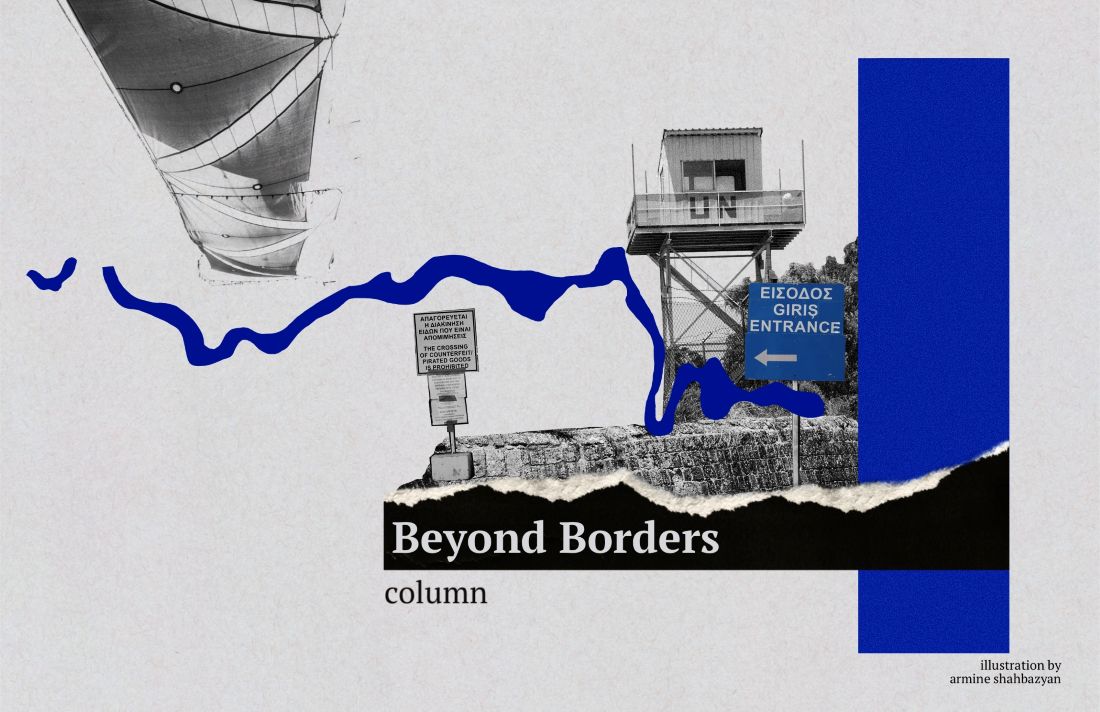
One evening this summer I found myself sitting at a street cafe in the old town of Nicosia, the divided capital of Cyprus. Surrounded by cats waiting for pieces of grilled fish from my plate, I was only a few meters from one of the crossing points connecting the two sides of the island.
People passed through continuously. Families with children, tourists carrying cameras and people who looked as though they made the crossing every day paused briefly to hand over their documents before walking on. The whole process took less time than airport security. As I watched, several people crossed to the other side only to return a short while later carrying shopping bags, as though moving between the two halves of the city was simply another errand on the day’s list.
For anyone familiar with conflict zones in the South Caucasus, the scene felt almost surreal. Checkpoints in our region rarely become ordinary places. More often they appear in the news because of political disputes, arrests, shootings or long closures that trigger humanitarian crises. They carry so much political weight that it is hard to imagine people treating them as just another part of the city.
Cyprus presents a striking contrast. The island has not resolved its conflict. Political negotiations remain deadlocked, and the disagreements that divided the island decades ago have not disappeared. Yet everyday life has gradually adapted to that reality. The conflict is still there, but it no longer dictates every movement across the dividing line or every interaction between the two sides.
Divided Island
The ease of crossing can give the impression that Cyprus has somehow left its conflict behind. But it has not. The island remains divided almost 50 years after the events that separated Greek Cypriots and Turkish Cypriots. The Turkish-controlled north still exists outside the international system, recognized only by Turkey, while United Nations peacekeepers continue to monitor the buffer zone separating the two sides. Negotiations about reunification have gone through repeated cycles of hope and disappointment.
The conflict is just as visible away from the crossing points. Walk through the streets of either side of Nicosia and you quickly notice that the past is never far away. Flags, memorials, museums and graffiti tell different stories about what happened and who bears responsibility. Conversations about the conflict often follow the same pattern—people speak readily about the suffering of their own community but much less about that of the other. Families forced from their homes still hope for justice.
None of this suggests a society that has overcome its divisions. The political dispute remains unresolved, and nobody can say with confidence when and how it will be settled. But that is precisely what makes the ordinary scenes at the crossing points so striking.
Since crossing points opened in the early 2000s, movement across the dividing line has gradually become part of ordinary life. Residents cross to work, shop, meet friends or visit places connected to their family history. Foreign visitors move between both sides of the island with just a passport check. Tourism has expanded, businesses have adapted and economic activity has continued to grow in the absence of a comprehensive political settlement.
The political dispute remains, and so do the competing memories, grievances and demands for justice. What has changed is that the conflict is no longer present in every ordinary decision people have to make. It has become part of life on the island without defining all of it.
Adaptation to Conflict
Cyprus offers no blueprint for other conflicts. The South Caucasus has followed a different historical and political trajectory, and no outside experience can simply be replicated. Still Cyprus challenges one assumption that often shapes debates about peace. We often imagine that societies have only two options: either a conflict is resolved through a political agreement and removal of all difficult issues, or meaningful interaction must wait until that day arrives.
This question feels particularly relevant today as Armenia seeks to normalize relations with Azerbaijan and Turkey. After decades of conflict, the 2020 war and the exodus of the Armenian population from Nagorno-Karabakh have deepened mistrust and made any discussion of engagement politically sensitive. At the same time normalization is increasingly tied to practical questions such as border openings, transit routes and regional development.
The Cyprus experience suggests that political negotiations and societal interaction do not always have to move at the same pace. Waiting for a comprehensive settlement before removing conflict-born divides may leave conflict as the only framework through which neighbors continue to know one another. Practical cooperation cannot resolve disputes over security, borders or historical memory. But neither should the absence of political progress prevent other forms of contact and cooperation.
The value of this approach extends beyond tourism or trade. Nor is this simply an argument for opening crossing points and allowing travel. Rather it is to say that regular interaction across different levels of society gradually changes the environment in which political decisions are made. Businesses acquire an interest in stability because disruption carries economic costs. Professionals develop practical reasons to preserve opportunities for cooperation. None of this removes the possibility of renewed confrontation, but it does make escalation more costly.
Armenia and Azerbaijan have already taken several modest steps in this direction. Officials have visited each other’s countries, building on earlier exchanges involving experts and journalists. Azerbaijan has also allowed limited transit of foreign goods destined for Armenia through its territory. Turkey has recently allowed direct trade with Armenia via the Kars-Akhalkalaki railway.
None of these measures resolves the underlying conflict, and some may ultimately prove unsuccessful. Nor does this mean that engagement should come at the expense of security or unresolved political and humanitarian issues. Those questions remain central and require difficult negotiations. The Cypriot experience offers no shortcut around them. What it demonstrates instead is that coexistence can begin before reconciliation is complete.
Watching people cross the dividing line in Nicosia what struck me most was not that Cyprus had solved its conflict. It clearly has not. What struck me was that ordinary life no longer had to wait for politicians to resolve the conflict before moving forward.
Perhaps that is the most valuable lesson the island has to offer. Peace is not only a goal achieved through a political agreement. It is also a gradual process of creating the conditions in which people can live, communicate and cooperate even while some of the hardest political questions remain unanswered.