
When I was a schoolchild in Armenia in the early 1990s, the standard curriculum had just two lower-division classes that related to the arts and creativity: carpentry (for boys only) and “nkarchutyun” – an all-encompassing Armenian term that literally means “picture-making”. Needless to say, these classes were run like an afterthought with no real program, or underlying rationale by instructors who had no training in the subject. At best you learned how to make a wooden toy, or a decoration for the Christmas tree; at worst, it was the perfect hour to skip class because nobody seemed to take these subjects seriously.
The arts as a whole were the equivalent of a diversion – a light pastime for children that bore no real connection to actual learning or knowledge production. Students with creative leanings had no outlet to develop their inclinations at school, which generally tended to undermine and even stifle such ambitions in favor of “serious,” career-building subjects like math, grammar, physics, chemistry and geography. Even today, Armenian public schools lack courses that deal with image and media literacy, analytical reflection and self-representation – all of which are deeply tied to art and art history and are essential components of the everyday social matrix.
So, I was pleasantly surprised to see new textbooks for 7-10th classes on Art approved for use in schools by the Ministry of Education, Science, Culture and Sport. These primers provide students with broad information on everything from visual art, architecture to cinema and music, breaking down the technical aspects of each discipline along with their historic and cultural cycles of evolution. However, once you dig inside, the familiar problems emerge: inconsistent structure, vague methodology, and an unclear pedagogical aim. Most alarmingly, the textbook essentially replicates the age-old Western-centric paradigm of art history, relegating everything else to the margins and making no effort to raise at least some awareness about the systemic issues in our indoctrinated, imperialistic understandings of world art history. There’s almost no mention of Mesopotamian, Persian and Islamic arts, while classical European antiquity is given a long-winded tour. Modernity and modernism don’t get a look-in either, except digressions into photography and cinema, which are then largely used as auxiliary material to illustrate the pre-modern periods (you want to know what Egypt and Rome looked like? Let’s watch Cleopatra and Spartacus!)
Even more bizarrely, the textbooks’ contents are recycled from year to year, slightly upping the complexity of their content in the higher classes without really broadening their scope. I’ve heard students complain that they go over the same material year after year, but didn’t realize to what extent until now. The key issue, however, is the way these textbooks promote the same philological–empirical approach that has long defined the modern Armenian educational system. Art is presented as yet another linear narrative of stylistic progression and expression of individual human creativity. There is little effort made by the authors to develop techniques of critical questioning and reflection about how society instrumentalizes art as a tool of power, or resistance.
All that aside, the very existence of these textbooks and the accessible, user-friendly manner in which they provide considerable knowledge and perspective into the development of human creativity seems like a milestone. As an art-obsessed child growing up in a provincial Armenian city at the beginning of the 1990s, I would have loved to learn about everything from Praxiteles and Da Vinci to the birth of Armenian cinema, instead of learning how to make garlands out of colored paper. Hopefully the wide employment of these resources in our secondary schools will lead to a new generation that possesses the kind of image and media literacy that has become essential for navigating the disorienting currents of our slippery reality.
EXHIBITIONS
SEVRUGIANS: HERITAGE AND DEDICATION
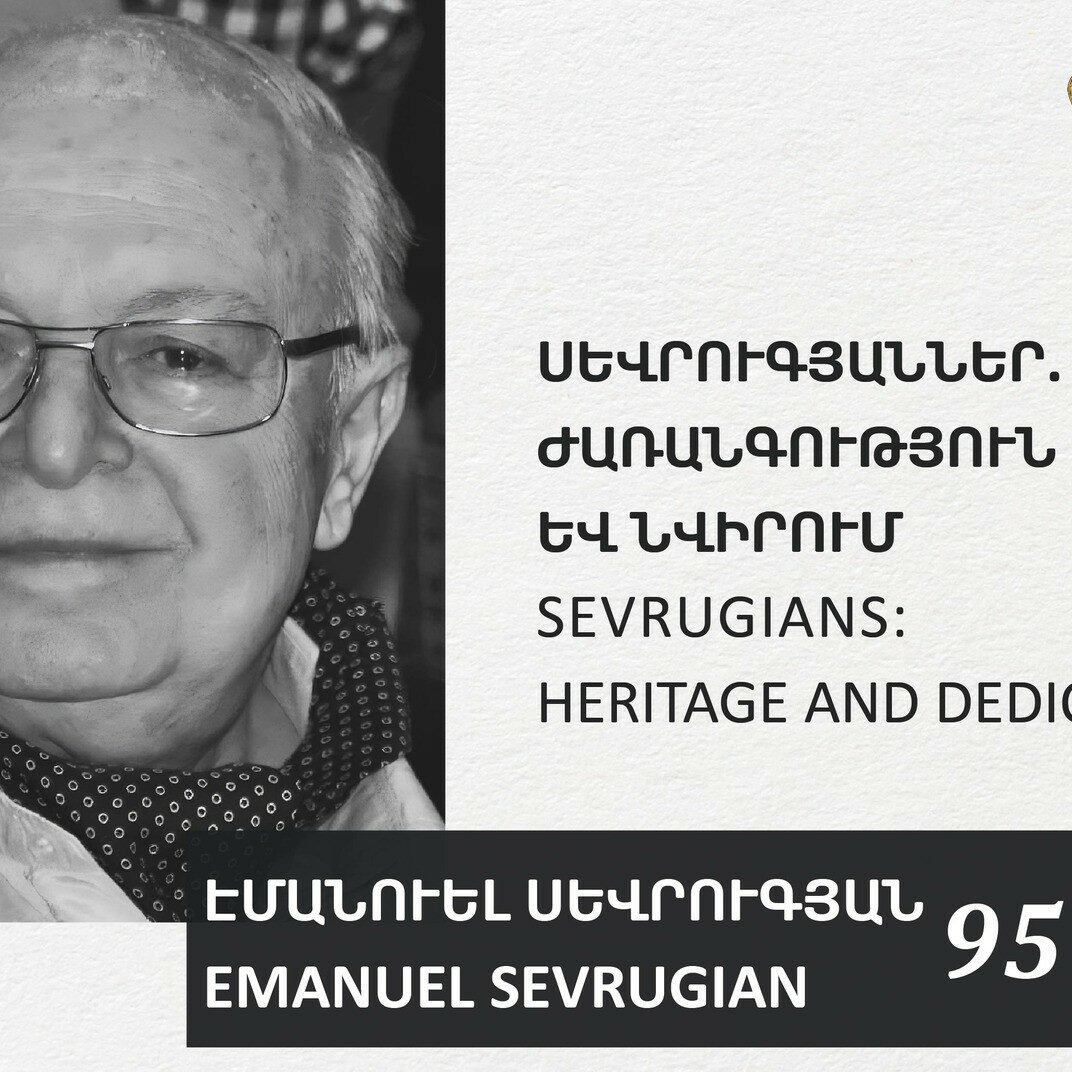
Though still relatively unknown outside a small circle of experts, the Sevruguin (or Sevrugian) family holds a distinguished place in the history of Iranian-Armenian cultural relations. The patriarch of this remarkable dynasty, Antoine Sevruguin, was a pioneering figure in the development of modern photography in Iran at the turn of the 20th century. His work provides a rich and nuanced visual record of a country undergoing profound political and social transformations.
Antoine’s artistic legacy was carried forward by his son, André Sevruguian—better known as Dervish—an accomplished painter celebrated for his flowing, expressive works inspired by Persian and Armenian miniature traditions. The family’s deep ties to art and heritage were further extended by André’s son, Emmanuel Sevruguian, who became both the guardian of the vast Sevruguian photographic archive and an avid collector of Armenian antiquities.
In recent years, the Sevruguian heirs have donated a significant number of artifacts to institutions such as the Matenadaran and the History Museum of Armenia. The latter is currently hosting a new exhibition showcasing paintings by Dervish alongside hundreds of ancient coins from Emmanuel Sevruguian’s collection—an offering that further cements the family’s enduring cultural legacy.
Exhibition: “Sevrugians: Heritage and Dedication”
Where: History Museum of Armenia
Republic Square, Yerevan
Dates: September 4-October 4
INTERCONNECTED: FATHER AND DAUGHTER FARIDANIS
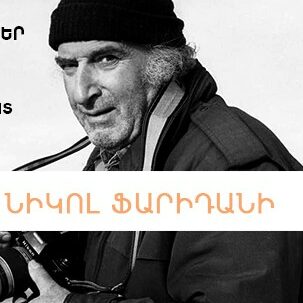
Nikol and Katrin Faridani are another Iranian-Armenian parent–child duo receiving a showcase in Yerevan with an exhibition of their respective photographic works. Beginning his career in the 1950s in technical and survey photography, Nikol Faridani soon became a prominent figure in Iran’s photographic milieu, known for his striking documentary images of the country’s remote landscapes and communities. As an Armenian, he followed in the footsteps of compatriots like Antoine Sevruguin, who had already established a strong local tradition of realist photography. Yet Faridani pushed this legacy further with his epic, romantic vision of nature, producing some of the most expressive and poetic images of Iran.
Relocating to Canada after the Iranian revolution, his daughter, Katrin, has charted her own course, focusing primarily on portraiture and urban or architectural photography, where the influence of German and American New Topographics is evident. Still, an emphasis on spiritual and humanist values unites both photographers. Their works will now be introduced to Armenian audiences for the first time in a mini-retrospective at the Vahan Tekeyan Cultural Centre.
Exhibition: “Interconnected: Father and Daughter Faridanis”
Where: Tekeyan Centre Fund
50 Khanjyan St., Yerevan
Dates: September 23-28
MHER AZATYAN: LOVE THE PLACE WHERE YOU LIVE

In Mher Azatyan’s work, photography’s many forms—and discontents—are pared down into something that appears banal, yet resists description. To my mind, Azatyan remains one of the most sensitive and penetrating contemporary Armenian artists, having engaged with the medium over the past two decades to singular effect. He gravitates toward insignificant, mundane objects and spaces from his immediate environment, captured with basic consumer cameras or smartphones.
Fleeting and unremarkable on the surface, these fragments of everyday reality are transformed through the addition of short poetic titles, expressions, sounds, or small sculptural objects that Azatyan often pairs with the images. Reminiscent of Japanese haiku, these “image-ideas” are distilled to their metaphysical essence with startling precision. The result is a quiet shock: a direct confrontation with time, existence, love, and the human longing for meaning.
His latest solo exhibition at Studio 20 is a meditation on place, a recurring theme in his oeuvre, understood as a vessel of lived experiences, memories, and feelings. For Azatyan, its fragility and transience are precisely what make it so precious and irreplaceable – something that all people should be more conscious and protective of.
Exhibition: “Love the Place You Live”, Mher Azatyan
Where: Studio 20
13 Hrachya Kochar St., Yerevan
Dates: September 5-19
SAROYAN COLORS: BEYOND WORDS
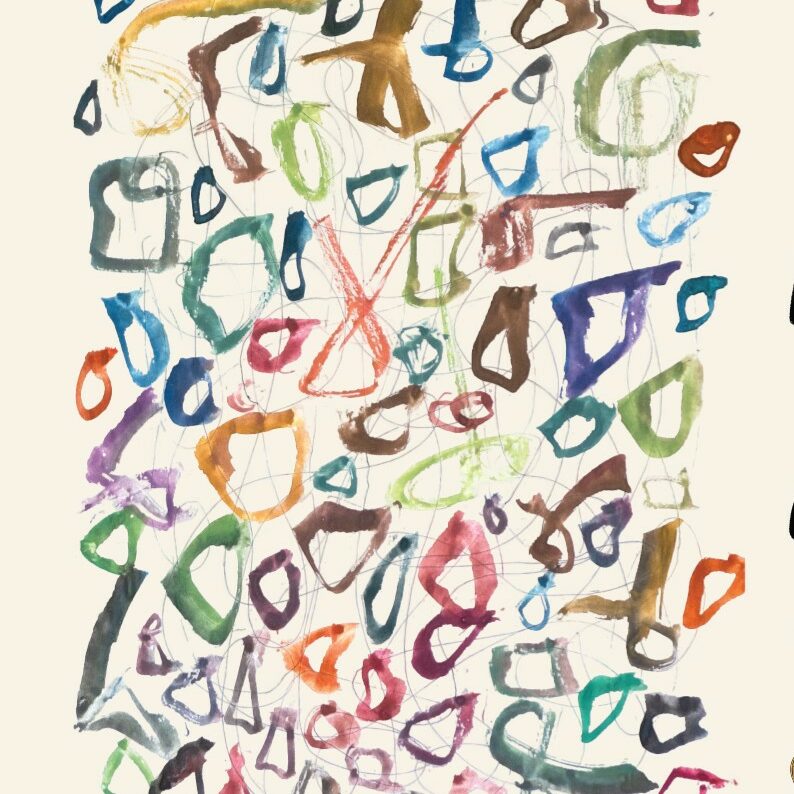
William Saroyan, the great ironist of modernity and American identity, left behind an immense literary heritage that still cuts through the noise of routine reality to reveal undeniable truths about human vulnerability and desire. Though highly influential worldwide, Saroyan remained something of a peripheral figure in English-language literature—not quite a realist, not quite a modernist, nor a classicist or romanticist—due to his idiosyncratic, intuitive style. This status of the revered “outsider” was reinforced by his pronounced, self-proclaimed “otherness” as a second-generation Armenian migrant, but not only.
Alongside his writing, Saroyan was also a prolific visual artist, painting and drawing from the mid-1930s until the end of his life. Despite several exhibitions in the United States and Europe during the 1960s and 1970s, he never actively sought institutional recognition. For him, art primarily functioned as a direct emotional and psychological outlet for his relentlessly searching mind. This does not mean, however, that Saroyan was not serious about it. Working mainly with ink, watercolor, pen, and paper, he began with free-form figurative drawings and soon transitioned into a non-objective style that resonates with the progressive movements of the time—abstract expressionism, minimalism, and the work of that other great American-Armenian, Arshile Gorky.
Covering sheets with rapid scribbles, scrawls and twisting lines, Saroyan seemed to play with automated visual notations—marks suggestive of letters or pictograms known only to him. Like a visual translation of his improvisational prose, the drawings function as real-time diagrams of Saroyan’s mental processes—at once oblique yet directly accessible via our emotional register. Despite their surface similarities, these strangely compelling images reveal a remarkable diversity of sensory dynamics, drawing the viewer into the restless workings of the writer’s mind.
It is therefore a rare pleasure to experience nearly 100 of these works, which have been brought to Yerevan for Saroyan Days and are now on view at the Literature and Arts Museum until January 30.
Exhibition: “Saroyan Colors: Beyond The Words”
Where: Museum of Literature & Art
1 Aram St., Yerevan
Dates: September 5-19
NONA GABRIELYAN: SOLO SHOW
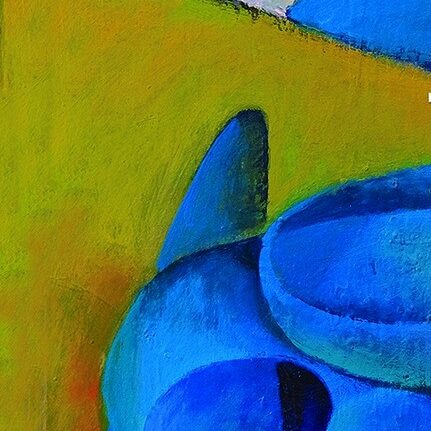
There was a brief moment in Soviet Armenian art during the 1980s when sculpture, design, painting, and even architecture began to fray at the edges and merge into ever more intriguing configurations. It was still tied to traditional notions of aesthetics and the modernist ideal of the Gesamtkunstwerk—the “total artwork”—just before the rapid rise of contemporary art swept away purist ideas of medium, beauty, or even objecthood.
Among the brightest and most radical voices in this cross-disciplinary wave was Nona Gabrielyan, alongside her more widely recognized husband, Van Soghomonyan. Trained as a ceramist, she made her mark on the local art scene with provocatively surreal object-sculptures that defied the conventional understanding of “decorative” or “aesthetic” usually assigned to the medium. Eerie and unsettling in the way they twisted everyday forms into something unfamiliar, her works—such as the brilliant 1982 group sculpture Target—seemed like omens of imminent upheaval.
The collapse of the USSR upended not only the kind of art Gabrielyan practiced (often destined for public spaces) but also her own life. She relocated to Germany with her family to escape Armenia’s economic crisis. Cut off from the fraught political realities of her homeland, her practice, especially her paintings, gradually softened, becoming more introspective and tinged with nostalgia, though still echoing the hybrid formalist experiments that marked the late Soviet decades.
Now returning to Yerevan in September, Gabrielyan will present these later works in a large solo show, an occasion to reassess her significant contributions to contemporary Armenian sculpture and ceramics.
Exhibition: “Solo Exhibition”, Nona Gabrielyan
Where: Artists’ Union of Armenia
16 Abovyan St., Yerevan
Dates: September 12-24
DAVIT DAVTYAN: SOLO SHOW
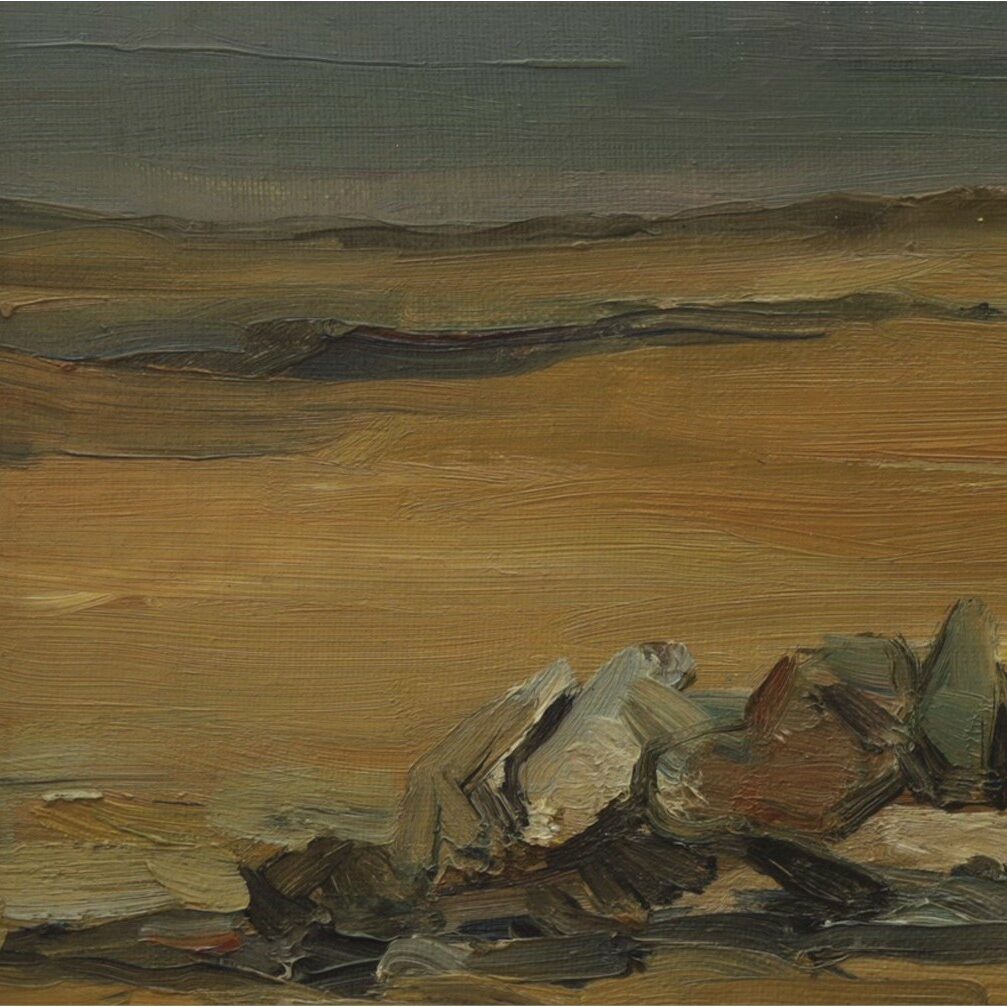
There’s something endearing about artists who keep making art as if it were still 1900, or 1855—or anywhere between Goya and the Post-Impressionists. Inevitably, these are people who have watched the art world transform into incongruity and chaos and simply refused to accept it. Soon to present his works in a solo show at the Mher Abeghyan Museum in Etchmiadzin, Yerevan-based painter Davit Davtyan is clearly one of them. His naturalistic landscapes, still lifes, portraits, and genre scenes—the bane of classical art—echo aesthetic idioms long detached from our technologically reconfigured times.
On his Facebook page, one finds examples of more “experimental” works that freely remix surrealism with Gothic romanticism, spiced with a dash of Minas Avetisyan for that distinctly Armenian flavor. These verge on psychoanalytic self-exhibitionism, yet it’s Davtyan’s naturalist paintings that prove more fascinating. Perfectly proficient yet devoid of distinguishing features, they hover just one subversive caption away from becoming conceptual works in the manner of Ed Ruscha or John Baldessari. But here the banal gesture of mimicking surface reality is authentic, even earnest. These paintings feel less like art objects than anthropological specimens of a vanishing sensibility, one that sees the world as a childlike projection of its own desires.
Exhibition: “Landscapes”, Davit Davtyan
Where: Mher Abeghyan Museum
2 Khorenatsi St., Vagharshapat/Etchmiadzin
Dates: Open from September 13
THE TRAJECTORY OF WOMAN: A GROUP SHOW
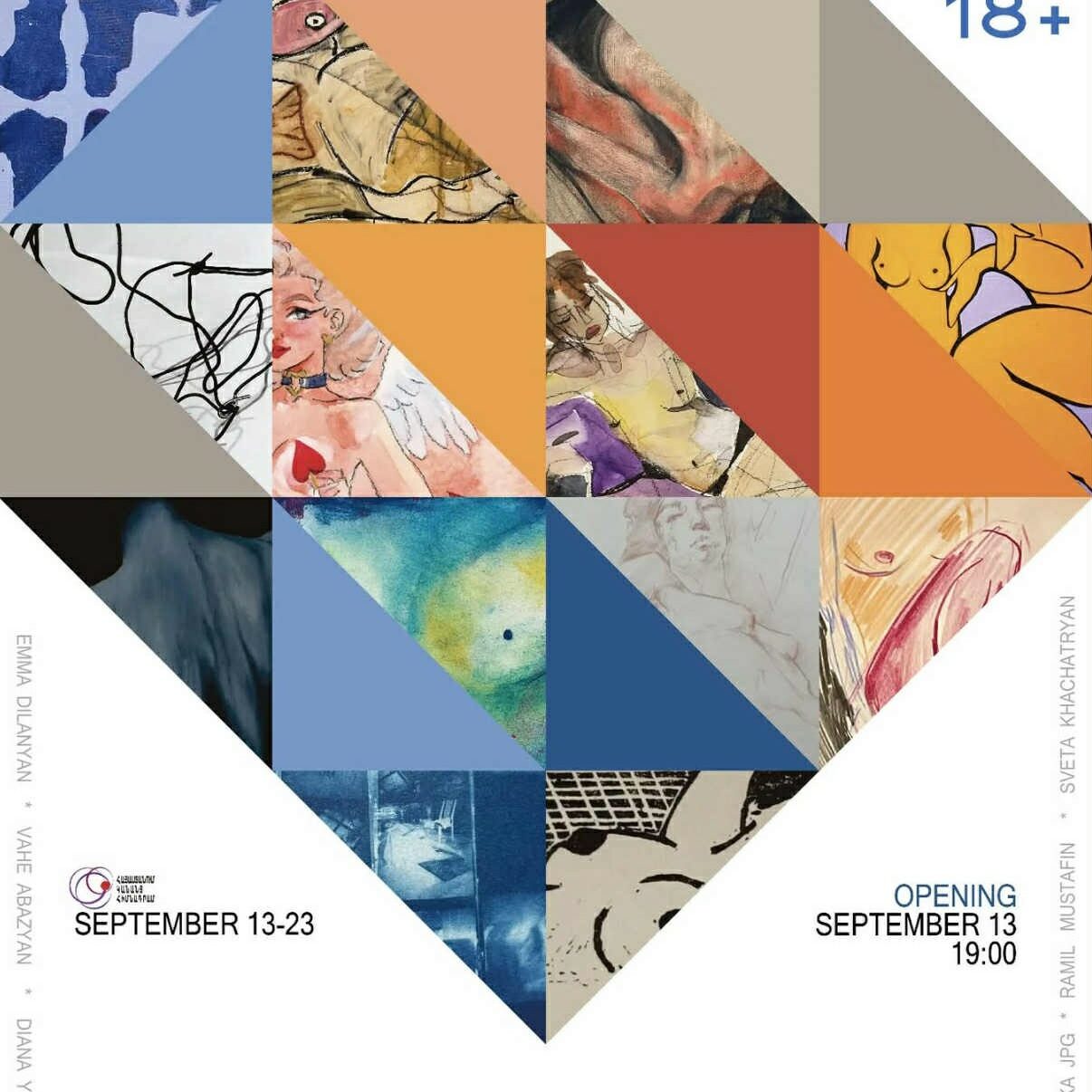
“Women’s art” has always been a derogatively loaded term and it’s not one that is taken at face value by any self-respecting female artist that I know of. But that’s precisely what the participants and organizers of this particular exhibition seem to want to present to the viewer. While the said group show, made up of eight up and coming women painters, hasn’t opened yet, the exhibition’s poster already speaks loudly of the type of salacious, decor-ready art that seems to have slept through two centuries of feminism.
What it happily does instead is to package the female sensibility into a fatuitous frivolity meant for some anonymous corner of the house between the kitchen and the bedroom. The bizarre emphasis on breasts and “organic” forms in the poster, together with the prominently featured 18+ disclaimer, create an anticipation of a respectfully titillating vernissage, where visitors walk around with a wine of glass and expound on the limits of morality or the virtues of the naked female form and sensuality as paragons of the “divine” while reiterating musty cliches about how “beauty will save the world.” Alas, clearly not this time around.
Exhibition: “The Trajectory of Woman”
Where: Nikoghosyan Cultural Foundation
19-21 Saryan St., Yerevan
Dates: September 13-23
GAZ GAZ GAZ
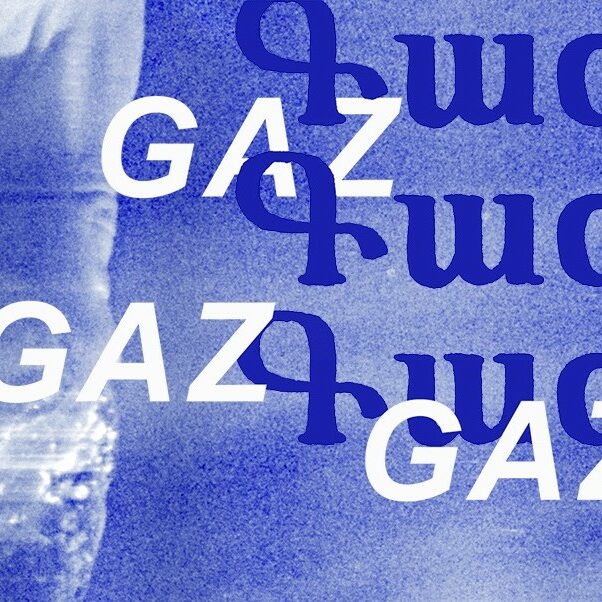
There is a hilariously absurd premise behind GAZ GAZ GAZ—a long-running research project by international contemporary artists Laura Freeth, Kevin Chrismann, and Leo Sudre, currently presented at ACCEA in Yerevan. After learning, by chance, that a mower was buried somewhere in the south of France, the artists set out to find it and to uncover the story behind such an odd act. The mower itself was never located, but in the course of searching they unearthed countless other objects, gestures, relationships, and materials—the scattered debris of modern “human capital.”
This curious blend of archaeology, anthropology, and contemporary art reflects a growing trend across the humanities, where once-separate fields of the arts and sciences increasingly overlap. As I understand it, the project—now titled Creuser (French for “to dig”) and expanded to include countries such as Armenia—asks how histories and memories are constructed, and whether what gets left out of those processes can challenge and reshape how we understand the past and imagine the future. It is an ambitious undertaking, but at the very least GAZ GAZ GAZ hints at what the archaeology of our own time might look like in the years ahead.
Exhibition: “GAZ GAZ GAZ”, Laura Freeth, Kevin Chrismann, Léo Sudre
Where: NPAK
1/3 Buzand St., Yerevan
Dates: September 28-October 18
PRESENTPERFECT: EDIK BOGHOSIAN
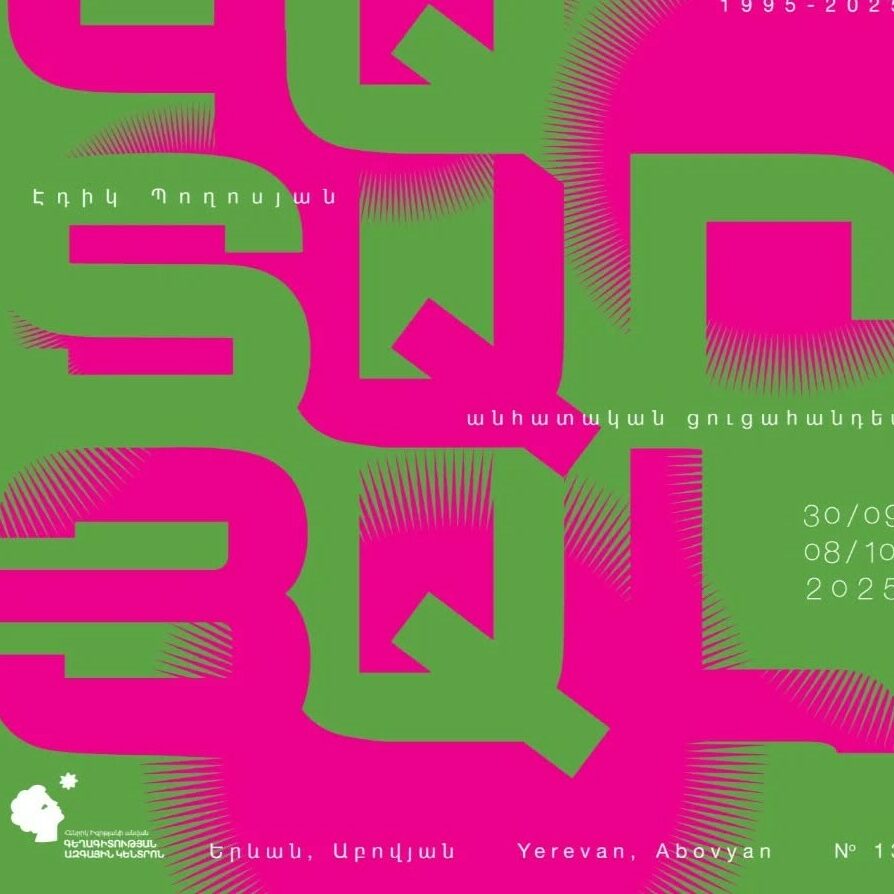
At a recent exhibition, a middle-aged artist pressed me to admire his political agitation posters, proudly listing the festivals and competitions he had entered. The works—painfully pedestrian, badly Photoshopped, and semantically primitive—seemed to sum up the state of contemporary graphic design in Armenia: an army of rudimentary technicians with little grasp of design’s philosophical frameworks, set against a handful of gifted practitioners, who are too isolated to inspire anything resembling a local “school” of graphic design.
Edik Boghosian is unquestionably among that handful. Educated in Iran, he moved to Armenia in the early 1990s and has since pursued a standard of excellence and invention in a field that, until recently, lacked any real ecosystem. Working across the full spectrum of graphic design, from books and theatrical posters to typography and word art, Boghosian has rightfully earned recognition as one of Armenia’s most accomplished graphic artists.
What sets his work apart is the way he respectfully engages with earlier masters and traditions while reinvigorating them with aesthetically fresh and conceptually-grounded ideas, always executed with an unmistakable flair for elegance. One might call it a kind of modernized classicism, or a principled refusal to give in to the trend-driven techniques so common among his contemporaries. However one interprets it, Boghosian’s contribution to contemporary Armenian graphic design is undeniable—bolstered by the international biennale of theatrical posters he has spearheaded for the past four years. His upcoming solo exhibition, opening September 30 in Yerevan, will bring this achievement and its fascinating trajectory into full view.
Exhibition: “Presentperfect”, Edik Boghosian
Where: National Center for Aesthetics
13 Abovyan St., Yerevan
Dates: October 1-8
From 11 a.m. – 8 p.m.
FESTIVALS
13th SUNCHILD INTERNATIONAL ENVIRONMENTAL FESTIVAL

Yerevan hosts so many film festivals that it is a miracle most have survived, given the competition for the same shrinking audience pool. Among the more niche yet socially pertinent is the SunChild Environmental Film Festival. Armenians are not exactly gripped by ecological issues—despite worsening environmental conditions countrywide—which makes this event all the more vital as an awareness-raising platform. Its wide-ranging program includes both fiction and documentary films tackling ecological themes from diverse perspectives.
Alongside the inevitable David Attenborough or National Geographic features on oceans and bees, audiences will also find poetic narratives exploring human–animal relationships, like the recent 4K restoration of Hayao Miyazaki’s sublime Princess Mononoke. Many of the selected films hold instant appeal for children, and parents should rush to make use of them as a means of introducing their kids to the pressing issues that will directly—and dangerously—shape their immediate future.
Festival: 13th SunChild International Environmental Festival
Where: Union of Film Professionals
18 Vardanants St., Yerevan
Dates: September 26-30
FIFTH INTERNATIONAL PRINT BIENNALE

Already in its fifth edition, the Yerevan International Print Biennale has firmly stamped (excuse the pun) itself on the capital’s cultural scene. Armenia is hardly the first place one would expect to host a printmaking biennale. While local traditions in the medium are strong, they cannot compare with its prominence in the cultural canons of Poland, France, or China. Until recently, Armenia lacked even a basic lithographic studio, and there is still no established market for printmaking. Yet, thanks to the tireless perseverance of its organizer, the KulturDialog Armenien Foundation, the Biennale has become an internationally recognized event, attracting hundreds of submissions from dozens of countries and sparking a revival of interest among younger Armenian artists.
Staged in the barrel-like halls of HayArt Centre, this year’s edition repeats the “more is more” formula of earlier iterations. Alas, there is no curatorial concept to hold the unwieldy parade together. The exhibition offers neither thematic nor critical framework to situate the works within the currents of contemporary art and visual culture. The significant evolution of digital printmaking, for instance, is lost in the mix, since the only clear logic of display appears to be size. This has long been the Biennale’s main shortcoming: content to resemble a traditional “fall salon” of all things print, while avoiding more stringent selection criteria. The result of this “quantity vs quality” approach is a weaker, underwhelming showcase—made all the more evident by the superb highlights from the Biennale’s first edition, presented in a capsule exhibition alongside it.
Such quibbles aside, the Print Biennale has established itself as one of Armenia’s most substantial and internationally resonant artistic initiatives, leaving a visible mark on the local milieu. It now has a strong foundation for growth—provided it embraces a more robust and intellectually-grounded institutional methodologies.
Festival: International Print Biennale Yerevan
Where: HayArt Centre
7a Mashtots Ave., Yerevan
Dates: Open from September 5
NPATAK INTERNATIONAL ARCHITECTURAL FESTIVAL
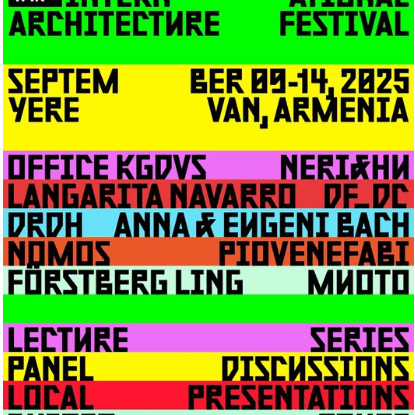
Of the many new festivals appearing all over Armenia in the past decade none seem quite as urgent as the international architectural festival organized by the independent collective Npatak (meaning “purpose” in Armenian). Quietly sliding into its third year, this is not a flashy, mass-scale or popular event. Initiated by a team of young architects, the festival is directed at the professional community, tackling many of the field’s more pressing issues.
Unlike the Tbilisi Architecture Biennale, the festival revolves around lectures and discussions, rather than project showcases. This makes it more academically oriented and less appealing to wider audiences, but also more conducive for local and regional practitioners. The chance to directly engage with some of today’s most innovative and internationally acclaimed architects, critics and theorists is a rare caveat even in the age of instant virtual accessibility.
At its core, the festival is a platform for networking and exchange that puts architecture back into the realm of ideas and philosophy, rather than money. And given the havoc that local architecture has inflicted on this country over the past three decades, this is something to be grateful and hopeful for.
Festival: NPATAK International Architecture Festival
Where: Various venues in Yerevan
Dates: September 5-14
FILMS
THE ARMENIAN JOB
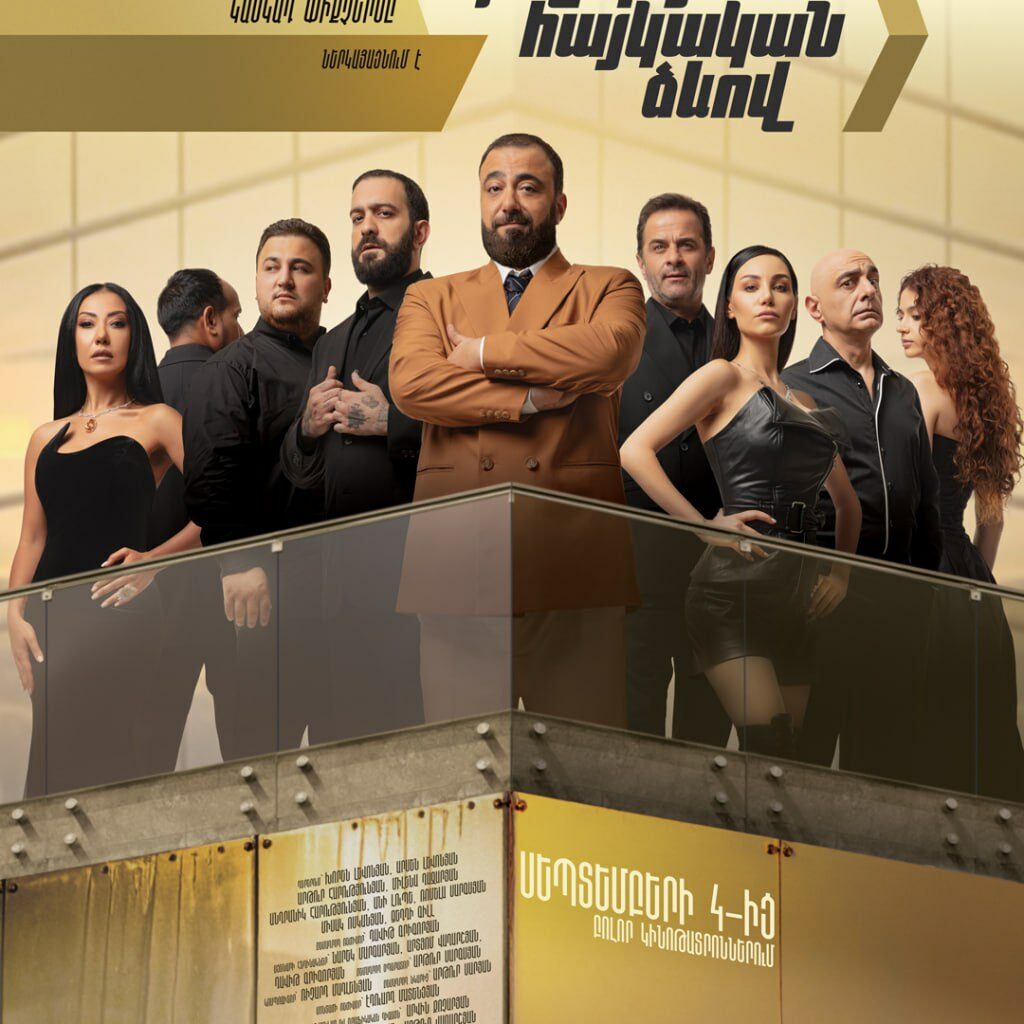
It was only a matter of time before “Yerowood” (yes, the bafflingly agile world of local commercial cinema deserves its own moniker) tapped into the growing Indian–Armenian cultural entanglements. Enter The Armenian Job—a lavishly shot action-thriller starring Khoren Levonyan and a sprawling cast of supporting characters. Judging from the trailer, it appears to be about a team of thieves planning to quit the game after one last job in India. But, according to the film’s breathlessly evasive synopsis, fate pulls them back for a final assignment in Armenia—this time involving an Indian crime lord, some expensive-looking gemstones, lots of automatic guns, car chases, and a squad of masked, leather-clad mercenary women.
The trailer promises a by-the-numbers plot cobbled together from countless forgettable Hollywood thrillers, only to dissolve into a bizarre cocktail of crashing cars, cocked guns, and cartoonishly sexualized women spouting one-liners like:“This seems like a dangerous movie, Mr. Director…” or “This evening I’m leaving for Antarctica. It’s nesting time for penguins…” Add stock suspense music, and you get the impression the filmmakers expect local audiences to check their brains at the door and swallow this tacky simulacrum whole.
The brazenness of the imitation is astonishing: the production company, Cascade Picture, has essentially copied Paramount’s iconic logo, swapping the mountain for a waterfall. The only vaguely intriguing element here is the Indian connection—though predictably reduced to a caricature of orientalist villainy. In the end, one wonders if the film’s title isn’t really a tongue-in-cheek metaphor for our commercial cinema’s (and mass culture’s) philistine compulsion to slip into formulas not of its own making.
Screening: The Armenian Job
Where: Showing in all major cinemas
Dates: Open from September 4