

Listen to the AI generated audio article.
Times change, and so do trends. Today, many Armenian couples dream of ceremonies inspired by Hollywood blockbusters like “Mamma Mia” or set in romantic locations like Lake Como. Yet beneath the glitter and allure of modern trends lies a deeper question: What exactly is a “traditional” Armenian wedding?
While most Armenians believe they know all the rituals of an Armenian wedding, they are in fact quite different from what we typically imagine. The traditional Armenian wedding as a unified ceremony developed in the 18th and 19th centuries. Ethnographer Gayane Shagoyan, chair of Archaeology and Ethnography at Yerevan State University, explores these layers of history in her monumental 600-page study, “Seven Days, Seven Nights: Panorama of Armenian Weddings.” While her work spans hundreds of customs and practices, this article highlights a few of the most striking traditions, ones that reveal just how much Armenian weddings have transformed over time.
Let’s start with perhaps the most important element of the modern wedding: the dress. Bridal boutiques can be found in every corner of Yerevan, offering hundreds of options, while some Armenian designers like Nina Sarkisyants have built their label exclusively around bridal wear. For many brides, the dream is a one-of-a-kind, designer gown.
Some brides seek traditional Armenian styles, but typically end up with long white dresses embellished with Armenian motifs, silver jewelry and belts from Armenian brands like Pregomesh. But these are merely reinterpretations rather than authentic replicas of Armenian wedding attire.
Green
& Red
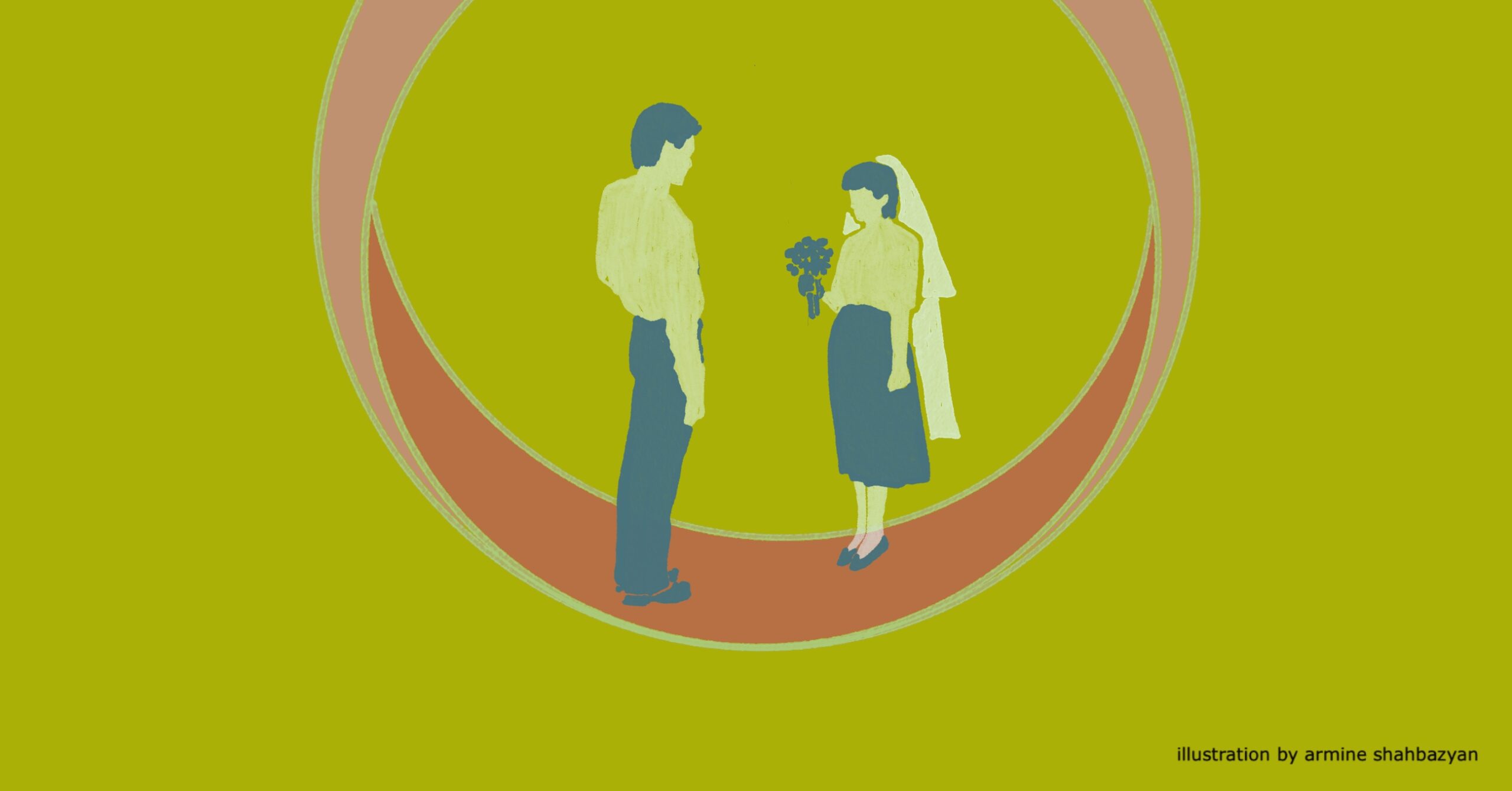
The white wedding dress, popularized in Victorian England, was only fully adopted into Armenian culture after World War II. Before then, traditional dresses featured green and red patterns, while weddings revolved more around the groom rather than the bride. Even today, Armenian grooms occasionally wear green and red sashes.
These colors symbolized prosperity, fertility, and the union of the couple. They represented the act of binding two lives together, so much so that the Armenian idiom “to tie green and red” (կանաչ-կարմիր կապել) literally means “to get married.” Some ethnologists suggest that green represents the groom while the red represents the bride.
Red was associated with the bride for symbolic reasons. Traditionally, she wore a red apron that functioned as a veil to “cover” or “conceal” her womb. Unlike the white gowns we associate with modern weddings, traditional Armenian ceremonies were vibrant celebrations filled with colorful traditional dress (“taraz” in Armenian), with the groom, not the bride, as the central figure of the ceremony.
Dressing
the Bride
Clothing carried deep symbolic weight, and the ritual of dressing the bride was equally important. This custom, though transformed, is one of the few rituals still in practice today. In modern weddings, the bride’s brother slips her right shoe onto her foot, a tradition borrowed from Western culture, rooted in the “Cinderella” story. In the past, however, the focus was on the belt rather than shoes. The bride’s girlfriends and female relatives would playfully steal the belt, demanding money in return. Then the godfather would spin it three times above the bride’s head, and the bride’s brother would secure it around her waist. Later, the veil replaced the belt as the item spun on top of the bride’s head. The belt itself was more than just an accessory, it symbolized protection, fertility, and the transition into married life. While its role has largely faded, belts sometimes survive as decorative jewelry, especially in silver, a nod to their traditional significance.
Unlike many other cultures, where the father escorts the bride down the aisle to meet the groom at the altar, in Armenian tradition the groom first goes to the bride’s home, and from there they proceed together to the church. The journey to the bride’s house carried just as much symbolism as the ceremony itself. Today, the groom arrives with his family and friends in a procession of luxury cars, honking loudly in celebration. In earlier times, however, the route to the bride’s house was seen as perilous, marking the symbolic boundary between the groom’s and the bride’s worlds. Crossing from one space to another was believed to carry risk.
The route was lit with lanterns, regardless of the hour, as people believed it passed through the “world of the dead.” People also believed that evil spirits lurked along the groom’s path, so his companions made loud noises to drive these spirits away. Over time, this practice evolved into today’s honking tradition—a modern version of the old belief that noise protected the couple and cleared their path toward marriage.
Animal sacrifice has long been a traditional ritual in Armenia for nearly every major milestone—births, weddings, or other important occasions. Wedding ceremonies often began with this ritual. To perform it properly, a symbolic “center of the world” was chosen, representing the point where the world’s axis crossed. The sacrificed animal, often an ox (in a tradition known as eznmortek, meaning “ an ox slaughter”), symbolized the entire community or the world itself. While the ritual carried various interpretations, its central principle was that it had to take place publicly, at the very center, before all witnesses.
Over time, this practice gradually faded as the sacrificial meat was replaced with sweeter alternatives. Today, weddings are unimaginable without a cake—one might say a modern substitution for animal sacrifice. Although the tradition of sweet confections at weddings dates back to ancient Greece and Rome, it is a relatively recent development in Armenia, introduced during Soviet times. The cake cutting ceremony now occurs at the celebration’s end, sometimes accompanied by fireworks as the couple cuts the cake together. Yet, elements of the old tradition persist: the cake is cut in the center, before everyone, and then “destroyed” as it is shared among the guests. Few people today would guess that the extravagant wedding cake has replaced the sacrificial ox of earlier times.
The “Luck”
of Marriage
Tarosiks, small souvenirs, are a crucial part of Armenian weddings. The bride and groom give them to young, unmarried guests to pass on the luck of marriage—the taros—to have that happiness themselves. Modern couples have become creative with tarosiks, offering candles, magnets, or even paintings, though these items often end up forgotten on guests’ shelves.
While tarosiks may resemble wedding favors that originated in 16th–17th century France and Italy, the Armenian version has deeper, distinct roots. Originally, a tarosik was not a souvenir but a cross-shaped gata (sweet bread) given exclusively to unmarried women. This gata was ceremonially cut above the bride’s head, on the day of her henna ceremony, a tradition that has almost entirely disappeared from weddings in Armenia, although it still persists in diasporan communities. During this ceremony, girls apply henna to their hands, as would the groom and sometimes unmarried men. However, during the Soviet era, both the henna and gata traditions were replaced by the tarosiks we see today.
One tradition that is not entirely Armenian, but that Armenians love to embrace, involves showering the couple with items like flower petals as they leave the church—creating a magical photo opportunity. The roots of this practice could be traced back to a 5th-century myth about the marriage of King Artashes I and Satenik. According to Movses Khorenatsi:
“Gold was pouring
At Artashes’ groom’s time,
Pearls were pouring
At Satenik’s bride’s time.”
Ոսկի անձրև էր տեղում
Արտաշեսի փեսայության պահին,
Մարգարիտ էր տեղում
Սաթենիկի հարսնության պահին:
During royal weddings, kings and queens showered their people with coins as a sign of prosperity for the nation. This tradition was borrowed from the Romans. A similar custom is “pouring” money on the bride while dancing. Today, the tradition has flipped: instead of the bride and groom showering others, guests “shower” the couple, whether with petals at the church or money during the reception
Lavash
& Honey
Although many traditions have evolved over the years, a few have remained unchanged. One of them is when the groom’s mother puts lavash on the couple’s shoulders. Lavash symbolizes fertility and protection from the evil eye. In some regions, it was placed only on the bride’s shoulder, signifying her role in filling the house with bread. The roots of this custom dates back to pre-Christian Armenian mythology. During the wedding of Vahagn, the god of war, and Astghik, the goddess of beauty, Aramazd, the greatest of the gods, placed lavash on Astghik’s shoulder as a blessing of luck and happiness. But on the way to Vahagn’s home, the lavash slipped off without her noticing. Angered, Aramazd declared, “The one who throws bread on the floor cannot be a wife or a mother.” As the story goes, Vahagn and Astghik were never wed, and thus the tradition of lavash at weddings was born.
After placing the lavash, the groom’s mother offers the couple a spoonful of honey so their life together will be sweet. Another ritual that has endured is the breaking of plates at the entrance of the groom’s house. Similar to the lavash, this ritual is also a protection from the evil eye. Although these rituals were traditionally performed at home, many couples now practice them during their wedding reception as well.
These examples show how Armenian wedding traditions continue to transform. While some customs may seem outdated, one thing remains clear: a wedding is a living, evolving celebration. It stays deeply rooted in culture while adapting to market influences, borrowed rituals, and contemporary trends. There is no single “right” or “wrong” way to celebrate, especially since many couples today choose a “traditional” Armenian wedding without knowing the true historical traditions. Ultimately, every couple has the freedom to create their own unique dream wedding, whether that means a “Mamma Mia!” escape or a deeply Armenian celebration.
Rhythms

The August issue of SALT will immerse you in the rituals, rhythms and contradictions that shape contemporary Armenian life. From the evolving traditions of wedding rituals to the raw voices of Yerevan’s underground music scene, this month is about encounters, where heritage meets reinvention, where spectacle (hello, J.Lo) collides with satire, and where diaspora-Armenia relations unfold in all their messy, modern “situationships.” August is a month of intensity, and this issue embraces it with stories that are layered, unexpected, magnetic.
Cover photo by Lilith Margaryan, featuring Futurili.
Jenny On Our Block: What the Latina Diva Triggered in Our Armenian Hearts
When Jennifer Lopez arrived in Yerevan, she brought music and glamor and lots of conversation. From admiration to envy, the J.Lo effect revealed our society’s contrasts, ignited debates about culture and trust, and hinted at Armenia’s potential as a stage for the world.
Read more
Armenia and the Diaspora: A Situationship?
Armenia and its Diaspora share a bond of love, pride and pain—full of longing, misunderstandings and unspoken truths. Tatev Hovhannisyan explores their complicated “situationship” where memory and survival meet politics, and where distance both deepens and strains connection.
Read more