
Listen to the article.
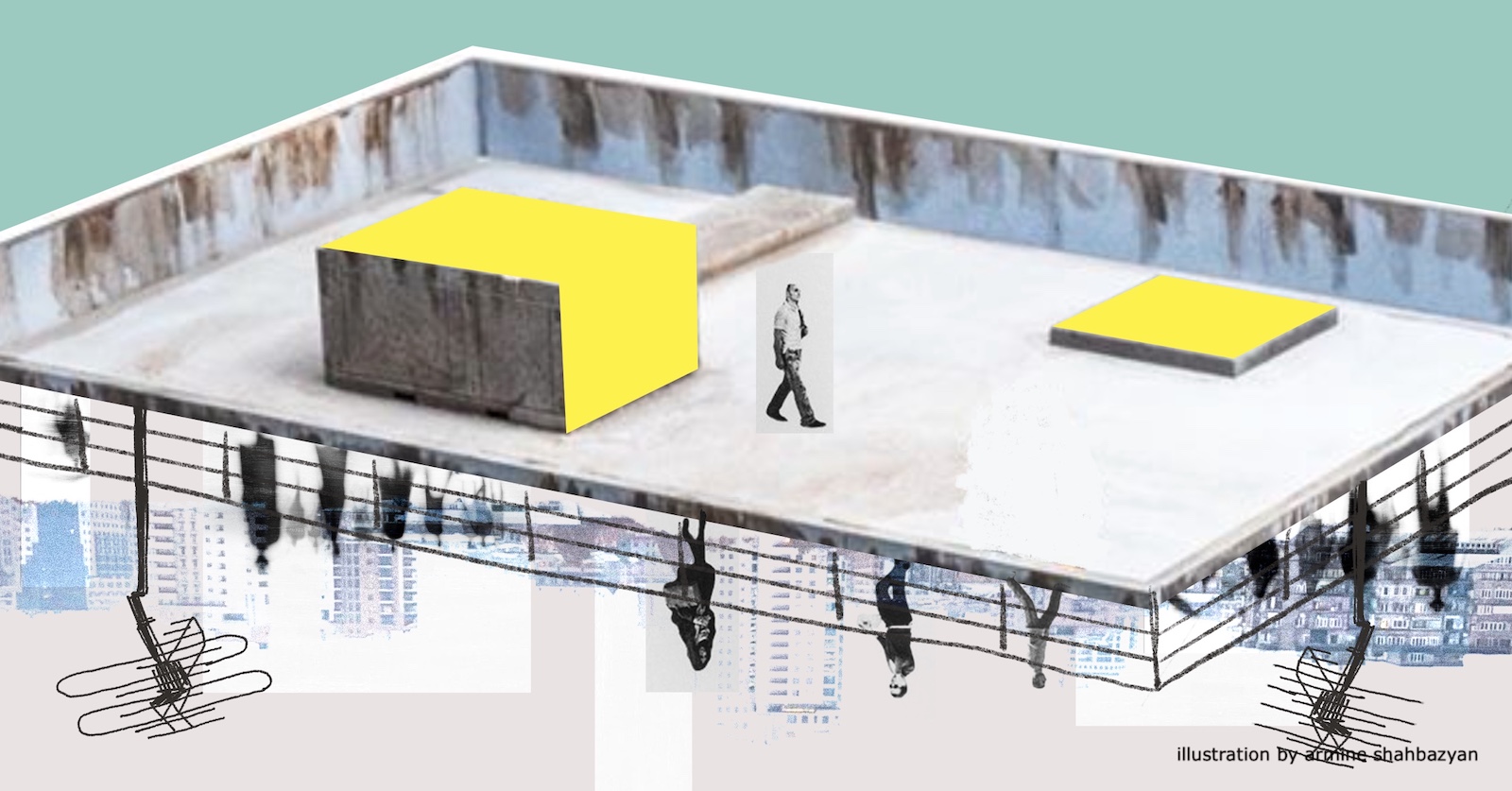
On a gloomy, gray day in January 2025, Alexey, one of the founders of the Museum of New Analogies (MNA), met me outside his apartment building at a busy intersection in central Yerevan. He was dressed in a long gray coat that matched the weather and warm, homey slippers. The elevator took us to the 8th floor. After passing through his rental apartment, we followed a narrow passage and climbed a metal staircase to what seemed like a floor between the floors – floor 8½. From there, we stepped out through metal doors onto the rooftop.
My footsteps echoed with a hollow sound against the surface, punctuated by the soft shuffle of Alexey’s slippers, an oddly comforting domestic sound against the backdrop of traffic noise and wind whistling through gaps between the buildings. As I moved toward the edge, the city unfolded beneath me like a living map. Soviet-era tufa apartment blocks and administrative buildings stood alongside the glass and steel of new constructions. From the added-on mansards crowning residential buildings to the enhanced balconies and streets down below, Yerevan pulsed with relentless vitality. The city seemed to thrive precisely because of, rather than despite, its chaotic and uncoordinated layers accumulated across decades of political and cultural transformation:
“You know,” Alexey said with a smile, “this reminds me of the film Being John Malkovich. That secret 7½ floor hidden between the floors of an office building, creating a somewhat absurd and surreal atmosphere.”
The comparison was apt. We found ourselves in architectural limbo, a housing extension that should not exist according to the conventional building logic of a seismic area. Yet here we were, observing similar structures as far as the eye could see.
Like most interesting things in life, MNA on the rooftop materialized unexpectedly. Alexey and his partner Katya were looking for an apartment when they stumbled upon an ad offering a place in central Yerevan at a very modest price. The host seemed quite shy when showing the apartment, because the ceilings were very low, only 1.8 meters, which explained the price. The rooftop access, not mentioned in the ad, came as a bonus and a positive externality.
As soon as he stepped onto the rooftop for the first time, Alexey declared it the territory of the museum. For a long time, MNA was a prank and obfuscation created by Alexey and his friend Felix, who refer to themselves as “Junior Research Fellows of MNA” and sign their side projects accordingly. This “organization” has no clear focus or permanent activities. It functions as a sort of philosophical-artistic concept that creates unexpected connections between disparate elements of experience—or just a catchy name to attract attention. It is everything and nothing at once, depending on how you want to look at it. Thus, the territorialized form of MNA on a Yerevan rooftop can accommodate virtually any creative idea.
The kick-off MNA event in Yerevan featured an exhibition of old nonfunctional antennas occupying the rooftop, left behind by former or current residents. When Alexey went up on the roof and saw these antennas, he immediately envisioned a ready-made exhibition, which opened to the public on March 28, 2023. Each antenna displayed a QR-code sticker that linked to an audio recording. These recordings shared stories from Alexey’s friends and acquaintances who, like him, had left their hometowns and dispersed across the world:
Standing on rooftops in different cities, they shared stories from faraway places, connecting these places as dots on the map through personal memories, experiences, and aspirations.
MNA also hosted “Chair of Reality,” an installation by artist Konstantin Terentyev, comprising a white weathered chair with this label:
You put this chair in any place on the roof and sit down. As soon as you sit, you are in immediate reality, for as long as you want. The chair has already become very uncomfortable, reflecting the current very unsettling state of affairs that we live in.
The first performance, “Silence on a Given Topic,” featured two actors standing silently while the audience moved between them. Taking place at sunset, darkness fell as the city grew increasingly noisy. On the roof, where “silence was maintained in two languages – Russian and Armenian”:
This rooftop is a museum in the sense of being a space for aesthetic attention, where people can come and admire something in company. Listen, be listened to, or stay mute. There are no answers, no fixed points, just the art of performed togetherness.
The MNA rooftop can accommodate 20–30 people during events. There is water and electricity, along with movable wood pallets and a white screen that can be arranged in various ways depending on the nature of the event. Practical limitations include weather conditions:
Hellish heat and strong wind. We host everything during the warm season, but closer to sunset, when there is shade, it’s not so hot, and the wind dies down.
Another consideration is compliance with what Alexey calls the “library format,” which requires minimal noise to avoid disturbing the building’s residents. This transforms the rooftop into a space of heightened awareness:
It is actually cool because we can hear and feel the city better. Through the sky, through the sounds of birds and streets, through the changing lighting. Here we are getting acquainted with Yerevan and its inhabitants from a different, less conventional viewpoint.
The enforced hush creates a meditative space where the city’s own voice becomes amplified. The “library format” paradoxically makes those on the rooftop more attuned to the urban experience, in the same way that one adjusts the volume on a complex symphony to hear harmonies previously lost in the noise.
Quiet events attract a quiet, occasional audience, as neighbors observe the events from their balconies:
They look from their balconies but say nothing. Yerevan has a tradition of rooftop life. Everyone here masters their roof with their own ingenuity. If you look around, you’ll see sheds, outbuildings, barbecue setups, and chill-out zones. Rooftops here are not just utilitarian surfaces; they invite varieties of social life.
Voices Are Strange

In April 2025, I first attended a play staged at the MNA by the Alexander Kudryashov Theater Company titled “Voices are Strange.” It featured 12 audio files collected by the director unintentionally between 2018 and 2024 across different cities and countries. The content ranged from a sex worker’s raw monologue to the solemn resonance of church bells during a funeral; from humorous discussions about garden plots to fragments of conversations about pastry. These audio files were presented in their original, unedited form—without clean cuts, artificial sequencing, or attempts to impose narrative coherence. Their power lay precisely in their authenticity and refusal to conform to theatrical conventions.
We sat on colorful cushions atop wooden pallets arranged in a loose circle on the rooftop, each person isolated in their own individual headset. The April evening air carried the scent of blooming apricot trees from nearby courtyards, while Yerevan’s distant street sounds provided a spontaneous soundtrack beneath our private audio worlds. The listeners visualized the play entirely within their minds, free from curatorial intervention or directorial interpretation, creating 12 unique performances from the same source material.
The play’s approach perfectly embodied MNA’s concept as a space between intention and accident, between the planned and the discovered. MNA exists not as an institution but as an ephemeral experiment—an extended family or hidden micro-public. It represents a particular way of being in the world, occasionally manifesting through voluntary, pop-up initiatives such as this Yerevan rooftop, yet never tied to any single location or permanent structure. As Alexey remarked at the end of our first meeting: “It came, and it will go someday. We will travel to another place and repurpose another space.”
For more information about MNA’s activities, follow their Instagram page @new_analogies
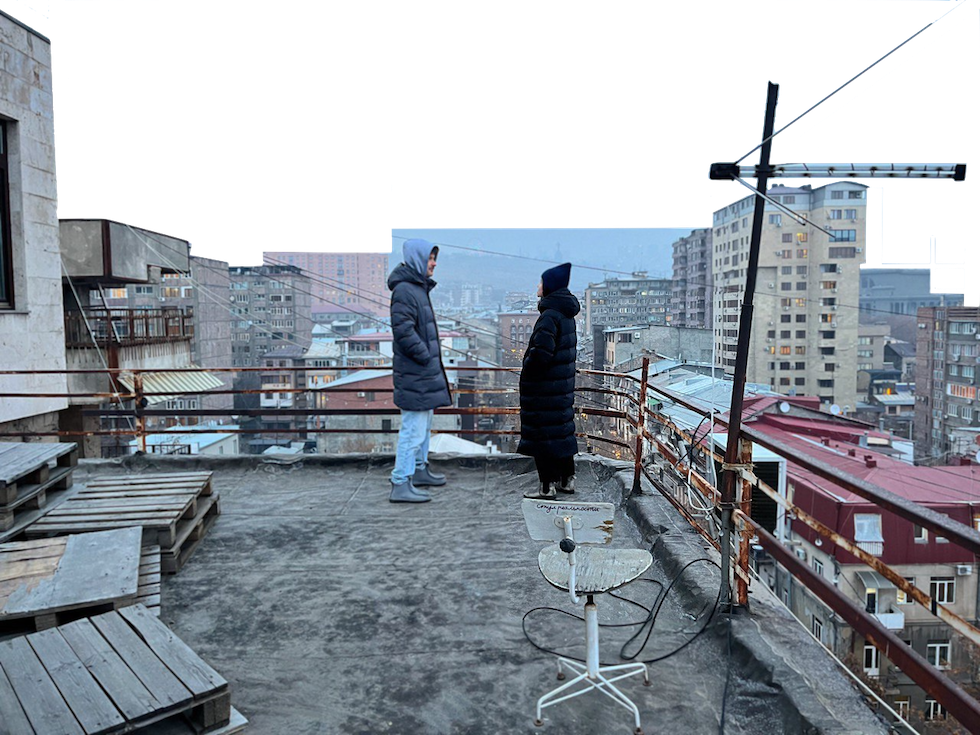
A conversation at the MNA rooftop.

The July issue of SALT is a sensory journey through Armenia’s summer landscape — from foraging wild herbal teas in the mountains of Syunik to the weird and wonderful world of Yerevan’s Qrchi Bazaar. We explore the rise of horror writing, visit a museum of strange analogies, and spotlight an artist whose work defies convention. This month, eclecticism is our mood.
Nestled in the outskirts of the southern Armenian town of Kapan, Darmanadzor is a soulful teahouse where Artur Patvakanyan serves hand-foraged herbal blends. Rooted in ancestral wisdom and personal healing, his teas offer comfort, connection and a quiet resistance to modern haste.