

Listen to the AI generated audio article.
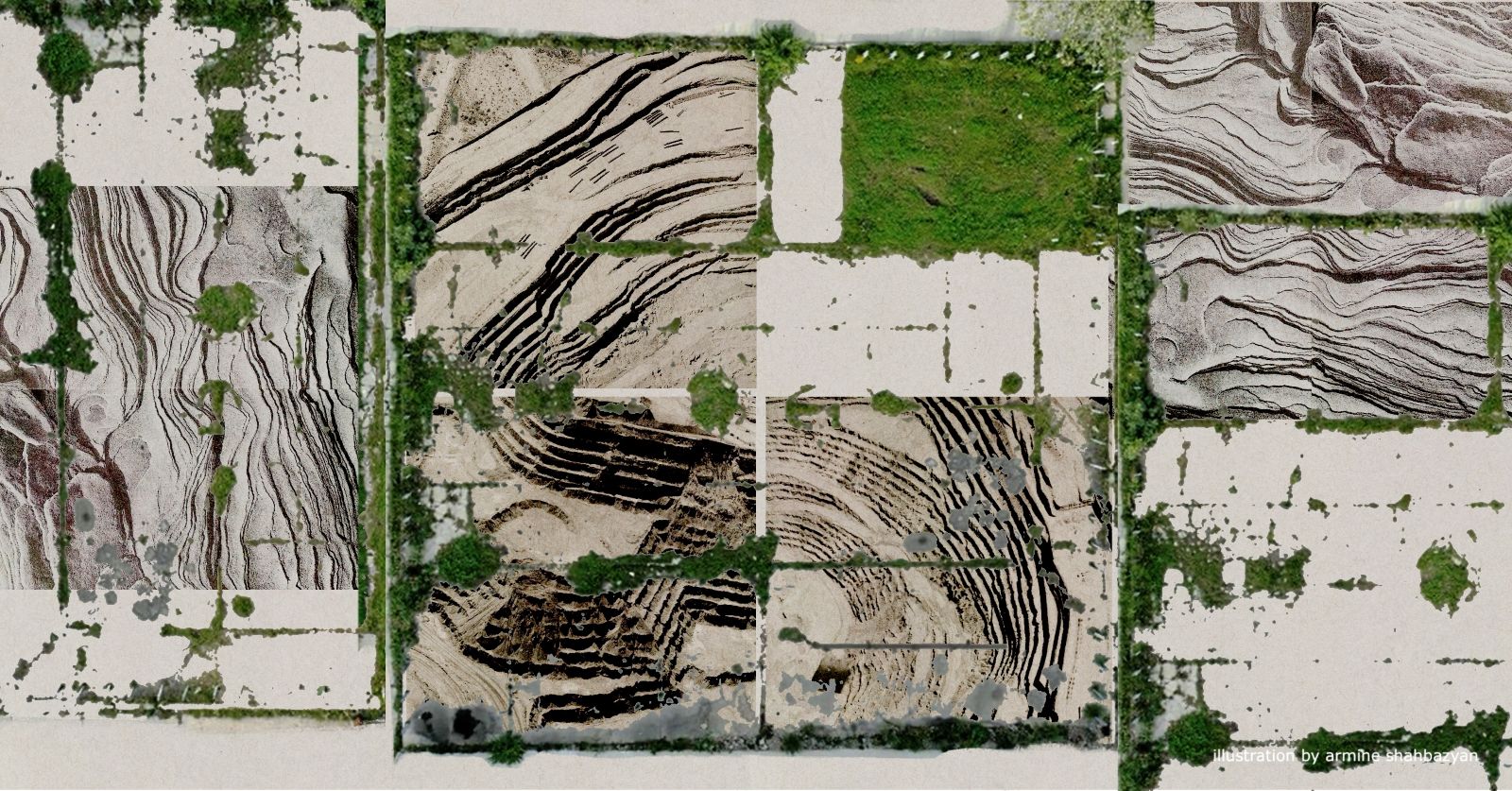
Across the garden table, 67-year-old Yegishe Hobosyan studies a photograph I hand him. The Teghut forest, which once stretched intact across the mountains, is now scarred and altered by a copper and molybdenum open-pit mine. Familiar places he once knew have been stripped of trees, fenced off, made unreachable. Having lived almost his whole life in Teghut, he points out the spots where he kept his pigs and where cold water once flowed.
“When I look at that place,” he says quietly, “I climb the mountain, look from the side, and want to cry my heart out. What can I say?”
Yegishe’s feeling has a name: solastalgia—a place-based distress, the homesickness you feel while still at home, when your surroundings change beyond recognition. The mining industry, especially open-pit and mountaintop removal, is one of the most common sources of solastalgia.
Armenia has a long history with mining, beginning in the 1770s with copper extraction at the Alaverdi mine. Of the 670 registered solid mineral mines, around 400 are actively exploited. The mining sector is a key contributor to the national economy.
In 2001, the Armenian Copper Programme (ACP) CJSC was granted the license to exploit the Teghut mine, Armenia’s second-largest copper-molybdenum mine. Between 2006 and 2013, major engineering and construction work was conducted across 700 hectares, including 357 hectares of forest. The mine began operations in 2014 but stopped in 2018 due to concerns about the tailings dam’s stability. It remained closed from March 2022 to July 2023 due to the political and economic situation.
The Teghut mine currently employs over 1,000 people from nearby villages and across the Lori region. The closest villages, Shnogh and Teghut, appear prosperous. Walking through them, you’ll see newly built cultural centers, stores, pharmacies, two-story houses and paved roads, improvements that locals tie to the mine.
According to residents, the mine brought opportunities for development. Young people found well-paid jobs and stayed in Armenia instead of migrating to Russia for work. They formed families and built lives there.
Yet beneath this veil of prosperity, another story unfolds—one of loss, displacement and grief. What is the cost of living in an industrialized place? How does one navigate the emotional weight of disappearing landscapes, lost and endangered species, and forests that once stood but are now gone?
For Yegishe, Teghut mine is not about prosperity and economic gain. It is a wound both in the land and in his memory. “In my dreams, I am still in that ravine,” he says, his voice shaking.
Vahagn,* 66, faces the same loss—his favorite place now lies beneath the dam. He loved it so much that he would have accepted a mine there, but not a tailings dam.
“When they do reclamation or something and close it, other generations will come and think it is just a plain, not a tailings dam,” he explains. “They may not feel all those changes, but since I know what was there before, those memories are completely different. You have valuable memories associated with those areas that are covered up today, and those memories cannot be repeated.”
The dam literally and figuratively covered a layer of memories, personal stories and attachments.
But their grief extends beyond place-based solastalgia. Ecological grief, a broader term, encompasses loss of ecosystems, species and traditional livelihoods.
River contamination and shrinking has been reported numerous times, highlighting the consequences for human and animal health. But the river was more than a water source for drinking and watering gardens, it was also a communal gathering space where villagers brought guests, did laundry, and swam on hot summer days. It is a core part of their memories.
“Our childhood was spent in the water… we used to go swimming there, but now it’s gone… it’s not even a stream,” says Tania.*
Yegishe remembers that years ago, villagers could drink water flowing from the mountains, graze their animals in open fields, and water their gardens with water from this river.
“With the same water I use to water my garden, my trees have dried up. Last year, there were lots of cucumbers and tomatoes, and one day I said, ‘I’ll leave the water running overnight,’ hoping it would be clear. In the morning, I saw what happened there, how many chemicals had been dumped in the water, how much acid there was, and my garden completely dried up. After watering, the crop falls from the trees like something rotten. Why won’t the animals drink the water anymore?” he says.
In Teghut and Shnogh, agriculture and animal husbandry formed the core of life before mining arrived. These practices were deeply woven into local identity. “We don’t have land to raise livestock. Not having land means agriculture, animal husbandry, and the forest are lost,” says Yegishe. When the mining company acquired most of the communal land, it eliminated these traditional livelihoods.
When a landscape is altered so drastically, it reshapes landforms and ecosystems, with lasting consequences for species that have long inhabited them. Frogs haven’t been heard croaking at night for years in Shnogh and Teghut. Crickets no longer appear in high summer, jumping over haystacks. The red mullet is found neither in the waters nor in the market. In another era, a new Silent Spring would have been written.
These physical losses stir mixed feelings among the villagers. Some say they are glad the frogs are gone—the croaking once disturbed their sleep. Children used to dive into the river at night to chase the sound and would often catch a cold. Now there is no proper river and no croaking, and, as one villager reflects with irony, the children are healthier.
Hearing rumors about the frogs’ return, Yegishe tried to find them: “I decided to go and see for myself one day. When I finally got there, I didn’t see any frogs. People say the frogs are discolored and deformed. It’s no surprise, considering what they’ve been subjected to. What kind of living thing could survive there?”
The last question reflects a common sentiment among the villagers. Human health receives at least some attention—several research papers focus on the consequences of mining and toxic metal accumulation in northern Armenia. Meanwhile, the non-human world suffers unreported losses to the point of extinction.
Ecological grief also involves an anticipatory dimension. Psychologist Therese Rando, a leading scholar on mourning, describes anticipatory grief as a process encompassing mourning, coping, interaction, planning and psychosocial reorganization. These processes begin in response to awareness of an impending loss, an understanding that what is loved and familiar is slipping away, and extends to the recognition of losses that have already occurred or are yet to come https://thedermatologyoffice.com/.
In Teghut, the sense of foreboding is palpable. Many villagers expressed concerns about the tailings dump. Yegishe called it “an explosive” spot, while Sylva* warned that “if they don’t cover the tailings dump, a very, very terrible thing happens. When the wind starts, the dust comes all the way, it stops, and that is very harmful and will be very dangerous for people’s health and for nature.”
The realization of inevitable future losses became the closing note of almost every conversation. Discussing mining activity and people’s attitude toward it, Vahagn* told me, “If everything continues like this, the damage will be greater, the damage to people and to everything in our environment will increase.”
One thing was clear: most people only think about confronting these losses after the mine closes. The ongoing losses are seemingly easier to bear as long as there is financial stability.
But what happens when it is taken away too?
*Names have been changed to protect their identity.
Author’s note: This story grew out of my master’s research on how people experience and cope with environmental loss; part of my thesis on place attachment and psychoterratic syndromes in industrialized landscapes, completed at the University of Warsaw in September 2025.
Environment

Solar Takes Off: Can It Fuel Armenia’s Energy Independence?
Armenia is rapidly embracing solar power, with rooftop and utility-scale projects driving energy independence and sustainability. Hovhannes Nazaretyan examines the country’s growing capacity, landmark farms like Masrik-1, future wind ambitions, and the challenges of integrating renewables into the national grid.
Read more
The Climate Is Changing, How Are Armenian Winemakers Adapting?
Armenia’s winemaking renaissance faces a new challenge: climate change. From shifting harvests to genetic research on native grapes, winemakers and scientists are adapting—experimenting with higher-altitude vineyards, irrigation methods, and biodiversity to preserve a six-millennia-old tradition.
Read more
From Urtsadzor to COP17: Biodiversity at Armenia’s Crossroads
As peace negotiations with Azerbaijan and regional integration projects advance, biodiversity corridors could become vital connectors across fractured landscapes and divided societies. With Armenia preparing to host COP17, the urgency of protecting its extraordinary biodiversity amid mounting ecological and political threats takes center stage.
Read more
Subsoil Security: The State of Mining and Armenia’s Mineral Wealth
Could Armenia’s mineral wealth, long dominated by Russian companies, emerge as a strategic asset in the global race for critical minerals? Gibran Caroline Boyce explores how mining now intersects with economic independence, national security and Armenia’s geopolitical diversification.
Read more
Maps Show a Forest, But Where Are the Trees?
Armenia’s forests are vanishing under the pressure of illegal logging and rural dependence on firewood. Lori Youmshajekian follows volunteer rangers in Dilijan who risk their safety to defend fragile ecosystems, exposing corruption, weak enforcement, and the urgent fight to save Armenia’s trees.
Read more