

Listen to the AI generated audio article.
Iran as the Keystone of a Regional Order
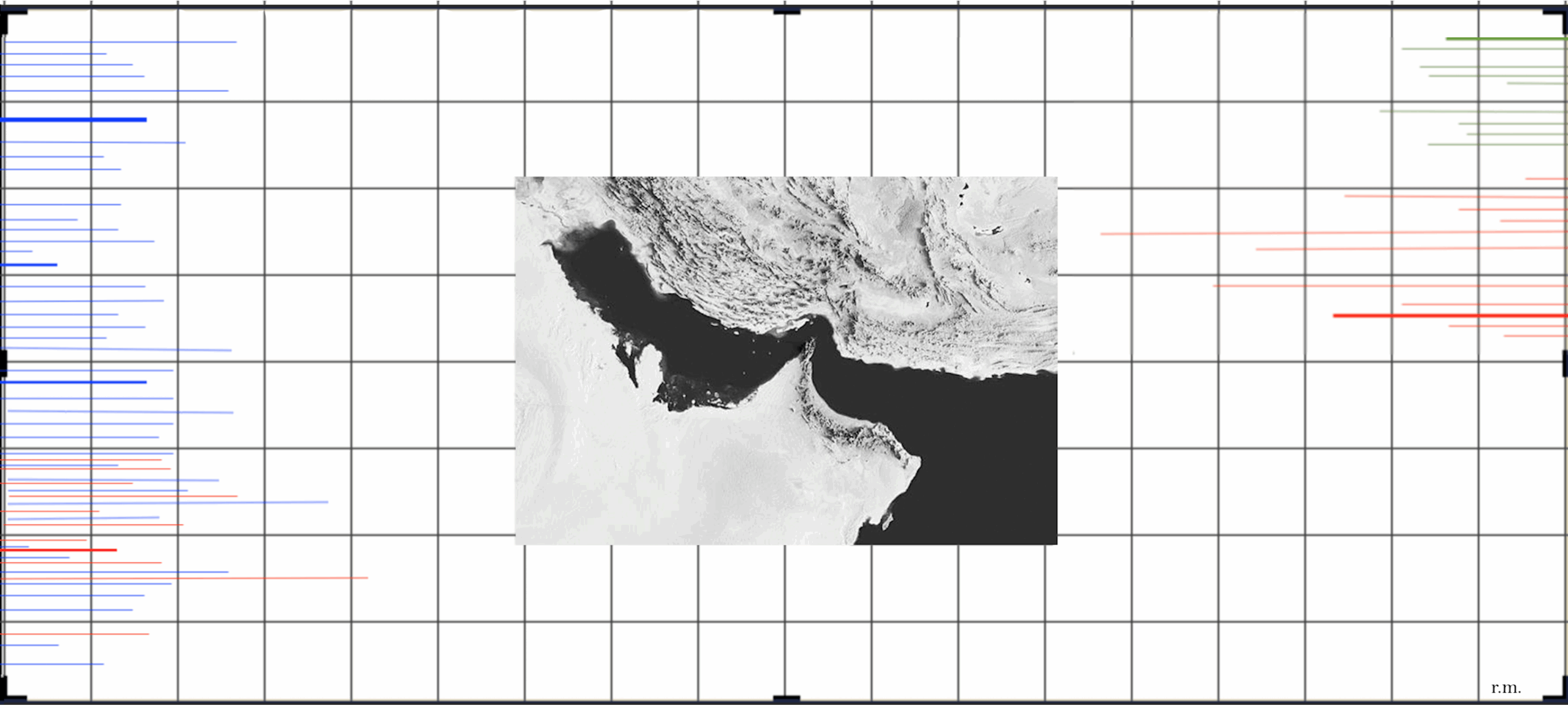
Iran constitutes one of the geopolitical keystones linking the Middle East, Central Asia and the Caucasus. Its Caspian coastline, shared borders with Armenia and Azerbaijan, and partial control of the Strait of Hormuz, through which a vital share of global oil trade flows, make it a strategic node whose destabilization produces immediate shockwaves.
The country also occupies a central position in the International North-South Transport Corridor, linking Russia to India via Azerbaijan and Iranian territory. For Armenia, this axis represents one of the few prospects for medium-term economic connectivity. Its paralysis therefore constitutes both a strategic and economic setback.
The failure of the blitzkrieg envisaged by Washington and Tel Aviv also suggests that Iran had prepared for a protracted conflict. Drawing on its long experience of wars of attrition, notably the 1980-1988 war with Iraq, Tehran appears to have anticipated a sustained confrontation. Its strategy is to shift the conflict beyond the military sphere toward the global economy, energy markets, and the international credibility of the United States.
Armenia and the Loss of a Strategic Counterweight
For Armenia, the security consequences of a weakened Iran could be considerable. Since the 2020 war and Azerbaijan’s September 2023 offensive, Tehran had emerged as the only neighboring regional power to consistently oppose Baku’s territorial demands, specifically the so-called Zangezur corridor.
Iran’s opposition, however, stems primarily from its own strategic interests. Such a corridor would alter the regional balance by cutting Iran’s land access to the Caucasus, strengthening the Ankara-Baku axis, and disrupting trade routes Tehran considers vital to its connectivity with Russia and Europe through Armenia.
If Iran weakens in a sustained way, Armenia’s position becomes even more precarious. Having effectively frozen its membership in the CSTO and seen its security relationship with Russia collapse, Yerevan now lacks a credible external guarantor. While Armenia has sought to diversify partnerships, turning to France, India and others for arms, and strengthening ties with the United States and the EU, none provide the immediate deterrent effect Iran currently offers.
Iran’s weakening would therefore leave Armenia facing Azerbaijani pressure with virtually no regional counterweight, at a time when Baku already occupies Armenian territory and continues to threaten further incursions into Syunik.
The war increases regional volatility, though not all incidents directly threaten Armenia. While events such as the reported crash of Iranian drones in Nakhichevan primarily concern Iran-Azerbaijan relations, the broader pattern of instability and Iran’s potential distraction from Caucasus affairs could indirectly embolden Azerbaijan to take a more aggressive posture toward Armenia.
Iran’s strategic preparation proved accurate. Drawing on its long experience of wars of attrition, Tehran shifted the confrontation beyond the military sphere toward the global economy and energy markets. Iran responded by launching hundreds of drones and ballistic missiles at Israel and at U.S. military bases in neighboring Arab countries, and closed the Strait of Hormuz, effectively blocking commercial shipping and charging tolls exceeding $1 million per vessel for the limited passage it permits.
Reports confirmed increased support from Russia and China in intelligence sharing and strategic coordination, adding the anticipated great-power confrontation dimension. The conflict, now in its seventh week, has evolved into precisely the protracted confrontation Iran prepared for, with effects extending far beyond the Middle East.
From Structural Vulnerability to Asymmetrical Impact
The economic consequences of the conflict are equally concerning. Since the 1990s and the Turkish-Azerbaijani blockade, Iran has served as an essential land outlet for Yerevan, with bilateral trade reaching nearly one billion dollars in recent years. One of the most immediate impacts would be on supplies of fuel and fertilizers, a significant share of which comes from Iran. Any disruption would raise transport and production costs, with ripple effects across the economy.
Restrictions imposed by Tehran on certain food exports add a second layer of pressure. In a country where purchasing power remains fragile, rising prices for basic goods could quickly translate into social tensions. At the same time, disruptions to Iranian transit routes threaten the revenues Armenia has developed since 2022 as a commercial hub facilitating trade flows linked to sanctions on Russia. This advantage could prove short-lived if regional logistics deteriorate further.
These vulnerabilities are unfolding within a broader asymmetrical dynamic. While Armenia faces mounting disruption tied to its dependence on Iran, Azerbaijan is directly benefiting from the crisis. Rising oil prices are generating billions in additional revenue for Baku, strengthening its position.
Meanwhile, efforts to reduce Armenia’s reliance on Iran, including the TRIPP corridor project, appear delayed by the conflict, highlighting the fragility of alternative routes. External support, such as the European Bank for Reconstruction and Development’s €5 billion package, may offer short-term relief, but does not resolve the structural imbalance: Armenia is losing a key economic lifeline even as its regional rival gains from the same crisis.
Displacement Risks and Demographic Pressures
Contrary to initial fears of a massive influx, the refugee situation remains, for now, under control. Armenian authorities confirm that there has been no large-scale arrival of Iranian refugees or Armenians from Iran. Those crossing the Armenian-Iranian border are primarily foreign nationals (citizens of 60 countries between February 28 and April 1) using Armenia as an evacuation corridor to return home via Yerevan. With Iran’s neighboring countries having closed their borders, Armenia remains one of the few available exit routes, but the Iranian government currently only allows passage to holders of foreign or dual passports.
Beyond immediate humanitarian considerations, the crisis also exposes deeper structural constraints in Armenia’s foreign policy.
For a small state like Armenia, navigating between competing regional powers requires strategic flexibility rather than rigid alignment. Yerevan has adopted what could be characterized as strategic ambiguity—maintaining relationships with multiple actors (France, India, the United States, and even residual ties with Russia) while avoiding full commitment to any single patron.
This approach, born of necessity given Armenia’s geographic isolation and the unreliability of past security guarantors, represents a deliberate strategy rather than policy drift. However, the effectiveness of this strategy depends heavily on the regional balance of power remaining relatively stable. An Iranian collapse or sustained weakening would eliminate one of the few counterweights to Azerbaijani pressure, forcing Armenia to navigate an even narrower path between capitulation and conflict.
Turkey’s Complex Game
Turkey’s position illustrates the ambiguities of the regional system. A NATO member that maintains significant economic ties with Iran and Russia, Ankara pursues a balancing diplomacy. An Iranian collapse would benefit Turkey strategically: it would remove Tehran’s opposition to Azerbaijani control over transit routes through southern Armenia, potentially allowing Ankara greater influence over connectivity between Azerbaijan and Central Asia.
Turkey would also position itself as the primary energy transit hub between the Caspian and Europe if Iranian routes are disrupted.
However, the situation is far from straightforward. An Iranian collapse could strengthen Iraqi Kurdistan along Turkey’s border, potentially backed by U.S. and Israeli support. For Ankara, a battle-hardened, internationally-backed, and possibly territorially-expanded Kurdish entity in northern Iraq would constitute a strategic threat that could outweigh any gains from Iran’s neutralization.
This is the fundamental paradox of Turkey’s strategy: the more Iran weakens, the more space opens for Kurdish emancipation, and the more the threat Turkey has sought to suppress for decades risks materializing. Iran is home to between 8 and 12 million Kurds—about 10-15% of its population, concentrated in the western provinces of West Azerbaijan, Kurdistan, Kermanshah, and Ilam. PJAK (Party of Free Life of Kurdistan), closely affiliated with the PKK, conducts sporadic armed operations from bases in Iraqi Kurdistan. The memory of the Republic of Mahabad (1946), the first independent Kurdish state in modern history, crushed within eleven months after the Soviet withdrawal, feeds both the hopes and the caution of Iranian Kurdish leaders. For a Kurdish autonomous zone to emerge in western Iran, several conditions would need to align simultaneously. The sine qua non is a collapse or severe weakening of the Iranian central state. This would also require substantial external support (the U.S., Israel, and potentially Gulf actors) and coordination among the various Iranian Kurdish factions, historically divided between the PJAK, the KDPI, PAK, and Komala.
It is precisely this last condition that makes the scenario most fragile. Unlike Iraqi Kurdistan, which since 1991, and especially since 2003, has had the time to build institutions, armed forces (the Peshmerga), an economy, and international alliances, Iranian Kurds have no comparable pre-state structure. Their political and ideological fragmentation is a major structural obstacle. A weakening of Iran could reinforce Turkish influence in the Caucasus and Central Asia by reducing one of its main strategic competitors. But this prospect also carries significant risks.
The disappearance of a stable Iranian state could spur Kurdish autonomy, which Turkey has sought to contain for decades. A Kurdish autonomous zone in western Iran would pose a major strategic threat to Ankara. President Erdoğan’s mediation efforts must be understood in this context. This posture reflects less solidarity with Tehran than a desire to limit regional destabilization whose consequences could escape Ankara’s control.
Azerbaijan Between Opportunity and Risk
Azerbaijan’s position also appears ambivalent. A close ally of Turkey and a strategic partner of Israel, Baku is exposed to the repercussions of the conflict with Iran. Between 15 and 25 million ethnic Azeris live in Iran, in the provinces of East and West Azerbaijan, Ardabil, and surrounding areas—more than in the Republic of Azerbaijan itself (approximately 10 million inhabitants). This “Greater Azerbaijan” question is monitored by Tehran, even as Baku has never officially laid a claim to it, aware of the geopolitical risks such a move would entail.
A weakened or fragmented Iran would open this Pandora’s box. Azerbaijani nationalist organizations, which Baku does not fully control, could then advance irredentist claims over Southern Azerbaijan. Even if marginal, these claims would be enough to provoke an Iranian reaction that would directly endanger Azerbaijani interests. Baku is not prepared to pay the price of a direct confrontation with Iran—the cost would be too high. The services rendered to Israel are not worth a regional war that could threaten the very foundations of the Aliyev regime, particularly if Azerbaijan’s critical infrastructure were targeted.
Azerbaijan’s calculus regarding Armenia depends primarily on its own territorial ambitions—particularly securing the Zangezur corridor and its assessment of the costs and risks of military action. Iran’s opposition to the corridor serves as a deterrent: Tehran has deployed troops to its Armenian border and made clear that severing its land access to the Caucasus is unacceptable.
If Iran is weakened or distracted by conflict, this specific deterrent effect diminishes not because Armenia is part of an “Iranian chain,” but simply because one of the few external constraints on Azerbaijani action would be removed. Azerbaijan’s decisions regarding Armenia would then be shaped by other factors: Western diplomatic pressure, the presence of EU monitors, its own military capacity, and calculations about international response. The relationship is one of opportunity, a weakened Iran creates a more permissive environment rather than compensation (attacking Armenia to offset tensions with Iran).
At the same time, Iranian suspicions that Azerbaijani territory could be used for Israeli operations deepen mistrust between the two countries. Baku must therefore strike a delicate balance between its strategic alliances and the need to avoid a direct confrontation with Tehran.
Between U.S. Substitution and Structural Uncertainty
The failure of the Islamabad negotiations (April 11–12) and the announcement of a U.S. blockade of the Strait of Hormuz starting April 14 indicate that the conflict is becoming protracted. For Armenia, this crystallizes a major geopolitical shift: the United States has effectively replaced Iran as the main external constraint on Azerbaijani ambitions, but under very different terms. Whereas Tehran opposed the Zangezur corridor out of direct strategic interest (maintaining its land access to the Caucasus), Washington now manages the issue through the lens of TRIPP and its broader objectives of Eurasian connectivity bypassing Russia and Iran.
This substitution carries inherent risks. U.S. attention is a finite and competitive resource: six weeks into the conflict, Washington remains focused on Iran, while Armenia’s parliamentary elections of June 2026 are approaching in a context of maximum uncertainty.
If the Armenian-Azerbaijani peace process loses its U.S. diplomatic momentum, or if TRIPP remains stalled due to regional insecurity, Armenia could find itself in a paradoxical position: having lost Iranian deterrence without fully securing the American alternative, while facing an Azerbaijan enriched by the very crisis that is weakening Yerevan.
The question is no longer whether Iran is weakening, this is now a fact, but whether the substitute architecture put in place will withstand persistent regional volatility and Washington’s shifting priorities.
A Systemic Shock for the South Caucasus
The war against Iran is not a localized conflict. It is a systemic shock, with repercussions extending into the South Caucasus, a region already weakened by the absence of any collective security mechanism.
For Armenia, the consequences are multidimensional. Economic disruption deepens structural vulnerability, while the erosion of Iran’s role as a regional counterweight increases security risks. In this environment, Yerevan’s room for maneuver remains extremely limited.
Armenia cannot shape the outcome of the conflict, nor can it fully choose a side. Its priority remains preserving internal stability, protecting its population, and strengthening international partnerships.
In the South Caucasus, history is rarely made with the consent of those who bear its consequences.
Statecraft & Governance

Iran War, Escalation and Armenia: Managing Ambiguity and Risk
The Iran War has produced two escalatory models: the U.S.-Israeli “escalate to de-escalate” approach and Iran’s “horizontal escalation” strategy. Armenia’s response is strategic ambiguity: avoiding entanglement while preserving ties with competing partners. To be successful in risk-mitigation, Yerevan must use “situational ambiguity” to navigate crises and de-risk the danger of entanglement.
Read moreState of Play
The Iran War: Strategic Implications for Armenia
Opinion

Transforming Outrage Into Policy Reform
The dismissal of Armenia’s Genocide Museum-Institute director sparked widespread outrage, but fragmented media responses failed to translate public anger into meaningful reform, underscoring the need to channel attention into informed debate, coordinated advocacy, and concrete policy-driven change.
Read more
“No Armenian Casualties”
In this provocative critique of Armenian “neutrality” in the Middle East, Garren Jansezian argues that the refrain “no Armenian casualties” obscures moral responsibility, reinforces selective empathy, and risks aligning Armenian identity with dangerous geopolitical narratives at the expense of broader human solidarity.
Read more
Armenia’s Transit Moment Is Bigger Than 43 Kilometers
TRIPP is more than a transit route, it’s a strategic opportunity within shifting Eurasian trade networks. As global supply chains realign, Armenia’s ability to integrate, diversify and position itself will determine whether it gains relevance or remains sidelined, writes Zohrab Mnatsakanyan.
Read more
Democracy as Strategic Capital: Armenia’s Path in a Transactional World
As global powers shift toward transactional, interest-driven alliances, Armenia faces a more fluid and uncertain strategic landscape. Anoush Begoyan argues that despite changing Western priorities, democratic governance remains Armenia’s most durable asset that will only strengthen its resilience, credibility, and long-term positioning in a fragmented international order.
Read more
Church and State in Armenia: A Crisis Decades in the Making
As emotion and polarization shape public discourse, ongoing debates over Church–State relations reveal a deeper fault line in Armenia’s post-Soviet order—structural ambiguity. Beyond personalities and politics, it exposes unresolved tensions between national identity, religious authority and constitutional governance.
Read more
The Struggle for Northeast Syria’s Future
Syria’s January 2026 offensive against Rojava threatens a decade of decentralized, pluralistic governance in northeast Syria. Among those at risk are Islamized Armenians, whose hard-won political and cultural gains illustrate the fragility of local autonomy under centralization.
Read more