
Listen to the AI generated audio article.
Mining has long been a prominent sector of Armenia’s economy. The country mostly extracts copper, molybdenum, and gold worth about $1 billion annually. Now, Armenia’s subsoil has attracted Washington’s attention. As the rivalry with China over raw materials intensifies, Armenia is looking to integrate more deeply into global markets and explore new deposits.
During the recent visit of U.S. Vice President JD Vance to Yerevan, Prime Minister Pashinyan announced that Armenia and the United States are “committed to developing a mutually beneficial partnership in securing the extraction and supply chains of critical minerals and rare earths.”
The sector remains central to Armenia’s economy, but its development exposes a structural contradiction. While rising global demand for critical metals presents clear opportunities, the country largely continues to export low-value raw concentrates, limiting domestic value creation. At the same time, communities near mining sites bear heavy environmental damage and social costs, raising persistent questions about the sector’s long-term sustainability and governance.
The Sector in a Snapshot
In recent years, mining sector output has exceeded $750 million annually, contributing between 3% to 5.5% to Armenia’s gross domestic product (GDP). In real terms (adjusted for inflation), the sector has more than doubled in the past decade. Output peaked at nearly $900 million in 2021, driven by surging copper prices, and has since plateaued at slightly lower levels, remaining well above its pre-2021 baseline.
The sector employs almost 13,000 workers, a 40% increase since 2018. Beyond underlying growth, this rise likely reflects a post-2018 push toward formalization, as the government moved to bring previously unregistered or informal employment into the legal framework. This represents 1.6% of Armenia’s active workforce, a figure that has remained steady through recent years. While the workforce is relatively small, wages in the sector are among the highest in Armenia. As of June 2025, the average gross salary in mining stood at 880,000 AMD ($2,300), second only to finance ($2,350) and well above the national average of 300,000 AMD ($775).
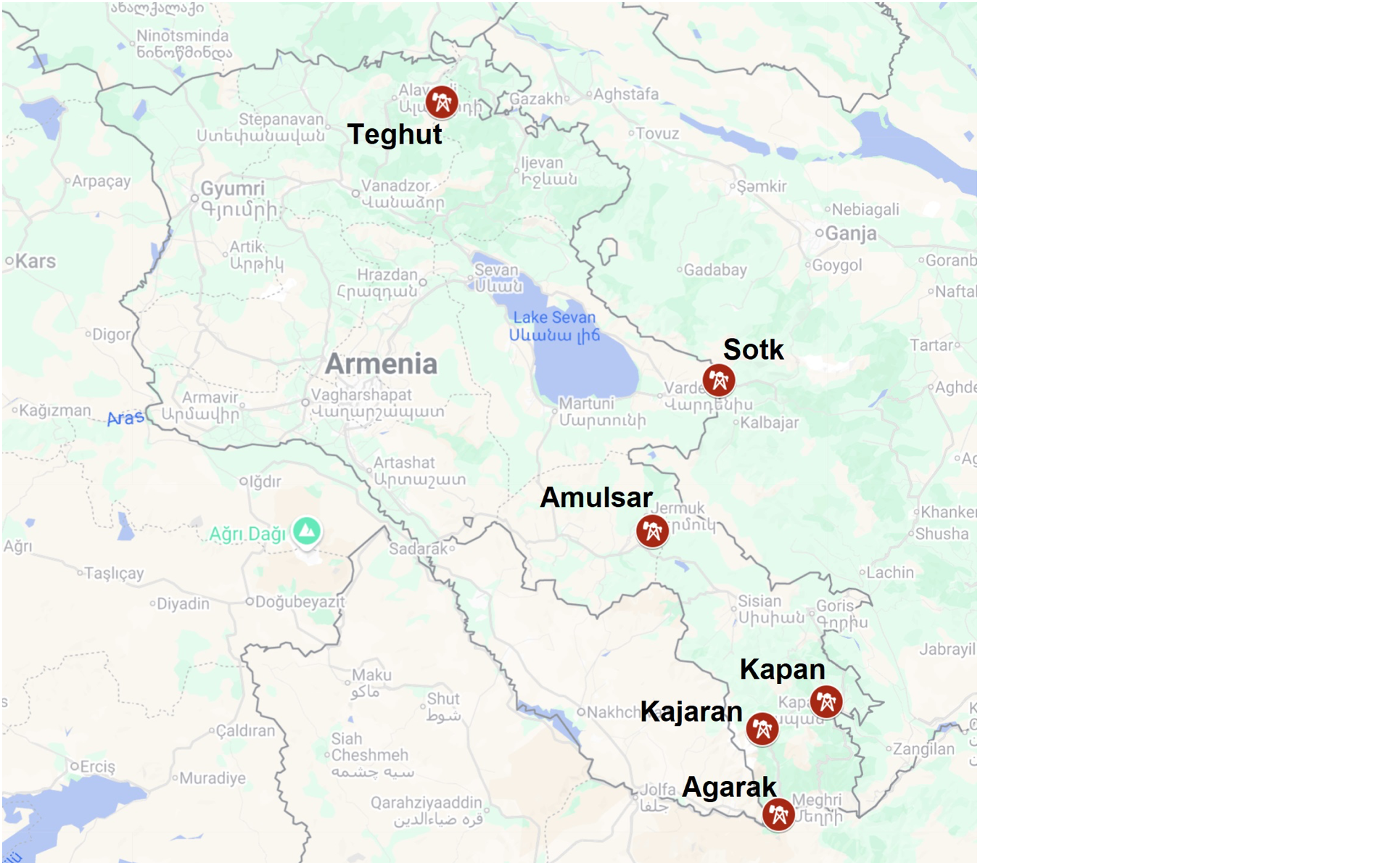
Armenia mostly mines copper, but also increasingly molybdenum and precious metals like gold and silver and small amounts of zinc. The mines in Kajaran, Teghut, and Agarak hold reserves of both copper and molybdenum, while the mines in Sotk and Amulsar contain gold. Armenia does not fully process its mined ore, instead exporting their concentrates and semi-processed products. More on this below.
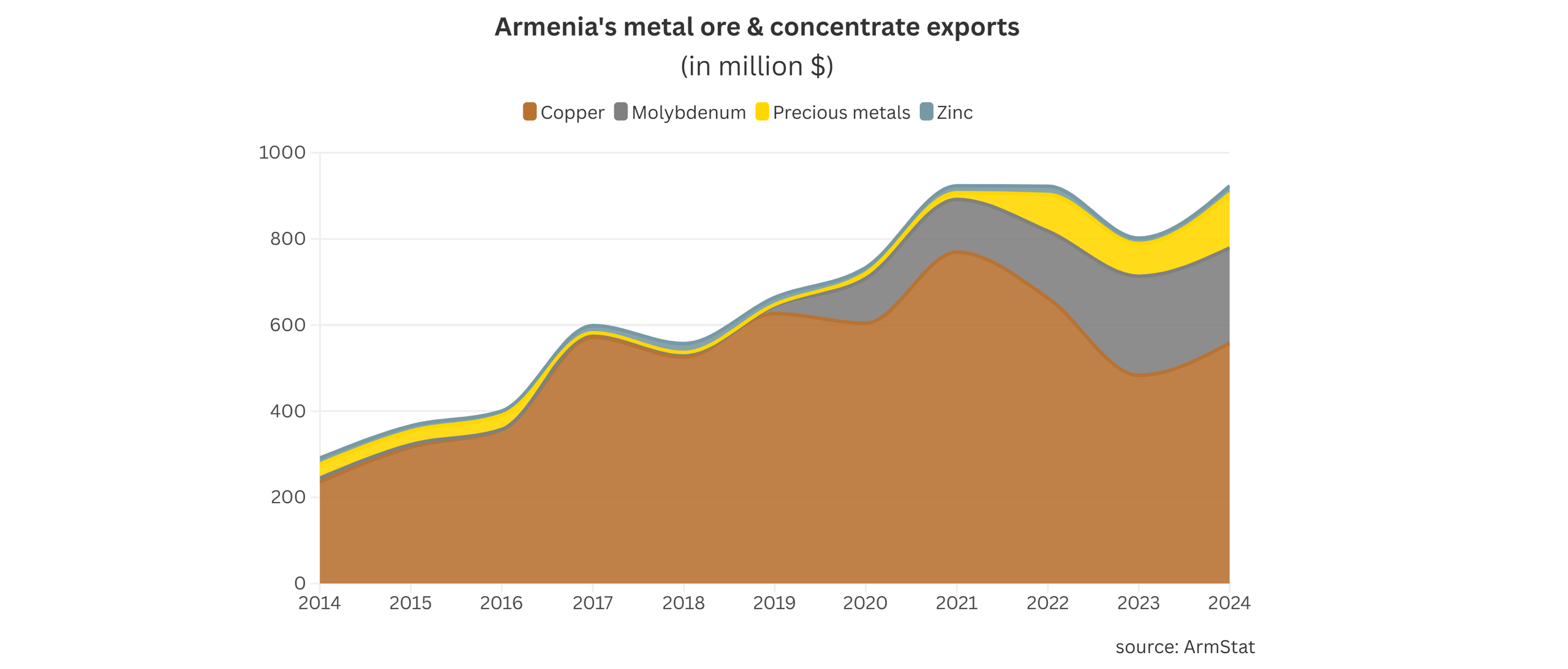
Metal ore exports have stood above $900 million in recent years, and constitute a key source of foreign currency for the country.
In 2021, before the Russian invasion of Ukraine and the surge in re-exports that later distorted Armenia’s trade figures, mined ore accounted for nearly 31% of the country’s total exports and almost 40% of merchandise exports (i.e. physical products). According to World Bank data, this places Armenia among the countries most reliant on ores and metals exports. That year, Armenia ranked 14th behind countries with large mining industries like Chile, Australia, and the Democratic Republic of Congo.
Armenia’s copper is primarily exported to China, Bulgaria, and Switzerland. China’s share has increased greatly in recent years, and now dominates these exports, reflecting its position as the world’s largest copper smelter and refiner, with capacity far exceeding that of any other country.
Old Data, New Prospects
Asatur Vardanyan, Deputy Minister of Territorial Administration and Infrastructure, notes that Armenia has around 45 confirmed metallic ore deposits, the majority of which were explored during the Soviet period and now require updated assessment and further study. At the Mining Forum Armenia 2025, Prime Minister Pashinyan emphasized the need for a new phase of early-stage geological exploration supported by modern technologies, improved data and capital.
Artyom Geghamyan, Managing Partner of TABIA Legal & Advisory and the Executive Chair of the International Chamber of Mines of Armenia, and former deputy justice minister in 2014, says that Armenia possesses viable copper-molybdenum and associated strategic metals that are increasingly important due to global electrification, renewables, and defense needs, offering strong potential to attract foreign investment if modern exploration, updated reserves reporting, advanced technologies, and strategic development are pursued.
Armenia, Geghamyan says, possesses viable mining assets, but unlocking its substantial untapped potential requires modern drilling and 3D modeling (to visualize underground deposits), reserve reporting (to verify how much ore is actually there), early-stage exploration capital, and advanced processing technologies. The country must aim for technological modernization and the momentum is favorable, Geghamyan says, adding that the “question is how strategically we develop them.”
The Geology Institute of Armenia’s Academy of Sciences is conducting a five-year long government-funded systematic assessment of rare metal reserves found in various deposits across Armenia. The project, set to complete in 2027, will evaluate both existing mines and tailings for economically viable extraction opportunities.
The research has identified several critical metals present in Armenian deposits, most prominently rhenium, which is found in abundance within the copper-molybdenum mines in Syunik. It is highly valued for its use in aircraft turbines. A U.S. Geological Survey report notes that in Armenia rhenium is associated with copper minerals in sedimentary deposits, where ore is processed for copper recovery and the rhenium-bearing residues are recovered at copper smelters. Selenium, tellurium, and bismuth are also present in Armenia. These materials are indispensable for a wide array of modern industries, including green energy, medicine, and defense.
While the focus is on southern Armenia, the potential exists across the country, with the iron ore deposit near the town of Abovyan also containing rare earth elements. Russian researcher Nikolay Nekrilov, who has been studying the site in recent years, estimates that the total amount of rare earth elements estimated at the Kaputan deposit is roughly equal to the world’s annual mining of rare earth elements.
U.S. Enters the Field
In recent months, the United States has publicly emerged as a potential major player in Armenia’s mining sector.
On February 4, 2026, Narek Mkrtchyan, Armenia’s ambassador to the U.S. attended the first-ever Critical Minerals Ministerial in Washington hosted by Secretary of State Marco Rubio. It brought together 54 countries, including the European Union. The aim of the meeting was to “reshape the global market for critical minerals and rare earths.” Armenia’s Deputy Foreign Minister Vahan Kostanyan said in an interview two days later that Yerevan views critical minerals as a new area of cooperation with Washington. He clarified that it is “not just about copper” and acknowledged that Armenia needs more data to understand its own resources and is looking to its U.S. partners for help in this regard, including by conducting on-site studies.
At the Washington Ministerial, Armenia did not sign a framework or MOUs and pro-government parliamentarian Maria Karapetyan noted that unlike other bilateral agreements (TRIPP, nuclear energy, semiconductors), much in this field is not yet set in stone.
At an industry event in early April in Yerevan, U.S. Deputy Chief of Mission Andrew Johnson said that the U.S. “looks forward to expanding cooperation with Armenia in mining and geological exploration.”
Geghamyan told EVN Report that this represents “a structural evolution” in bilateral ties. While long-focused on democratic reform, governance, and development assistance, Armenia-U.S. ties have gained a strategic industrial dimension with Vance’s visit.
Smaller states like Armenia, with targeted but meaningful mineral resources, can integrate into diversified supply chains and thereby increase their geopolitical relevance, Geghamyan argues. He recalls Nerses Kopalyan’s EVN Security Report on “Mining for Security”, which suggests that small states can leverage resource extraction to align their economic assets with broader security partnerships, adding, “The more diversified and international the stakeholder base in a country’s strategic sectors, the more that country’s stability becomes interconnected with global interests.”
He suggests that the current momentum in U.S.-Armenia cooperation on critical minerals should be seen as “part of a larger strategic repositioning of Armenia within global economic and security systems.” While previous efforts to attract American investment have yielded limited results, the environment has shifted dramatically with TRIPP and Vance’s visit. Geghamyan says has already observed increased inquiries and exploratory engagement from U.S.-based investment groups, trading houses, and mining-focused funds.
In fact, there is already tangible cooperation, a joint venture with a U.S. investment group focused on a gold and antimony project. The Armenian operating entity has been established, governance documentation finalized, and exploration licensing secured. The project is structured with the objective of supplying antimony to the U.S. within a defined development horizon. “This is not theoretical alignment. It is a reality and an operational engagement,” Geghamyan says.
The EU is also showing interest. The Strategic Agenda Yerevan and Brussels signed on December 2, 2025 contains a section on mining and critical minerals setting out short- and medium-term priorities, such as cooperating in the field of geological research and mineral resources exploration, with a focus on critical raw materials in Armenia, and with the possibility of implementation and application of modern methods and tools.
As part of a structured EU-backed effort to evaluate Armenia’s mineral potential a local company, Environment Group, led by former Environment Minister Erik Grigoryan, has been chosen to carry out the work by a major European raw materials body, Deputy Minister Vardanyan revealed. They have been tasked with mapping Armenia’s mineral resources, evaluating the potential of strategic metals and other critical raw materials, and analyzing opportunities for investment and industrial cooperation.
The Mines and their Owners
According to the most recent data, 22 companies in Armenia have been granted mining rights. However, not all are actually operational. In fact, only ten appear in the list of the country’s top 1000 companies, meaning the rest are either dormant or operating at a very small scale. Armenia joined the Extractive Industries Transparency Initiative (EITI) in 2017 and has since made transparency in mining, including beneficial ownership disclosure, a central government priority.
The southern region of Syunik is where nearly 85% of Armenia’s mining is currently concentrated. By far the largest mining operation takes place in Kajaran, followed by Kapan and Agarak. Teghut in the north represents another major site. The country’s two large gold mines, Sotk and Amulsar, are outside Syunik, but have faced major disruptions in recent years.
Kajaran, Agarak, Sotk
Roman Trotsenko
The Kajaran mine is run by the Zangezur Copper Molybdenum Combine (ZCMC), the industry heavyweight that employs 4,600 people. The town of Kajaran, for context, has a population of 6,500. It holds vast reserves at 2.11 billion tons of proven reserves with more than 100 years of mine life at current extraction rates. It has been operating since 1945 and its processing plant since 1952. Privatized in 2004, ZCMC has long been one of Armenia’s largest companies as measured by total taxes paid. From 2021 to 2024, it was the country’s number one corporate taxpayer.
To the south, the copper and molybdenum mine of Agarak, close to the Iranian border, has operated since 1963 and is run by the Agarak Copper Molybdenum Combine. Vastly smaller than Kajaran, it holds 42 million tonnes of ore with copper content at 0.41%.
The gold mine at Sotk has operated since 1976 and is run by GPM (GeoProMining) Gold. More than half of the mine came under Azerbaijani control in the aftermath of the 2020 war when Armenian forces withdrew from the Kelbajar district, which they had controlled since 1993. The Armenian-controlled section of the mine was shut down in early June 2023 after Azerbaijani shelling. Almost simultaneously, it emerged that open-pit mining at Sotk is set to cease due to depleted reserves. Operations resumed partially and only underground by 2024. Armenian officials suggest the fate of the open-pit section will be addressed after the border is delimited.
The Russian billionaire Roman Trotsenko has been involved in all three mines in recent years. With a net worth of $2.5 billion, Trotsenko acquired a 48% stake in companies operating Sotk and Agarak in 2019. He acquired a majority stake in Kajaran (ZCMC) in September 2021 and “donated” 25% of its share (company’s 15% equity) to the Armenian government, which received additional 6.875% of the company equity in August 2022 from another shareholder, raising the state’s total share to 21.88%. The circumstances of these deals remain murky, but Pashinyan has hailed this as transfer of the share controlled by “local oligarchs” to the state and “to the people.” Trotsenko said that the share transfer was part of establishing a long-term partnership with the government and to secure predictable business conditions.
At Kajaran, Trotsenko himself, and later his son Gleb, held significant stakes directly. Trotsenko’s son previously controlled nearly 77% of the shares at Agarak and Sotk. In 2024, the U.S. sanctioned GeoProMining and subsequently the ownership of these mining assets was transferred to new entities registered in the United Arab Emirates.
The companies running all three mines have the same five major shareholders. Three of them, Svetlana Ershova, Mirzaaziz Musakhanov and Aleksandr Trunov, are associates of Trotsenko, while two other Russian nationals (Evgeniia Vasileva, Irina Gorshkova) are obscure figures.
Kapan and Lichkvaz
Sasun Avetisyan
Two more major mines operate in Syunik, one in its regional center of Kapan, and another in Lichkvaz near Meghri. The Shahumyan mine in Kapan contains zinc, copper, gold (50 tonnes), lead, and silver deposits with a total of nearly 18 million tonnes of ore. The Lichkvaz-Tey mine contains mostly gold, estimated at 17.65 tonnes.
The first is run by the Kapan Mining and Processing Company, which traces its origins to the mid-19th century, while the second by a company simply called Lichkvaz. Both are controlled entirely by Armenian businessman Sasun Avetisyan, who is part of a network of businesspeople with connections to the country’s major mining operations through family and professional relationships.
Teghut
VTB, Norik Petrosyan, Pavel Korichnev
The copper and molybdenum deposit at Teghut in the northern region of Lori was explored during the Soviet period, but it has been mined for a little over a decade. The mining permit was granted in 2013 amid opposition by environmentalists. The government originally greenlit the project in 2007 and it was inaugurated in 2014. Nearly 360 hectares of trees were cut down in a dense forested area.
Production was halted in 2018 due to environmental concerns regarding toxic leaks from its tailings dump. Vallex Group, which had operated the mine, lost control to the Russian bank VTB in October 2018 after failing to repay its debts. Operations under new ownership resumed in mid-2019, but were halted again for more than a year in 2022–2023 due to the Russian invasion of Ukraine, operations later resumed.
As of March 2025, Teghout CJSC has three beneficial owners. VTB, which is a Russian state-controlled bank, has a 49.95% stake. Norik Petrosyan, an Armenian businessman based in Russia, controls 25.05%, while Pavel Korichnev, a Russian national, holds the remaining 25%. Petrosyan has several businesses in Russia, including Neftegazstroy, which won a tender in 2016 to build a 60 km long section of the Power of Siberia pipeline. He appears to have links with the Russian-Armenian billionaire Samvel Karapetyan, with the latter’s representative calling him a friend of Karapetyan. Almost nothing is known about Korichnev.
Amulsar
Justin Michael Dibb
By far the most controversial mining operation in post-Soviet Armenia has been the gold deposit at Amulsar, not far from the spa town of Jermuk in the Vayots Dzor region. With estimated reserves of nearly 74 tonnes of gold, Amulsar has been at the forefront of the environmental movement. The project was officially launched in mid-2016 with American and British support with mining expected to start in 2018. Lydian was given a license to operate the mine.
Following the 2018 revolution, environmentalists and local residents began blocking the mine’s entrances and demanded a halt to all operations. Potential risks include cyanide and acid-drainage contamination via surface runoff and groundwater, threatening the Kechut reservoir, downstream flow toward Lake Sevan, and Jermuk’s thermal springs.
Pashinyan said the dispute should be resolved “based on facts rather than emotions.” In 2019, his government commissioned an independent environmental audit, which found that the original environmental impact assessment has major flaws in data collection, modeling, and impact prediction. An expert of the consultant firm said they could not evaluate the risks properly, because Lydian’s environmental assessment, research and investigation are “not credible.” Pashinyan requested additional evaluation.
The criminal proceedings regarding Amulsar—an investigation into potential environmental and regulatory issues, within which the independent audit had been commissioned—were terminated in December 2021. After several years of disruption caused by the Covid pandemic and the 2020 war in Nagorno-Karabakh, the project was revived in 2023. Amnesty International noted that the mine was given permission to resume operations “without fully addressing the environmental concerns around water and land pollution.”
As of July 2025, Justin Michael Dibb, an Australian national based in Dubai, holds 87.5% of the shares in Lydian Armenia, with the rest controlled by the Armenian government. The state received a 12.5% stake in the project in 2024 in return for a pledge to manage their risks. In February 2025, the government granted Lydian $150 million in loan guarantees. Armenia’s Economy Minister Gevorg Papoyan visited the Amulsar mine in October 2025, where he announced that extraction had begun with ore processing set to begin soon.
Environmental Effects and Health Risks
Mining has significant adverse effects on the environment and public health. A 2017 assessment found high arsenic contamination of the soil in Alaverdi and Akhtala in northern Armenia with most children there having elevated blood lead levels. A 2018 longitudinal analysis revealed that all sampling locations in Kajaran posed non-carcinogenic health risks to children, while molybdenum and copper contamination of the soil exceeded allowable concentrations. A 2022 study found that women living within 50 km of metal mines had a 20% higher incidence of miscarriages and stillbirths, along with increased rates of anemia and lower birth weights.
There have been several major incidents in recent years. In 2018, mining tailings from the Akhtala Combine’s tailings pond were leaking heavy metals into the Debed River. In 2019, heavy rains in Kapan caused acid mine drainage from metal mining operations to flow through the city streets and into the Voghji River. A separate incident involving a damaged pipeline from the ZCMC also polluted the Voghji River with toxic mining waste.
Armenia’s largest tailings dump at Artsvanik, operated by the ZCMC since the 1970s, has consumed hundreds of hectares of agricultural land from surrounding villages, causing environmental pollution and health concerns among residents.
Despite the relatively high wages, working conditions in the sector are harsh. In late January 2025, thousands of workers at ZCMC in Kajaran staged an unprecedented strike demanding significant pay raises and better working conditions. They cited hazardous conditions, excessive dust, health problems, and wage disparities with management. While management dismissed the strike as “illegal” and eight organizers were fired, an agreement was reached to partially meet worker demands.
Politics

Azerbaijan Continues to Arm Itself While Talking Peace
Azerbaijan speaks the language of peace while steadily expanding and diversifying its military arsenal. As negotiations with Armenia inch forward, Hovhannes Nazaretyan examines Baku’s sustained rearmament, including its suppliers, capabilities and strategic intent, and what it reveals about the fragile balance between diplomacy and deterrence in the South Caucasus.
Read more
Armenia’s Diversified Partnerships: Opportunities and Risks in a Fragmenting Geopolitical Order
As Armenia moves away from decades of security dependence on Russia, it is building a network of partnerships across the West, Eurasia and Asia. Sossi Tatikyan explores the opportunities, and geopolitical risks, of Armenia’s emerging multi-alignment strategy in an increasingly fragmented world.
Read more
On Armenia’s Southern Frontier
Syunik occupies a critical place in Armenia’s security and development calculus. The EU’s Resilient Syunik initiative represents one of the largest coordinated Western-funded regional programs in the country, combining infrastructure upgrades, economic support and governance reform.
Read more
Strategic Partnerships in Motion: J.D. Vance in Armenia and Azerbaijan
J.D. Vance’s visit to Armenia and Azerbaijan signaled a deeper U.S. role in the South Caucasus, with new defense and nuclear agreements, AI cooperation and TRIPP connectivity. The parallel tracks pursued in both capitals raise important questions about balance, leverage and the future architecture of peace in the region. Sossi Tatikian explains.
Read moreEnvironment
The Unloved Others: Invertebrate Conservation in Armenia
Examining how Armenia’s conservation priorities overlook invertebrates, despite their vital ecological roles, Anahit Ghazakhetsyan explores barriers of stigma, weak research and habitat loss, urging narratives that value the “unloved” species sustaining ecosystems.
Read more
Yerevan’s Air Crisis: Inside the Pollution Emergency
Yerevan’s worsening air pollution has moved from background concern to a public health emergency. Hovhannes Nazaretyan examines the main drivers including construction, quarries, transport and waste and why government responses have so far fallen short.
Read more
System Failure: Draining Strategic Aquifers for Short-Term Profit
Armenia’s most vital aquifer is collapsing under decades of unchecked fish farming, illegal drilling and political neglect. The Ararat plain’s groundwater, critical for drinking water and agriculture, is being drained faster than it can recover, forcing the government into a race against ecological collapse. Hovhannes Nazaretyan explains.
Read more
The Queen, Armenia’s Forests and Bureaucratic Hurdles
A royal visit spotlighted Armenia’s forests, but also exposed how bureaucracy, competing land interests, and weak governance continue to undermine reforestation. As Armenia prepares for COP17, ambitious pledges collide with stalled permits, mining pressures and a system struggling to turn promises into forests. Hranoush Dermoyan reports.
Read more
Unconventional Grief: Armenia’s Landscapes Lost to Mining
In Teghut, Armenia, as mining transforms forests into pits and rivers into waste, villagers like Yegishe mourn landscapes lost to industry, naming their sorrow solastalgia—the homesickness felt while still at home.
Read more
Solar Takes Off: Can It Fuel Armenia’s Energy Independence?
Armenia is rapidly embracing solar power, with rooftop and utility-scale projects driving energy independence and sustainability. Hovhannes Nazaretyan examines the country’s growing capacity, landmark farms like Masrik-1, future wind ambitions, and the challenges of integrating renewables into the national grid.
Read more
The Climate Is Changing, How Are Armenian Winemakers Adapting?
Armenia’s winemaking renaissance faces a new challenge: climate change. From shifting harvests to genetic research on native grapes, winemakers and scientists are adapting—experimenting with higher-altitude vineyards, irrigation methods, and biodiversity to preserve a six-millennia-old tradition.
Read more
From Urtsadzor to COP17: Biodiversity at Armenia’s Crossroads
As peace negotiations with Azerbaijan and regional integration projects advance, biodiversity corridors could become vital connectors across fractured landscapes and divided societies. With Armenia preparing to host COP17, the urgency of protecting its extraordinary biodiversity amid mounting ecological and political threats takes center stage.
Read more
Subsoil Security: The State of Mining and Armenia’s Mineral Wealth
Could Armenia’s mineral wealth, long dominated by Russian companies, emerge as a strategic asset in the global race for critical minerals? Gibran Caroline Boyce explores how mining now intersects with economic independence, national security and Armenia’s geopolitical diversification.
Read more