

Listen to the AI generated audio article.
They are not Armenia’s highest, most sacred, or most beautiful mountains. Yet from their summits, surrounded by valleys carved by rivers over millennia and lush forests stretching across slopes, it is easy to understand why these highlands are so often seen as the embodiment of Armenia itself: a blend of a civilization older than living memory, timeless farming traditions, and a deep reverence for the land. Widely regarded as the cradle of the Armenian people, these summits have served as a crossroads for pilgrims, merchants, soldiers and monks traveling between East and West for centuries.
But these mountains are not frozen in time, as one might expect. The Soviet legacy persists, not in abandoned factories or crumbling infrastructure, but in attitudes and institutions shaped by decades of centralized rule. While villages remain places of remarkable hospitality and resilience, the legacy of centralized rule can still be felt in local institutions and attitudes. At the same time, they preserve a way of life and a connection to the land that modernity has steadily eroded.
In Dzoragyugh, a village in Lori region, there are no paved roads or gas lines, and the number of households has dwindled dramatically. Of the nearly 1000 households, only 71 remain, according to Karen Gabrielyan, who was born and raised there. After spending much of his life in the United States, Gabrielyan returned to invest in his birthplace. He transformed one of his family homes into a luxury guesthouse for hikers and has helped keep the village’s primary school open through his own donations.
Karen’s family has lived here since the late 19th century, at a time when the building must have been a humble shelter for cattle and other animals. Today, it has been transformed into a small villa that would look at home in the Swiss countryside. Karen dreams of bringing hot-air balloons to Dzoraget Valley, allowing visitors to experience its dramatic cliffs and winding river from above. Perhaps one day there could even be a direct connection between Dzoragyugh and Tsater, the village on the rocky far side of the canyon, making this one of Armenia’s most distinctive destinations for hot-air ballooning.
Walking Through Living History
HIKEArmenia, which brings new visitors to these remote villages, is helping preserve the legends, beauty and quiet magic of these highlands, ensuring that greater visibility doesn’t come at the expense of the very qualities that make them special. Unlike parts of the European Alps, where hiking has become inseparable from crowded restaurants, seasonal resorts and the machinery of mass tourism, these trails offer something increasingly rare: the chance to experience the landscape on its own terms.
Romantic stories unfold along the Armenian National Trail, HIKEArmenia’s flagship initiative, which is expected to be completed by 2030. Along the way, hikers can stop for a cup of coffee at a local shop, wander past an ancient basilica, find shelter in monasteries perched on canyon cliffs, or enjoy hospitality in museum-like guesthouses listed in the NGO’s database. In June 2026, HIKEArmenia inaugurated the first two sections of the Armenian National Trail in Lori and Tavush regions.
HIKEArmenia aims to connect communities like Tsater and Dzoragyugh through slow, self-paced tourism and ultimately link the entire country, from north to south. The trail follows historic trade routes and centuries-old footpaths that once connected neighboring villages, inviting hikers to experience Armenia at the pace its landscapes were meant to be explored. As the organization explains on its website: “We’re a group of passionate hikers from across the globe who want to show the world what Armenia has to offer.” Visitors can access detailed route maps, elevation profiles, local guides and GPS navigation through the HIKEArmenia app, available as a free download.
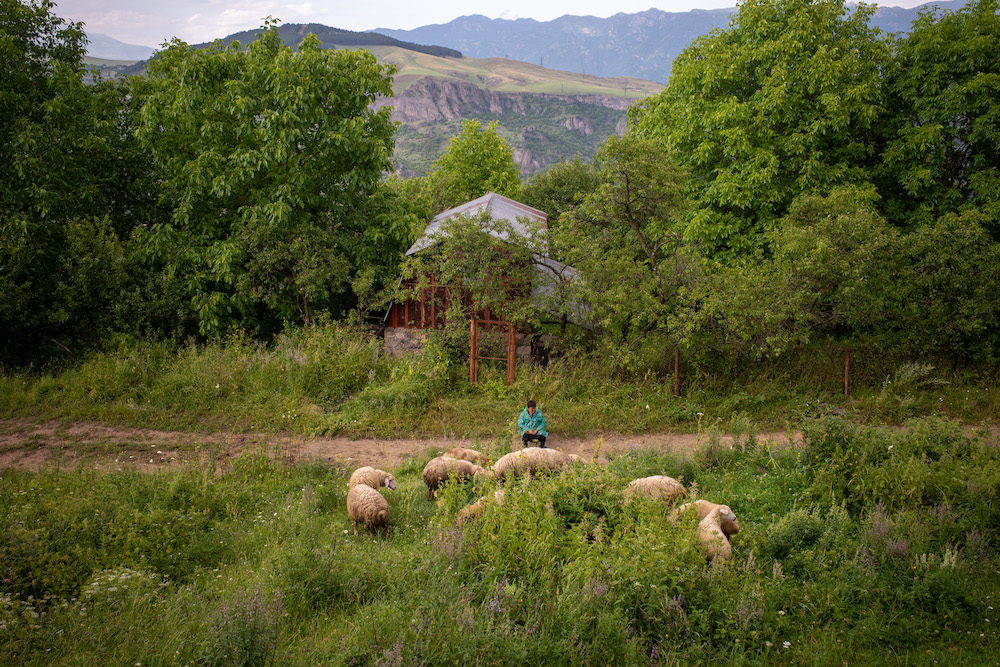
Although official numbers are not yet available, hikers are already discovering the trail. I was one of them, setting out with my friends Sandra and Artyom from the villages of Odzun and Tsater along the well-marked path that winds through the walls of the Debed Canyon. Along the way, we met a family from Czechia and followed the trail past canyon walls sculpted by water over millennia, their smooth surfaces resembling blown glass. Bright greenery clung to the rocky mountain slopes, while falcons soared high against the pale blue sky.
Along the New National Trail
This is the beauty that a hiker experiences past Odzun, one of Lori’s oldest and largest rural settlements, perched above the Debed Canyon. Even in July, vendors selling handmade gloves and hats are a reminder that, at 1,200 meters above sea level, summer here is rarely as warm as it looks.
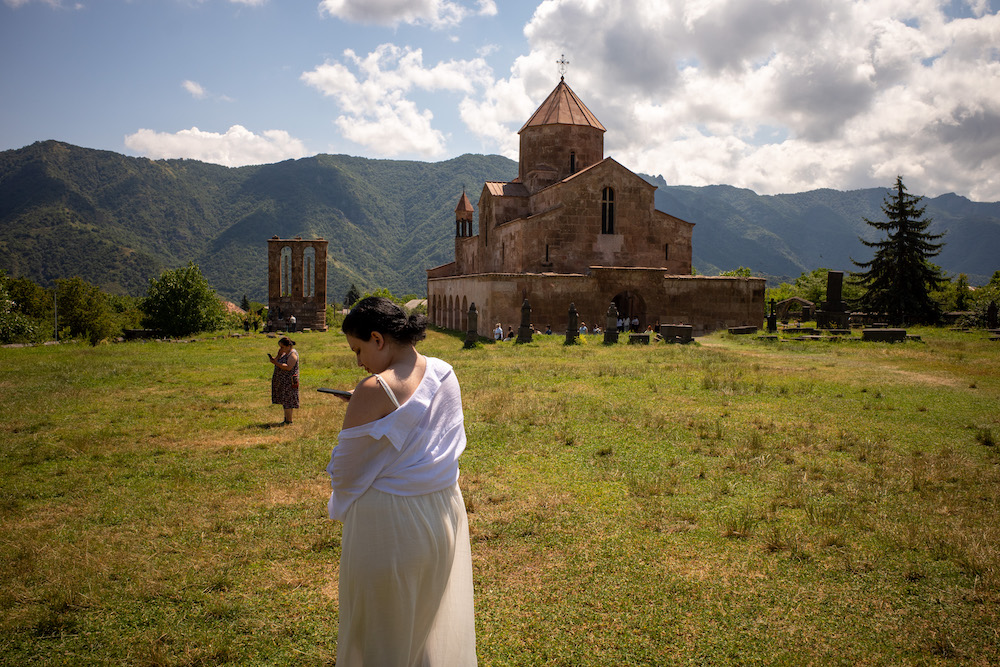
Odzun, a village of 5,000, carries an ancient legacy. Stories that blur into legend trace its name to the Armenian word otsel, meaning “to ordain”. It is said that the Apostle Thomas passed through these highlands, ordaining priests and bishops as Christianity began to spread, linking the village’s origins to Armenia’s earliest Christian traditions.
Odzun’s basilica, renovated in 1888 and again in 2017, began as a small church built in the 4th century by King Tiridates the Great and Gregory the Illuminator, following Armenia’s adoption of Christianity as a state religion.
Odzun’s basilica
A Landscape Brought to Life
For centuries, Armenia’s highlands have shaped the country’s spiritual imagination. Following the Armenian National Trail means passing through this landscape of monasteries, villages and mountain sanctuaries, where history is not confined to museums but remains embedded in the terrain. Churches and monasteries rise from cliffs, forests and mountain ridges, where isolation offered both sanctuary and resilience. In these remote, high-altitude sanctuaries, faith found both solitude and resilience, helping preserve Armenia’s religious and cultural traditions through centuries of foreign rule.
Religious complexes are wedged into the landscape. Some like Odzun remain living monuments; others dominate canyon valleys or disappear into the forest. For centuries, monasteries served not only as places of worship, but also as centers of learning, refuge and community life for the surrounding villages.
Horomayr is among the most striking. Perched on the sheer cliffs of the Debed Canyon, the monastery appears almost to merge with the mountain itself. It is embraced by hundred-meter tall natural walls, like those surrounding its parent monastic complex of Kobayr. Time and nature have left much of it in ruins, yet restoration work is slowly revealing the beauty of its surviving frescoes and architecture. Across the canyon lies the town of Tumanyan, named after Armenia’s beloved poet Hovhannes Tumanyan, a reminder that this landscape continues to layer history upon history.
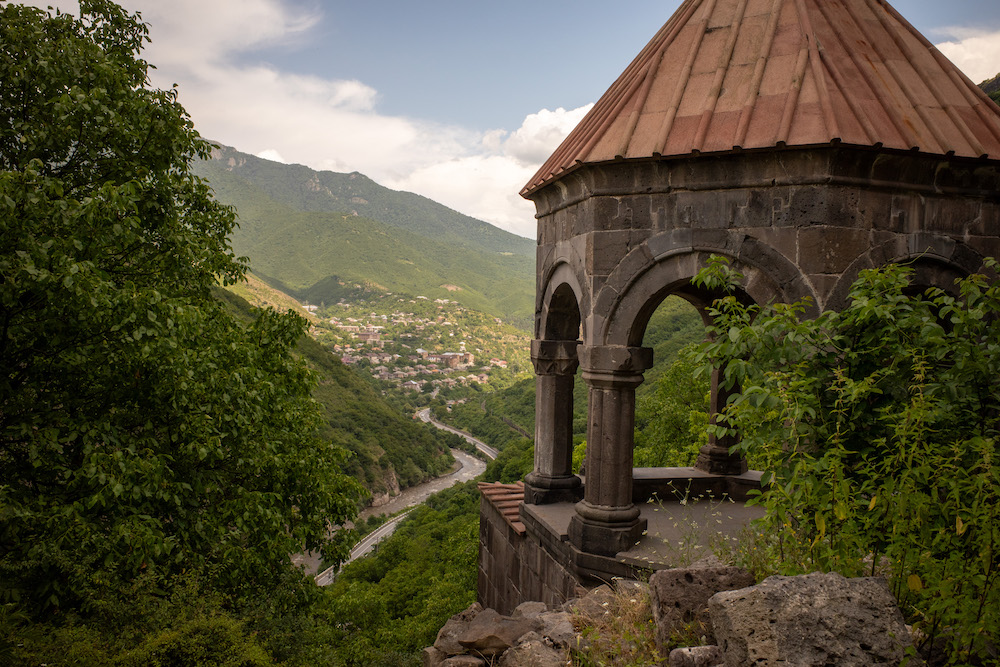
Kobayr monastery. In the background is the village of Tumanyan
Long before the Armenia National Trail connected these landscapes on foot, artists and writers had already mapped them in the Armenian imagination. In 1829, Khachatur Abovyan became the first Armenian documented to climb Mount Ararat, transforming the mountain from a sacred symbol into a lived experience. Later, Gevorg Bashinjaghyan captured Armenia’s landscapes in luminous paintings that helped define the country’s visual imagination. But it was Hovhannes Tumanyan, born in a village on the Debed Canyon, who brought the landscape fully to life. Through his shepherds, folklore and village life, he turned the Armenian landscape into literature:
The way was heavy and the night was dark,
And yet we survived
Both sorrow and gloom.
Through the ages we go and gaze at the stark
Steep heights of our land-
The Armenian Highlands.
[…]
And we gaze with dolorous, longing eyes
At the earth in its gloom,
At the distant stars;
Ah, when will the dawn break at last
Over our green
Armenian Highlands.
The trail does more than lead visitors through these landscapes, it also brings them into the communities where many of these traditions continue to endure. Today, this culture lives on in small villages shaped by farming and hospitality. After nearly a century of Soviet rule that sought to suppress religious life, and years of economic migration, many families have left hamlets like Odzun or Dzoragyugh in search of opportunities elsewhere. Those who remain make a living through livestock, agriculture or small guesthouses; some of the best places to sleep cost just under 20,000 AMD (about $54 US), with gardens overlooking the gorges and opening up onto sunrises and sunsets.
In Tsater, Mher Virabyan’s guesthouse is a traditional Armenian home with a remarkable collection of Soviet bric-a-brac. The breakfast table sits among these objects, gathered over decades in the quiet of a village that produces exquisite homemade milk, butter, honey, cheese and eggs, all served on Mher’s table.
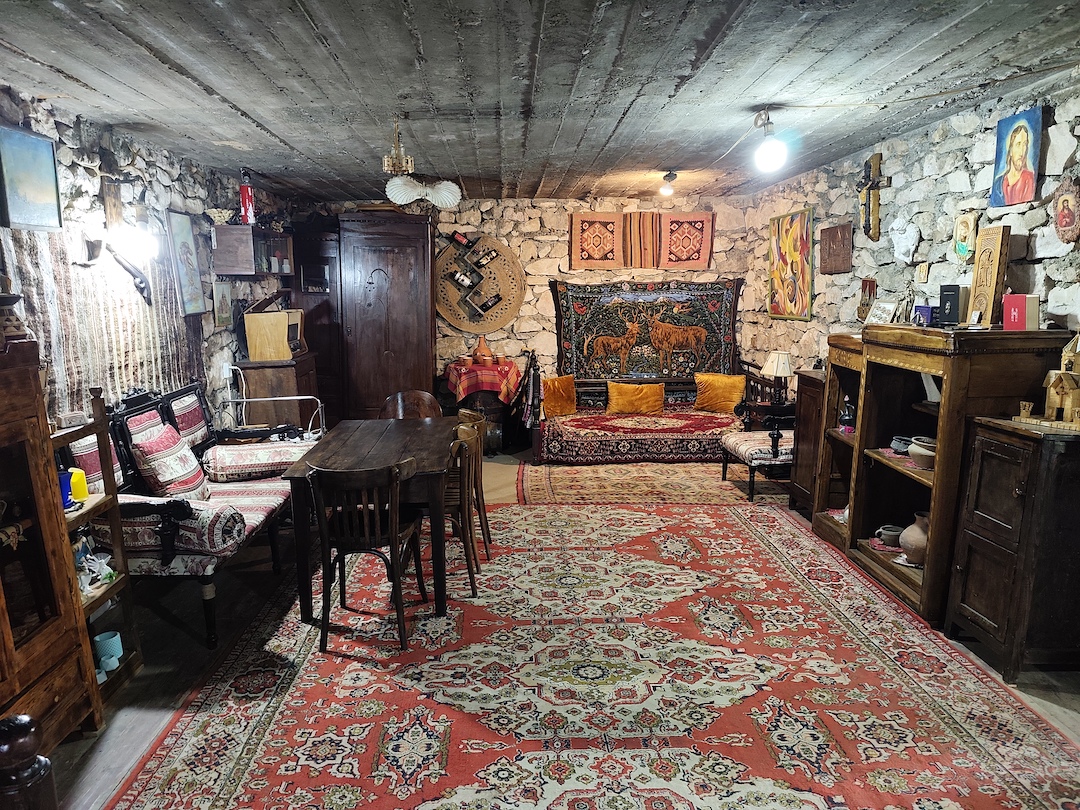
Mher’s collection in Tsater
The Scent of Flowers and Herbs
If part of the journey required a taxi, so be it. We had originally set out from Kobayr Monastery toward Tsater, but the trail was overgrown with tall grass, obstructed by fallen trees and had yet to be cleared after winter. We found ourselves probing the thick vegetation with our trekking poles, trying to stay on the path as dark clouds gathered above the steep cliffs. The ground grew slick beneath our feet, thunder rolled across the canyon and, as Sandra and Artyom later admitted, it was “the scariest shit I’ve done in my life” and “at some point, I would have gone home.”
But we were lucky. The storm passed before conditions became truly dangerous, and what I remember most isn’t the fear. It’s something much older, perhaps one of humanity’s most ancient memories: the scent of flowers and herbs rising from the earth after heavy rain.
Nevertheless, I didn’t grasp the essence of the Armenian highlands after only a weekend excursion. Being close to the mountain taught me that foolish decisions can cost hikers dearly, and that a young project like HIKEArmenia needs as much thorough feedback as possible—indeed, their staff said workers cleared the trail after we passed.
But what HIKEArmenia offers is something rare. It’s not only the majestic landscape, or the vodka offered by hosts like Karen beside his fireplace in Dzoragyugh. The Armenia National Trail passes through a living culture that reveals itself only to those willing to slow down. Like the pause Karen took before telling us why he had returned after his wife’s death, some stories cannot be rushed.

Cover photo by Meghrie Yaacoubian.
LIFESTYLE
Drunken Cherry
Go on a journey through Armenia’s landscapes and kitchens, its memories and quiet rituals in this month’s issue of SALT. From vegan dining and forgotten recipes to hiking trails and nostalgic reflections, these stories invite us to slow down and appreciate the unexpected.

Nothing Taken for Granted
Music in Kapan, a wedding, Vardavar and encounters with strangers become part of a journey both outward and inward. Returning to Armenia, Kristi Rendahl reflects on joy, loss, friendship and the unexpected moments that can bring the fragmented pieces of a life together.
Read more
It’s Not Just Salads
Once limited to salads and side dishes, vegan dining in Armenia is quietly expanding. New restaurants, cafés and bakeries are proving that plant-based food isn't about restriction, it's about creating spaces where everyone can enjoy a meal together.
Read more