

Listen to the AI generated audio article.
Only a handful of people knew I was traveling in Armenia this month, since I left most social media a few years ago. The trip came together the way many trips to Armenia do: one plan layered on top of another and yet another.
My friend Anna had urged me to attend the International Music Festival in Kapan and I do most anything that Anna tells me to do, so I dutifully booked my ticket months ago. She was not wrong to advise me. As is often the case, she was so very right.
Sevak, a whirlwind of a man, spearheads the festival, a nod to his family’s roots in Kapan. The unlikely location—not the Opera, not a Yerevan theater—resonated with me, the farmer’s daughter from a rural community in North Dakota, where I organized a speaker series for eight years in adulthood, though I lived elsewhere. I did that in part to show others the place I come from, the people who collectively raised me, and insist by default that it is a place people should want to visit. Its political relevance cannot compare to that of Syunik in this moment, but there was a time when my sparsely populated home state thought it may be targeted for its two air force bases and nuclear arsenals.
The festival is held in the town’s music school, which to me signals wealth of spirit and mind. There is no specialized music school where I’m from. I simply moved from one piano teacher to the next, whenever they advised it was time for the next level, and by the age of 15 I was making a 170-mile round trip to a university for lessons with a professor. I have my parents to thank for taking me and my education seriously, but never too seriously, and I remember them each time I place my hands on the keyboard.
Musicians from Armenia, Belgium, Denmark, the United States, Russia, and elsewhere descended upon Kapan, which I have to believe was disorienting for the locals, even if it’s the fourth such annual festival. The logistics of this endeavor make me sweat. Tickets and instruments and tuning and hotels and food and every little thing that can and will arise with a group of visiting artists gathered in a distant corner of a country. But it’s the talent that overwhelms entirely.
The musicians performed daily with students, sight reading and sitting with music for precious little time before presenting with embodied excellence. Seemingly endless formations of talent gathered on the stage to astonish the crowds that stood in grateful admiration. I was one who stood.
If I were posting on social media, Americans may have expressed concern about my proximity to Iran, but my biggest problems while there were not war: it was titrating my appetite as meal after meal was served by Elen, a stylish woman with a scandalous amount of talent and an equal amount of love. It was finding time for sleep when all anyone wanted was to be awake, synchronized with the rhythms and hums in the room—of music, yes, but mostly of heart. There is more than one way to fill an appetite and it’s not until you’re full that you realize you have been famished.
At one point, I asked one of the cadre of musicians if I could play his guitar, handmade by a Lithuanian luthier just for him. I ended up singing Gillian Welch’s Orphan Girl while standing on one leg because I had meant to strum a few chords and didn’t think to sit down until it was all over. It was a humble student lounge in the music school, but the acoustics were something like a church and the song like a prayer I hadn’t intended to offer.
It was over in an instant, as if it never happened. But I know it happened because people posted videos later and others told me they’d watched them. What era do we call it when we aren’t on social media but then we hear that in fact we are on social media?
This trip to Armenia was not exclusively about the festival. There was also a wedding between middle-aged people who found love, no less! I know that was documented, too, but I can’t bring myself to watch it all, even though I played piano and sang the Armenian wedding service in the ruins of a 3rd-century church.
Anna’s husband was the Der Hayr, and neither of us would’ve known, when we met 25 years ago, that one day we’d share space and voice in this way, celebrating the union of our mutual friend and her person. We would have laughed thinking that one day we would be in the ad hoc band at the wedding reception, a short walk away from a 1st-century pagan temple where a rave was underway. And I did laugh on this day, when I wore progressive sunglasses to play piano and sing in Armenian, amused that I was returning to an earlier version of myself, but with greater financial stability and much worse eyesight.
If I were still updating everyone who may or may not care about the comings and goings of my life, I certainly would’ve told them about Vardavar, another Armenian festival, this one from pagan times, when people drench each other with water in the streets. It was impossible to walk more than a block without someone dumping a pail of water down my back, aiming a water gun out of a car window at an intersection, or throwing water off a balcony onto my already wet head.
It is the great equalizer of adults and children, with adults taking more liberties, relieved at last from keeping everything together, free to splash and show mischievous care for strangers by including them in this ritual.
There was nowhere to run, so I surrendered and my clothes were soaked by the time I reached the gym, where they lent me a t-shirt to work out in, even though my shorts were still wet and my shoes waterlogged. The walk back was no less perilous before I slipped through the door of my lodging to shower and change and then do it all over again. It was sheer, squealing, unadulterated joy. And I do not take that for granted.
Two strangers sitting near me in a Yerevan café that day had attended the rave the previous night. They were brothers, doubled over laughing about something, I don’t know what and it doesn’t matter. I asked through my own smile if they were okay, if I should bring them some water, and they laughed even harder. My own brother died three years ago this month and I do not take laughter for granted either.
In these moments, when water streams down your arms and the air dries it just as quickly, you would never know what Armenians have seen and survived. You wouldn’t know what squiggly lines on maps mean about where the movement of lives start and stop, if they ever really do. You wouldn’t know that the hand you see paying for eggs in the grocery store may have won global violin competitions.
Then again, you would know that harmony is all around us, ready to be freed in song or laughter. You would know that we stand in places where people have stood for millennia, under a scorching sun that has turned seed into harvest for just as long. You would know that love can happen at any moment and that adults can play as children once again.
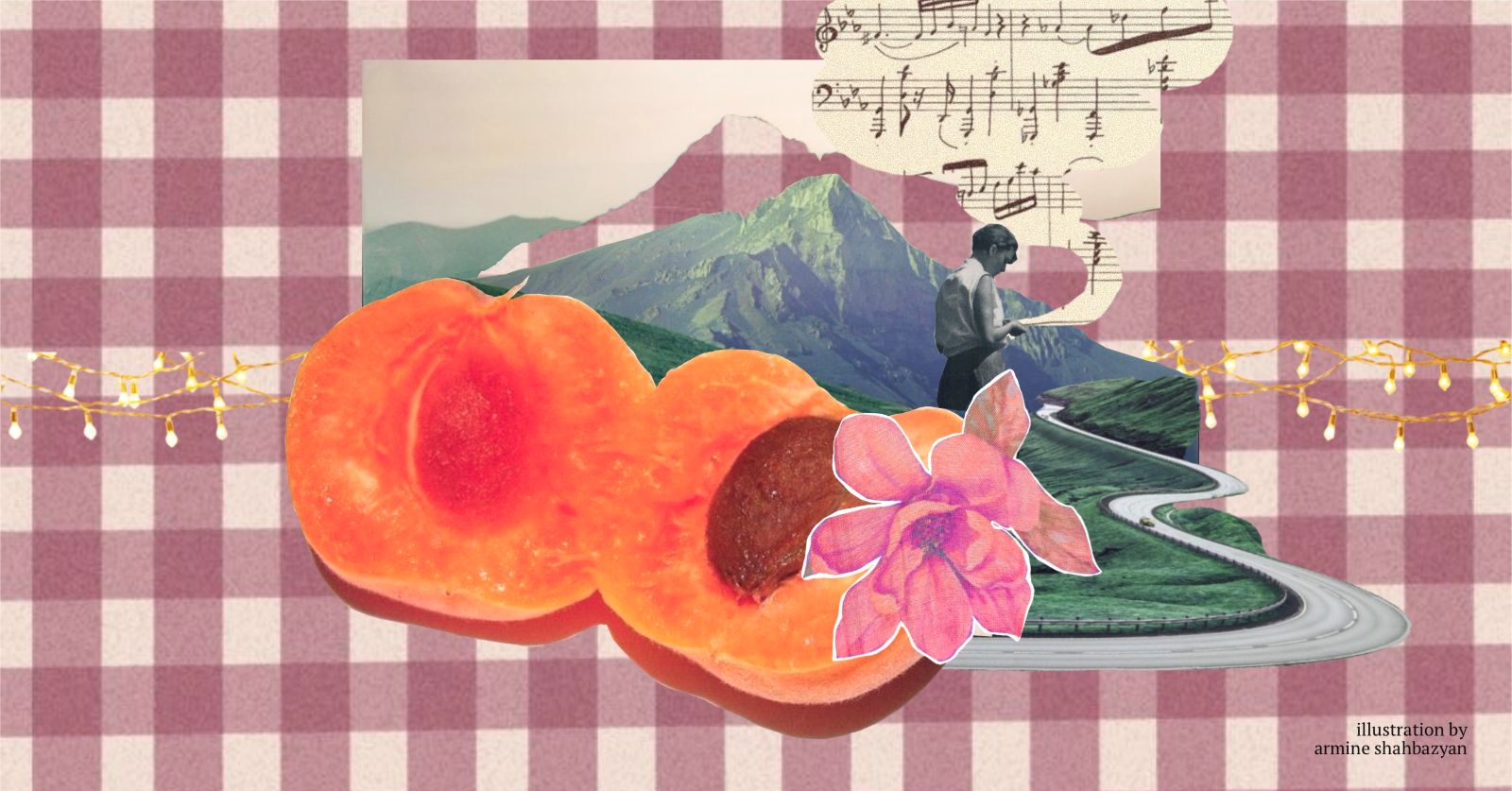
“I can’t believe how good this tsiran is,” I said in a mix of languages one morning, marveling at the half apricot in my hand while I ate the other half. I was entirely unaware that a man sitting nearby would overhear me talking to myself, but his bemused look reminded me that I don’t mind this kind of insanity, when I am too absorbed to notice anything except what is right in front of me.
It’s been a few days since the festival and the wedding—days filled with concerts, dance performances, coffees punctuated by conversations with friends and strangers and thoughts of changing my return ticket for a third time.
As I packed my bags this morning, my travel speaker flashed red, a sign of its nearly depleted battery. “Me, too,” I thought. A taxi came early to take me to the airport and the driver was disoriented because my request ping had woken him from a deep slumber. He asked if we could stop for coffee on the way as he pointed to a coffee stop. When I first arrived in this country I was days away from turning 22 and a taxi stopping like this would’ve caused me anxiety, because I barely understood what was going on. Now it seems like the most civilized way to transition from one place to the next, and I no longer need to understand what’s going on.
He offered me a cup too and I asked for one, cold and black. “I have some cash if you need,” I called out the window in Armenian. “Ba ur mnats hyurasirutyun?” he said as a refusal. I laughed knowing that Armenians take hospitality seriously and relaxed into my seat.
I’m boarding my flight now, verging on tears since last night. If we’re lucky, we live and that alone is remarkable. If we’re extra lucky, and paying attention, we love and we come together for all that is beautiful for as long as we can. If we’re among the luckiest, we recognize that a few days can bring us closer to ourselves than ever before, integrating the fragmented pieces of a lifetime. And we should never, ever take any of it for granted.
Cover photo by Meghrie Yaacoubian.
LIFESTYLE
Drunken Cherry
Go on a journey through Armenia’s landscapes and kitchens, its memories and quiet rituals in this month’s issue of SALT. From vegan dining and forgotten recipes to hiking trails and nostalgic reflections, these stories invite us to slow down and appreciate the unexpected.
It’s Not Just Salads
Once limited to salads and side dishes, vegan dining in Armenia is quietly expanding. New restaurants, cafés and bakeries are proving that plant-based food isn't about restriction, it's about creating spaces where everyone can enjoy a meal together.
Read more