

Listen to the AI generated audio article.
For years, Armenia’s tech sector ran on a growth model that seemed reliable: outsourced services, foreign clients, relatively affordable skilled labor, and a global tech boom that kept hiring at a stable pace. For a whole generation, “going into IT” came to feel like the safest choice in the job market. That confidence is now starting to crack. Today, anxiety hangs over the market, and AI has become the easiest explanation for shrinking opportunities. Yet the real story runs deeper. Armenia’s tech hiring slowdown began before AI became the main source of concern over layoffs, hiring freezes and fewer entry-level opportunities.
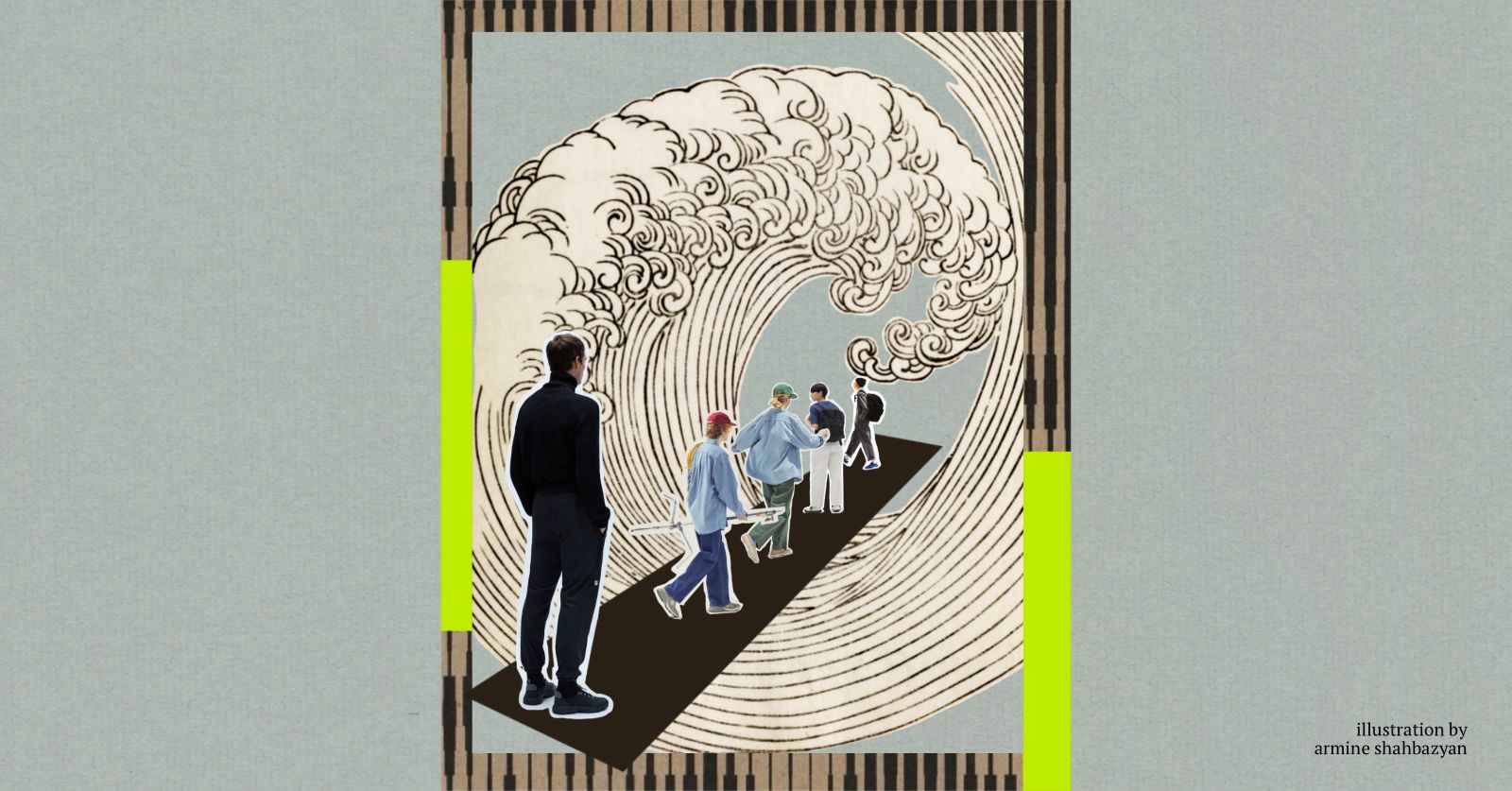
What we are seeing now is the result of several shocks in an ecosystem that grew quickly, but not necessarily resiliently. Here, AI may end up as not the villain of the story, but as part of the solution.
The First Shockwave
As Tigran Sargsyan, CEO of the Yerevan-based outsourcing firm AOByte, describes it, the Armenian tech market often reflects the North American one. What happens there tends to echo here quickly, sometimes with a lag, and sometimes almost in real time. That dependence served Armenia well during the boom years, when capital was flowing, client bases were expanding, and the U.S. tech market seemed to have an endless appetite for growth. But when the U.S. market entered a crisis, that same dependence quickly became a source of fragility. The venture capital downturn was one of the first shocks to make that clear.
After the pandemic-era boom of cheap money, high startup valuations, and strong investor appetite for risk, global venture capital hit its peak in 2021. The reversal came swiftly. In 2022, as interest rates rose and investors grew more cautious, global VC investment fell sharply, from $595 billion to $379 billion. Deal activity slowed as well. Startups suddenly found themselves in a different market: funding rounds became harder to close, valuations came under pressure, and investors shifted from chasing growth at all costs to preserving capital. The collapse of Silicon Valley Bank in March 2023 amplified the panic. What followed was a wave of cost-cutting across the global, and specifically U.S., tech ecosystem: hiring freezes, layoffs and a broader shift from expansion to survival.
In Armenia, the first and most direct hit fell on product companies, still one of the more fragile layers of the country’s developing tech ecosystem. Many had relied on U.S. venture capital to grow. Once that source began to dry up, the pressure was immediate. Fundraising became harder, and growth plans were harder to sustain. The shock then spread further across the market through demand. North America, the key market for much of Armenian outsourcing, was slowing down. As clients there became more cautious, delayed decisions, or cut spending, Armenian service firms began to feel the contraction as well.
To some extent, the venture capital shock has eased. Global startup funding ticked up again in 2024, and early 2025 also showed signs of renewed momentum. But the recovery has been highly uneven. Venture capital is increasingly flowing into AI, drawing attention and money toward a narrower set of companies and business models. According to OECD, AI firms captured 61% of global venture capital investment in 2025. The market, then, did not simply recover to its old state. It came back more concentrated, selective, and biased, adding another layer of pressure on tech markets, including Armenia’s, already adjusting to slower growth and hiring.
The Second Shockwave
The second shock to hit Armenia’s tech market was geopolitical. Russia’s full-scale invasion of Ukraine in 2022 triggered large inflows of people, capital, and business activity into Armenia, which in turn pushed the dram sharply upward against the U.S. dollar. For an export-oriented tech sector earning much of its revenue in foreign currency while paying many of its costs locally, that appreciation quickly turned into a serious strain. Unlike the venture capital slowdown, which was more external and diffuse, this shock was immediate, visible, and felt on the ground. It quickly became one of the most talked-about pressures in Armenia’s tech community.
From January – April 2026 alone, the dram appreciated against the U.S. dollar by about 1.95%. For service firms already working on tight margins, even small shifts can be disruptive. Sargsyan’s observations confirm that many service companies have been hit hard: some have responded with layoffs, while others have shut down operations altogether.
Final Shockwave
Then came AI, which has been changing paradigms. The distance between what arrived in late 2022, when ChatGPT first entered everyday working life, and what we have today as regular users of increasingly capable models is striking. For programming workers especially, the change has been fast. At first, AI was mostly used as a helper: checking code, explaining errors, or speeding up small routine tasks. Then it became part of the workflow itself, integrated into development tools and everyday processes. Now, with coding copilots, automation layers, and early AI agents entering the picture, the pressure is no longer just to code, but to do it differently.
Effects on the Local Tech Labor Market
The slowdown in tech hiring is visible in the numbers. According to Staff.am, programming vacancies in Armenia fell by about 50% in 2023 compared with 2022, marking the first major drop the platform recorded in IT jobs. In 2024, demand for programming roles declined slightly further, and reached its lowest point in seven years. There were some signs of recovery in 2025, but the market still remained far from its earlier levels. The anxiety surrounding the sector, then, is real. Armenia’s tech labor market is going through several shocks arriving through different channels: funding, external demand, profitability and, increasingly, the changing composition of work itself. This article does not attempt to isolate the exact impact of each one. Instead, it traces how they have been reshaping the labor market as people actually experience it.
Less Funding Means Less Room to Hire
At the heart of the hiring slowdown is a simple reality: companies had less money to spend. For product firms, that means fewer opportunities to raise money after the venture capital downturn. For service companies, it means tighter margins and less financial breathing space. And as more investment flows into AI, the rest of the market is left competing for a smaller share of attention and capital. This is usually the point when companies start pulling back. Hiring freezes, delayed expansion, more selective recruitment and, in tougher cases, layoffs all follow from the same logic. The issue is not just that money has become scarcer, it’s that the money still available no longer creates the same sense of security. And that, too, changes how companies behave.
Changing Demand Is Reshaping What Firms Sell and Who They Hire
Then there is the demand side. It is no longer possible to pretend that AI is not changing the market—it is. But not always in the simplistic way the panic suggests.
The global wave of digitalization spending that peaked around the Covid years is gradually giving way to a new race around AI tools, AI agents, automation and productivity solutions. Armenian firms, especially those working for external markets, have little choice but to adapt their offerings to that shift in demand. And when offerings change, hiring changes with them. Some roles that once dominated job boards are starting to appear less often.
But this is where the AI story becomes more complicated than the fear around it. People who know how to work with AI can become more valuable, not less, explains Narek Aslikyan, CEO of Armenian Code Academy, which delivers AI literacy programs for the local market. In some cases, he adds, AI also lowers entry barriers for people who may not have traditional coding backgrounds but do have strong problem-solving skills, product sense, or the ability to translate business needs into workable solutions. So yes, AI can narrow some paths. But it can open others too.
How Work Inside Firms Is Changing
The effect is visible not only in hiring volumes but also in the kind of work firms now need people to do. In Aslikyan’s view, this depends on the size of the company, sector, and even the founder’s personal preferences. Sargsyan, for example, cites an Armenian marketing agency that let go of much of its creative staff and now produces a large share of its advertising content with AI. Cases like that are real and should not be dismissed. But he is also careful not to reduce the story to “AI replaced people.” In his view, that framing is too shallow.
Speaking about his own company, he starts from a basic question: what exactly is IT work? If it is defined as coding alone, then replacement becomes much easier to imagine. But if the work is understood more broadly, as problem-solving, designing solutions, understanding client needs, and delivering value, then coding is often only one small part of it.
That distinction matters. Firms whose value lies in solving real problems are better positioned for this transition, and the same goes for people. The safer place in the market is no longer simply knowing how to perform a task that can be automated; it is being close to the problem that needs solving and being able to use AI as part of that process. So here too, the picture is mixed. AI can reduce the need for some roles, but it can also strengthen the position of those who learn to use it well.
Early-Career Professionals are the First to Feel the Shift
If any group is already feeling the impact of the third shockwave more than others, it is entry-level professionals. Sargsyan acknowledges this directly. Entry-level roles are under greater pressure, and this may be the most visible labor-market effect of the AI shift so far. When firms become more cautious, they tend to protect senior, client-facing, immediately productive roles first. Junior positions are often the easiest to cut, delay, or quietly stop opening. And if juniors make up 31.6% of Armenia’s tech workforce, this is not a marginal issue.
But if the challenge is sharper for juniors, so is the opportunity. Those who learn to use AI as a working tool early, build portfolios around real problem-solving rather than only technical exercises, and can show they are productive from the start may still stand out in a much more selective market.
***
So far, the strongest pressures on Armenia’s tech labor market seem to come from a broad mix of external, structural, and market-wide forces: tighter funding, weaker external demand, squeezed profitability, and a shift in the kinds of work the market now values most. AI has added a distinct layer of disruption, but it is also the part of this story that can most clearly become a tool for adjustment. That is why adaptation matters so much.
This piece is observational rather than definitive. It does not attempt a strict causal breakdown, nor does it claim to capture the full, long-term picture. Instead, it is a reading of the market through visible trends, reported data, and industry observations, focused mainly on the effects that can already be felt.
The deeper consequences may still lie ahead, especially as the third shockwave continues to reshape business models, lower the cost of certain services, and change what firms consider valuable work.
Author’s note: This article was inspired by conversations with Narek Aslikyan and Tigran Sargsyan, whose insights helped shape some of the reflections explored here.
Creative Tech

From Noise to Meaning: Krisp’s Next Step in Voice AI
Krisp, known for eliminating background noise, is moving into a new phase of voice AI. Its Accent Understanding feature aims to make speech easier to follow across accents, raising both practical benefits for global work and deeper questions about identity and communication.
Read more
Armenia’s AI Story Is Coming Into Focus
A series of recent announcements, from a major AI factory expansion to plans for a small modular nuclear reactor, suggest Armenia’s technology ambitions are moving beyond rhetoric. Together, they hint at an emerging strategy linking AI infrastructure, energy capacity and the country’s growing innovation ecosystem.
Read more
A Cold Room, a Hot Field: YSU’s Supercomputer and Armenia’s AI Ambitions
At Yerevan State University, a new supercomputing center powered by 64 NVIDIA H100 GPUs is transforming Armenia’s AI research landscape. Backed by major public investment, the facility lifts long-standing computational limits, enabling advanced machine learning, cross-disciplinary collaboration and stronger global scientific partnerships.
Read more
Armenian Women in Tech Lead on Their Own Terms
In Armenia’s tech sector, women founders are redefining leadership while navigating motherhood, bias and limited representation. Through resilience, education and visibility, they are building successful companies, and in the process reshaping what the “ideal founder” looks like.
Read more
When AI Speaks Armenian։ Podcastle’s New Voice for a Nation
Armenian finally sounds natural in AI. Elen Tovmasyan explores how Podcastle’s new Armenian text-to-speech technology could transform media, education, accessibility and diaspora engagement, while raising important questions about ethics, voice ownership and what it means for a “small” language to enter global AI systems.
Read more
Why 2025 Mattered for Armenia’s Tech Sector
2025 may be remembered as a turning point for Armenia’s tech ecosystem, a year of long-term foundations taking shape. Ani Toroyan writes that while these developments open new opportunities they also raise expectations and if the past year was about setting direction, then 2026 will be about delivery.
Read more