
Listen to the AI generated audio article.
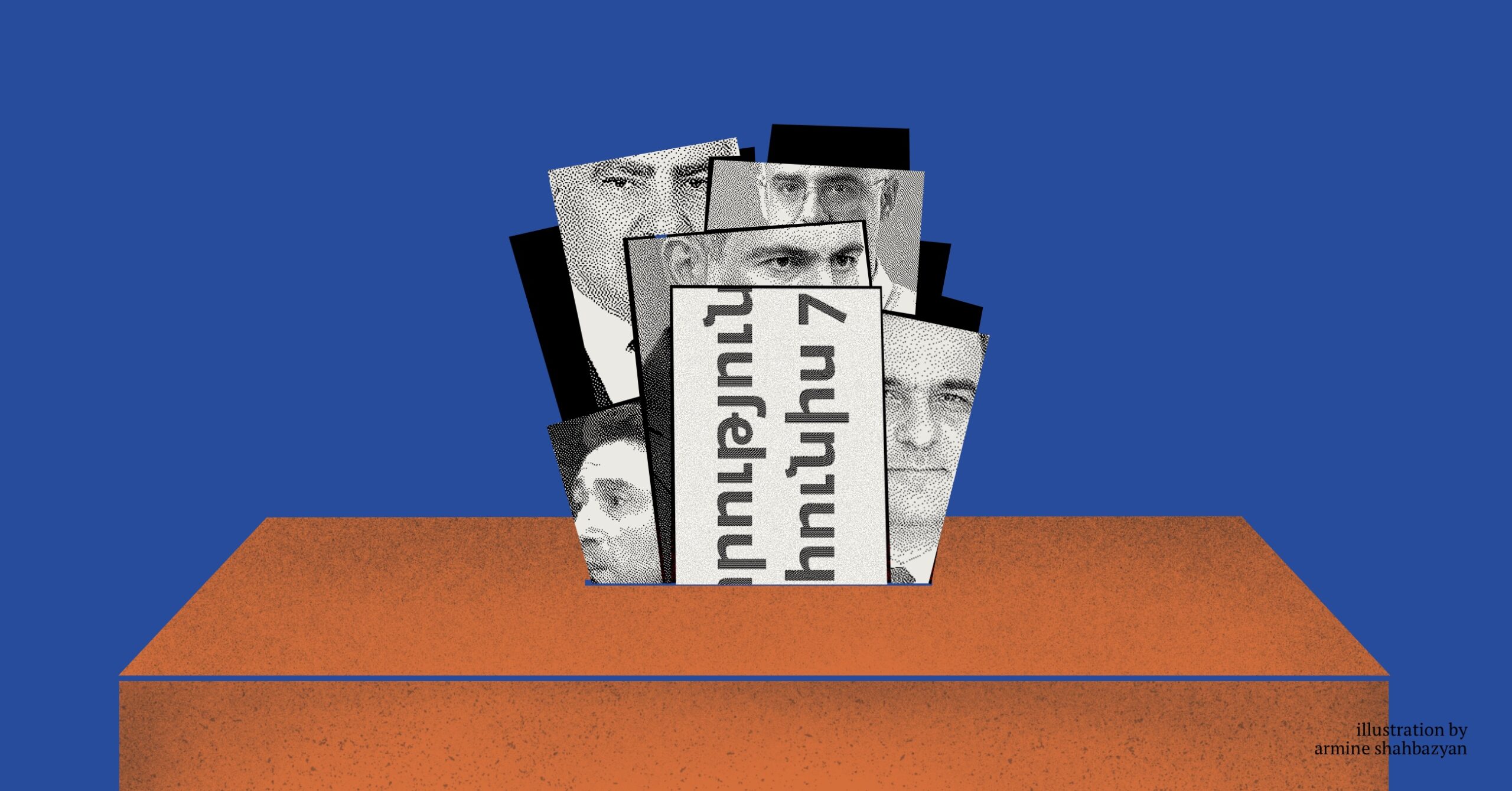
Parliamentary elections will be held in Armenia on Sunday, June 7, 2026. It will be the first regular (as opposed to snap) elections since 2017, an important distinction in a political system that, over the past eight years, has been shaped less by routine electoral cycles than by crisis. The elections of 2018 and 2021 were both called early, triggered by the Velvet Revolution and the fallout of the 2020 Nagorno-Karabakh (Artsakh) War.
Prime Minister Nikol Pashinyan and his Civil Contract party have been in power since 2018. Pashinyan will face a myriad of opponents, from former president Robert Kocharyan and the Armenian Revolutionary Federation, Russian-Armenian billionaire Samvel Karapetyan’s Strong Armenia party, to former human rights ombudsman Arman Tatoyan, former Yerevan Mayor Hayk Marutyan, and Levon Ter-Petrosyan’s Armenian National Congress.
Rules of the Game
The threshold for parties is set at 4%, one percentage point lower than in previous elections. For blocs, there is no single threshold; it depends on the number of parties joining forces. For three or fewer parties, the threshold has been set at 8%, while for blocs with 4 or more parties, it is at 10%.
Unlike referendums, there is no minimum turnout requirement for parliamentary elections to be considered valid.
Perhaps the most controversial clause in the Electoral Code is the mechanism of a second round to ensure the formation of a “stable parliamentary majority” if one does not emerge from the initial vote or subsequent coalition negotiations. It is triggered if, after the first round of voting no single party or bloc receives a majority of mandates and coalition efforts fail. Only six days are given to parties and blocs for talks to create a majority and agree on a candidate for Prime Minister. If no such coalition is formed to achieve a majority, a second round of voting is held. The second round is held on the 28th day after the first round of voting with only two parties or blocs that received the highest number of votes running. Unlike the first round, the second-round ballot specifically includes the name of the party or bloc and the name of their Prime Minister candidate. The winner is provided with additional mandates to have 54% of the seats in parliament.
The cap on how many parties could join a post-election coalition has been removed. Under the previous rules, a party that had entered parliament could be joined by at most two other parties that had cleared the electoral threshold in order to form a coalition. The restriction no longer exists.
According to the Electoral Code, a person must meet several specific criteria to be eligible for election as a member of parliament. The individual must be at least 25 years old, have been a citizen of only Armenia and have permanently resided in Armenia for the last four years. They must also be proficient in Armenian. The same criteria apply to the Prime Minister and government ministers.
The law establishes a minimum number of candidates, at 80, that parties and blocs must nominate. It also sets a one-third quota for women in each party or blocs’ list. A maximum quota of 30% is established for “guest” candidates—individuals who are not party members.
Parties and blocs must submit their application documents between 55 and 45 days before the vote, with registration finalized by the Central Electoral Commission (CEC) between 45 and 35 days prior. The formal pre-election campaign period begins on the 5th day following the deadline for candidate registration and concludes at midnight on the day before the election. Consequently, the campaign begins 30 days before the election and lasts for 29 days.
The Law on Political Parties set a minimum membership requirement with a party required to have no fewer than 300 members at its founding congress.
Finances
The Electoral Code requires parties and blocs participating in elections to manage their campaign finances through a mandatory pre-election fund. Campaign expenses must be paid exclusively from this fund, including campaigning through mass media and the internet, conducting polls and research, renting spaces and offices for meetings and campaign headquarters, preparation and distribution of campaign posters and other related items.
Parties must deposit 7.5 million AMD to register with the Central Electoral Commission, while blocs/alliances double the amount, at 15 million AMD. The deposit is refunded if the party receives 2% of the vote and blocs that receive 4%.
The law establishes an 800,000,000 AMD (over $2.1 million) maximum limit for campaign expenditures, with an additional 200,000,000 AMD ($530,000) allowed in the case of a second round. Individual donations are capped at 10,000,000 AMD ($26,000) annually.
The law prohibits foreign citizens and organizations from organizing and engaging in pre-election campaigns. Separately, Armenia’s Law on Political Parties explicitly prohibits political parties from receiving donations from foreign states, foreign legal entities, and non-Armenian citizens. A party can be suspended by the Constitutional Court for receiving and improperly managing foreign funding, such as intentional failure to transfer foreign donations to the state budget.
Who’s Running
A number of parties have confirmed their participation with some having already announced their candidates for Prime Minister.
The favorites, according to polls, are Prime Minister Nikol Pashinyan’s Civil Contract party, which came to power in 2018 following the Velvet Revolution. Despite reduced approval ratings from his early years in power (2018-2020), Pashinyan maintains a significant popular base.
The chief opposition contender appears to be the Russian-Armenian billionaire Samvel Karapetyan. His allies launched the In Our Way (Mer Dzevov) movement, which was registered as a party in early December under the name Strong Armenia. This is the name they will run with. Last summer, Karapetyan was charged with publicly calling to seize power, money laundering, and tax evasion. The movement is effectively led by his nephew Narek Karapetyan, who is the son of Karen Karapetyan, a former member of parliament and chief of staff of former President Serzh Sargsyan. Samvel Karapetyan was jailed until late December 2025, when he was moved to house arrest on bail over $10.6 million, the largest in Armenian history.
Under current rules, Samvel Karapetyan is ineligible for the premiership. Besides his Armenian citizenship, he also holds Russian and Cypriot passports. His team has declared that it will amend the Constitution to remove the eligibility barrier. The plan involves amending Article 148 if the party secures a parliamentary majority. It would permit any individual holding solely Armenian citizenship (after renouncing others) to become Prime Minister.
Former president Robert Kocharyan, whose Armenia Alliance is currently the largest parliamentary opposition group, remains another key opposition candidate. It is composed mostly of Kocharyan’s non-partisan allies and the Armenian Revolutionary Federation (ARF). A minor party, Forward (Araj), recently joined the alliance. The bloc named Kocharyan as its Prime Ministerial candidate on March 16. The alliance’s campaign slogan, “Together We Can”, was also announced on the same day.
Another former president’s party, the Armenian National Congress of Levon Ter-Petrosyan, has confirmed its participation. Their candidate for Prime Minister is Levon Zurabyan, ANC’s Vice President. Zurabyan has identified Samvel Karapetyan as the “favorite” of the field, confirming that the ANC is actively negotiating with them to form a potential coalition as Karapetyan’s team holds a unique opportunity to facilitate a broad “national consolidation.” Former Pashinyan ally Edmon Marukyan and his Bright Armenia party also appear inclined on collaborating with Karapetyan.
Tycoon Gagik Tsarukyan, who in recent years has been mostly busy with his commission and building of the monumental statue of Jesus, remains head of the Prosperous Armenia party. In September 2025, he unveiled his “Proposal to Armenia” program, signaling his intention to also run. Three smaller parties have officially joined Tsarukyan. The first to join was Democratic Alternative, a small party led by Suren Surenyants, a former ally of Ter-Petrosyan. Another is the Mother Armenia Party, led by former parliament member Andranik Tevanyan. Until 2023, Tevanyan was a deputy from the Armenia Alliance. He launched Mother Armenia to run in the Yerevan City Council elections, where it received more than 15% of the vote. It has also run in recent municipal elections in Gyumri and Vagharshapat, where it has had less success, winning 5-6% of the votes and passing the threshold in both. Also joining Tsarukyan is Martun Grigoryan, a current parliament member from I Have Honor. Formerly a member of Prosperous Armenia, he left the party in 2015, and in 2025 his Our City Alliance won over 15% of the votes in local elections in Armenia’s second city Gyumri.
Several former officials and parties have also announced their participation.
These include former human rights ombudsman Arman Tatoyan, who founded the Wings of Unity party along with Pashinyan’s tax authority chief Davit Ananyan. Tatoyan has publicly called on former presidents not to run if they want Pashinyan out. Tatoyan has allied with nationalist activist Shahen Harutyunyan, the son of Shant Harutyunyan. Tatoyan has been joined by the HayaKve civil initiative led by Avetik Chalabyan. The latter was formerly a senior partner in the Moscow office of the American consulting firm McKinsey. In 2012 he co-founded Repat Armenia, an NGO promoting and facilitating the repatriation of diaspora Armenians. Since 2022, he has been detained twice in a controversial case that drew both domestic and international scrutiny. Chalabyan has ruled out cooperating with both Pashinyan and the former presidents.
Yerevan’s former mayor Hayk Marutyan, once an ally of Pashinyan, announced on December 24 that his newly-formed party called New Force (Nor Ouzh) will run in the elections. He said the party will have a social-democratic orientation, primarily focusing on addressing socio-economic problems facing the population. Marutyan officially declared his candidacy for Prime Minister on March 21. He has ruled out cooperation with Pashinyan or Kocharyan, adding that his party sees Armenia’s development “along a European model” and will consider partnering with Karapetyan if they publicly commit to a European path for Armenia.
In the pro-Western camp, former Prime Minister Aram Sargsyan will be the Republic Party’s candidate. He is the brother of Vazgen Sargsyan, the Defense Minister who was killed in parliament in 1999, and is largely aligned with Pashinyan’s policies. Sargsyan was a leader of the Eurovote initiative that collected 50,000 signatures and pushed parliament to pass a largely symbolic law to commit Armenia to EU membership.
A newly formed party, called Against All (Bolorin Dem Em), is running on a platform of three key demands: 1) remove the “stable majority” clause; 2) lower the electoral threshold to 1%; and 3) add an “Against All” ballot option. Their plan is to form a 100-day government to implement these three changes, then dissolve and trigger new elections under the reformed system. It announced its registration as a party on March 19.
In October, rights activist Nina Karapetyants and allies launched the Scale (Nzhar) constitutional movement with her as the candidate for Prime Minister.
Pashinyan’s former Social Affairs Minister Mane Tandilyan said in early June that Country to Live In, the party she co-founded, views its participation in the elections as a natural waypoint in its political journey, approaching them with exceptional responsibility, working to present a more unified and stronger front.
Former president, Serzh Sargsyan, heads the Republican Party, which forms the core of the smaller parliamentary group under the name I Have Honor (Pativ Unem). They have not made a final decision yet, with media reports suggesting they will skip the elections, but the party congress on April 4 is expected to provide the answer. The Homeland party of Artur Vanetsyan, formerly allied with Sargsyan, has declined to run. Vanetsyan was National Security Service chief under Pashinyan in 2018-2019.
EVN Report
Election Study Survey
Wave 1

Undecideds Swing New Poll Numbers: Armenia’s Parliamentary Elections Take Shape
EVN Report’s first of four Armenian Election Study polls ahead of the June 7, 2026 parliamentary elections offers a methodologically rigorous snapshot of voter preference, groundbreaking results on non-committed (undecided) voters and party performance, revealing cautious optimism on security and economy, and a competitive but incumbent-leaning race.
Read morePodcast
Armenia’s Electoral Mood: What Our First Poll Reveals
What do nearly 37% of undecided voters mean for Armenia’s June 2026 elections? Dr. Rafael Oganesyan and Dr. Nerses Kopalyan, the social scientists behind the Armenian Election Study, break down new data on voter intention, the non-committed electorate, public perceptions of security and the economy, and how these forces are shaping the parliamentary race.
Read moreFrom our Opinion Section
Democracy as Strategic Capital: Armenia’s Path in a Transactional World
As global powers shift toward transactional, interest-driven alliances, Armenia faces a more fluid and uncertain strategic landscape. Anoush Begoyan argues that despite changing Western priorities, democratic governance remains Armenia’s most durable asset that will only strengthen its resilience, credibility, and long-term positioning in a fragmented international order.
Read more
Church and State in Armenia: A Crisis Decades in the Making
As emotion and polarization shape public discourse, ongoing debates over Church–State relations reveal a deeper fault line in Armenia’s post-Soviet order—structural ambiguity. Beyond personalities and politics, it exposes unresolved tensions between national identity, religious authority and constitutional governance.
Read more
Armenia’s Hate Speech Blind Spot
The arrest of two Armenian podcasters has reignited debate over where free expression ends and criminal liability begins. Beyond one case, the episode exposes Armenia’s unresolved legal blind spot in addressing sexualized, gendered abuse without undermining democratic speech.
Read more
Notes From Armenian Street: Lessons on How Moldova Defeated Russia’s Hybrid War
Moldova’s quiet resilience tells a story of survival. Political analyst Mikayel Zolyan traces how this small nation confronted Russian hybrid warfare, reclaimed its democratic voice, and reflects on what its hard-won lessons might mean for Armenia’s struggle against disinformation and dependence.
Read more