
Listen to the AI generated audio article.
For the first time in my life, the most emotional moment of a film came during the ending credits. Seeing around 60 Armenian, Georgian and Azerbaijani names roll together stirred something in my pessimistic heart. For a brief moment, I saw a world where creative collaboration works. Not a utopia, but a real space that offers hope for emancipation and change through artistic tools, which are among the most powerful for reshaping our narratives. And our South Caucasian narratives, so entangled in ethno-nationalistic molds, desperately need this more than ever. I wish that were all I had to say after a screening of Caucasian Blues. I wish it offered strength and optimism for imagining a future together. But it does not.
Roles Frozen in Time
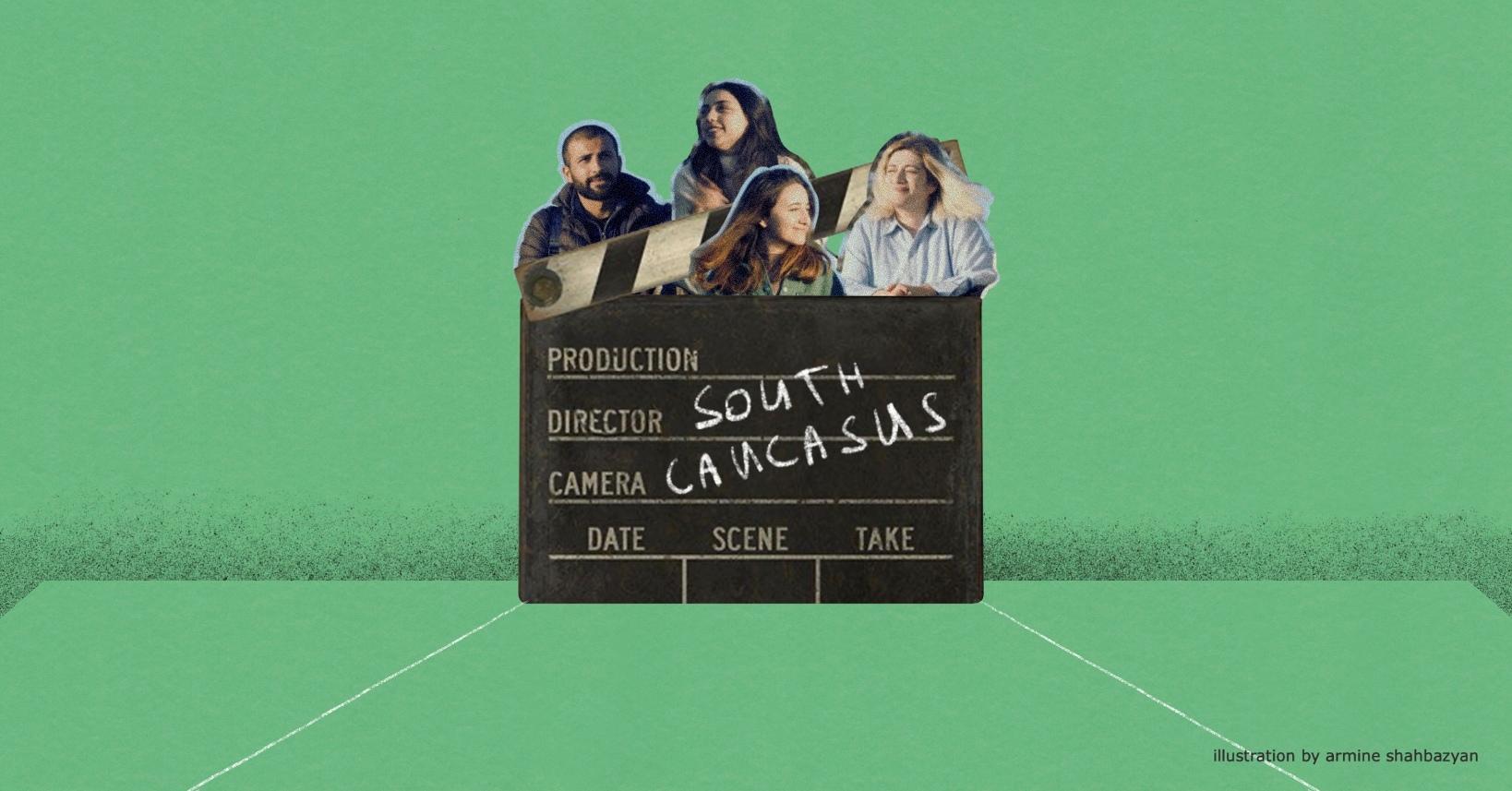
Caucasian Blues follows three young women and one young man from the South Caucasus: Ani, Nino, Sevinj and Emin. Their paths cross in Tbilisi, where they face intimate challenges tied to the conflicts of Armenia, Georgia and Azerbaijan. Ani and Emin feel an instant attraction, despite quickly understanding they’re Armenian and Azerbaijani. Emin’s fragile mental health, shaped by his experience as a young veteran of the 2020 war plunges him into a sense of despair. He responds by volunteering for a mission in Ukraine, which turns out to be a scam to send young men to fight for Russia. Thus begins a road movie of sorts. Ani, Nino and Sevinj (Emin’s sister, who came from Baku worried about her brother) set out to find him before he is sent away. Through these new relationships, these young people try to overcome their fractured past. Shot in all three countries, it is the first Armenian-Azerbaijani-Georgian feature co-production of the post-independence era.
Unfortunately, Caucasian Blues traps us in stereotypes. Nino, the Georgian character, serves as the fresh and funny, condescending mediator between Ani and Sevinj—reinforcing the image of a paternalistic Georgia, naturally more progressive and trendy than its neighbors. The Armenian character worries about religion and marriage, while the Azerbaijani man embodies fragile masculinity: he’s paranoid about his crush talking with another guy and unable to call psychotherapy by its name, insisting he doesn’t need therapy but a “coach”. Important themes do emerge—the psychological distress of war veterans, resisting parental expectations—but they remain superficially treated.
Despite having three female leads, the story revolves around saving Emin, who is central in most of their discussions—rare are the scenes passing the Bechdel test. Whether in fiction or documentaries, our creations keep men at the center, which is unsurprising given that our countries are shaped by militarism. Yet fiction is a space that could challenge that. Even though friendship emerges between the three young women through their shared goal of finding Emin, it feels unexplored; there is no real relation-building arc between them.
The clichés continue with anecdotal side characters: a tax-evading Turk, a greasy long-haired Russian wanting to “improve integration” of Russians in Tbilisi, an English spy, and a Ukrainian woman helped by the Georgian character due to alleged shared struggles. Perhaps this confirms the double-edged solidarities between occupied people, considering the number of Israeli flags in Tbilisi.
Stereotypes are often based in reality, but the film misses the chance to challenge the rigid representations that Western and local ethno-exceptionalist gazes impose on the region. The myths and narrative manipulations the region endured throughout the 20th century could make perfect ground for subtle, subversive creations. One could blame the German director Oliver Müser (who already worked on the equally caricatured Dolma Diaries series) for lacking emotional understanding of the region, but at least half a dozen South Caucasians co-wrote the script. Is this really all we can produce together: stereotypes, superficial politics, and a predictable story? Weak dialogue makes most scenes feel fake. Even with untrained actors, more careful writing could have avoided embarrassing moments: a suicide attempt resolved by a reminder that suicide is a sin, followed by casual chatting as if nothing happened; or Ani dryly stating, “Yes of course I lost people during wars, we all did” as if it’s no big deal. Alongside cute jokes that bring a welcome smile here and there, Caucasian Blues feels like a forced attempt to be cool.
The film ignores one of filmmaking’s basic rules: “show, don’t tell.” Characters explain their feelings instead of enacting them, creating telenovela-like scenes framed by sentimental music and lighting that at times hides more than it reveals. Yet the production clearly had technical resources. You can make masterpieces with an early 2000s camera and no budget, as long as you have a purpose.
We Can’t Afford Bad Caricatures
The only arc that works is the over-the-top parody of Irakli Kobakhidze, Georgia’s prime minister — complete with a bad wig, a mini-dictator complex, and Sacha Baron Cohen-style absurdity. At least here, humor serves a political function. The movie as a whole might have succeeded had it fully embraced satire, but satire requires a viewpoint. Fiction without anything new to say becomes empty. Apart from “Look, we managed to make a 90-minute movie together,” what does Caucasian Blues actually offer? There was a chance to address the difficulties of dialogue, the broader military context, civil society fatigue, and everyday oppression without preaching an agenda—which to some extent the film does, but only on the surface, as if it were scared to go further. By attempting to represent our realities, the movie ends up exposing real stigmas, amplified by its technical flaws.
I may sound harsh toward a small production team doing their best. I wouldn’t be if there weren’t so much at stake. This production illustrates the lack of purpose we’re stuck in. I don’t doubt the team’s intention to change perceptions of our region, and I believe South Caucasian cooperation is vital—perhaps more tangible and honest than the agreements our leaders sign. But weak art changes nothing. Meaningful art, even modest, does, even if it’s just a drop in the ocean. I know Caucasian Blues is no Scorsese or Bong-Joon-Ho film, nor does it claim cinematic innovation—still, it’s too weak to become even that drop.
Rare collaborations like this inevitably raise expectations. If the aim isn’t to make an artistic film, then commercials, campaigns, or informational documentaries exist for that purpose. What Caucasian Blues seems to forget is that art is inherently political. Creative work emerges from specific contexts and inevitably reflects them. An Azerbaijani-Armenian-Georgian creation especially cannot avoid being political. Yet the film delivers something that resembles a feel-good NGO campaign, skimming over the difficult conversations that would inevitably occur—and that we must have. NGOs often provide material change, but their polished approach prevents them from addressing difficult realities. The NGO-ization of art impedes confrontation with the subtle, unnamable, and existential aspects of life.
The film reveals peacebuilding’s habit of avoiding difficult realities—a cowardice that stalls progress. No societal change happens without discomfort or confrontation. In this fragile environment, we don’t have time for poorly executed caricatures. Maybe the reason we can’t create good art together is that we are, in our own ways, broken. Years of suffering and division may have damaged our creative capacity for who knows how long.
At least Caucasian Blues doesn’t attempt a happy ending. How could it, when it closes with the 2023 ethnic cleansing of Nagorno-Karabakh Armenians? Ani concludes, “We’ll always have Tbilisi,” as their paths diverge. I’m not sure what they had there? What can you build out of a void?
Still, as the first joint Armenian-Azerbaijani-Georgian feature, I hold onto the hope that it lays stones on the path toward future, stronger collaborations. But after this screening, I indeed got the blues thinking about what we could create together, and how we still aren’t. Not yet.
Film Reviews
Stereotypical Armenians and Armenian Stereotypes in Film
With a spotlight on Sean Baker’s film "Anora" that won the top prize at the Cannes Film Festival this year, Sona Karapoghosyan examines how evolving yet often reductive depictions in American cinema shape perceptions and cultural narratives about Armenians.
Read more
Salome of Our Days: From Misogyny to a Woman-Centric Narrative
Blending the two worlds of theater and cinema, Atom Egoyan’s new film “Seven Veils”—named for the biblical character Salome whose seductive dancing earns her the severed head of John the Baptist—portrays Salome not as a cruel femme fatale but as a victim.
Read more
From Artsakh to Gaza, No One Will Be Free
An Armenian film, “1489” won the Main Jury and the International Federation of Film Critics prizes at the International Documentary Film Festival of Amsterdam in 2023 amid upheaval and controversy that triggered a series of withdrawals and boycotts of the festival for its perceived silence regarding Israel’s invasion of Gaza.
Read more
The Armenian Dream: Michael Goorjian’s Film About Charlie the Repatriate
Michael Goorjian’s feature film “Amerikatsi” succeeded in infusing a sentimental and “positivist” tone inherent to Hollywood cinema within an Armenian reality, writes film critic Sona Karapoghosyan.
Read more