

Listen to the AI generated audio article.
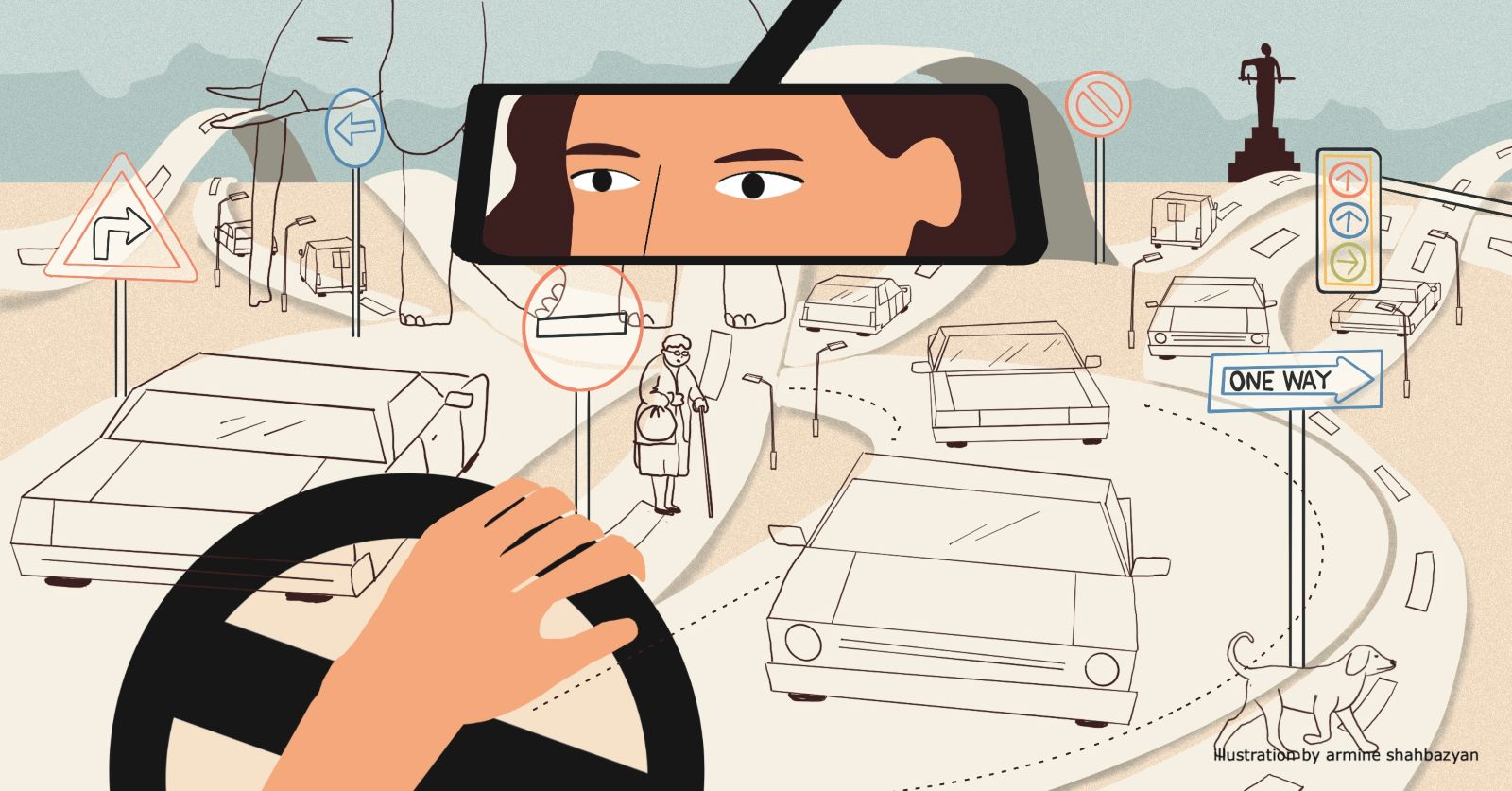
On a cold but sunny Yerevan morning, I carefully parked near the driving school. It was my fifth or sixth lesson, and I still felt uncertain about what I was doing.
When learning how to drive, I was still constantly glancing at the speedometer, trying not to exceed the limit, making sure I didn’t confuse the brake with the gas pedal, and trying to remain aware of my surroundings.
After the lesson, the instructor asked my age. When I told him I was 34, he remarked that it would have been much easier at 18. I wasn’t sure whether to feel offended or regretful about not starting sooner.
In Yerevan, having a driver’s license hasn’t traditionally been considered essential. Distances are short, and for years, most people got by with public transportation or taxis. Only in the past decade have more households acquired cars, some even two, with driving becoming more common among women, alongside a sharp increase in the number of vehicles on the road.
Against this backdrop, I finally began the process of getting my license—something I’d contemplated for at least five years, though apparently rather late according to my instructor. The final push came after my daughter’s birth: the challenges of finding taxis with car seats, cramming into crowded buses, and dealing with unreliable public transport transformed driving from a luxury into a necessity.
Still, I often wonder why it took me so long. While everything I needed was always nearby, there was another reason I rarely admitted: fear. Not of driving itself, but of driving in Yerevan specifically. The erratic behavior of drivers, poorly maintained roads, confusing intersections and roundabouts and unpredictable pedestrians all made me hesitate. Now that I’ve begun to learn, I can confirm that this fear wasn’t unfounded.
The Jungle That Is Armenian Traffic
I’m not the only one who finds Yerevan traffic terrifying. I’ve heard it from plenty of people—Armenians living abroad and foreigners alike—who say they wouldn’t dare drive here. The scariest thing on the roads isn’t the lack of infrastructure or road signs. It’s the other drivers.
The disregard for basic traffic rules is staggering. As Yerevan has grown more congested, drivers themselves bear much of the responsibility. One particularly maddening habit is intersection blocking. A universal traffic rule states that you should never enter an intersection unless you can clear it. Yet in Yerevan, many drivers charge ahead even when it’s clear they’ll get stuck in the middle. The result? Complete gridlock. One blocked intersection affects the next, and suddenly the city’s traffic grinds to a halt with no apparent cause.
This intersection blocking is just one of many ways Yerevan drivers ignore traffic rules. But perhaps the most dangerous––and deadly––habit is their refusal to wear seat belts.
Studies show that seat belts reduce the risk of death in serious accidents by up to 50%. When Volvo invented the three-point seatbelt in 1959, they made the patent free so all car manufacturers could use it—a testament to this safety measure’s critical importance. Despite this, many drivers in Armenia refuse to buckle up. Even worse, police have largely abandoned enforcement. The fine for not wearing a seatbelt is a mere 5,000 drams (about $12), an insignificant amount that is rarely imposed.
Some drivers even actively discourage seatbelt use. When I fasten mine in a taxi, drivers often say: “You don’t need to do that, we won’t get fined”—as if the only reason to wear a seatbelt is to avoid a ticket. Many go further by inserting fake buckles into the slots just to silence the warning beep.
Speeding, tailgating, and cutting others off are common practices. So common, in fact, that I’m genuinely surprised whenever someone actually pulls over to let an ambulance or fire truck pass.
What’s behind this kind of behavior? Impatience, I’m convinced. As someone still learning to navigate the chaos of Yerevan traffic, I’m regularly honked at—presumably for driving too slowly. It’s deeply unsettling. When you’re simply trying to figure out which lane to take or how to make a proper turn, the constant honking and impatient glares compound an already stressful situation.
This impatience extends beyond fellow drivers to how people treat pedestrians. By law, drivers in Armenia must stop at crosswalks without traffic lights to let pedestrians pass. In reality, many don’t bother.
Then there are the unpredictable pedestrians. When I started university in Yerevan back in 2008, the police had just begun cautioning and fining people for jaywalking. That was also when marked crosswalks started appearing on the streets. Proper street-crossing etiquette remains a relatively new concept for many, and it shows. You might be driving down a major avenue with multiple lanes on each side when suddenly a pedestrian darts into the road. It’s especially terrifying at night—many streets are poorly lit, and people in dark clothes materialize in front of your car like ghosts.
We’re Aware of the Issue, But Don’t Have a Solution
The government is fully aware of the problem. In April, the parliamentary committee on defense and security held hearings on Armenia’s alarming rate of traffic accidents and related fatalities. Senior government officials, the police, parliament, and NGOs participated. During this more than six-hour hearing, officials revealed the scale of the problem: daily, one person dies and 16 are injured on Armenia’s roads. Over the past decade, this has resulted in more than 3,600 deaths, nearly 70,000 injuries, and thousands of new disabilities in a country of just three million people.
Officials identified a range of causes, including poor infrastructure, fragmented governance, driver negligence, and lack of awareness. They highlighted recent reforms such as stricter driver’s license requirements and infrastructure improvements––new signage, guardrails, and road markings. Education initiatives were also highlighted, including mock traffic zones in kindergartens and safety instruction in vocational schools. Despite these efforts, one message remained clear: Armenia still lacks a comprehensive road safety strategy.
The consensus was unanimous: while Armenia has taken important steps over the past five years, without a unified policy document, clear lines of responsibility, and consistent funding, the country will continue pursuing piecemeal solutions rather than systematically reducing casualties.
Getting a Drivers License in Armenia
Among the most visible changes, alongside road construction, has been the introduction of stricter driver’s licensing rules. But many Armenians wonder if the process has actually become more rigorous or simply more arbitrary, with exam officers seemingly deciding on a whim who passes and who doesn’t. What’s undeniable is that obtaining a license has become a long, complex, and frustrating journey.
Before Armenia’s 2018 change of administration, bypassing driver’s licenses was an open secret. There was even a standard price: 120,000 drams (around $300). Driver’s licenses were sometimes given as birthday or graduation gifts. While some people did take the tests, particularly during Serzh Sargsyan’s later years in office, many saw little reason to bother when paying was faster and easier.
When Nikol Pashinyan’s government took power, it cracked down on this practice. Since 2020, the government has introduced numerous changes to the licensing process, expanding both written and practical exams while aiming to increase transparency. Practical exams, previously held in closed lots, now take place on actual city streets—a real improvement in both relevance and difficulty. Though reports of bribery occasionally emerge, such incidents have become far less common.
Despite being better regulated, the process remains far from smooth—and is often exasperatingly time-consuming. I began pursuing my driver’s license in December 2024. After a month of studying for the written test, I finally secured an appointment in mid-February, not in Yerevan, but in nearby Abovyan, as I’d heard the capital’s waiting time was twice as long. My friend traveled to Gyumri for her test, while another woman I spoke with went as far as Yeghegnadzor—both locations about two hours from Yerevan.
For my written and practical exams, my husband and I had to take time off work—almost half a day each time—to drive to Abovyan, take the test, and return to Yerevan. I could have taken a public bus, but that would have added even more time to an already long day. A taxi was another option, though not an affordable one. The process requires both patience and flexibility that many working people simply don’t have.
I passed my written test on February 12. Registration for the driving exam opened the next day, with the earliest available date being April 28. Written exam results are valid for one year––if I don’t get my driver’s license within that timeframe, I’ll have to retake the test. Both the written and practical exams must be completed at the same location.
Officials insist these changes are necessary to ensure only well-trained drivers receive licenses, but many find the experience discouraging and inefficient.
A new law may offer some relief. Currently, those who fail the theoretical or practical driving exam must wait 7 or 30 days respectively before retaking it––through high demand often extends these waiting periods significantly. The proposed change would allow first-time failures to retake the test much sooner—either the next day or within three days—by paying a set fee. Even after a second failure, candidates could retake the test within one or two weeks, instead of waiting the full 30 days.
For now, though, the process remains frustrating. When I failed my first driving exam on April 28, the next available date I could find was August 12.
Rumors circulate that examiners deliberately fail candidates on their first, and sometimes second attempts. While I acknowledge I made a mistake, and an instructor at my driving school claims many students pass on their first try, the statistics suggest otherwise.
In 2024 alone, of the 75,171 people who took the practical driving exam, only 24,033 passed, a success rate of just 32%. This means roughly one in three candidates succeeds, while the remaining two-thirds endure a prolonged ordeal.
To pass, you must successfully complete at least 10 out of 11 required tasks. In an effort to ensure transparency, the Ministry of Internal Affairs has announced that cameras will be installed in the testing vehicles.
The Core Issue: Enforcement
Armenia faces numerous traffic and road safety issues, including poor infrastructure and inadequate public awareness. However, the core problem remains simple: lack of enforcement.
Fines are low and often not enforced. The patrol service rarely stops people for not wearing seatbelts, much less for transporting children without car seats. While jaywalking technically carries a fine, no one is actually penalized for it.
Armenia indeed needs a national strategy for road safety. However, strategies and laws are only effective when backed by enforcement and political will. Until that happens, road safety will remain rhetoric rather than policy.
Law & Society

Anatomy of a Process: Armenia’s Biometric Passport Journey
Armenia’s long, troubled journey toward biometric passports reveals much about its institutional weaknesses and European aspirations. As the EU moves forward with visa liberalization and new border controls, the country’s ability to deliver secure documents will shape its citizens’ access to Europe.
Read more
Electric Vehicles Surge in Armenia, But Where Will the Batteries Go?
Armenia’s electric vehicle market is booming, driven by import incentives and global trends. But as EV adoption accelerates, the country faces a looming challenge: how to safely recycle lithium-ion batteries in a system unprepared for hazardous waste disposal.
Read more
Childcare: The Working Mother’s Dilemma in Armenia
Facing limited childcare options and short parental leave, many Armenian mothers are forced to choose between career and caregiving. Hranoush Dermoyan explores the systemic failures behind Armenia’s childcare crisis, and what it means for women, families and economic growth.
Read more
Medication Shortages and Inadequate Treatment in Armenian Prisons
Inmates in Armenia’s penitentiary system describe a pattern of medical neglect, medication shortages and systemic delays. Astghik Karapetyan investigates the failures of prison healthcare, based on firsthand accounts and reports, and the government’s reluctance to respond publicly.
Read more
“I Chose to Live”: Surviving Disability in Armenia’s Prisons
While some efforts have been made to improve conditions for inmates with disabilities, accessibility measures in Armenia’s penitentiary institutions remain piecemeal. Most facilities are still ill-equipped to accommodate people with mobility issues, creating daily challenges for those behind bars.
Read more
Behind Bars: Work and Education as a Lifeline
In Armenia’s prisons, work and education offer rare paths to purpose, income and potential early release. Astghik Karapetyan explores how inmates, including those serving life sentences, are learning trades, earning degrees and pushing for systemic change.
Read more
 Nelly
Nelly  Joseph Matossian

Honestly this podcast brought much needed laughter in my family today. It made us recall the days growing up in Beirut when frustrated taxi drivers would drive on the sidewalks, honking non stop as a way to alert the pedestrians to watch out for them. Or during the civil war, when drivers would fire a few shots in the air as an expedient way to clear traffic in front of them. We survived those days and I pray that Armenia will never see them.
I have been driving in Hayastan for the last 15 years and I am still very nervous (semi terrified) driving here. Driving from Ushi, near Ashtarak (25 klm ) to yerevan is more tiresome physically and mentally than driving from Berkeley near San Francisco to Los Angeles (550 klm). I believe the main problem is “lack of enforcement “ of the existing road rules.
Think about it, why are my compatriots better drivers after 2 weeks in LOS ?