

Listen to the AI generated audio article.
A woman can recover from a bad outfit. A bride cannot.
On that day, she is not just getting dressed, she is refining her image.
A wedding dress has never been just a dress. It reflects ideas about beauty, femininity, status and belonging, and in Armenia, those meanings have been shaped by layers of tradition, rupture and outside influence.
Origins of Identity: Taraz & Symbolism
Historically, in Armenia, as in many other parts of the world, red was the color of the bride’s dress. It was a deeply symbolic and distinctly feminine color, marking a woman’s passage into marriage, fertility and motherhood. Tradition held that unmarried girls should not wear red before marriage. The color would first appear subtly in elements such as the apron or decorative details of a young woman’s clothing, gradually becoming more prominent and darker with age and marital status. Traditional Armenian dress, known as taraz, was far more than clothing. As fashion historian and designer Ophelia Azizyan explains, it functioned as a visual language in which every element, from color to embroidering, fabric to ornamentation, carried symbolic and social meaning.
The difference between everyday clothing and bridal dress was immediately visible in the fabrics and craftsmanship. Daily garments were usually made from practical materials like wool or cotton, while wedding attire featured silk, velvet and other costly fabrics chosen according to the family’s means.
The taraz came alive with meticulous embroidery in silk and gold thread, forming intricate floral compositions. Pearls and stones were woven into cloth, catching the light with every movement. These garments were often made by the bride herself. From a young age, Armenian girls were taught to embroider, gradually assembling their dowry. In a time when marriages could take place as early as nine or ten, knowing craftsmanship early was a necessity.
Regional variations added their own layers of meaning. In Sasun, for example, the bride’s head was covered with a red veil layered beneath a sheer white one, creating a striking contrast of color and texture that symbolically marked the transition from girlhood to married life.
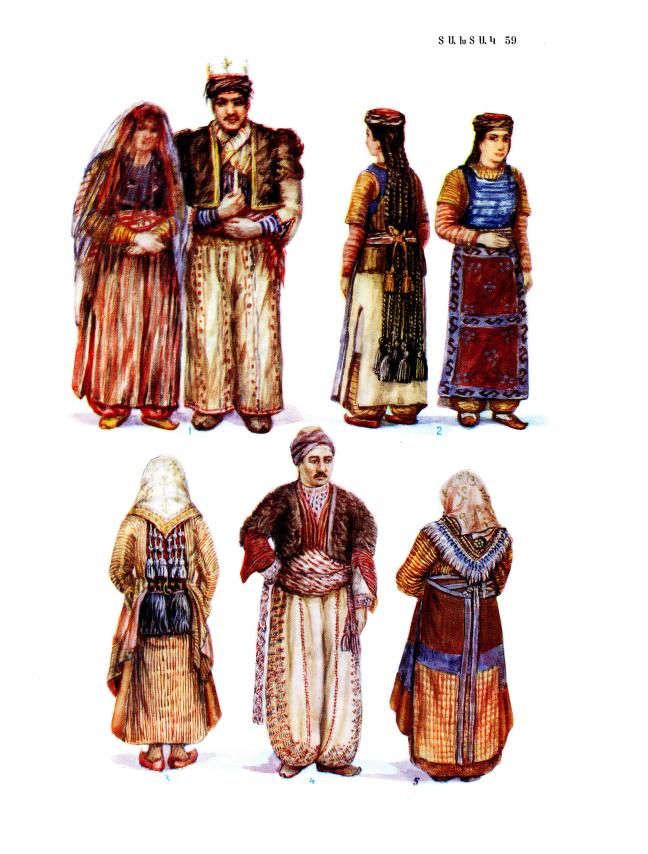
The bridal taraz of Akhaltskha, reflects the traditions carried by Armenians who migrated from Karin. Richly decorated sleeves draw the eye across the entire garment, while the red apron serves as both a visual centerpiece and a symbolic element. Along the belts, embroidered inscriptions preserved names, dates and personal milestones, turning the dress into a personal archive.
The structured and richly ornamented headdress is the most expressive element of the ensemble. Built around a red fez, it features gold detailing, cascading pearls, and coin accents that catch the light as they move. Floral elements soften the otherwise structured form, while a delicate chain across the forehead gives it an almost architectural elegance.
An example of late 19th-century bridal attire in Yerevan, reconstructed by the Teryan Cultural Center, features a cream-colored, floral-patterned dress with double sleeves. Beneath it, the bride wore an embroidered bodice with botanical motifs, layered with a belt-apron. The headdress featured a coin-decorated frontal ornament, covered by a veil. The look was completed with white stockings and embroidered shoes.
Interrupted Tradition: The Soviet Shift
With the arrival of Soviet rule, traditional Armenian dress did not simply fade away; it was gradually pushed aside. According to Ophelia Azizyan, the shift went far beyond changing fashion trends. A centuries-old visual language, one that communicated region, status, age and identity, was slowly replaced by a new Soviet ideal of sameness.
National dress came to be seen as backward, and incompatible with the image of the modern Soviet citizen. Across the USSR, including in Armenia, cultural distinctions were expected to soften into a single collective identity, and clothing became part of that project.
By the early 1920s, publications such as The Armenian Working Woman were already promoting this new image of Soviet femininity: uncovered heads, practical silhouettes and functional clothing suited for work rather than ceremony or tradition. Dress was no longer meant to express lineage, symbolism or regional belonging. It was meant to reflect the values of the new socialist order.
Fashion itself became centralized and institutionalized. The patterns published in these magazines were not locally generated; they were designed in Moscow by the All-Union House of Fashion Design and circulated across the Soviet space.
While clothing became standardized, bridal dress retained distinction through the quality of its materials and craftsmanship. In some cases, brides sought alternatives beyond the local system, sourcing dresses from abroad in pursuit of singularity.
Read in isolation, this shift can seem like a closed ideological system, detached from global fashion movements. Yet, elsewhere, particularly in Europe in the 1920s, women’s fashion was undergoing dramatic change. Designers like Coco Chanel were redefining modern femininity through the little black dress, straight silhouettes, jersey fabrics and a deliberate rejection of corsetry and excessive ornamentation. In very different political and cultural contexts, older dress codes were beginning to give way to modernity.
And yet, across these shifting worlds, one thing remained remarkably constant: the wedding dress continued to function as a rare space for personal expression, symbolism and distinction, even when everyday life demanded conformity.
In a 1959 issue of The Armenian Working Woman, the article “The Wedding Dress” outlines a carefully codified vision of bridal attire: light tones such as white, pale blue, soft pink and fabrics, chiffon, satin, and taffeta, define its softness. The silhouette is restrained, favoring straight lines and controlled volume. Decoration is present but disciplined, appearing in measured accents rather than excess. Even accessories, from veils to shoes, are expected to follow a unified visual logic, in which each element contributes to a coherent composition.
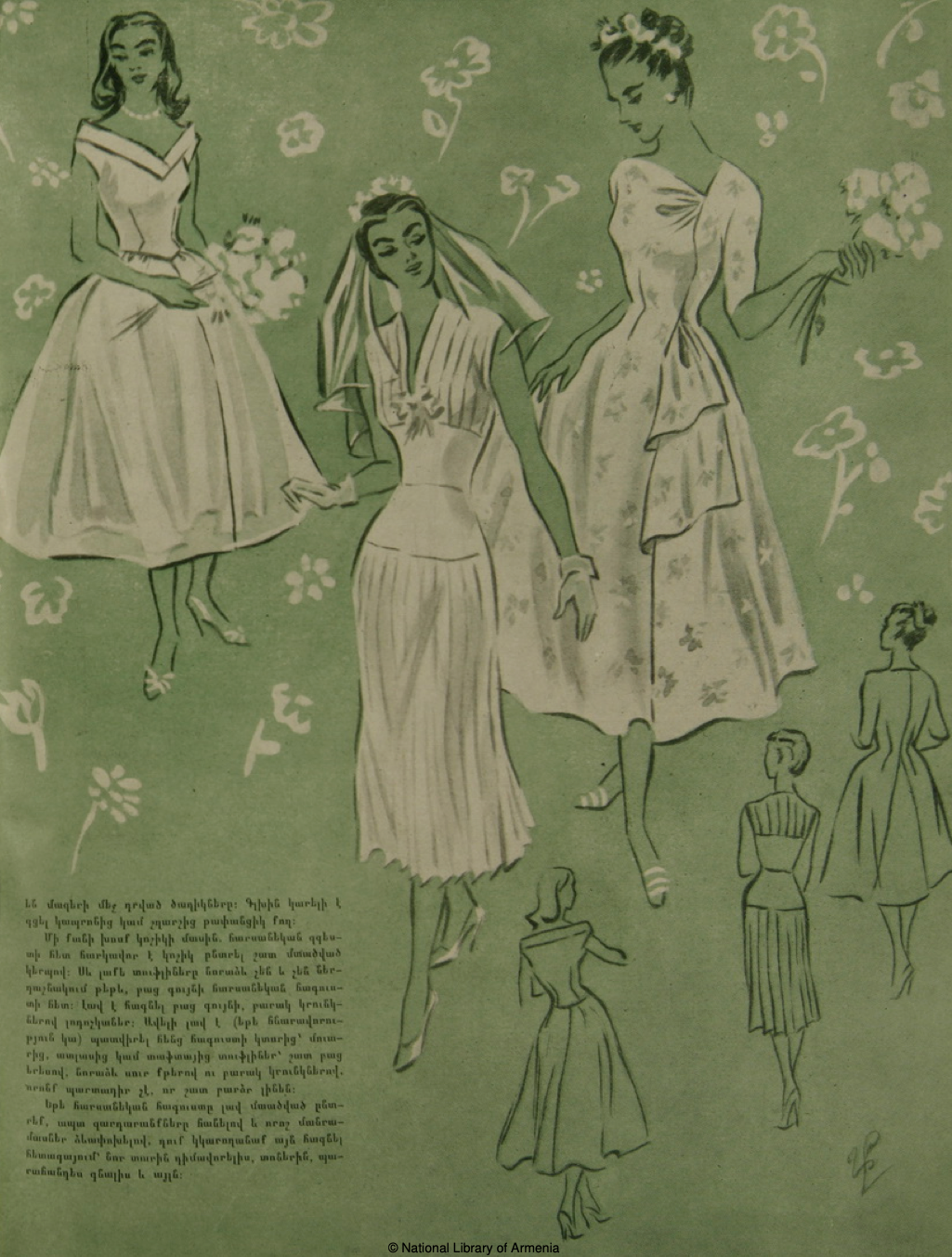
Most telling is the garment’s proposed afterlife: “A wedding dress, if carefully designed, should extend beyond the ceremony itself, its details adjusted and ornaments removed so it may be worn again for New Year celebrations, holidays and social occasions.”
Another issue of the same publication defines not simply what to wear, but how to understand clothing itself. The “correct” use of fashion is framed not as imitation of what is deemed trendy, but as selection; choosing only what corresponds to one’s figure, age, and even temperament and character.
At the time, emphasis was placed on a growing preference for simplicity: minimal, unembellished clothing free from excessive detail or decoration. Yet the text suggests that this aesthetic shift is not universally understood or practiced.
Dressing well, it argues, extends beyond the dress itself. It is a cultivated act of composition, where shoes, hat, handbag, gloves, and jewelry must be considered as a unified visual language.
Clothing is presented as a marker of cultural literacy.
Meanwhile, white as a bridal color gradually emerged within European aristocratic culture: first worn by Mary, Queen of Scots, and later popularized by Queen Victoria. Her choice highlighted the delicateness of the lace, but it became widely admired and helped define the modern bridal silhouette.
Post-Independence Bridal Identity (1990s–2000s)
In the post-independence period, bridal fashion in Armenia was largely shaped by European influences, with dresses more often rented than locally produced.
This preference did not form in isolation. The global bridal industry, shaped by royal weddings and couture fashion, defined much of what “modern bridal beauty” looked like, from Grace Kelly’s lace bodice to Princess Diana’s voluminous taffeta gown, Vera Wang’s minimalist silhouettes, and later Kate Middleton’s lace sleeves and Meghan Markle’s restrained elegance.
Against this backdrop, the early 2000s marked the emergence of the first generation of Armenian bridal designers and the first fashion shows, laying the groundwork for a local bridal industry. Designers associated with this formative period, including Lilit Margaryan, Vahan Khachatryan, Faina, Mika Danielyan, and Arevik Simonyan, helped shape an early local bridal aesthetic.
Organza, taffeta and tulle defined most silhouettes, alongside short, voluminous veils and a more limited use of lace than today. Corsets were present but integrated into the construction rather than emphasized, while bouquets remained compact and rounded, often artificial and most commonly composed of roses.
Over time, however, this framework began to shift. In recent years, there has been a gradual move toward custom-made gowns and a stronger emphasis on individuality. This marks a transition from imitation to self-definition; brides are no longer selecting dresses, but constructing identity.
The Contemporary Armenian Bride (2010s–Today)
Over the past decade, Armenian bridal fashion has entered a phase of visible transformation, shaped by local traditions, global aesthetics, digital culture, and a new generation of women redefining what it means to be a bride.
Today’s Armenian bride exists at the intersection of multiple influences. She is exposed both to international editorials and couture references and local customs and family expectations. This creates tension between tradition and self-expression, and can limit individuality.
Designers and photographers working within this space increasingly describe a shift in mindset. The bride is no longer merely the visual centerpiece of a large social event; she is becoming an active participant in shaping her own image. As one designer notes, the modern bride “is no longer choosing a dress simply to impress others, she is choosing to express herself.”
At the same time, this evolution brings its own complexities. Family influence, societal expectations, and deeply rooted wedding traditions continue to shape decision-making. As a result, the contemporary Armenian bridal landscape is defined not by a complete break from the past, but by an ongoing negotiation with it.
Within this context, Armenian bridal designers play a crucial role, not only as creators of garments. Their work often extends beyond aesthetics, involving a deeper engagement with the bride’s personality, psychology and sense of self.
Designers as Image-Makers
Alena Konnova
Russian-born designer Alena Konnova (Moment of White) has lived and worked in Armenia since 2020, and today positions her work firmly within the Armenian bridal landscape, representing the country at exhibitions and working predominantly with Armenian clients.
Konnova sees bridal fashion as a space where technical mastery and creative expression converge. A significant share of her clients are diaspora Armenians who return to marry in Armenia, seeking a more individual and refined aesthetic. In this sense, Armenian bridal fashion increasingly exists in dialogue with global expectations, rather than within a purely local framework.
At the same time, her observations point to a deeper cultural tension that extends beyond aesthetics into questions of agency. “Family members do get involved. It happens, especially husbands,” she notes. More importantly, many brides struggle to articulate preference at all: “Armenian women are sometimes raised in a way that they can’t say what they don’t like… I see something is wrong, but they say: ‘No, everything is fine.’”
This gap between personal desire and social conditioning becomes central to understanding the contemporary Armenian bride. While a younger generation increasingly approaches the wedding as a moment of ownership, this mindset is still emerging rather than established. Within this space, the designer’s role becomes as interpretive as it is aesthetic: “My mission is to make it her day, not to turn her into a decoration.”
Konnova rejects standardization, treating each dress as an individual collaboration: “I have never made two identical dresses. Every girl is different, in body, in character, in how she feels herself.” The result is a practice that prioritizes identity over convention, even within a culture where convention still carries significant weight.
Her approach also challenges how Armenian identity is often translated into design. “When Armenian designers work with ethnic elements, it is often very direct, pomegranates, alphabet, and that’s it,” she observes, adding that she hasn’t yet been asked to incorporate traditional elements, though she would like to explore them through texture and fabric rather than literal motifs.
Nina Sarkisyants
Alongside emerging voices, established designers such as Nina Sarkisyants continue to shape the Armenian bridal landscape through a couture-driven practice rooted in craftsmanship and precision.
In her view, the Armenian bride has undergone a noticeable transformation in recent years. “She is far more self-aware, refined, and intentional,” Sarkisyants explains. Brides are increasingly choosing personal expression, signaling a shift away from performative beauty toward identity-driven decision-making.
While global trends and social media inevitably shape visual perception, Sarkisyants draws a clear distinction between inspiration and imitation. “A true bride does not follow trends blindly,” she says, “she filters them through her own taste.” In this framework, the designer’s role becomes one of guidance, shifting attention from temporary aesthetics to something more enduring. “Trends fade, but a well-created image remains,” she says.
Many clients are still learning to recognize the value of craftsmanship and individuality within couture, while the local market remains limited in scale, she explains.
Sarkisyants defines the modern bride not by appearance, but by mindset: “She is confident, selective, and emotionally connected to her choices.” In this framing, the dress becomes more than an object, it becomes “a statement, a memory, and a reflection of who she is.”
Narek Jhangirian
I often think of Narek Jhangirian as the “Black Knight” of Armenian fashion. His work is immediately recognizable: sharp lines, monochrome palettes and silhouettes that feel almost architectural in their precision. In a bridal landscape often dominated by softness, embellishment and excess, his designs stand apart. For Jhangirian, restraint itself becomes a form of expression, where every detail is controlled, intentional and stripped down to its essentials.
In Jhangirian’s practice, the wedding dress never leads, the woman does. The garment is secondary to the person wearing it. “The dress is not what defines identity on its own,” he explains. “It gains identity from the person who wears it.” Bridal design becomes an act of calibration, aligning silhouette, presence, and character before any aesthetic decisions are made.
Even the process begins beyond the dress itself. He advises brides to choose their shoes first, letting them set the direction for the entire look. Though capable of constructing any silhouette, he notes that shoes often present a greater challenge than the dress.
At the core of his philosophy is a strict rejection of excess. The dress should never dominate the bride. “When a girl enters the room, people should look at her, not the dress,” he says. “The dress should highlight the person, not replace her.”
Accessories — shoes, veils, and styling elements are not secondary details but foundational components of the image and the dress follows as a final articulation.
Jhangirian also points to the tension between personal desire and external influence, particularly from family members who often participate in decision-making.
His brides are minimalist, independent, and self-directed. Most are over 25 and often financially involved in their own dress.
Functionality is central to his approach. He values garments that extend beyond the ceremony, transformable pieces that can be reinterpreted later in life, such as corsets paired with denim or gowns reshaped into new silhouettes. Bridalwear, in this sense, is not an endpoint but a continuation.
Armenian elements are rarely requested, Jhangirian says, as most clients gravitate toward a more European aesthetic. When traditional embroidery is used, it adds complexity and significantly increases cost.
Looking ahead, Jhangirian anticipates a shift toward lighter, more adaptable silhouettes, driven by both lifestyle and climate. While many designers focus on the process itself, for him the defining moment remains the end, when construction becomes presence, and the bride finally inhabits the dress.
Following the 2020 Artsakh war, interest in national elements has grown significantly. Traditional wedding formats have re-emerged, with some brides choosing to wear traditional taraz, yet still in white rather than red. The result is a subtle fusion of tradition and modernity.
Artist, designer and director of the Teryan Cultural Center, Lilit Melikyan says interest in traditional Armenian wedding attire has risen noticeably in recent years, even if demand has fluctuated over time. Today, the center creates around seven to ten traditional bridal and groom ensembles annually and also helps organize Armenian-style wedding ceremonies both in Armenia and abroad. Over the years, this work has allowed the center to build an extensive archive of bridal taraz, which has been exhibited locally and internationally.
Within this landscape, displays of scale and excess often remain tied to perceptions of status. Multi-tiered cakes rising the height of the venue and voluminous dresses dominating physical space continue to function as visual markers of wealth. Yet such gestures rarely produce depth. Instead, they reinforce a performative model of luxury, one that prioritizes visibility over meaning.
Dialogue With the Past
Contemporary Armenian bridal fashion resists easy definition. It exists somewhere between tradition and reinvention, between inherited expectations and personal expression. Designers may follow global trends, but family dynamics, cultural memory and social expectations still shape many of the final choices. In Armenia, choosing a wedding dress is often less an individual decision than a collective negotiation, one in which mothers, relatives and unspoken ideas about femininity and respectability continue to carry weight.
At the same time, bridal fashion reflects something larger than aesthetics alone. In periods of uncertainty and rapid change, people often turn toward nostalgia, borrowing from imagined versions of the past in search of beauty, stability or meaning. This helps explain why historical silhouettes and older styles continue to resurface, even within highly modern weddings. Fashion rarely moves in a straight line forward; it constantly circles back, revisiting and reinterpreting older forms.
And perhaps that is why the wedding dress continues to matter so deeply. It is never simply fabric or ornamentation. It carries ideas about identity, femininity, family, status and belonging. More than anything, it reveals the complicated space between how a woman sees herself and how society expects her to be seen.
Cover photo by Roubina Margossian.
LIFESTYLE
Afterglow
May’s issue of SALT is a mix of nostalgia and gumption. From the evolution of Armenia’s post-Soviet music scene to the history of Armenian bridal fashion, from a photo story capturing the outdoor games children still play to reflections on the life of Armenian radio, and the story of one man helping revive forgotten vines, these pieces explore memory, identity, creativity and resilience in all their different forms.

The Sound of Post-Soviet Armenia and the Grunge Era of Rabiz
In the aftermath of the Soviet collapse, Armenia’s music scene underwent a dramatic transformation. From the rise of rabiz and estrada to experimental fusion and underground influences, Tamara Khachatryan explores how hardship, freedom and cultural upheaval reshaped the country’s post-Soviet musical identity.
Read more