

Listen to the AI generated audio article.
Autumn drizzle in Yerevan arrives with a particular melancholy. Not the dramatic downpours that flood the city due to poor drainage—those moments when underpasses become impromptu lakes and intersections turn into rivers. This is gentler; a persistent mist that settles over the city like a veil. Yet Yerevan is one of those rare cities that rain actually suits. Unlike so many cityscapes that turn grey and depressive under overcast skies, Yerevan’s pink and orange tufa stone seems to glow even brighter when wet.
My friend and I are standing at the entrance to Kond, clutching a paper bag from Ambar Gastroshop, a sandwich place on Paronyan Street. The bag is already growing slightly damp at the corners. Inside are two jamón sandwiches wrapped in foil. In my backpack I have a thermos of hot tea and a flask of cognac.
The walk through Kond in the drizzle was supposed to be a guided tour for my Yerevan State University students. But I decided that walking in wet weather is only for sturdy grownups like us. Rather than cancel altogether, my architect friend, who was meant to be our guide, and I decided to venture into Kond alone for an improvised picnic.
Professionals who have researched Kond’s history and social peculiarities have said and written much about this oldest and most “authentic” district of Yerevan. But what does “authentic” actually mean in this context? The term, perhaps, suggests that Kond’s decaying structures confer some kind of cultural legitimacy, that the neighborhood is somehow more “real” than Tamanian’s Soviet boulevards or the new towering residential buildings. Yet there is nothing more authentic about neglect than deliberate urban planning. Both are genuine products of their historical moments. What can be said definitely is that Kond feels different. It offers a particular aesthetic experience unavailable elsewhere in the city.
I make no claim to discover new facts or settle debates about preservation and “authenticity.” This essay is about a sensory exploration of a place when soft autumn rain creates a particular mood—quiet, unhurried, wistful. It is also an invitation to discover how it feels to wander in Kond during different seasons, weathers, and times of day.

Descent Into the Labyrinth
From Paronyan Street, Kond reveals itself gradually, reluctantly. Within several steps, the built environment changes entirely. The pink tufa and steel-and-glass constructions of central Yerevan give way to older forms, less concerned with presenting a unified face to the world.
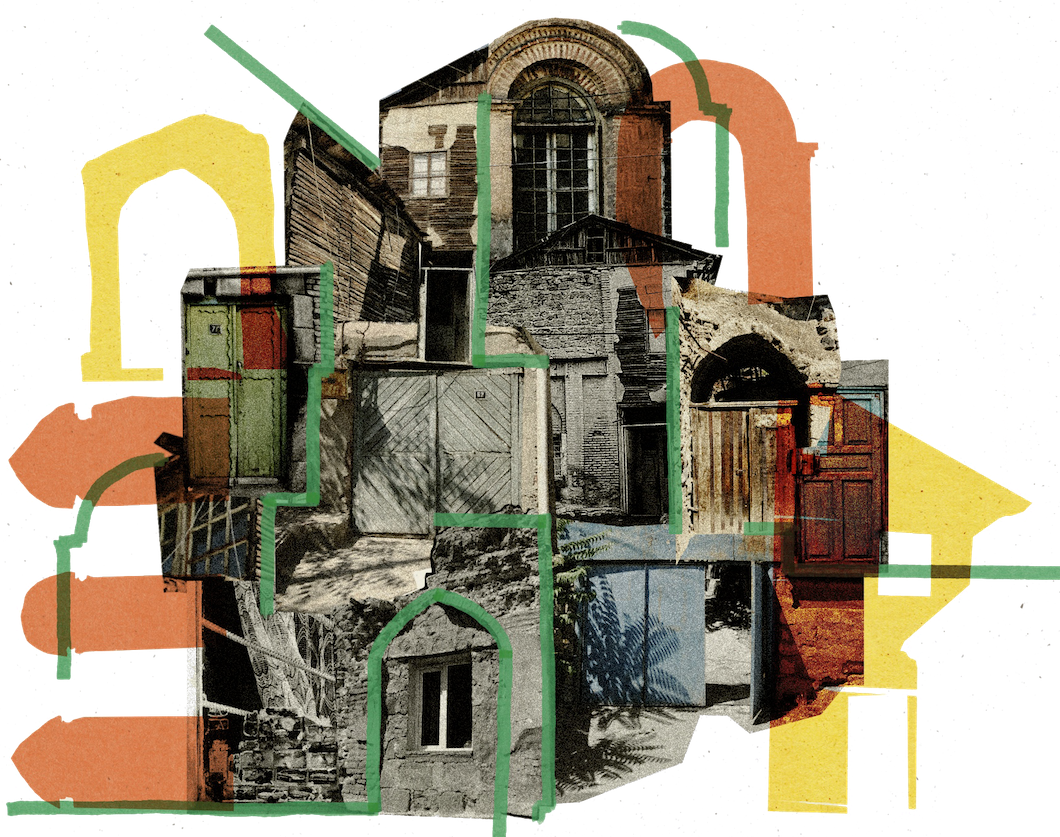
The street, though it can hardly be called a street when it is barely several meters wide, becomes a dark ribbon of wet stone beneath our feet, covered with yellow grape leaves from vines that still twist through courtyards. Houses rise on either side, built directly onto one another without regard for personal space. Clay and small stones, asymmetric bricks, wooden beams visible where plaster has fallen away. Foreigners call this “vernacular architecture,” but for local residents this is simply home. Some walls lean at angles that, in a seismically active region, would terrify any structural engineer. Yet here they stand, have stood, for centuries, defying both gravity and the periodic earthquakes that shake the South Caucasus.
My friend points out a particularly precarious-looking structure, darkened with age and moisture. It is both admirable and worrying. The drizzle persists, neither worsening nor clearing. We stroll, looking for a nice spot to eat and chat, our feet navigating the uneven stones with care. Wet stone is treacherous, especially when worn smooth by centuries of footsteps.

Looking at Layers of History
Kond’s pathways do not seem designed for easy passage. They evolved chaotically and organically over centuries, shaped by the daily foot traffic of residents, the hillside’s contours, and the need to squeeze maximum dwelling space from limited land. The result is a three-dimensional puzzle. Every turn reveals unexpected courtyards, dead-end alleyways, DIY staircases of scrap metal that materialize from nowhere leading to doors painted in faded colors. We take wrong turns, backtrack, and laugh.
Kond predates the Soviet urban redesign that transformed Yerevan in the first half of the 20th century. While Alexander Tamanian’s master plan envisioned wide boulevards and imposing administrative buildings, Kond was left untouched, though not through conscious preservation. The Soviet state was notorious for remaking landscapes across the USSR—constructing cities where none had existed before, demolishing historic quarters, and imposing its architectural vision of socialist modernity. That Kond escaped this fate suggests a lack of priority, most likely due to indifference and logistical difficulty.
The pre-modern street layout persists, largely unchanged. To walk these lanes is to trace paths that Armenian merchants, Persian administrators, Ottoman traders, and Bosha families walked centuries ago. Persian architectural influences blend with Armenian construction techniques. An old mosque became a house. Every wall tells multiple stories, depending on how you look at it.
We find partial shelter near a staircase surrounded by small trees. The sandwich is cold, but this does not diminish it. Cognac becomes a perfect match in this weather. A woman passes by, and my friend engages her in conversation in Armenian. He later tells me that this matters—to feel more included, to show respect rather than merely gaze like tourists. Kond is not a museum but a living, breathing neighborhood. This ritual of sharing food and drink on the street feels simultaneously public and private, visible to any passerby yet somehow obscure. In the spirit of the district.
What draws outsiders to Kond—tourists, photographers, urban explorers—is precisely what makes life here difficult. The picturesque decay, the photogenic doorways, the Instagram-worthy graffiti and murals covering crumbling walls. These are the consequences of municipal abandonment translated into aesthetic appreciation by those who do not have to live here. It is easy to romanticize neglect and hardship when you are just visiting.
Beyond the problematic tourist gaze, Kond’s value lies in what might be called “unarchitected” architecture. These buildings predate the assumption that cities should be “rationally” planned according to principles of efficiency and control. The step-like construction climbing the hillside, houses sharing courtyards, narrow passages designed for foot traffic and donkeys rather than automobiles—this is architecture that emerged from use, from the accumulated decisions of generations responding to the specific conditions of place.
As we wander deeper, we pass open doorways where residents go about their daily routines, barely visible in the dim interiors. A woman hangs laundry despite the weather. An elderly man sits on a stone bench worn concave by decades of use, smoking a cigarette with the patient pleasure of someone who has nowhere else to be. A cat picks its way along a wall top, placing each paw with fastidious care.

What the Hillside Reveals
We climb toward the edge of Kond, where the hillside offers sudden, dramatic views over central Yerevan. The drizzle continues, and the city spreads below, softened by mist. From here, the contrast between Kond and the rest of central Yerevan becomes obvious—but binaries are too simple, too clean. Kond is not simply “the past.” People live here now. Children are growing up in these houses. Life continues in real time even as the built environment slowly deteriorates. And contemporary Yerevan is not simply “the future”—many of those gleaming new buildings will themselves be obsolete in decades, replaced by whatever aesthetic comes next, the inevitable cycle of urban development’s creative destruction.
My friend and I stand here, slightly damp and pleasantly full, the aftertaste of cognac and jamón mingling on my tongue while I think about what Kond means beyond its architecture. This question has no easy answer. Various reconstruction plans have circulated since the 1930s. Fortunately or unfortunately, depending on perspective, lack of funds has prevented most schemes from materializing.
Uncertainty now hangs over Kond as persistently as today’s drizzle. New buildings appear one by one, clashing with their surroundings. Each replacement erodes the district’s chaotic coherence. Meanwhile, residents wait—for reconstruction promises that may never come, for building collapses that seem inevitable, for government attention that rarely comes except as plans that threaten displacement rather than improvement.
Tomorrow, perhaps, Kond will still be there. Perhaps the long-promised reconstruction will begin. Perhaps nothing will change. Perhaps everything already has. The only certainty is drizzle, autumn leaves in water channels, and the knowledge that some experiences are best savored in good company.

LIFESTYLE
Change
The November issue of SALT explores the parts of life in Yerevan that often go unnoticed but quietly shape our days: from the city’s increasingly chaotic rental market and the struggles of those living with celiac disease, to caring for our bodies in the age of Google, wandering a neighborhood layered with memories that refuse to fade, and stepping into the world of an Armenian viola maker, where tradition and craftsmanship create their own kind of magic.

Welcome to the Rental Hunger Games
A darkly funny dive into Yerevan’s rental market, where outrageous prices, crumbling “designer” homes, and Soviet-era domiks collide with the everyday despair of tenants just trying to find a livable space. Ella Kanegarian-Berberian’s sharp, witty look at a city caught between illusion and reality.
Read more