

Listen to the AI generated audio article.
“I have no more energy or moral strength to see these images. I have never felt so powerless in my life. I can’t see how I could change a thing…” says a friend through a WhatsApp message, then continues by sharing some links. I brace myself for images from Gaza.
Instead, I open the links to find Yerevan apartments for rent. A war between prices and quality, logic and illusion, Instagram-fed desires and market-led reality.
One of the screenshots she shared showed a red temporary metal shipping container provided by the Soviet government and international aid organizations to house the hundreds of thousands of people left homeless in the aftermath of the 1988 Spitak earthquake.
The announcement was proudly named “Domik Vagon” (Russian for “small house” and “carriage”) and appeared in three languages, all stating the same thing. The Domik Vagon was for rent, proudly priced at 500,000 AMD ($1,305 US) and located in—Spitak. For comparison, you can rent apartments in Spain and Italy, nice little European towns close to the sea or with breathtaking views for the same amount. But who needs that when you can experience life in a Domik for 500,000 AMD and feel like you’ve been transported back to the dark and cold 1990s?
Her next screenshot showed a house for sale in Dilijan titled “House with designer renovation.” It was just an ordinary house with fading Soviet-era remodeling, untouched since Lenin’s statue was removed from Republic Square. Priced at $250,000, this “amazing work of designer art” promised to create many plumbing issues.
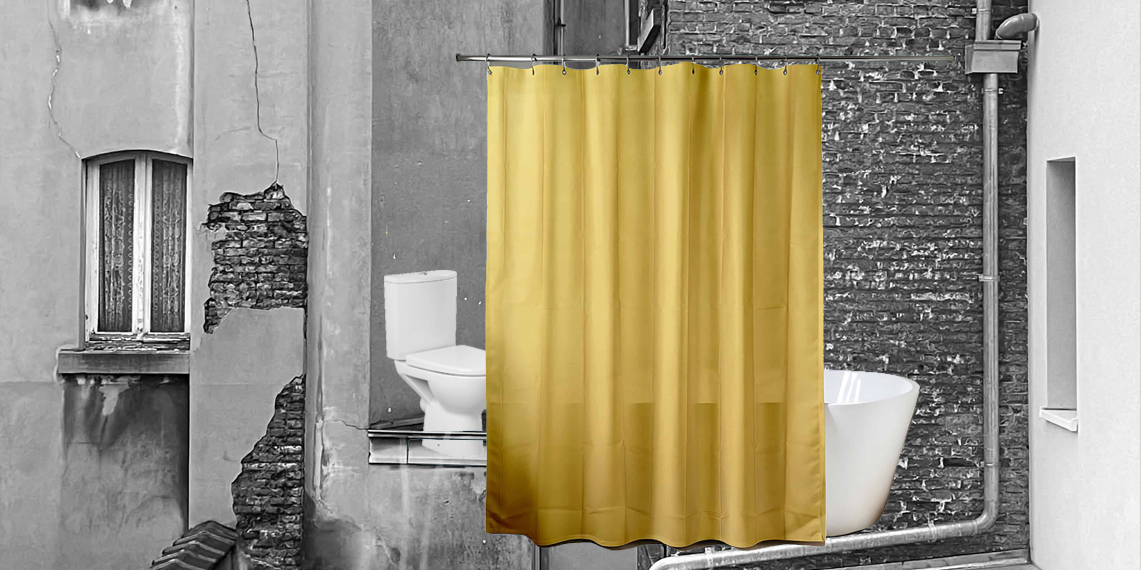
The other screenshot introduced me to a rental with the most incredible logistic solution I’ve ever seen for just 180,000 AMD ($470)—a bathroom where the washing machine stands right under the shower. You can shower and wash your clothes simultaneously without losing time! I think this level of innovation would make even Steve Jobs jealous. And this attractive picture, placed as the cover photo of the listing, was bound to bring attention, but not necessarily the good kind. By the way, this incredible apartment may still be vacant and could be yours if you hurry!
After scrolling through dozens of grim-looking apartments, I understood where my friend’s mood and despair were coming from. She and her husband bought an apartment nearly a year ago and are waiting for it to be finished. In the meantime, they rent. Her salary is 300,000 AMD and her husband’s is around 600,000 AMD ($783 and $1566 respectively)—both considered high compared to Armenia’s minimum wage of 75,000 AMD. They spend around 300-400,000 AMD on renting a normal, clean, decent-looking apartment anywhere, not necessarily in the city center. The leftover money goes toward food and other necessities.
And though their financial situation is pretty good for Armenia, putting them well above average (yes, we’re still a poor country—you can see it clearly if you take a few steps from city center), most of their combined income of 900,000 AMD ($2,300) still disappears into the black hole of rent, groceries, and what seasoned economists would simply call existing.
“I just can’t scroll through these photos anymore,” my friend laments. “People sometimes don’t even clean their homes before they take a photo and put it online. And they want to charge you 450,000 AMD for something that looks dirty even in photos! But it’s not like more expensive places are better—there’s always something, a nasty twist you’ll only discover after you sign the deal. I feel so trapped, like there’s no way out, only a loop,” she continues, while I take a breath to share some stories on the housing crisis, so she doesn’t feel alone.

My go-to story is always the one about a studio apartment. The listing advertised it for 150,000 AMD ($392) in the city center, located in Aygestan, almost 70 square meters. But it had no photo, which made it more intriguing to check out. After I found the address and stepped inside the fence, an old lady greeted me. She could have passed for the evil witch from Snow White, but I didn’t pay much attention—I was interested in seeing the apartment. She slowly walked me to something that looked like a garage, opened the door, and there it was: ground covered in soil with a few cuts of industrial carpets that locals call cavraline on it, and a few pieces of old furniture (yes, the kind from the 1990s, grey and brown, offering discomfort and a sense of humiliation). The walls were simply stones, and a little piece of cloth covered the area that was supposed to be a bathroom, separating it from the area that had to be the kitchen, since it had one small gas stove. My shock was so deep that I didn’t know what to say, but I repeated loudly, “I can see your toilet and bathtub from here—there are no walls, no walls!” To which the lady answered with as much shock as I had: “What walls? It’s a studio apartment. Are you a villager?” I clearly remember it was sometime around 2 p.m., because that’s when I realized that Yerevan will always give you reasons to have a glass of wine before 4 p.m.—sometimes good, sometimes bad, sometimes weird.
But this story didn’t help my friend whose stress levels kept elevating. Some of her friends were literally thrown out of their rentals once the Russians arrived in 2022. Even locals with long-term rental contracts were pushed out of their flats to make space for Russians, whom some landlords saw as cash cows.
I remembered this period well. Many international outlets were interested in covering these stories, but all the locals I found who fell victim to this situation refused to speak out. They said they felt uncomfortable compromising the “Armenian brand” of friendliness and hospitality. Even some local artists, considered celebrities, were evicted but refused to give interviews.
This story didn’t cheer my friend up either, so I offered to help her find an apartment.
I kept scrolling through links on list.am, Armenia’s biggest online marketplace, and various rental groups, and the deeper I went, the more the options took on a strange Gothic quality: dark laminate floors, heavy drapes, oppressive color palettes, and every possible mismatch of shades and textures. Even in photos, the rooms felt airless, suffocating, and inexplicably gloomy.
After barely 20 minutes of browsing everything from the cheap to the outrageously overpriced, I realized something horrifying. We, the majority of locals, have terrible taste and have mastered the art of transforming even decent spaces into dark, cave-like holes, sometimes expensively decorated, meant more for hiding than living. The majority of apartment photos I saw whispered only one thing from the screen: “Darkness is my friend, yes, precious, always has been, always will be.”
When did Yerevan’s apartments start looking this way? Were they always so distasteful, or had I simply failed to notice? My mother blames the 1990s. “That’s when the brown furniture came,” she said, “and never left.” The decade of collapse and survival left behind not just an economic scar but an aesthetic one. Meanwhile, the current abundance of materials brought something else: wrong things in wrong places. Expensive items and materials appear where they shouldn’t be. One photo showed expensive bathroom tiles placed in a living room. Another apartment, priced at 300,000 AMD, included an image of an armchair with torn edges. Perhaps the owners didn’t want to throw it away.
After almost an hour, 20 apartments, and seven calls later, my chest began to hurt—like I might have a heart attack. I had just learned that a three-room apartment on Sayat Nova Street with a basic 1990s renovation, no sun, and no heating system, costs 1,000,000 AMD ($2,613) per month. I started imagining that my family property, a three-floor house in the city center, might cost as much as a small, cute chateau somewhere in France.
I kept scrolling through apartment listings, interrupted by my friend’s desperate messages that there’s nothing decent left in this town. At a certain point, I started to feel that the rental madness wasn’t entirely driven by greed, as my friend claimed, but by the same despair. The landlords are desperate too, trying to stay afloat and make ends meet, keeping up with rising prices everywhere. Some may have no other income. Others clearly have no taste, no desire to improve things, and a complete lack of common sense.
That sense of uniqueness, one of our national traits, combined with a lack of real dialogue with the world (I mean an open market) creates the prices we have and the quality of apartments on offer.
But before I could give this thought more time, I found an amazing offer!
An extremely well-priced three-room apartment on Tumanyan Street. I immediately booked a viewing and headed out to see it.
The estate agent met me on the street, greeted me, and immediately told me—as if sharing a secret name from the Epstein list—“You know, it’s not just any street. It’s the safest street in the whole republic!” I smiled and, without questioning what made this street the safest, entered the building and then the apartment. I moved through the rooms, checking how the light fell here and there and whether there was noise. While I was busy imagining my friend’s life there, the agent repeated the same sentence a few more times. It was like he was an amateur stand-up comedian setting up the joke and waiting for someone to react so he could finally deliver the punchline. So I asked the agent: what made this street the safest in all of Armenia?
He sparkled with excitement when telling me this. “It’s where our ex-president’s brother lives!” he said. For a moment, I couldn’t understand what he meant. “What brother?” I asked. Then, seeing the horror in his eyes, it dawned on me—he was talking about “The Brother”, the reputed connoisseur of other people’s assets.
I had nothing to say, so I smiled, shook the real estate guy’s hand, and sealed the deal.
After all, how often can you find a three-room apartment in downtown Yerevan for less than a million, with high-level protection like this as a bonus?
Any estate-horror stories? Share!
LIFESTYLE
Change
The November issue of SALT explores the parts of life in Yerevan that often go unnoticed but quietly shape our days: from the city’s increasingly chaotic rental market and the struggles of those living with celiac disease, to caring for our bodies in the age of Google, wandering a neighborhood layered with memories that refuse to fade, and stepping into the world of an Armenian viola maker, where tradition and craftsmanship create their own kind of magic.