

Listen to the AI generated audio article.
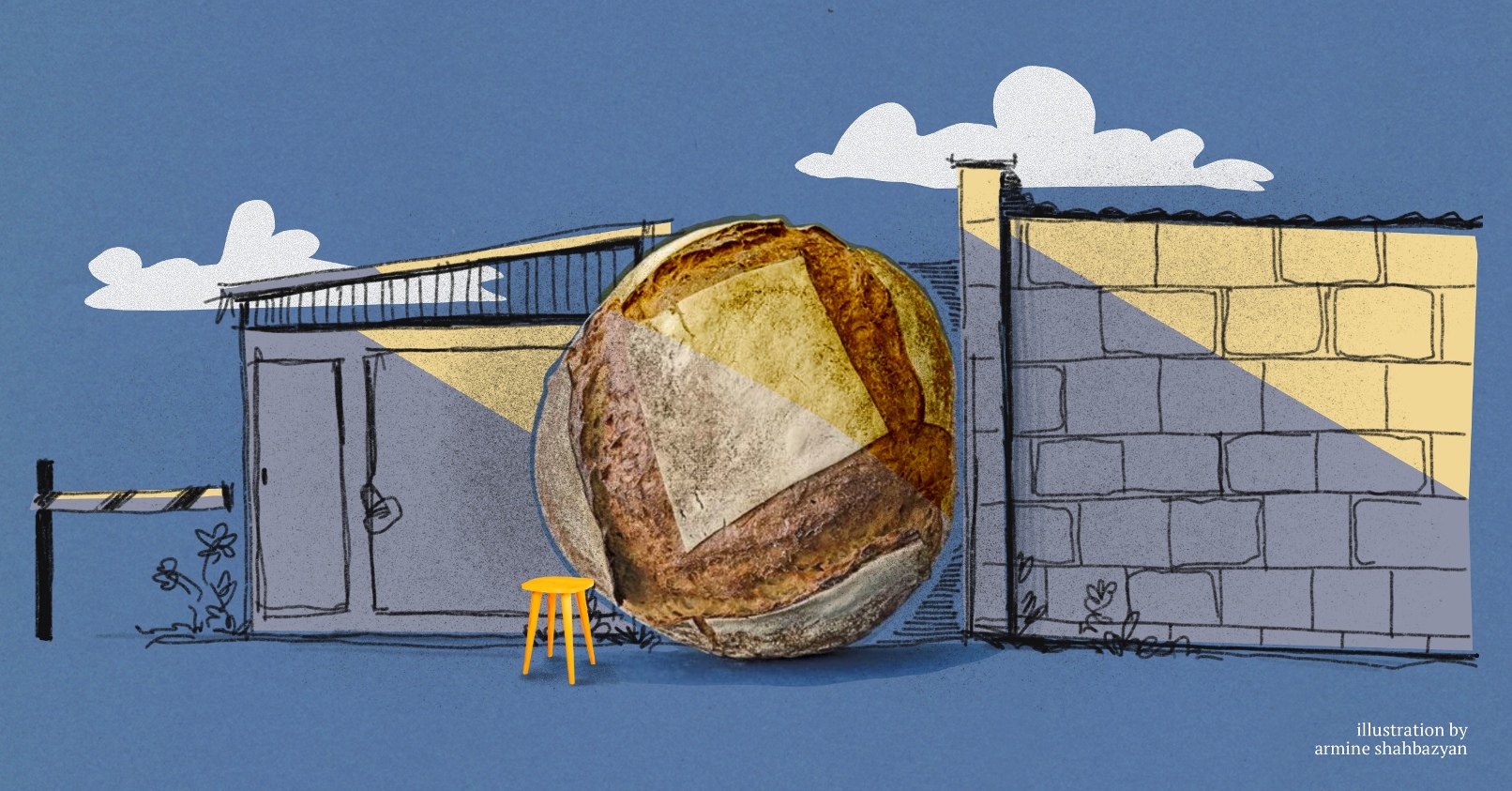
Some urban spaces are easy to find only if you already know where to look. They aren’t advertised to draw crowds. There is no signage, no fancy glass façade to draw the passing pedestrian’s eye. Runnin Bakery is one of them—a former garage tucked away in an ordinary courtyard of an otherwise ordinary residential building in central Yerevan.
The bakery’s philosophy is straightforward: the product should speak for itself. People who recommend because they genuinely want to, not because they were prompted. The result is a clientele built almost entirely through word of mouth, which in Yerevan has long functioned as its own remarkably efficient distribution network.
Runnin Bakery was founded by two young women. Vasya bakes, runs, and draws. Valya bakes, runs, and coaches running professionally. In many cities around the world, the relationship between baking and running has become an established social institution. Running clubs have their affiliated bakeries, their designated home bases, their post-run rituals of coffee and carbs. In that sense, Runnin Bakery is not a strange idea at all—it is simply Yerevan’s version of that institution. Its name is a triple entendre: the baked goods, the sport, and the act of running a business, a phrase that gains particular texture when the business is run by two people who also run dozens of kilometres each week and have no intention of slowing down.
Thirty Hours of Bread-Making Labor
Everything at Runnin Bakery is sourdough. This is not a stylistic choice, but an operating principle with consequences that ripple outward through the enterprise’s entire logic. Sourdough requires time in a way that mass-market commercial bread does not. A cookie needs ten to twelve hours of fermentation. A loaf of bread, a tartine, a rye, a borodinsky, takes up to thirty. To produce bread that can be sold on a Tuesday morning, work begins on Sunday. There are no machines to accelerate the process; temperature, hydration, and timing are controlled by hand and by judgment. The leavening agent is a starter, a live culture of wild yeast and bacteria, fed daily with flour and water, sometimes maintained for years. It has a rhythm, a temperament, a sensitivity to heat and neglect. It cannot be rushed without being killed. Industrial baking compresses fermentation into hours through additives and controlled atmospheres. Here, nothing is accelerated. The process runs on its own clock.
This temporal structure creates a particular relationship between the product and its price. Vasya has described having a conversation with a man who could not bring himself to pay 1,300 drams for a loaf of bread when matnakash, the soft Armenian bread available everywhere, costs four times less. She patiently explained: matnakash is made in three to five hours; this loaf requires thirty—thirty hours of manual and intellectual labor that should be compensated. The man seemed to grasp this intellectually but remained unconvinced, leaving without buying. This is a recurring feature of Runnin Bakery’s commercial life: the local customer who understands the information and still cannot make the conceptual leap to a bread that costs what this bread costs.
The gap in understanding is not about money, or not only. It is about categories. Matnakash emerged in the dry heat of the Armenian highlands, where wheat grew well and the tonir gave intense heat, producing soft bread ready on the same day. Sourdough comes from another world, from the cold climates of Northern Europe. There, rye was among the main grain cultures, requiring long fermentation simply to become edible, and a live culture kept in a warm corner of a kitchen was the only available technology for that. Both bread-making traditions answered the same human problem of survival; they simply answered it from opposite ends of the continent, where geography shaped the method. None of this is easy to convey across a counter, in a few sentences, to a stranger who came expecting to spend 300 drams and is being asked to spend four times that. Vasya and Valya do it every time anyway.
A Garage Between Two Addresses
The search for the right space to open Runnin Bakery took a long time. The requirements were more infrastructural than aesthetic. If either of the two owners needed to respond to an overnight problem, a sourdough starter that demanded attention, a force majeure of fermentation, they had to be able to reach the bakery within three to five minutes. The space, therefore, had to be near one of them. Period.
The space Vasya and Valya eventually found was a garage in a courtyard behind Hay Art Center, another example of this (post-)Soviet architectural form that has become one of Yerevan’s most generative sites of reinvention. In a city where, in recent years, garages have been converted into wine bars, coffee shops, art galleries, and party headquarters, the Runnin Bakery garage has a similarly layered prehistory. It came with some equipment already inside, which mattered. The renovation, carried out between December 2025 and February 2026, was a matter of imposing order on inheritance: rewiring the electrics, clearing the space, acquiring what was missing, and registering the business officially.
The limiting condition is that Runnin Bakery is licensed only for production, not for public catering. You cannot pull up a chair. You will not be offered tea or coffee. The owners are not cold or unwelcoming, they are simply law-abiding, and the law left a gap that a friendly coffee shop has quietly filled. Garage Ara on Saryan Street is a place with which Runnin Bakery has developed a relationship built on genuine affinity rather than any formal arrangement. The bakery recommends the coffee; the coffee shop recommends the baked goods and even lets you bring them in already purchased. Valya told me, precisely, that only seven hundred meters separate them—the terrain is hilly, and the calories from the baked goods take care of themselves. Both parties consider this an acceptable arrangement for now.
The Day of the Poppy Seed Buns
The menu changes every day. This, alongside sourdough fermentation, is the other governing principle that gives Runnin Bakery its operational character. At the core there is always bread and buns, but the day’s specials are built around seasonal produce—strawberries in their season, then cherries, then apricots—appearing not only in sweet pastries but in focaccias and savoury things. Each week’s schedule is assembled from the previous week’s data: what moved quickly, what could be increased, and what new idea arrived that might be worth testing.
One day that broke from this balance and has since become the cautionary tale of the operation’s history: poppy seed buns, which were (or still are?) apparently in fashion and in demand. When the day of the poppy seed bun was announced, people queued outside. Still some left empty-handed. Runnin Bakery, by design and by name, requires a certain speed of response. Items sell out.
From the outside, it looked like success of a rare order. From inside, as Valya and Vasya told me, it was the worst day of their baking career. They were great at baking poppy seed buns; that is not the question. But a full day of a single item, under social pressure and against the drift of their own interests and instincts, is not the kind of work that sustains a bakery run on two people’s energy and genuine enthusiasm for what they make.
Epilogue
Runnin Bakery points toward a kind of business that Yerevan’s current moment makes unusually possible: small enough to remain entirely under the control of the people who made it, technically rigorous in ways that can’t be faked, and priced according to what the work actually costs rather than what the market will passively absorb. It isn’t scalable in the way that word is usually meant. It isn’t even trying to be.
The long-term vision is to establish a proper café, with coffee from Garage Ara and food from Running Bakery, serving the kind of breakfast that doesn’t need to be complicated to be excellent. The vision fits with everything else about the project: simple things, done correctly, by people who actually care what they eat. A good pastry, good butter, good cheese. The kind of breakfast that leaves you satisfied with what you’re doing in life, because that day you already started healthy and clean.
As our conversation was winding down and I was about to leave, I asked Vasya and Valya if there was any borodinsky left. In the brief moment before the answer, I imagined a thick piece of dark rye bread that, to me, smells like home—topped with salted herring, onions, and dill. They answered in unison: No. Come on Thursday. And I did, becoming one of the clients who keeps coming back and telling people, not as a paid advertisement, but out of genuine conviction. Vasya and Valya bake only what they would eat themselves; I only write about places I go myself.

Cover photo by Meghrie Yacoubian.
LIFESTYLE
Summertime
Armenia is surprisingly good at summer, especially with kids in tow. From splash pads and dinosaur parks to circus training and Armenian-language camps, this is a dense guide for the parent who wants options without having to work hard to find them.

A Parent’s Survival Guide to Summer in Armenia
Armenia is surprisingly good at summer, especially with kids in tow. From splash pads and dinosaur parks to circus training and Armenian-language camps, this is a dense guide for the parent who wants options without having to work hard to find them.
Read more

There are many places like Runnin Bakery in Yerevan, or further out in the marz. One example is Mikaelyan Farms, which makes incredible aged cheeses, but only offers its lowest tier products at SAS Supermarket. Or all the places that only advertise on Instagram: places like Alour or Mammamade, or Araks. It’s really a shame that there is no unified vehicle for advertising these places.