

Listen to the AI generated audio article.
Since independence, Armenia has become the political center of gravity of the Armenian world. But that centrality has encouraged a quiet, dangerous assumption: that the Diaspora exists primarily as a resource for the Armenian state, a reservoir of remittances, lobbying power and demographic reinforcement. That view is too narrow. Armenia and the Diaspora need each other, but they are not the same thing, and neither should be expected to simply dissolve into the other.
A Civilization Built Away From the Homeland
For much of the 20th century, Armenian communities across the Middle East, Europe and the Americas built their own institutions: schools, churches, cultural organizations, newspapers, political parties and intellectual circles. These were not waiting rooms for an eventual return to Armenia. They were societies in their own right, with a distinct internal logic, leadership and sense of purpose.
Today, many of these institutions have weakened. Some communities have shrunk dramatically, others are being reshaped by migration and assimilation, and leadership has often failed to renew itself. The answer, however, cannot simply be “move to Armenia.”
There is no Armenian equivalent of Zionism, nothing capable of drawing the overwhelming majority of Diaspora Armenians to a single state. Not even the “araratism” theorized by the Swiss-Armenian pastor James Karnusian, who envisioned Western Armenia and Mount Ararat, rather than the existing Republic, as the true unifying pole of the nation. That vision never became a mass political program, and it is more honest to accept that than to build policy around an idea that will not materialize.
The Armenian world is, and will remain, polycentric. Yerevan is one center, but it cannot be the only one. Beirut, Paris, Istanbul, Los Angeles, Montreal and, as I will argue, Isfahan and Tehran, have each produced their own Armenian cultures, institutions, and historical experiences. Some of these centers need to be revived; others need to be reinvented.
The Precedent Diaspora Armenians Have Forgotten: New Julfa
If Armenians need a model for what a Diaspora that “lives for itself” can look like, they do not have to invent one. They already have it, and it is largely forgotten: the merchant network of New Julfa.
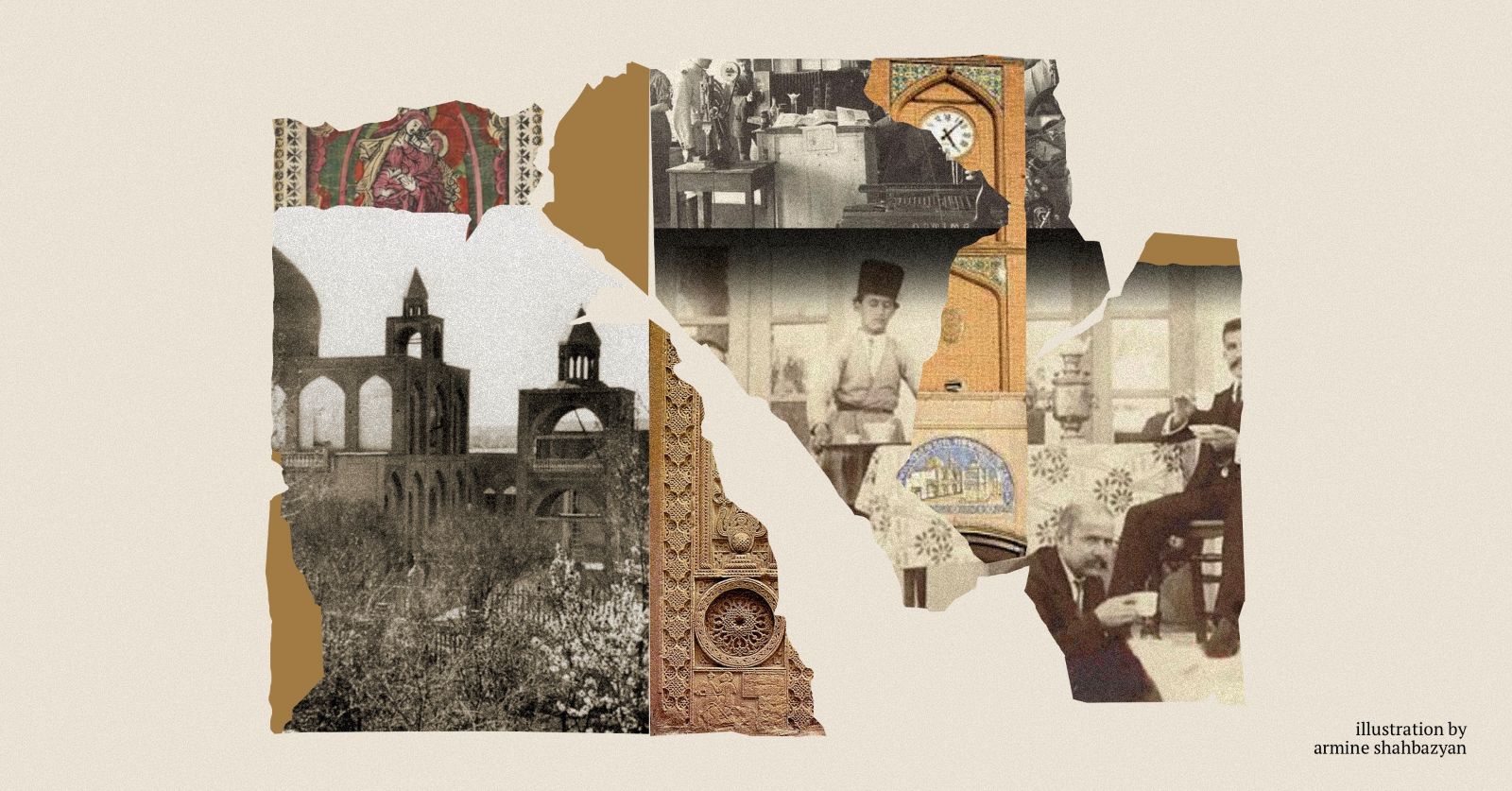
When Shah Abbas I deported the Armenians of Old Julfa to Isfahan in 1604-1605, he could not have anticipated what his resettlement on the banks of the Zayandeh River would produce. Within a few generations, the Julfa Armenians built a trading network stretching from Amsterdam and Venice to Manila and Canton. They moved silk, silver, and information across Safavid Persia, Mughal India, the Ottoman lands, and Europe. They operated through family firms bound by contract law, credit instruments, and a shared confessional identity administered from the cathedral of Vank, a diaspora that was simultaneously commercial, religious, and self-governing. It was answerable to Isfahan and to itself, not to a distant Armenian state that did not yet exist.
New Julfa’s genius was precisely what today’s Diaspora debate keeps circling back to without naming it: institutions strong enough to generate wealth, knowledge, and cohesion independently, while remaining culturally and spiritually tethered to an Armenian center. It was polycentric before the word existed. It did not need political sovereignty to be a nation in the sociological sense. It needed schools, a press (the first Armenian printing press operated in New Julfa in the 1630s), credit networks, and a shared narrative of who its members were and why that mattered.
The Iranian-Armenian community of today in Tehran, Isfahan, and beyond is the living, if diminished, descendant of that network. It is one of the oldest continuously self-governing Armenian communities anywhere, with its own schools, press, churches, and two seats reserved in the Iranian parliament. It has survived revolution, war, and mass emigration by doing exactly what this essay argues the wider Diaspora must relearn: producing its own clergy, teachers, and civic leadership rather than importing them, and treating cultural transmission as a discipline rather than a sentiment.
Iranian Armenians also embody a second lesson the New Julfa merchants understood instinctively: the diaspora condition is not only about preservation, it is also about mediation. The Julfa merchants were indispensable precisely because they moved between the Safavid, Mughal, Ottoman and European worlds, translating not just goods but law, trust and information from one world to another. Iranian Armenians today, straddling Persian, Armenian, and increasingly global commercial and cultural circuits, continue that same function on a smaller scale. That capacity for mediation should be treated not as a relic of the Silk Road but as a genuine asset for the 21st century—one the Lebanese, French, and American Armenian communities possess in their own registers as well, each fluent in a host society few Armenians in Yerevan will ever need to navigate.
Why Young Armenians Stay, and What They Are Owed
Assimilation itself is not the real danger; identities evolve and languages recede in every diaspora, always. The greater danger is arriving at a point where Armenian identity has nothing substantial left to transmit. Why should a young person remain Armenian? The answer cannot be ancestry alone. It has to be a cultural tradition, a historical experience, a religious heritage, a creative capacity and, as New Julfa shows, a documented, usable model of how a small nation without a state once operated at the center of world trade. That is not nostalgia; it is a resource.
Partnership, Neither Dependency nor Separation
None of this means building walls between Armenia and its Diaspora. Diaspora Armenians should recognize that Armenia is a sovereign state whose citizens vote, pay taxes, serve in its army, and live with the direct consequences of its political choices. Living abroad does not confer a right to dictate its domestic politics. But Armenia, in turn, should not see the Diaspora merely as a source of investment, lobbying, or demographic replenishment. The more productive question is not whether the Diaspora exists for Armenia or for itself, but how Armenia and its Diaspora can build institutions and mechanisms that strengthen one another.
The Diaspora holds assets Armenia cannot easily generate alone—expertise, universities, scientific and technological capability, professional networks, capital, and international connections built over generations—from Isfahan’s old trading houses to Los Angeles’s professional class. Armenia offers something equally irreplaceable: a living Armenian state, a society where the language and culture form the dominant environment, and a place where Diaspora knowledge can be converted into durable institutions. A polycentric Armenian world should not mean a disconnected one. Beirut, Paris, Los Angeles, Montreal, Tehran, Isfahan, and Yerevan have different histories and different priorities, but they can be linked through shared projects, knowledge networks, educational exchange, scientific cooperation, and new forms of leadership. A scientist in Los Angeles, an engineer in Paris, a physician in Beirut, an entrepreneur in Boston, a merchant family in Isfahan, and a researcher in Yerevan should not have to work in isolation or rediscover one another with each generation. This, too, is a New Julfa inheritance: a network is only as strong as the correspondence, credit, and trust that runs between its nodes.
There is no longer a single Diaspora to speak of, in any case. Historic communities shaped by the Ottoman Empire and the Middle East, post-Soviet Armenian migrant communities, new waves of emigration from Armenia itself, and the displaced Armenians of Nagorno-Karabakh each carry a different relationship to the Armenian state, language and identity. A single centralized model cannot represent them all, but a connected, deliberately polycentric one, built on institutions rather than slogans, can.
Beyond the Old Pillars
For decades, the Armenian world organized its collective imagination around three pillars: Armenia, Artsakh and the Diaspora. That framework has been shattered, and repeating the old slogans will not rebuild it. What is needed now is not only a new narrative but new mechanisms to carry it: sustainable financing, professional management, measurable objectives, and young leadership willing to move from statements of principle to institutions that function.
The Diaspora will survive only if it stops thinking of itself as temporary, and starts drawing more deliberately on the precedents it already possesses, New Julfa chief among them, of communities that built wealth, learning, and cohesion of their own, while remaining unmistakably Armenian. A strong Armenia needs a strong Diaspora. But the reverse is equally true: a strong Diaspora cannot exist unless it first believes that its own continued existence, on its own institutional terms, matters.
Opinion
Tlön, Uqbar, Gandzasar: Notes on the Imaginary Land Called “Caucasian Albania”
Using Jorge Luis Borges’ imagined world of Tlön as a lens, Sebouh David Aslanian examines Azerbaijan’s decades-long reinvention of Caucasian Albania, arguing that a fabricated historical narrative has been deployed to appropriate Armenian heritage, erase the region’s Armenian past, and reshape the South Caucasus in the present.
Read more
From Survival to Statehood: Reflections on a Sovereign Armenia
Drawing on Armenia’s history and recent security challenges, K.M. Greg Sarkissian reflects on what sovereignty means for a small state navigating competing powers and argues that resilience depends not on choosing between geopolitical camps, but on strengthening institutions, diversifying partnerships, and building a country where Armenians can confidently build their future.
Read more
When “Diplomacy” Becomes a Vehicle for Information Manipulation
The European Union has invested heavily in Armenia’s resilience against foreign information manipulation. But when its own Special Representative reduces Azerbaijan’s state-sponsored historical revisionism to competing “narratives,” diplomacy risks becoming a vehicle for the very manipulation the EU seeks to counter.
Read more
Anchored in the Past: History as Ontological Resource in Armenian Collective Memory
Why do nations cling to familiar stories, even when reality changes? Drawing on theories of ontological security, collective memory and political psychology, Andronik Papyan examines how the loss of Artsakh unsettled Armenia's national narrative and the search for a new sense of collective identity.
Read more