Listen to the AI generated audio article.
“The methodical fabrication of hrönir (says the Eleventh Volume) has performed prodigious services for archaeologists. It has made possible the interrogation and even the modification of the past, which is now no less plastic and docile than the future.”
Jorge Luis Borges,
“Tlön, Uqbar, Orbis Tertius”
in “Labyrinths: Selected Stories and Other Writings”
Jorge Luis Borges invented stories and places so vivid and uncanny that they briefly unsettle the reader’s sense of where reality ends and simulacrum begins. In a single paragraph short essay, “On Exactitude in Science,” the Argentine master storyteller recounts how a make-believe empire’s ingenious cartographers draw a map so exact (a 1:1 correlation) that it grows to the size of the actual empire itself. In another brilliant essay “Tlön, Uqbar, Orbis Tertius,” written in 1940 and with postface addenda in 1941, 1944 and 1947, a secret society of scholars called Orbis Tertius and based in the imaginary land of Uqbar (ironically placed by Borges’ narrator in Asia Minor and near “Armenia”) invents a world, Tlön, down to its languages, which lack nouns. By the story’s end in 1947, Tlön’s artifacts are surfacing in our own world, as reality begins to yield to the fiction.[1]
I have loved Borges’s stories for their ability to make me pause over this troubled world and ponder the relationship between the “real” and the simulacra, the hallucination of the world and the real world, blatantly fabricated fiction and real history. I recalled Borges this week as I watched Hikmet Hajiyev, foreign-policy aide to Azerbaijan’s autocrat and the second most distinguished genocidaire of our time, Ilham Aliyev. Hajiyev, seen with his ear-to-ear grin in a recently posted online clip, led a delegation of European Union and other diplomats through the Armenian monasteries of Gandzasar and Dadivank in Nagorno-Karabakh (Artsakh in Armenian) and Kelbajar.
Hasan-Jalal Dawla, an Armenian prince of the real medieval kingdom of Khachen (Խաչէն), whose name was clearly Arabic and Islamicate as was common among Armenians at the time, built the thirteenth-century church of Saint John the Baptist (Surb Hovhaness Mkrtich) inside the monastic complex at Gandzasar (literally Treasure Mountain). He “signed” his pious donation with a carving of himself sitting, Seljuk-style, cross-legged and holding a miniature of the church in his raised hands, accompanied with multiple inscriptions in Classical Armenian.[2]
During that tour, Hajiyev presented this magnificent monastery as the heritage of “Caucasian Albania,” referring to an enigmatic Christian South Caucasian kingdom that disappeared from history during the ninth and tenth centuries. Without citing proper empirical evidence, Hajiyev and Azerbaijani officials and their historians have claimed that the Armenians and their Church hierarchy were complicit with the ninth-century Arab rulers of the region in supposedly bringing the Caucasian Albanian kingdom to a swift end, of systematically erasing original literary work in the now lost language and alphabet of Caucasian Albania.[3]
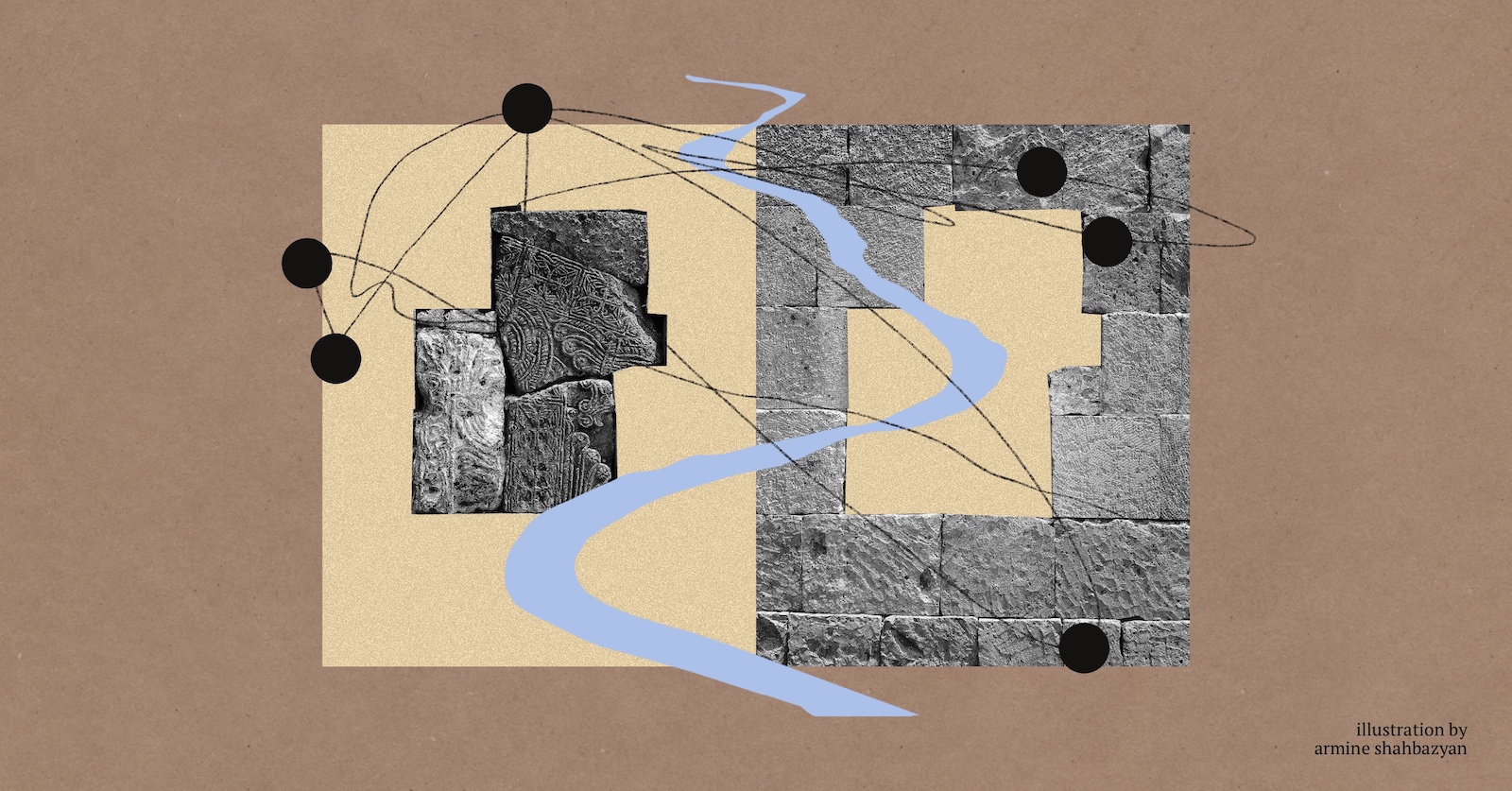
Some have even accused Armenian restorers and guardians of this endangered heritage of purposefully replacing original Albanian inscriptions with Armenian language replicas of khachkars (Armenian stone-crosses) with ancient-looking inscriptions—all supposedly during the nineteenth and late twentieth centuries. It is interesting to note that even the paleo-Christian, Armenian art form of ornately decorated stone-crosses, known to the world as khachkars, are culturally appropriated by Baku’s historians and transmuted into khachdashes in Azerbaijani Turkish (which unlike the imaginary language of Tlön apparently has nouns that refer to chimeras).[4] The irony is that the Armenian stone-cross inscriptions, meant to anchor memory on enduring material surfaces in order for future generations to remember the dead, are subverted by the Orbis Tertius group to erase that very memory.
Aliyev the son and his aides accomplished what Aliyev père could not in the 1990s. In September 2023, following a nine-month siege and starvation campaign, Baku ethnically cleansed Karabakh’s remaining Armenian population, some 100,000 people, a people indigenous to the land. The operation followed the 2020 war, during which there was credible open-source evidence suggesting that Azerbaijani forces used white-phosphorus or similar incendiary munitions to set fire to forested areas in Armenian-controlled territory. There is also ample evidence that Israeli hi-tech firms had supplied most of the drones and missiles including on-the-ground advisors that enabled Azerbaijani forces, backed militarily by NATO-member Turkey, to triumph in that war.
The physical erasure of Armenian heritage in Karabakh, however, did not begin with the September 2023 exodus. Following the 2020 ceasefire, visual evidence emerged of the desecration of Armenian churches, crosses and monuments in territories that had come under Azerbaijani control. This followed a much longer record of the destruction of Armenian cultural heritage in Nakhijevan, where thousands of Armenian monuments and sites were systematically erased. The destruction in Karabakh accelerated after the removal of its Armenian population, with churches, cemeteries, khachkars, monuments and inscriptions subsequently demolished, desecrated or otherwise erased.[5]
Lost in many accounts of this brutal conflict and ethnic cleansing is the vital role played in the incitement of genocide and the destruction of cultural heritage by Baku’s own version of Orbis Tertius. The members of this group have labored over the last 60 years to create an alternative reality in which the ethic cleansing/genocide of Karabakh’s Armenians is almost a foregone conclusion, if not a necessity.
This group was conceived in the wake of plagiarism-accused historian Ziya Buniyatov’s 1965 monograph “Azerbaijan from the VII-IX Centuries”, a largely fictionalized pseudo-historical account that recast Caucasian Albania as Azerbaijan.[6] This work of dubious scholarship has taught several generations of Azerbaijanis, made uncomfortable by the region’s older and more deeply rooted South Caucasian histories (Armenian and Georgian) that, as an indigenous people themselves, they are, through the Tlön-like invention of a Caucasian Albanian past, the true owners of Karabakh’s monuments and history.[7]
The Armenians, according to this viewpoint, came to Karabakh only as nineteenth-century migrants, settlers and usurpers, following the annexation of the area by the Russian Empire in 1828. What is more, Buniyatov maintained that age-old Armenian inscriptions and manuscripts were in fact not Armenian at all but “Albanian,” and that the Albanians were the ancestors of the Azerbaijani Turks. In so doing, Buniyatov was short-circuiting the historical fact that the Turks entered the region only from the eleventh century onward.
Lest the reader become confused, it is important to state here that Caucasian Albania, was indeed a real place. It was known in Armenian sources as “Ałuankʿ”, in contemporary Arabic accounts as “al-Rāni”, and to the Greeks and Romans as Ἀλβανία/Albania[8] and “Albanoi”.
The Albania of Baku, however, is pure Tlön.
The resemblance between the “Albanization” of Karabakh and Borges’ celebrated short story ends in two places. First, the tale is told not by a writer’s genius but by largely dim-witted functionaries and falsifiers of history such as Buniyatov, his loyal disciple, Farida Mamedova, who surpassed her master, and, most recently Hikmet Hajiyev. Second and more important, where Borges’ Tlön conquered reality only on the page, Baku’s Caucasian Albania arrived by bulldozer, clearing the way for the erasure of a real people and their civilization.
The Borgesian modus operandi of treating the local Armenian population not as the true heirs of the region’s historical monuments as they themselves regard, but as imaginary usurpers of Caucasian Albanian art and architecture is visible in many places. Such deeply flawed and intentionally fabricated accounts of the past have led to calls for the removal of all traces of Armenian “falsifications,” in effect paving the way for the kind of bulldozing that destroyed thousands of stone-crosses at Old Julfa by the defacing, “gouging, sandblasting, or removing of Armenian inscribed stones.”[9] In February 2022, the Azerbaijani Ministry of Culture declared the creation of a special committee to “remove the fictitious traces written by Armenians on Albanian religious temples.”[10]
This lachrymose prognosis for the future of Armenian heritage in its own place of birth has led one connoisseur and historian of art to speculate on what might happen to the Caucasian Albanians of lore and to the Armenians and their heritage:
Finally, there will be a celebration of the “multiculturalism” of Azerbaijan. “Come to Karabakh, home of ancient Christians,” people will say. “Please ignore the gouged-out letters on that stone wall, for it is not an Armenian inscription. There were never Armenians here!” Except for soldiers and invaders, like the ones depicted in a reprehensible museum in Baku, featuring waxen figures of dead Armenian soldiers—a sight so dehumanizing that an international human rights organization, including Azerbaijani activists, cried out for its closure.[11]
Borges’ narrator foresaw a world that would become Tlön. We may now wait in horror as Baku’s historians draw their own maps of Caucasian Albania, perhaps even at one-to-one correlation! For the last 15 or more years, the intrepid researchers at Orbis Tertius have been openly and quite literally redrawing the cartography of the South Caucasus. On their new map, the Republic of Armenia is now labelled “Western Azerbaijan” with the same inscrutable logic as Tlön.
As early as 2007, one of the lesser lights of the Orbis Tertius group, Kamala Imranly, framed the mental map of Armenia in a way only someone with the irony of the Argentine writer could have conceived. In her curious account of Armenian history, “War Against Azerbaijan: Targeting Cultural Heritage”, published in a series tellingly labeled as the “True Facts about Garabagh” [sic] by the Heydar Aliyev Foundation in 2007, Imranly writes:
Although the Republic of Armenia does not have an ethnic Azerbaijani population now, its territory was a native land of Azerbaijanis long before Armenians appeared there for the first time. A considerable portion of the territory of modern Armenia until the occupation by Russia in the early 19th century was part of different states established by the ancestors of Azerbaijanis, namely Caucasian Albania, and after the arrival of Arabs, different Azerbaijani Muslim states such as the Sajids, Salarids, Shaddadids, then Atabays, Hulakids (Elkhanids), Garagoyunlu and Aghgoyunlu, with its peak during the Azerbaijani Safavid state from 1501 to 1736 (excluding for a short period of time being a part of Turkey), the state of Nadir Shah also for about a decade, and finally the Iravan and Nakhchyvan khanates.[12]
Given the tendency of the hallucinatory histories and forged maps like those of fictional Uqbar to materialize in the real world, all people of good will, including citizens of Azerbaijan and Armenia, should remain vigilant and gravely concerned, as should the international community, insofar as it can resist the temptations of the so-called “Azerbaijani laundromat.”[13]
*The author wishes to credit Marc A. Mamigonian for first bringing the Borges story to his attention. Mamigonian’s brilliant short account uses Tlön not in connection with Caucasian Albania but with the Turkish Historical Society’s campaigns of deforming and disfiguring the history of the Armenian genocide of 1915.
Footnotes:
[1] Jorge Luis Borges, “On Exactitude in Science,” and “Tlön, Uqbar, Orbis Tertius,” in Borges, Collected Fictions, Andrew Hurley, trans., New York: Penguin Books, 1998, p. 325, and 68-81.
[2] See Rachel Goshgarian’s lucid treatment of the fluid and complex identities of medieval communities and individuals like Hasan Jalal Dawla, “The Complexity of Medieval Identities in the Caucasus: The story of Hasan Jalal Dawla, an Armenian prince in Artsakh, offers insight into the world of Medieval people”. For a useful and accessible introduction to the monastic complex’s history and architecture, see Bagarat Ulubabian and Murad Hasratian, Documenti di Architettura: Gandzasar No. 17 (Milano: OEMME, 1987).
[3] In a Borghesian twist, in 1996, the Georgian scholar Zaza Aleksidze, discovered two Caucasian Albanian palimpsests (Albanian writing superimposed by Medieval Georgian subtext) kept inside a wall in Saint Catherine’s monastery in Mount Sinai. This sensational discovery confirmed that the Albanians not only had their own script but a fledgling Christian literature as well, a fact denied until the unexpected find. Jost Gippert “Textual Heritage of Caucasian Albania,” Caucasian Albania: A Handbook, edited by Jost Gippert and Jasmine-Drum Tragut (Berlin, Boston: De Gruyter, 2023), 95-166.
[4] Christina Maranci, “What Cultural Genocide Looks Like for Armenians in Nagorno-Karabakh,” Time. The revisionist work on appropriating khachkars and magically transfiguring them as Khachdash (Armenian khach for cross and Azeri Turkish Dash/tash for stone) is the fabulous brainchild of Davud and M.D. Akhundov. My information here is drawn from Babken Arakelyan and Artsruni Sahakyan, “Khachkarerĕ hakagitut‘yan kheghat‘yurumneri aṙarka,” [Khachkars as anti-historical deformations) Lraber hasarakakan kitut‘yunneri, no. 7 (1986): 38–48. (1987): 38-48.
[5] The scholarly literature of the bulldozing and destruction of Armenian khachkars (stone-crosses), see the influential study, Simon Maghakian and Sarah Pickman, “A Regime Conceals Its Erasure of Indigenous Armenian Culture” Hyperallergic, February 18, 2018. See also “Silent Erasure: A Satellite Investigation of the Destruction of Armenian Cultural Heritage in Nakhchivan, Azerbaijan”.
[6] According to Thomas De Waal, “Buniatov’s scholarly credentials were dubious. It later transpired that the two articles he published in 1960 and 1965 on Caucasian Albania were direct plagiarism. Under his own name, he had simply published, unattributed, translations of two articles, originally written in English by Western scholars C.F.J. Dowsett and Robert Hewsen” (Black Garden, pp. 152-53). In an endnote, De Waal explains: Buniatov’s Mxitar Gosh, Albanskaya Khronika, predislovie, perevod i kommentarii Z. M. Buniatova [Mxitar Gosh, the Albanian Chronicle, forward, translation, and commentary by Z. M. Buniatov], published in 1960, is an unattributed translation of C. F. J. Dowsett’s “The Albanian Chronicle of Mxitar Gosh,” published in Bulletin of the School of Oriental and African Studies XXI, Part 3 (1958). Buniatov’s “O Khronoligicheskom nesootvetsvii glav ‘Istorii Agvan’ Moiseya Kagankatvatsi” [On the chronological non-correspondence of chapters of Movses Dasxuranc’i], published in Baku in 1965, is an unattributed translation of Robert Hewsen’s “On the Chronology of Movses Dasxuranc’i,” published in Bulletin of the School of Oriental and African Studies XXVII, Part 1 (1954)” (p. 311). I thank Marc Mamigonian for bringing this passage to my attention.
[7] For a detailed study of how Azerbaijani writers have engaged in the fabrication of “invented traditions” used to buttress artificially manufactured collective or national identity in Azerbaijan, see Hratch Tchilingirian, “Reverse Engineering: A State-Created ‘Albanian Apostolic Church’”, Caucasian Albania: A Handbook, 581-608; and Sebouh Aslanian and Artyom Tonoyan, “From an Antique Land: A ‘Usable Past,’ the Caucasian Albanians, and Ethnic Cleansing in the South Caucasus,” in Sebouh David Aslanian ed. Invented Tradition and Ethnic Conflict in the South Caucasus: Armenia, Azerbaijan, and the Legacy of Soviet Nation-Building, (London and New York: I.B. Tauris/Bloomsbury, 2026 forthcoming). As the latter study notes, the genealogy of Orbis Tertius’s alternative world of Caucasian Albania began in the late 1930s, following the 1936 Stalin constitution when Soviet nationality policy required each “titular nationality” to be endowed with its own indigenous national past. In line with this policy of what Terry Martin has called “Stalinist “primordialism,” Russian Orientalists such as Zelik Iampolskii and Azerbaijani Chairman of the Council of Ministers of the Azerbaijan SSR Mir Jafar Basghirov, initiated a top-down process of “indigenization of history,” resulting in the imaginary world of Caucasian Albania. (see Harun Yilmaz, National Identities in Soviet Historiography: The Rise of Nations Under Stalin (Routledge, 2015), 34-35, 118. This invention only became weaponized and targeted on Karabakh’s Armenian population beginning in the 1960s by Buniyatov and his school. The standard account of the role of discourse in shaping conflict in the South Caucasus is Victor A. Shnirelman, The Value of the Past: Myths, Identity, and Politics in Transcaucasia (Osaka: National Museum of Ethnology, 2001). For Stalinist primordialism, see Terry Martin, The Affirmative Action Empire: Nations and Nationalism in the Soviet Union, 1923–1939. (Cornell University Press, 2001), 244-246.
[8] For the terminology, see Marco Bais, “Caucasian Albania in Greek and Latin Sources,” in Caucasian Albania: An International Handbook, Berlin, Boston: De Gruyter Mouton, 2023 and Jasmine Dum-Tragut and Jost Gippert, “Caucasian Albania in Medieval Armenian Sources (5th–13th Centuries),” Caucasian Albania: An International Handbook.
[9] Christina Maranci, “What Cultural Genocide Looks Like for Armenians in Nagorno-Karabakh,” Time.
[10] Amos Chapple, “Forgeries: The Armenian Art that Azerbaijan May Erase,” Radio Free Europe/Radio Liberty, February 09, 2022.
[11] Christina Maranci, “What Cultural Genocide Looks Like for Armenians in Nagorno-Karabakh,” Time.
[12] Kamala Imranly, War Against Azerbaijan: Targeting Cultural Heritage (Baku: Ministry of Foreign Affairs, 2007). Scholars of Safavid Iran will no doubt be stunned at the Orbis Tertius reinvention of Iranian history as the “Azerbaijani Safavid state from 1501 to 1736.” The same author has also made the patently absurd and historically illiterate claim (veiled as a suggestion) that the early modern Armenian merchants from New Julfa whose ancestors were deported and resettled in Iran by Shah ‘Abbas I in 1603-1605 from (Old) Julfa and who formed a successful and cosmopolitan merchant diaspora across the Mediterranean and Indian Ocean were Caucasian Albanians. For instance, Imranly, who does not seem to know any Armenian not to mention other relevant languages, insinuates that the deported and resettled population of Armenians from old Julfa and its environs, were “Caucasian Albanians.” In a footnote casting doubt on what “Armenian historians” have written on the deportations and the Julfan diaspora, Imranly states: “Here it should also be mentioned that while talking about the deportation of Armenians, Armenian authors include in this story, as well as in the number of deported Armenians, the Caucasian Albanians, who were of the same confession as Armenians, presenting them as Armenians and narrating all events related to them as part of Armenian history. As for non-Armenian historians, one being John Perry, based on primary sources, he concluded that about 3000 families of Georgians, Armenians and Turks [sic], who survived the deportation initiated by Shah Abbas, were settled at New Julfa by Isfahan and on lands around the capital and in the Bakhtiari foothills, where their descendants still live.” See Kamala Imranli-Lowe, “Nakhchyvan, the Armenian Arguments and the Allied Powers in 1919,” Middle Eastern Studies, 52:2 (2016): 295-317 (fn. 23, 315).
[13] See the independent report issued by OCCRP, the organized crime and corruption reporting project “The Azerbaijani Laudromat.” Published in 2017, the study follows the paper trail of how the Aliyev kleptocratic regime and its minions had already laundered 2.9 billion US dollars (2.5 million Pounds Sterling) through four UK-based shell companies to finance, in part, its made-up world of Tlön in such places as the Oxford-based and Pashayeva-sponsored Nizami Ganjavi Center for the “scholarly” study of Azerbaijan and the Caucasus. Led by Bonafide scholars, such as its first director, Dr. Edmund Herzig, the Center interestingly leaves Armenia entirely out of the Caucasus. It has also housed at least one member, the Armenophobe Kamala Imranly (quoted above) of the Azerbaijani version of the Orbis Tertius society as a “visiting fellow.” David Matthews,“Concern Over Azerbaijan Ruling Family Influence at Oxford Centre”.
New Column
on EVN Report
[juris]prudence

One Republic
In his new juris/prudence column, Davit Khachatryan examines Armenia’s statehood through the lens of international law, arguing that governments may change but the Republic’s legal identity and obligations endure. It explores sovereignty, state responsibility, international claims, and the lasting legal consequences of decisions made in Armenia’s name.
Read moreOpinion
From Survival to Statehood: Reflections on a Sovereign Armenia
Drawing on Armenia’s history and recent security challenges, K.M. Greg Sarkissian reflects on what sovereignty means for a small state navigating competing powers and argues that resilience depends not on choosing between geopolitical camps, but on strengthening institutions, diversifying partnerships, and building a country where Armenians can confidently build their future.
Read more
When “Diplomacy” Becomes a Vehicle for Information Manipulation
The European Union has invested heavily in Armenia’s resilience against foreign information manipulation. But when its own Special Representative reduces Azerbaijan’s state-sponsored historical revisionism to competing “narratives,” diplomacy risks becoming a vehicle for the very manipulation the EU seeks to counter.
Read more
Anchored in the Past: History as Ontological Resource in Armenian Collective Memory
Why do nations cling to familiar stories, even when reality changes? Drawing on theories of ontological security, collective memory and political psychology, Andronik Papyan examines how the loss of Artsakh unsettled Armenia's national narrative and the search for a new sense of collective identity.
Read more
Notes About War and Peace From Sarajevo
Traveling through Sarajevo, Mikayel Zolyan reflects on the city’s long history of war, nationalism and coexistence. From the assassination that helped ignite World War I to the devastation of the 1990s, he considers how a society emerges from conflict and learns to live with its past.
Read more
Regional Peace Cannot Be Built by Ignoring Azerbaijan’s Rhetoric
Baku’s “Western Azerbaijan” narrative continues to be prominent in state media, education and official discourse. Tatev Hayrapetyan examines how the concept has evolved, how it is being institutionalized, and what its continued promotion means for Armenia and the prospects for lasting regional peace.
Read more
Between Scylla and Charybdis: The Geopolitical Labyrinth of the South Caucasus
As Armenia redefines its foreign policy after the collapse of the post-Soviet security order, Ferdinant Grigoryan explores how strategic diversification and regional connectivity are reshaping the country's role in an increasingly fragmented geopolitical landscape.
Read more
A Beach House, a Khachkar, an Orchard
A beach house in Lebanon, Armenian khachkars and Kurdish orchards in Iraq seem to have little in common and while the legal and geopolitical contexts may differ, Karena Avedissian traces the logic that connects them, revealing how security narratives can transform people, places and memory into perceived threats.
Read more